Stop Guessing: The Step-by-Step Diagnostic Guide to Remove Write Protection on USB Drive

By: Muneed Seo

You plug in your USB drive, drag a file over, and instantly get the message: “The disk is write-protected. Remove the write-protection or use another disk.” No copy. No format. No save. Just frustration. A quick search for how to remove write protection on a USB drive only makes things worse, throwing registry hacks, DiskPart commands, and conflicting advice at you with no clear starting point.

This error is one of the most common and most misunderstood USB problems. Whether you’re trying to save a document, back up photos, or format a stubborn stick, write protection turns a simple task into a dead end. The core issue? Most guides treat this like a guessing game.

But write protection isn’t random; it’s a symptom. It can be physical, software-based, permission-related, or a sign of hardware failure. Each cause requires a different fix. This guide replaces guesswork with diagnosis.

Instead of trying everything, you’ll follow a logical roadmap to identify why your USB flash drive is locked, then apply the correct solution. If you want to remove write protection on a USB drive safely and permanently, follow this process.

The Golden Rule: Before You Do ANYTHING Else

Before making any changes to your USB drive, follow the golden rule: always back up your data first. Then, you can safely proceed to remove write protection on a USB drive.

Step 0: Safeguard Your Data (If Possible)

Before attempting any fix, try copying any important files from the USB drive to your computer or another storage device. Some solutions, especially those involving formatting or partition reformatting, will permanently erase data.

Be realistic

If the drive is fully write-protected, copying may fail. That’s exactly why proper diagnosis matters. But if the drive still allows reads, take advantage of it now. Once recovery steps begin, rollback may not be possible. This single precaution prevents a repair task from becoming a data-loss incident.

The Diagnostic Flowchart: Find Your Fix

Now, let’s get into the diagnostic fix guide with multiple steps that you need to try:

The Troubleshooter’s Path: Start Here, Not With Random Commands

This is the core of the guide. Follow these steps in order. Each one rules out an entire class of causes.

Diagnostic Step 1: The Physical Check

Action:

Examine your USB drive closely. Look for a small physical lock switch, usually on the side. Brands like SanDisk, Kingston, and older USB flash drives often include a tiny slider that toggles write protection at the hardware level.

Instruction:

If you find a switch, slide it to the unlocked position, reinsert the drive, and try again. If this works, you’re done. If no switch exists, or unlocking doesn’t help, move on. Software solutions cannot override a physical lock.

Diagnostic Step 2: Try a Different Environment (Rules Out Local PC Issues)

Action:

Plug the USB drive into:

  1. A different USB port on the same computer
  2. A completely different computer

Interpretation:

  •       Works elsewhere: Your original system has a configuration, policy, or driver issue.
  •       Fails everywhere: The problem is on the USB drive itself. Proceed.

This step prevents you from fixing the wrong machine.

Diagnostic Step 3: Check Drive Properties & Permissions (Software Lock)

Action (Windows):

  1. Open File Explorer
  2. Right-click the USB drive > Properties
  3. Go to the Security tab
  4. Check your user account’s permissions.

Ensure write access is allowed.

Interpretation:

Incorrect permissions can trigger write-protection errors even when the drive is healthy. Fixing permissions here often resolves the issue instantly. If permissions are correct, continue.

Diagnostic Step 4: Scan for File System Errors (Logical Corruption)

Action:

Use Windows’ built-in file system checker.

  1. Open Command Prompt as Administrator
  2. Run: “chkdsk X: /f” (Replace X with your USB drive letter.)

Interpretation:

Logical file system corruption can force Windows to mount a drive as read-only to prevent further damage. chkdsk repairs these inconsistencies. If errors are fixed and write access returns, you’re done. If not, escalate.

Diagnostic Step 5: Registry & Group Policy Check (Advanced Software Lock)

Action:

Check whether Windows is enforcing removable storage write protection via “Group Policy Management Editor”:

  •       Registry keys
  •       Group Policy settings


These controls are commonly used in corporate or shared environments.

Important Warning:

Editing the registry incorrectly can damage your Windows installation. This step is only for advanced users who know how to back up and revert changes. If protection is enforced here, removing it restores write access. If not, the issue goes deeper.

Diagnostic Step 6: Drive Is in Permanent Read-Only Mode (Firmware or Physical Failure)

Interpretation:

If none of the above steps work, the USB controller may have locked the drive into read-only mode. This often happens when the drive detects an internal failure and switches to data-preservation mode. At this point, the problem is no longer user error; it’s structural.

The Solution Hub: Matching the Fix to the Diagnosis

After you complete the diagnosis, proceed to the appropriate fixes to resolve the issue without confusion.

Your Diagnosis Is Clear. Now, Here’s Your Cure.

This section translates diagnosis into action.

For Physical Switch or Port Issues (Steps 1 & 2)

The fix is straightforward:

  •       Unlock the switch
  •       Use a different port or system

No software required.

For Permission or File System Issues (Steps 3 & 4)

If permissions were incorrect, correcting them restores write access. If chkdsk repaired file system errors, the drive should now accept writes normally. Always test by creating and deleting a small file.

For Deep Software & Formatting Issues (Step 5 & Beyond)

This is where most users get stuck. At this stage, the drive often needs:

  •       Write protection flags removed
  •       Partition tables rebuilt
  •       A forced format

Windows Disk Management and DiskPart can do this, but they’re command-based, unforgiving, and frequently fail on stubborn drives.

The Safer, More Powerful Solution: 4DDiG Partition Manager

4DDiG Partition Manager is designed for low-level disk operations through a clean, graphical interface with no risky commands required.

Why it fits here perfectly:

  •       Handles stubborn write-protected drives
  •       Reduces human error
  •       Designed for exactly this escalation point

Key Features That Matter

Force Format Function

Can format drives even when Windows refuses.

Partition Management

Deletes and recreates partitions, removing software-level write protection at the root.

File System Repair

Fixes corruption that triggers read-only states.

Simple Workflow

After diagnosing a deep software issue:

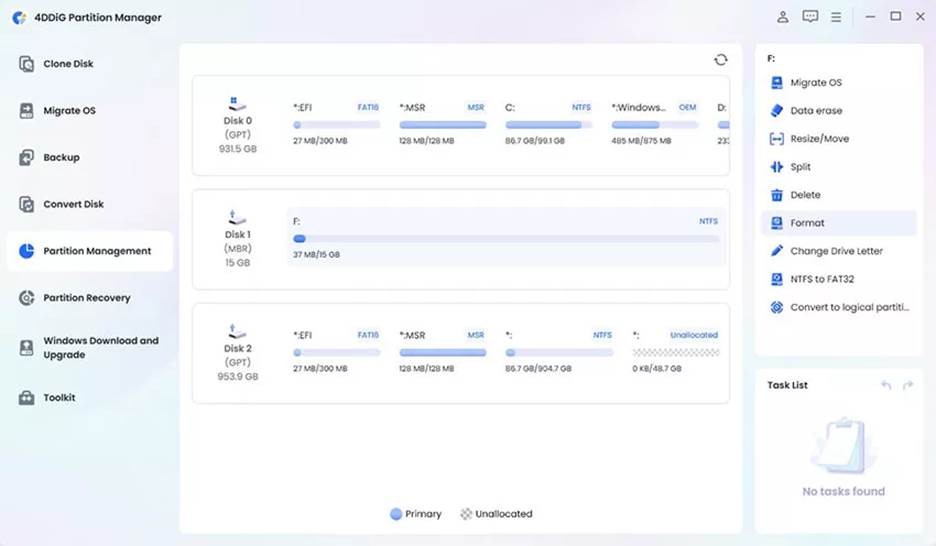
1. Launch 4DDiG Partition Manager after downloading and installing it, then select “Partition Management” and click on the “USB” to select it.

Stop Guessing: The Step-by-Step Diagnostic Guide to Remove Write Protection on USB Drive


Photo Courtesy: 4DDiG/Tenorshare


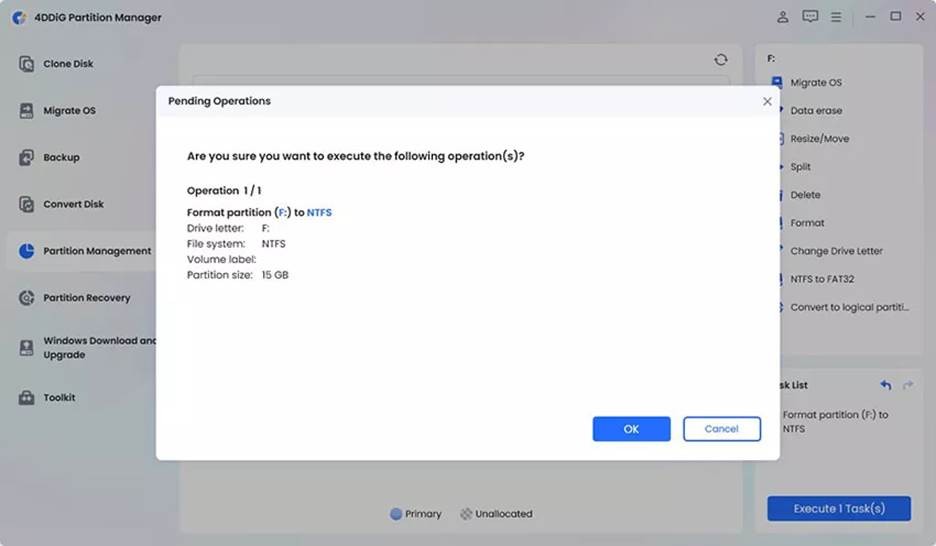
2. Click “Format” to wipe its partition table and then create the new partition table with the pop-up window. Click “OK” to proceed and “Yes” to confirm.”


3. Click “Execute Tasks” then “OK” and wait as 4DDiG formats your USB. Once the process is successfully completed, click “Done”.
Stop Guessing: The Step-by-Step Diagnostic Guide to Remove Write Protection on USB Drive

Photo Courtesy: 4DDiG/Tenorshare

All done in a few clicks, no CMD, no registry edits, no guesswork.

Final Verdict & When to Give Up?

By following this diagnostic guide, many common write protection issues can be resolved. Physical switches, permission errors, and file system corruption account for most cases. For stubborn software-level locks, tools such as 4DDiG Partition Manager offer a safe and effective solution.

If the drive has entered permanent read-only mode due to hardware failure, no software can fix it. At that point, replacement is the only option.

Tired of error messages? Download 4DDiG Partition Manager to safely and powerfully handle the complex formatting and partition tasks that often lock your USB drives.

FAQ

Q: How do I remove write protection on a USB flash drive that has no switch?

Follow the diagnostic steps: test on another PC, check permissions, run chkdsk, then use a partition manager if needed.

Q: I need to remove write protection on the USB pen drive to format it, but Windows won’t let me.

This usually indicates deep software-level protection. A dedicated partition manager can force formatting safely.

Q: How to remove the write protection on a USB drive using CMD?

DiskPart can sometimes work, but it’s risky. One wrong command can erase the wrong drive. GUI tools are safer for most users.

How Iontra & MAGFAST Have Teamed Up to Build a Smarter Charging Solution

The reality of the portable power industry is that change comes slowly.

Sure, you get a few more watts this year. Maybe a slightly faster chip. The box gets a marketing refresh. But innovation that matters? Does it make you rethink what’s possible? Rarely.

A partnership between MAGFAST and Iontra is worth paying attention to.

One company focuses on how charging feels: the weight in your hand, the satisfying snap of magnets, the unboxing moment that makes you smile. The other focuses on what’s happening inside the battery at the molecular level: electron flow, thermal behavior, and the physics of lithium-ion degradation.

Together, they join to create something different: products that combine thoughtful design with smarter power management.

When Battery Science Meets Design Thinking

Most “partnerships” in tech are really just marketing arrangements; two logos slapped together in a press release. Iontra and MAGFAST’s partnership is different.

Iontra’s technology has been validated by multiple battery manufacturers and OEM partners because it addresses a genuinely difficult challenge. It modifies how a battery absorbs energy in real time, adjusting the charge profile based on the cell’s current needs. Think of it like a personal trainer for your battery, knowing when to push hard and when to ease off.

The practical benefits:

Faster recharging for power banks. MAGFAST’s power banks with Iontra technology recharge much faster than the typical 2-3-hour wait most power banks require. That’s the difference between “I can’t leave yet, my battery’s dead” and “Give me a quick coffee break and I’m good to go.”

Extended battery life. When you’re not in a rush, Iontra’s technology automatically switches to a gentler charging mode that substantially extends the battery’s life. Your power bank doesn’t become e-waste after a year. It keeps working for years.

Better cold-weather performance. Cold batteries are problematic. They charge slowly, degrade quickly, and quit on you when you need them most. Iontra stabilizes charging behavior in low temperatures, which matters if you’ve ever tried to use your phone on a ski lift or during a winter commute.

Improved safety. Better thermal management reduces stress on the cells, leading to more reliable long-term operation. Not flashy, but important when you’re carrying a high-capacity power bank in your bag.

Here’s what Iontra doesn’t do, and this can be confusing: It doesn’t make your phone charge faster. It’s not magic wireless power. It makes the power bank itself smarter about how it charges and how long it survives.

Why MAGFAST moved quickly 

Iontra works with companies across multiple industries. But MAGFAST is bringing Iontra’s technology to market in a consumer power bank. Why?

Like any good relationship, they’re compatible. 

MAGFAST doesn’t just make wireless chargers. They design products with magnetic modularity and attention to tactile feedback when you pick them up. They’re not interested in racing to win the trophy of most affordable. They want to build things that last and that people enjoy using. Which, one could argue, saves you money in the long run.

Iontra’s technology is about longevity and intelligence, not just flashy specs. It’s a perfect match.

Plus, MAGFAST embraces open standards. They use USB-C, MagSafe, and Qi2…standards that work across devices. Iontra’s tech enhances those standards rather than locking you into a proprietary system.

And here’s what stands out: MAGFAST is oddly transparent for a hardware company. They host live webinars. They acknowledge when things go wrong. They explain their engineering decisions to thousands of community supporters who’ve actually invested in the company. This transparency leverages Iontra’s science-first approach.

What This Means for Users

The global battery-charger market is projected to reach $34.1 billion by 2026, driven largely by the adoption of wireless charging. But most of what’s out there is generic and disposable.

MAGFAST and Iontra are pursuing a different approach:

  • Power banks that recharge themselves quickly
  • Batteries that stay healthy for years
  • Wireless magnetic charging that feels effortless
  • Products built for modularity. Expand and upgrade, rather than replace
  • A charging ecosystem that’s thoughtfully designed

In an industry that’s been coasting on incremental improvements for years, this partnership represents a direction of growth.

Smarter Power, Not Just More Power

The world has plenty of chargers. What it lacks is a charging solution that’s smarter, longer-lasting, and doesn’t require hours to recharge.

MAGFAST brings the design focus. Iontra brings the battery science. Together, they’re building products that aim to deliver a premium experience.

CES 2026 is where the world got its first look. But this means more than a trade show feature. It’s an effort to bring genuine innovation to a category that’s been relatively stagnant.

For the first time in a while, someone’s not just making charging more available. They’re trying to make it more enjoyable. Pay attention… it will be worth watching what this collaboration produces in the coming months and years.

Inside Inceptives Digital, a Young Firm Finding Its Footing in Enterprise Software

By: Elowen Gray

As enterprises scale, software often becomes a structural challenge rather than a simple tool. While digital platforms are central to modern operations, many organizations find that standard solutions no longer meet their needs as complexity grows. Industry analysts estimate the global enterprise software market will surpass $500 billion annually, yet studies suggest more than 50% of implementations struggle to deliver expected efficiency gains.

Much of this gap stems from misalignment. Businesses frequently rely on a patchwork of systems—sometimes five to ten separate tools—to manage operations, customers, and internal data. Over time, this fragmentation can slow decision-making and increase manual work. As a result, many enterprises are turning toward more adaptable, custom-built software.

This movement also reflects a growing awareness that software is no longer just a support function but a strategic asset. When systems are designed around real operational behavior, they influence productivity, data accuracy, and even company culture. Well-structured software ecosystems allow leadership teams to make decisions faster and with greater confidence.

This shift has brought attention to firms like Inceptives Digital. Still early in its growth, the company operates entirely in the B2B space, developing enterprise software and custom applications based on specific business requirements. While ERP and CRM systems form part of its work, Inceptives Digital is not limited to predefined categories, instead building applications that support unique operational workflows.

Rather than offering fixed products, the firm functions as a development partner, designing software around how organizations actually operate. This approach reflects a broader industry trend: nearly 65% of enterprises now rely on internally developed or customized applications to support core business functions that off-the-shelf platforms fail to address.

From Planning to Measurable Impact

Enterprise software projects often face challenges before development even begins. Research indicates that almost 30% of ERP projects exceed original timelines due to unclear requirements. Inceptives Digital’s process appears shaped by this reality, placing strong emphasis on planning and workflow analysis before building begins.

In practical terms, consolidating multiple systems into a unified platform or replacing manual processes with custom applications can reduce internal processing time by 20–30%, particularly in reporting and coordination tasks. While outcomes vary by industry, these efficiency gains are a key reason enterprises continue to invest in tailored software.

Beyond efficiency, custom platforms often strengthen data ownership and security. Enterprises gain better control over sensitive information, integration points, and user access. This is increasingly important as regulatory pressure and cybersecurity risks grow across industries that handle financial, medical, or proprietary business data.

Where Custom Software Makes a Difference

Inceptives Digital works across sectors such as healthcare, logistics, retail, and professional services—industries where inefficiencies tend to scale quickly. In healthcare alone, administrative work accounts for nearly 25% of operational costs, making automation and system integration especially valuable.

Custom-built applications designed around real workflows can improve data visibility, reduce repetitive tasks, and support compliance without forcing businesses into rigid systems. These changes are often incremental, but over time, they shape how effectively organizations operate.

Over the long term, such systems also create a foundation for scalability. As organizations expand, well-architected software can accommodate new departments, locations, and processes without major restructuring. This prevents the cycle of constantly replacing platforms and allows technology to grow alongside the business.

A Selective Presence in a Competitive Market

Unlike large vendors managing dozens of simultaneous deployments, Inceptives Digital limits the number of projects it takes on. This allows teams to remain involved beyond launch, refining software as business needs evolve.

This model aligns with enterprise buying behavior. Surveys show more than 70% of organizations now prioritize long-term adaptability and ongoing support when selecting software partners.

Key Takeaway

As enterprise software becomes more central to how businesses operate, the focus is shifting from one-size-fits-all platforms to systems that reflect real operational needs. Inceptives Digital’s steady growth highlights a broader trend in the market: enterprises are increasingly valuing flexibility, thoughtful planning, and long-term adaptability over rapid deployment or brand recognition, recognizing that sustainable success depends on solutions that evolve with changing business demands and technological advancements.

Website

Facebook

Instagram

Linkedin

Dechecker AI Checker: Making AI-Written Content Ready for Real-World Use

AI writing rarely fails at producing text. It fails later, when that text needs to survive review, judgment, or consequence. Dechecker exists in the narrow space between “done” and “acceptable,” where small signals determine whether content moves forward or is questioned.

The Moment AI Writing Becomes a Liability

AI tools accelerate output but also concentrate decision-making in fewer hands.

When Speed Stops Being the Advantage

In early drafts, speed feels like progress. Once content reaches editors, teachers, or compliance teams, speed loses value. What matters then is whether the text feels intentional.

This is typically the first point at which an AI Checker enters the workflow. Not as a gatekeeper, but as a diagnostic tool. It helps answer a simple question writers often avoid asking: Does this read like someone meant it, or like something assembled it?

Familiar Patterns Raise Flags

AI-generated content tends to repeat successful structures. That repetition saves time, but it also creates recognizable patterns. Reviewers may not name them, but they sense them.

Short paragraphs that resolve too cleanly. Transitions that always explain themselves. Conclusions that never commit. These are not errors, but they are signals. An AI Checker surfaces them early, before external reviewers do.

How Dechecker Fits Into Decision-Oriented Writing

Dechecker is most useful when the goal is approval, not exploration.

Detection That Informs Action

Rather than issuing binary judgments, Dechecker shows where the text leans toward artificiality and where it behaves naturally. Writers can decide which sections deserve attention and which already work.

This matters in professional settings where rewriting everything is unrealistic. Targeted revision saves time and reduces unnecessary risk.

Editing for Outcome, Not Purity

Many teams do not need content to be “fully human.” They need it to pass review, feel credible, and move forward. Dechecker supports that mindset.

By focusing on impact-heavy sections, such as introductions, conclusions, and claims, users align effort with consequence.

Academic Submissions Under Pressure

Education is one of the first areas where AI-generated writing met formal resistance.

Why Polished Work Can Backfire

Assignments written with AI assistance often sound refined but detached. They answer questions without revealing thought. That absence draws attention.

Students using an AI Checker often notice that their writing feels too balanced. Adjusting stance, introducing uncertainty, and reshaping conclusions lowers suspicion while preserving clarity.

Dechecker as an AI Homework Helper

As an AI homework helper, Dechecker encourages revision rather than replacement. Students learn which habits increase detection signals and which reduce them. Over time, this feedback changes how they draft, not just how they edit.

The result is writing that survives scrutiny without pretending AI was never involved.

Content Marketing Where Trust Is Measured

In marketing, credibility affects conversion long before compliance does.

When Content Explains but Doesn’t Persuade

AI-generated marketing copy often informs without persuading. It lists benefits but avoids preference. Readers sense that hesitation and disengage.

Running drafts through an AI Checker highlights sections where language avoids choice. Strengthening those moments often improves performance more than adding features or keywords.

Search Visibility Without Formulaic Tone

Search engines increasingly reward writing that behaves like human communication. Overly consistent phrasing and predictable structure can undermine that perception.

Dechecker helps writers loosen those patterns while preserving SEO intent, keeping content readable without becoming mechanical.

Internal Documents and Professional Risk

AI writing is now common inside organizations, even when policies lag behind practice.

Ownership Matters in Business Writing

Reports and proposals circulate among stakeholders who expect accountability. Generic text often delays responses, even when the facts are correct.

Dechecker helps writers identify where language sounds unowned. Small revisions in tone and emphasis can change how decisively a document is received.

Reducing Review Friction

In regulated environments, the use of AI is less controversial than undocumented AI use. Running content through an AI Checker creates a defensible step in the process.

It signals care, not avoidance. That alone reduces friction during audits and reviews.

Humanization Without Losing Control

Rewriting is only effective when it respects the writer’s intent.

Strategic Use of AI Humanizer

Within Dechecker, the AI Humanizer is applied selectively. It reshapes phrasing that feels overly synthetic while preserving structure where it already works.

This avoids the common problem of over-editing, in which content loses clarity in pursuit of naturalness.

Knowing When to Stop

One overlooked benefit of Dechecker is restraint. When detection scores stabilize and text reads convincingly, further editing often adds noise.

Writers learn to stop adjusting once the outcome is secured, not when perfection feels tempting.

Developing Better Judgment With AI Tools

The long-term value of Dechecker is not automation. It is calibration.

Learning Through Repetition

Repeated use of an AI Checker trains intuition. Writers begin to anticipate which phrases will raise signals and which will pass unnoticed. This feedback loop reshapes how drafts are formed in the first place, not just how they are edited afterward. Over time, sentence structure, pacing, and emphasis shift subtly toward more deliberate choices. Drafts improve upstream. Editing becomes lighter. Dependence decreases.

Writing That Survives Real Evaluation

Dechecker does not promise invisibility. It supports writing that withstands judgment.

For students, creators, and professionals who already rely on AI tools, Dechecker functions as a practical safeguard. It helps content move from draft to decision without unnecessary risk, and without forcing writers to abandon the efficiency that made AI useful in the first place.

In workflows where approval matters more than novelty, that balance is what keeps work moving forward.

What Is a Fake Close Button and How Dangerous Streaming Sites Use It

A fake close button is one of the oldest and most effective deception tools deployed by malicious websites — a visual element designed to look like a standard interface control that, when clicked, does the exact opposite of what the user expects.

Instead of closing an advertisement, dismissing a pop-up, or exiting an overlay, clicking a fake close button typically triggers an unwanted action: initiating a file download, redirecting the browser to a different site, executing a script, or granting permissions the user never intended to provide. On dangerous streaming sites in particular, this technique has been refined into a systematic user manipulation architecture that causes real harm to real devices and real people.

The Anatomy of a Fake Close Button

To the untrained eye, a fake close button is indistinguishable from a legitimate one. It typically appears as a small “X” positioned in the corner of a pop-up window, an overlay advertisement, or a content gate — exactly where a genuine close control would appear. The visual mimicry is deliberate and precise.

The deception operates at the level of intent. A real close button executes a single function: it closes the element. A fake close button is a clickable trigger mapped to a completely different action, often one that benefits the site operator financially or operationally at the expense of the user. The visual presentation is identical; the underlying function is entirely different.

Variations include buttons labeled “Skip,” “Continue,” “Close Ad,” or “Play” that are positioned to intercept clicks intended for legitimate controls. Some implementations cover the entire viewport with an invisible clickable layer, meaning any click anywhere on the page — not just on the fake button — triggers the unintended action.

Why Dangerous Streaming Sites Rely on This Technique

Unauthorized streaming sites operate on advertising revenue generated through impressions and clicks, much of it sourced from ad networks that do not scrutinize where their inventory appears. The financial incentive to maximize clicks — regardless of whether those clicks are intentional — is built directly into the revenue model.

Fake close buttons serve this model efficiently. Every user who arrives at an unauthorized streaming site intending to watch content must navigate multiple layers of pop-ups and overlays before reaching the player. Each layer is an opportunity to capture an unintended click. The more convincingly those overlays mimic legitimate interface elements, the higher the click-through rate and the higher the advertising revenue generated per visitor.

Beyond advertising revenue, some implementations serve darker purposes. Unintended clicks can trigger malware downloads, install browser extensions without informed consent, redirect users to phishing pages, or initiate subscription sign-ups to services the user never agreed to join. The fake close button is the trigger mechanism for all of these outcomes.

The Technical Methods Behind the Deception

Malicious streaming sites deploy fake close buttons through several technical mechanisms. The most straightforward is simple visual positioning — placing a non-functional graphic element that resembles a close button adjacent to a large invisible clickable area that executes the actual action.

More sophisticated implementations use z-index layering in CSS to place a transparent clickable div over a visible interface element, so the user sees what appears to be a legitimate control but is actually clicking through it onto a hidden layer. JavaScript event listeners capture the click before it reaches the visible element, executing the malicious function and optionally suppressing the expected behavior entirely.

Clickjacking — a related technique recognized by cybersecurity authorities as a significant threat vector — works on a similar principle. A legitimate-looking interface is rendered visible while a hidden malicious element is positioned precisely underneath the cursor. The user believes they are interacting with the visible element but their click is captured by the hidden one.

What Happens After the Click

The consequences of clicking a fake close button vary in severity depending on the site’s intent and technical implementation. At the lower end of the harm spectrum, the user is redirected to an unwanted page or served an additional advertisement. These outcomes are annoying but not immediately dangerous.

More serious consequences include the automatic initiation of executable file downloads — files that, if opened, install malware, ransomware, spyware, or adware onto the user’s device. Browser-level attacks can modify homepage settings, install unauthorized extensions, or enroll the device in a botnet without any visible indication that anything has occurred.

Users who interact repeatedly with dangerous streaming sites without protective software are statistically likely to accumulate device compromises over time, many of which operate silently in the background — harvesting credentials, logging keystrokes, or serving as relay points for further criminal activity.

How to Identify a Fake Close Button

Several behavioral signals help distinguish fake close buttons from legitimate ones. Legitimate close buttons respond precisely to the click target — only the button itself, not the surrounding area, triggers the close action. If clicking anywhere near a button produces an unintended result, the element is likely a fake.

Hovering over a suspected close button and observing the cursor behavior and the browser’s status bar can reveal the underlying link destination. A close button that displays a URL in the status bar is not a close button — it is a link styled to look like one.

Browser developer tools allow technically confident users to inspect element positioning and identify overlapping clickable layers. Ad blockers and script blockers — tools that security specialists and organizations focused on digital safety, such as network security solutions providers, consistently recommend as baseline protective measures — significantly reduce exposure to these techniques by preventing the scripts and ad layers that power them from loading in the first place.

Protective Measures for Everyday Users

The most effective protection against fake close button attacks is avoiding unauthorized streaming sites entirely. Legitimate streaming platforms — licensed services with established reputations — have no structural incentive to deceive their users and are subject to regulatory and commercial accountability that malicious sites are not.

For users who encounter suspicious pop-ups on any site, closing the entire browser tab rather than interacting with any element on the page eliminates the risk entirely. On mobile devices, closing the app and clearing the browser cache is the equivalent action.

Keeping browsers updated, maintaining active security software, and enabling pop-up blocking in browser settings each reduce the attack surface that fake close button techniques depend on. Security-aware browsing habits are not optional extras in an environment where interface deception has been refined into a systematic revenue model.

The Broader Design Deception Problem

Fake close buttons exist within a wider category of dark patterns — interface design choices deliberately engineered to manipulate user behavior against their own interests. Regulatory attention to dark patterns is increasing across major jurisdictions, with the European Union’s Digital Services Act and the United States Federal Trade Commission both identifying manipulative interface design as an actionable consumer protection concern.

Awareness is the first layer of defense. Users who understand that a visual element can be designed to deceive are significantly less vulnerable to the deception than those who extend automatic trust to anything that resembles a familiar interface control.

AI’s Acceleration Curve: What Rapid Model Improvement Means for Biotech Innovation

For biotech leaders, artificial intelligence no longer feels like a future capability. It feels like a moving target. Models that seemed impressive just two years ago are now outdated. Tasks once assumed to require deep human expertise are now being completed faster, cheaper, and, in some cases, more accurately by machines. This pace of improvement is not incremental. It is exponential.

Behind that acceleration are a handful of forces, such as scaling laws, massive data ingestion, and ever-growing compute power, that are reshaping how innovation happens across industries. In biotech, where timelines are long and margins for error are thin, the implications are powerful.

The question biotech executives are now asking is not whether AI will transform research and development, but how long the acceleration will last—and what will happen if it slows.

AI’s Acceleration Curve: What Rapid Model Improvement Means for Biotech Innovation

Photo: Unsplash.com

Why AI Is Improving So Fast and Why It Matters

Recent AI research shows that performance improves as systems scale. As models are trained on more data, with larger architectures and greater compute, error rates drop and capabilities expand. These scaling laws have held across language, vision, and reasoning tasks.

The result is a pace of progress that feels unfamiliar. Benchmarks tracked over just a few years show AI systems moving from below human performance to exceeding it across tasks such as image classification, complex pattern recognition, and even competition-level mathematics. And these comparisons are not against average users, but against highly trained specialists.

For biotech, this matters because so much of the work depends on recognizing patterns in enormous datasets—molecular structures, genomic sequences, imaging data, and patient records. When AI crosses human-level performance in these domains, it changes not just efficiency, but also feasibility.

AI’s Acceleration Curve: What Rapid Model Improvement Means for Biotech Innovation

Photo: Unsplash.com

AI as a General Purpose Technology

Economists describe technologies like electricity or steam as general-purpose technologies—foundational tools that spread across the economy, improve continuously, and spark complementary innovations. AI is also becoming a general-purpose technology.

In biotech, this means AI is not a single solution layered on top of existing workflows. It is becoming infrastructure. It influences how compounds are identified, how experiments are designed, how labs operate, and how clinical decisions are supported.

Electricity initially replaced steam engines before reshaping factory design. But AI adoption in biotech is still in an early phase. Many organizations are using AI to speed up existing processes rather than rethinking how R&D could work if those processes were rebuilt from the ground up around machine intelligence.

The companies that extract the most value are likely to be those that move beyond substitution and toward transformation.

Faster Iteration in Drug Discovery and Research

AI’s acceleration is especially visible in drug discovery. Traditional discovery cycles can stretch over years, driven by trial-and-error experimentation and limited throughput. AI compresses those cycles by narrowing the search space.

Machine learning models can now predict protein structures, identify promising compounds, and simulate interactions before a single wet-lab experiment begins. This does not eliminate lab work, but it dramatically reduces the number of dead ends. 

Lab automation amplifies this effect. AI-driven robotics and experimental design tools enable researchers to run more experiments in parallel, analyze results in real time, and refine hypotheses faster than human teams alone could.

That means R&D timelines are no longer fixed. They are elastic and more likely to be shaped by how well AI systems are integrated into discovery pipelines.

Diagnostics and Clinical Operations Feel the Pull

Beyond discovery, AI’s performance gains are reshaping diagnostics and clinical workflows. In imaging, pathology, and risk stratification, models are matching or surpassing expert-level accuracy in specific tasks. Combined with speed and consistency, this creates more pressure to adopt this technology, even in highly regulated environments.

AI’s potential also impacts clinical trials. AI tools can optimize trial design, improve patient matching, and flag anomalies earlier in the process. Research shows that AI-assisted professionals complete complex tasks faster than those working without it.

That means leaders need to ask strategic questions about workforce design. The most effective teams may not be those with the most automation, but those that learn how to pair human judgment with AI systems that can surface insights at scale.

The Data Bottleneck No One Talks About

Despite rapid progress, there are emerging constraints. One of the most significant is data availability. AI systems thrive on large, high-quality datasets—but biological data is finite, expensive, and often siloed.

Unlike internet text or images, biological datasets are harder to generate and more challenging to share. Privacy rules, intellectual property concerns, and fragmented standards limit reuse. Some researchers now warn of data exhaustion, where marginal gains from additional training data begin to shrink.

For biotech firms, this makes proprietary datasets both a strength and a vulnerability. Companies with unique data assets may have a competitive edge, but closed ecosystems also slow progress, especially in foundational science.

From Open Science to Closed Models

Another shift that’s underway is the move from open research to proprietary AI models. Open papers, shared benchmarks, and transparent methods drove early breakthroughs in AI. As competition has intensified, more models are now closed. 

That means that many of the most advanced models are released without detailed technical disclosures. For biotech, this raises concerns about reproducibility, validation, and long-term scientific trust. When critical research tools become black boxes, regulators and collaborators may push back for more transparency.

Scientific credibility remains a core asset. AI may accelerate discovery, but it does not replace the need to explain and validate research, especially in health-related fields.

Will the Curve Continue?

Will AI’s acceleration curve continue?  Some argue that gains will slow down as data and computing resources become scarce or more expensive. Others point to efficiency improvements and smaller, more capable models as evidence that innovation will continue even under these constraints.

The smart approach to AI acceleration? Today’s biotech leaders will need to balance healthy skepticism with informed optimism. The acceleration is real, but it is uneven. Breakthroughs will continue, but not always on predictable schedules.

Flexibility is your strategic advantage. That means leaders need to build organizations that can absorb fast improvements while remaining resilient if progress plateaus.

Key Takeaways

According to Singularity University, a pioneer in executive education around exponential technologies, AI is set to fundamentally transform research and development. Here’s what leaders should understand and how to stay ahead of the accelerating curve:

  • AI is advancing at a pace that is reshaping R&D timelines, not just costs.
  • Treat AI as infrastructure, not a bolt-on tool.
  • Faster iteration creates competitive pressure across discovery and clinical trials.
  • Data scarcity and closed ecosystems introduce new strategic risks.
  • Long-term value depends on balancing speed with scientific integrity.

AI’s acceleration curve is changing what’s possible in biotech. Leaders who understand not just how fast the technology is moving but also where its limits may eventually appear will benefit most from this curve.

Disclaimer: The views expressed in this article are for informational purposes only. The rapid advancements in AI, particularly in biotech research and development, present both opportunities and challenges. While AI is transforming drug discovery, diagnostics, and clinical operations, its application is subject to various constraints such as data availability, privacy concerns, and the need for scientific validation. Readers should exercise caution and consult relevant experts before making decisions based on this information.

Why Developers Prefer Private Cloud Services for Testing and Deployment

Developers need environments that are reliable, flexible, and secure. Whether they’re working on a small internal tool or a large-scale product rollout, the way code is tested and deployed matters just as much as the code itself. While public cloud platforms offer speed and convenience, more development teams are turning to private cloud services for their day-to-day workflows. The reasons are clear: better control, tighter security, and more predictable performance.

Environments Developers Can Actually Trust

Testing environments often mimic production. That’s the whole point – to catch bugs, performance issues, and behavior differences before the real users ever see them. But when teams use shared or public environments for testing, the results can be inconsistent.

In private cloud services, the infrastructure is dedicated. You’re not sharing resources with other companies or risking interference from unrelated workloads. Developers can set up staging environments that closely match production, making tests more meaningful and easier to repeat. That kind of reliability builds confidence. If something works in staging, there’s a good chance it’ll work in production, too.

Flexible Resource Allocation, Without Surprises

One of the biggest frustrations for developers is when environments aren’t available or when resource limits are hit during a critical deployment. With private cloud setups, teams can define their own quotas, scale resources on demand, and avoid many of the limitations of public cloud tiers. There’s no waiting for shared capacity to free up. There’s no risk of being throttled because other tenants are suddenly using more bandwidth or compute power.

This flexibility means faster builds, quicker test runs, and smoother deployments – all things that keep development moving forward instead of getting stuck in infrastructure bottlenecks.

Security Is Built In, Not Patched On

Testing often involves sensitive data. Maybe it’s anonymized customer information, internal APIs, or upcoming product features. That kind of data shouldn’t be sitting in a public environment without tight controls.

Private cloud services (such as cloud server hosting) enable teams to implement security policies across all layers: network, access, data, and application. Developers can create isolated environments that grant access only to specific users. Logs stay within your infrastructure. Data doesn’t travel through third-party providers unless you want it to.

Integrated Tools and DevOps Pipelines

A private cloud environment doesn’t mean giving up automation. Many private cloud setups include built-in support for DevOps pipelines, container orchestration, and version control integrations.

Developers can automate builds, run tests in parallel, and deploy code with the same tools they’d use in a public cloud – just with more control and fewer surprises. This kind of integration helps teams maintain speed and consistency without sacrificing visibility or security.

Cost Predictability and Operational Control

Public cloud billing can get complicated fast. Small changes in usage, unexpected data egress, or increased test activity can all trigger higher-than-expected costs. With a private cloud, pricing tends to be more predictable. You’re paying for infrastructure you control, with fewer variables and better insight into how resources are used. That makes it easier to plan budgets, allocate costs across projects, and keep management happy. It also allows for more efficient long-term planning. When teams know what their infrastructure is doing, they can optimize it – reducing waste, improving performance, and scaling intentionally.

Developers don’t just want environments that work. They want environments they can trust, control, and rely on as they build, test, and deploy code. Private cloud services offer that kind of stability, especially for teams working on critical products or managing sensitive data. By giving developers more control, better security, and a predictable foundation, private cloud setups support faster, safer, and more confident development cycles – from first commit to final deployment.

Sanctuaries Under Siege: Jonathan Hernandez Bringing Digital Defense to the Church

By: Natalie Johnson

For most of American history, churches have worried about attendance, doctrine, and community trust. Very few have worried about ransomware.

That omission is no longer sustainable. As churches digitize their giving, communications, and operations, they have quietly become some of the most vulnerable institutions in the country. They store sensitive personal data. They operate on limited budgets. They rely on volunteer labor. And perhaps most critically, they assume goodwill in a digital environment that rewards exploitation.

Jonathan Hernandez has seen what happens when that assumption breaks.

A cybersecurity professional with experience spanning government work, Fortune 100 companies, and healthcare systems, Hernandez now finds himself fielding calls from pastors and church administrators facing threats they never imagined would target them. His path from the Philippines to Ohio to a seminary in Kentucky has positioned him as a leading voice in a neglected corner of the tech world.

Why Churches Are the Ideal Target for Hackers

From a technical standpoint, churches present an ideal attack surface.

Many rely on aging systems assembled through years of incremental fixes. Budgets are often allocated toward visible ministry needs rather than invisible infrastructure. Volunteers manage critical platforms with minimal training. Security updates are delayed. Passwords are reused. Backups are incomplete or nonexistent.

The most dangerous vulnerability, Hernandez says, is cultural.

“Churches operate on trust,” he explains. “That trust works beautifully in person. Online, it becomes a liability.”

Churches collect donation data, contact information, counseling records, and, in some cases, background check materials for children’s ministry volunteers. Hackers know this. They also know churches rarely maintain incident response plans, legal counsel for breaches, or cyber insurance coverage. A single phishing email can compromise an entire organization.

Unlike corporations, churches often assume they will not be targeted. That assumption is precisely what attackers exploit.

The Unexpected Rise of a Church Cybersecurity Specialist

Over the past year, Hernandez’s inbox has filled with invitations that did not exist before. Churches began asking him to assess their systems. Conferences invited him to speak. Administrators reached out quietly after noticing suspicious activity. What emerged was a clear pattern of unmet need.

“I didn’t plan to work in this space,” Hernandez says. “But once I saw the gap, I couldn’t ignore it.”

His background positioned him to respond where few others could. He understands enterprise-level security threats, but he also understands how churches operate, often with limited resources, volunteer-run systems, and a deep sense of relational trust. That combination has made him uniquely effective in a space largely overlooked by both the tech world and the church.

At conferences, Hernandez watches leaders react in real time as he walks through common attack vectors. Many are stunned by how exposed their systems are. Others realize, often uncomfortably, that they are already vulnerable. What distinguishes Hernandez in these rooms is not only technical fluency, but the way he frames risk without condemnation.

He does not approach churches as negligent. He approaches them as responsible leaders who were never given the information they needed.

How Seminary Shapes Crisis Response

Hernandez’s seminary training has not softened his technical advice. It has sharpened it.

When churches experience breaches or near misses, fear and blame often follow. Seminary has shaped how Hernandez navigates those moments. He emphasizes shared responsibility over individual fault. Recovery over accusation. Education over embarrassment.

“Once blame enters the room, the technical problem becomes relational,” he says. “And then you have two crises instead of one.”

Christian ethics also inform how he frames data privacy. Protecting information is not merely a compliance issue. It is a pastoral responsibility. Churches hold stories, struggles, and identities entrusted to them. Mishandling that data violates care, not just policy.

His theological training has taught him to ask different questions. Not only what failed, but who is hurting. Not only how to secure systems, but how to rebuild trust.

The Church’s Digital Blind Spot

Across regions, Hernandez encounters the same misconception. Churches believe that moral integrity makes them less attractive targets.

“That is exactly why they are targeted,” he says. “Attackers look for places where skepticism is low.”

Artificial intelligence has accelerated this vulnerability. Deepfake audio can imitate pastors requesting urgent transfers. AI-generated emails mimic familiar writing styles. Social engineering attacks now scale with alarming precision.

When Hernandez explains these threats, pastors often respond with disbelief, then concern, and finally urgency. Many admit they assumed technology was neutral or peripheral to spiritual leadership. That assumption no longer holds.

When Vulnerability Becomes Visible

At a recent U.S. conference, Hernandez guided church leaders through a simulated breach scenario. Within minutes, administrators saw how interconnected their systems were and how quickly damage could cascade. Several realized they were one incident away from operational paralysis.

Internationally, similar conversations take on even greater weight. In parts of Asia, churches face digital surveillance alongside cybercrime. There, cybersecurity is not only about finances. It is about safety and continuity.

“These are global conversations,” Hernandez says. “The threats just wear different faces.”

What unites them is unpreparedness. Churches often discover their vulnerability only after harm occurs.

Faithfulness Is Not Passivity

Hernandez is careful not to frame cybersecurity as fear-driven. He frames it as stewardship.

Faithfulness, he argues, does not mean inaction. It means responsibility. Ignoring risk does not demonstrate trust in God. It abdicates care for people.

If every church asked for his help tomorrow, Hernandez would begin with culture before code. He would build security awareness as a form of discipleship. Train leaders who could educate their congregations. Document systems so that churches are not dependent on a single individual. Prepare response plans so panic does not dictate decisions.

“Security is not about locking everything down,” he says. “It is about making sure the mission can continue when something goes wrong.”

A Mission Still Taking Shape

Hernandez does not present himself as a savior for the church’s digital crisis. He presents himself as a servant responding to a visible need.

Through consulting, teaching, public speaking, and training, he hopes to help churches recognize risks before damage occurs. The emotional burden, he admits, is witnessing communities remain unaware of vulnerabilities that could fracture trust overnight.

“I wish more churches understood that being targeted does not mean they failed spiritually,” he says. “It means they live in the same digital world as everyone else.”

American churches are not under siege because they are weak. They are under siege because they are trusted, connected, and often unguarded. In an AI-accelerated world, that combination demands attention.

Jonathan Hernandez is paying attention. And increasingly, the church is listening.

Church leaders seeking expert guidance on cybersecurity risks, digital preparedness, and safeguarding their congregations in an increasingly digital world can contact Jonathan Hernandez at itsjhernandez14@gmail.com for education, training, and consultation.

Disclaimer: The information provided in this article is for educational purposes only and does not constitute professional advice. Church leaders should consult with qualified cybersecurity professionals for specific guidance tailored to their needs.

Why Most Indie Games Fail and How Better Data Could Help Improve Outcomes — A Look into MIKROS

Indie games are often where the most original ideas in gaming are born. Free from the constraints of massive publishers and blockbuster expectations, indie developers take creative risks that shape new genres, mechanics, and storytelling approaches. Yet despite the passion and innovation behind these projects, the harsh reality is difficult to ignore: nearly 93% of indie games never achieve sustainable revenue.

This failure is rarely a question of talent or effort. Instead, it is rooted in a more invisible problem, a lack of clarity.

Small and mid-sized game studios constantly ship updates, tweak gameplay loops, and experiment with marketing campaigns. But too often, these decisions are made without a deep understanding of why players behave the way they do. Teams move quickly, but blindly, hoping that the next patch, feature, or ad campaign will finally unlock growth.

The Data Problem Indie Studios Don’t Talk About

Most indie studios are not short on data. Player sessions, installs, churn rates, in-game purchases, and retention numbers are all being tracked in some form. The problem is not data collection, it’s data interpretation.

Developers face recurring challenges that slow growth and drain resources:

  • Player acquisition is inconsistent or unpredictable.
  • Key performance indicators fluctuate without clear explanations.
  • Retention drops sharply before Day 7.
  • Players churn without leaving feedback.
  • Monetization feels random instead of intentional.

As a result, teams rely on instinct rather than evidence. A feature is reworked because it feels wrong. A patch is shipped because it might help retention. Marketing budgets are spent without a clear understanding of return on investment. Meanwhile, the real issues remain hidden beneath layers of raw numbers and confusing dashboards.

This trial-and-error approach is expensive, and for indie studios with limited budgets, it can be challenging.

The Missing Piece: Clear, Contextual, Understandable Data

What indie developers need is not more data, but better insight.

MIKROS Analytics was built to solve this exact problem. It gives game studios what they struggle to find elsewhere: a clear, accurate, and more accessible understanding of what is actually happening inside their game.

Instead of overwhelming teams with spreadsheets and generic dashboards, MIKROS focuses on clarity and context. It answers the questions developers are actually asking:

  • Where do players drop off and why?
  • Which gameplay loops keep players engaged long-term?
  • What signals predict churn before it happens?
  • Who are the most valuable players in the audience?
  • Which behaviors drive revenue and retention?

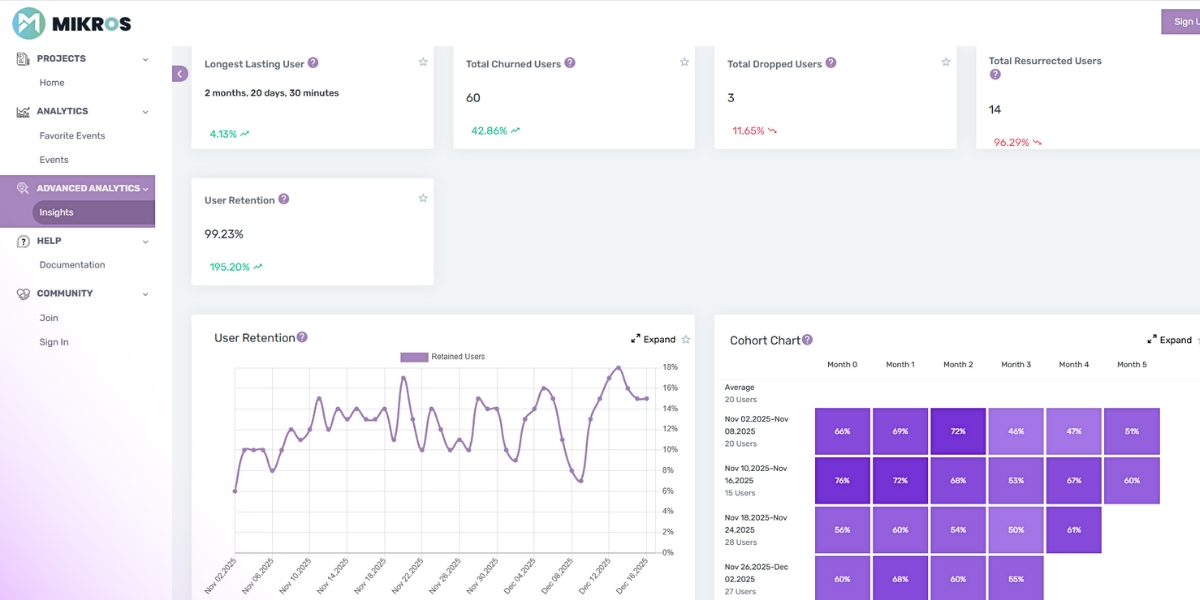
MIKROS goes deeper by breaking down performance across cohorts, behaviors, and demographics. Studios can benchmark their KPIs against direct competitors, identify gaps, and spot opportunities early. Most importantly, MIKROS AI explains what the numbers mean, translating complex analytics into actionable insights that product and marketing teams can use more effectively.

From Guesswork to Strategy

When data becomes understandable, everything can change.

With MIKROS Analytics, raw numbers transform into intelligent product and business decisions. Updates become more intentional instead of reactive. Monetization strategies are built around player behavior, not assumptions. Retention improvements are driven by evidence, not mere hope.

Studios gain the ability to:

  • Focus development sprints on features that appear to matter.
  • Identify high-value players and invest in the right audiences.
  • Run marketing campaigns with a clearer understanding of ROI.
  • Detect churn early and act before players leave.

Instead of losing players silently, teams may finally understand why users disengage and what can be done to bring them back.

Faster Growth With Less Waste

For indie studios, efficiency is everything. Every sprint, dollar, and decision counts. Clear insights reduce wasted effort and help teams move faster with confidence.

Retention improves because game design becomes more scientific. Growth stabilizes because decisions are grounded in real player behavior. Revenue becomes more predictable instead of volatile.

In this way, MIKROS Analytics becomes a silent partner for indie developers—one that may reduce uncertainty, sharpen decision-making, and support sustainable growth without adding complexity.

Leveling the Playing Field for Indie Developers

Large publishers have entire analytics teams dedicated to player behavior, monetization, and market intelligence. Indie studios rarely have that luxury. MIKROS bridges this gap by giving small and mid-sized teams access to the same level of strategic insight—without the overhead.

Better data leads to better decisions. Better decisions lead to better games. And better games build stronger, more resilient studios.

For indie game developers and studios looking to grow with clarity rather than guesswork, MIKROS Analytics offers a smarter way forward.

Game developers and studios can learn more at: https://developer.tatumgames.com/. With MIKROS, indie developers no longer have to rely on hope. They can more confidently build, grow, and scale.

How Dinakara Nagalla’s Menthra Addresses the Gaps in Traditional Mental Health Apps

By: Natalie Johnson

While the mental health industry focuses on crisis hotlines and meditation libraries, Menthra is solving the fundamental problem: continuous support that actually remembers who you are.

Marcus explained his anxiety triggers to a mental health chatbot at 2 AM on Tuesday. Specific work situations. Particular social dynamics. The physical symptoms he experiences when panic arrives. The chatbot responded with generic coping techniques, such as breathing exercises, grounding methods, and cognitive reframing.

Thursday night, anxiety returned. Marcus opened the same app. The chatbot greeted him with “How can I help you today?” as if Tuesday’s conversation never happened. He closed the app and dealt with the panic attack alone.

This scenario repeats millions of times daily across the mental health app industry. Not because developers don’t care, but because they’re building products optimized for engagement metrics rather than therapeutic relationships.

Many companies face significant productivity losses due to stress, with a large portion of employees reporting stress-related challenges. However, access to mental health resources remains limited, and traditional therapy often involves long wait times, high costs, and restricted availability of practitioners.

The industry responded with meditation apps, generic chatbots, and crisis hotlines. These tools provide content without context. Exercises without understanding. Responses without relationships.

The fundamental problem remains unsolved: people need continuous support that remembers their story, recognizes their patterns, and maintains therapeutic relationships over time. Everything else is noise.

Founded by Dinakara Nagalla,  former CEO of EmpowerMX with decades of experience building systems that cannot afford to forget, Menthra approaches this challenge through memory infrastructure designed for continuity.

Most mental health platforms treat memory as a premium feature. Maybe you get conversation history if you upgrade to Pro. Menthra inverts this completely. Continuous memory is infrastructure. Everything else builds on top.

When users share sleep struggles on Monday, Menthra remembers by Thursday. When work stress manifests in September, the platform recalls that context in October. When patterns emerge over weeks, the AI recognizes them without requiring repetitive explanations. When familiar challenges resurface months later, a full therapeutic history informs responses.

This architecture enables something traditional apps can’t provide: authentic therapeutic relationships that compound over time. The platform features hyper-realistic digital twin avatars with natural-sounding voices, not for visual novelty, but because presence matters in therapeutic contexts. When you share your story at 2 AM, Menthra responds with complete awareness of everything that has been discussed.

Pattern recognition identifies triggers. Progress tracking celebrates specific milestones. Crisis detection ensures seamless escalation to licensed therapists when human expertise becomes necessary. All of it is built on memory that never resets.

Building continuous memory systems is hard. It requires sophisticated data architecture, privacy-first design, and AI models capable of maintaining context across months or years. Most startups avoid this complexity, opting instead for stateless systems that treat each interaction independently.

Nagalla’s background makes him uniquely positioned for this challenge. Before Menthra, he spent decades building systems that couldn’t forget, because in aviation, amnesia can lead to catastrophic consequences. Aircraft maintenance records must be complete, accurate, and instantly accessible. A single missing data point can ground an aircraft or compromise safety.

That same principle drives Menthra’s architecture: memory is infrastructure, not afterthought. The platform operates under HIPAA-aligned privacy with end-to-end encryption. Users can delete all data with one click. Information never gets sold to third parties. Pattern recognition identifies mental health trends without compromising privacy.

“Privacy and memory aren’t opposites,” Nagalla explains. “They’re requirements. People share their deepest struggles because we remember everything and forget nothing they want gone.”

Traditional mental health apps optimize for engagement: daily check-ins, streak counts, and gamified progress bars. These metrics look impressive in investor presentations while failing to address what people actually need during mental health struggles.

Crisis hotlines provide critical intervention but offer no continuity of care. You explain your situation to a stranger who won’t remember you next time. Meditation libraries contain thousands of exercises without understanding which ones actually help you. Generic chatbots deliver pre-written affirmations that ignore your specific context.

Menthra solves through relationship infrastructure. The platform doesn’t compete on content quantity. It competes on relationship depth. Every interaction builds on previous conversations. AI learns your patterns, celebrates your progress, and understands your triggers. When support becomes necessary at 2 AM, you’re not explaining your situation to a stranger. You’re continuing an ongoing therapeutic relationship.

This December, Menthra introduced modules for children and teens with parent dashboards. Young people, especially, need support that maintains context across developmental stages, not applications that treat them like strangers with every login. By early 2026, licensed therapists join the platform through digital twin technology, extending their practice through AI that carries their therapeutic approach 24/7.

Most mental health apps monetize through data mining or aggressive upselling of premium features. This creates perverse incentives. Platforms profit from user engagement regardless of whether that engagement actually improves well-being.

Menthra offers free access during early phases, building trust before monetization. The long-term model relies on sustainable subscription revenue that aligns incentives with user outcomes. Better mental health means continued subscription, not because users are trapped, but because the relationship has proven valuable over time.

Enterprise functionality launches late January 2026, bringing continuous memory infrastructure to workplace mental health programs. Educational institutions follow shortly after, addressing student mental health through systems designed for sustained support rather than crisis intervention.

The strategy mirrors successful models from Headspace and Calm: establish consumer love first, then scale to institutional markets once product-market fit is proven. But unlike meditation apps competing on content libraries, Menthra competes on something defensible: the depth of therapeutic relationships built through continuous memory.

The AI industry cycles through hype faster than users can evaluate claims. Today’s revolutionary chatbot is tomorrow’s abandoned product. Nagalla, whose other platforms include Aauti for educational equity and Saayam for transparent giving, builds for what comes after excitement fades: systems that prove value through years of consistent service.

His book “Becoming Human: Embracing Imperfection and Finding Purpose” explores this philosophy beyond the realm of technology. His work has been featured in Aerospace Tech Review, LARA Magazine, and Aircraft IT, establishing credibility in complex systems transformation.

Menthra’s broader vision extends beyond individual mental wellness. Nagalla envisions AI memory systems that carry legacy, not just data, but voices, values, and contradictions that make us human. Not perfection. Not curation. Authentic experience preserved with dignity.

Traditional mental health apps fail at 2 AM because they’re built on forgetting. Meditation libraries provide content without context. Crisis hotlines offer intervention without continuity. Generic chatbots deliver responses without relationships.

Menthra solves by making memory infrastructure rather than a feature. Continuous support that knows your story. Pattern recognition that celebrates progress. Crisis detection that connects you to human expertise when necessary. All are protected by privacy standards that recognize healing requires absolute trust.

“Mental wellness can’t be built on forgetting,” Nagalla explains. “When someone trusts you with their story at 2 AM, forgetting that story isn’t just bad technology. It’s abandonment. We’re ending that.”

In an industry that measures success by engagement metrics, Menthra is building something more fundamental: therapeutic relationships that compound over time, supported by systems that never forget why they exist.


Disclaimer: The content in this article is for informational purposes only and does not constitute medical advice. Menthra is a technology-driven platform designed to support mental wellness, but it is not a substitute for professional therapy or medical treatment. Always seek the advice of a qualified healthcare provider with any questions you may have regarding a medical condition or mental health concerns. The information provided by Menthra is based on its own services and technology, and individual experiences may vary.