Making Decisions and Adjusting to Change with Clarity and Purpose: Insights from Fred A. Kressaty’s ‘Inner Harmony’


Life often doesn’t follow a straight path. Career changes, family responsibilities, health concerns, and personal loss can create turning points that call for careful decisions. In Inner Harmony: Mastering Emotional & Spiritual Intelligence, Fred A. Kressaty explores how emotional intelligence (EQ) and spiritual intelligence (SQ) may help people manage change and make wiser choices. By combining emotional skills with spiritual values, individuals can move through transitions with steadiness and purpose.

The Challenge of Change

Transitions frequently bring stress and uncertainty. A job shift, a new stage of family life, or an unexpected loss might cause people to feel unsettled. Without the right tools, emotions could take over, leading to poor decisions or a sense of being stuck.

Kressaty suggests that EQ and SQ provide balance in these moments. EQ offers skills for recognizing and managing emotions, while SQ provides perspective and meaning. Together, they can turn change from something to fear into an opportunity for direction and growth.

Emotional Skills for Decision-Making

Decisions made during stressful times are often reactive. People may act out of anger, fear, or pressure. EQ helps slow this process by encouraging self-awareness and emotional regulation. By noticing feelings and pausing before responding, people might be able to make choices that align with long-term values rather than short-term reactions.

Kressaty points out that self-awareness may prevent blind spots. Recognizing bias, stress triggers, or recurring habits can allow for clearer thinking. Emotional regulation helps ensure that decisions are not clouded by panic or frustration. Motivation and empathy add further depth by keeping goals in sight and considering the impact on others.

The Spiritual Dimension of Choices

While EQ helps with clarity, SQ provides meaning. Kressaty describes SQ as a form of wisdom that considers purpose, compassion, and connection to something greater than oneself. When applied to decision-making, SQ encourages people to ask not just, What do I want now? But also, what matters most in the bigger picture?

Spiritual practices such as prayer, meditation, or journaling can support this process by giving time for reflection. Instead of rushing into decisions, individuals might pause, consider options, and evaluate how choices align with their beliefs and values. This process often leads to peace of mind, even when decisions are difficult.

Balancing Work and Personal Life

One of the most common challenges is balancing professional responsibilities with personal well-being. Modern life can push people toward constant work, leaving little time for family, rest, or reflection. Kressaty writes that EQ and SQ together may provide tools for restoring balance.

EQ helps manage stress in the workplace by improving communication and conflict resolution. SQ adds perspective, reminding individuals of values beyond productivity. Setting boundaries, practicing gratitude, and making time for rest and reflection are presented as practical ways to create harmony between different parts of life.

Transitions as Opportunities for Growth

Kressaty emphasizes that life transitions, though difficult, can also be moments of growth. Instead of resisting change, people may view it as a chance to gain maturity and strengthen character. EQ provides emotional flexibility—helping individuals face uncertainty with calm rather than fear. SQ brings a sense of trust and acceptance, seeing change as part of a larger purpose.

The book shares practical strategies for handling transitions: setting intentional goals, reflecting on lessons from past experiences, and practicing mindfulness to stay present. These steps may prevent people from being overwhelmed and allow them to move forward with steadiness.

Building Daily Practices for Stability

Even during stable times, daily habits can prepare people for future transitions. Kressaty recommends simple routines such as mindful breathing, evening journaling, gratitude reflections, and prayer. These habits develop the self-awareness and spiritual grounding needed when unexpected challenges arise.

The key is consistency. Regular practice strengthens emotional control and spiritual focus, making it easier to respond to change when it happens. Over time, these habits can create resilience—not as a dramatic quality, but as steady readiness for life’s ups and downs.

Choosing with Purpose

Inner Harmony: Mastering Emotional & Spiritual Intelligence presents decision-making and life transitions as opportunities to practice awareness and purpose. EQ provides the tools to recognize and manage emotions, while SQ offers meaning and perspective. Together, they may help people make choices with clarity and live with balance, even during uncertain times.

Making Decisions and Adjusting to Change with Clarity and Purpose: Insights from Fred A. Kressaty's ‘Inner Harmony’

Photo Courtesy: Fred A. Kressaty

Kressaty’s message is steady and practical: change is a part of life, but with the right skills, it can lead to stronger relationships, wiser choices, and a deeper sense of direction.

About the Author

Fred A. Kressaty is a writer, teacher, and professional coach who has worked in education, business, and counseling. He holds degrees in sociology, business, and marriage and family therapy. A near-death experience shifted his outlook on life and led him to focus on helping others manage challenges with faith and clarity.

Over the years, he has taught high school, managed a sales team, owned an insurance agency, and worked as a counselor. Today, he continues his work as a coach and Christian counselor. He lives in Myrtle Beach, South Carolina, with his wife, Doreen. Married since 1976, they enjoy travel, golf, and time with their children and grandchildren.

To Purchase The Book, Visit:

E-book: Link

Paperback: Link

Hardcover: Link


Disclaimer: The information provided in this article is intended for general informational purposes only. It is not a substitute for professional advice, diagnosis, or treatment. For specific concerns, please consult a qualified professional in the relevant field.


The Spoilt Parrot: When a Parrot Learns Manners – Lessons from Dooley’s Farm

By: Elowen Gray

Children often enjoy stories featuring animals, especially when those animals teach us valuable lessons about ourselves. The Spoilt Parrot by Betty R. Young is an example of such a tale: colorful, lighthearted, and filled with gentle lessons about kindness, respect, and friendship. Set on the lively Dooley’s Farm in the Caribbean, these books are more than just stories. They are mirrors that help children understand how our choices can affect others.

With Part 1 and Part 2 of the series already available, young readers can follow Dolly the parrot through her noisy, playful adventures and her eventual realization of how wonderful it can be to live in harmony with others.

A Farm Like No Other: The Magic of Dooley’s Farm

Imagine a farm where donkeys talk about peace, goats dream of harmony, ducks share opinions, and even cats help teach lessons about kindness. That’s the world of Dooley’s Farm: bright, tropical, and full of life. Every animal plays a role, and together they create a setting where children can learn about cooperation, empathy, and respect in a playful, engaging way.

Dolly the Parrot and Her Noisy Antics from Part 1

In The Spoilt Parrot: Part 1, we meet Dolly, a beautiful, colorful parrot with feathers that shimmer in the Caribbean sunshine. Dolly knows she’s special, and she enjoys being the center of attention. But her way of getting attention is not always pleasant. She makes loud noises, mimics other animals, and even teases her shy brother, Tony.

For the other animals on Dooley’s Farm, Dolly’s behavior isn’t fun. It’s quite frustrating. They long for peace and harmony, but Dolly’s antics disrupt the calm. Children reading Part 1 may laugh at Dolly’s silliness, but they’ll also begin to see the effects of her actions: hurt feelings, lost trust, and unhappy friends.

Part 1 concludes with the farm animals realizing that something needs to be done about Dolly’s behavior. And that’s where Part 2 picks up.

What Kids Can Learn from Part 1

  • Showing off can seem fun at first, but it often makes others feel upset.
  • Being kind to siblings and friends often matters more than being the loudest in the room.
  • Good manners, like not talking with your mouth full or respecting quiet moments, can make life better for everyone.

A Plan to Help Dolly Change in Part 2

In The Spoilt Parrot: Part 2, the animals finally decide to take action. With the help of Tyler, the friendly cat, they come up with a gentle but clever plan. Tyler begins imitating Dolly’s noisy ways, showing her exactly how disruptive and silly she has been. For the first time, Dolly sees her behavior from another perspective.

This moment of self-reflection is important, not just for Dolly but also for young readers. Dolly realizes that her antics aren’t quite as amusing as she thought, and she begins to understand the value of kindness, cooperation, and bringing joy instead of chaos.

By the end of Part 2, Dolly has changed. She greets her friends politely, plays nicely with her brother Tony, and joins the other animals in enjoying the simple beauty of life on Dooley’s Farm.

What Kids Can Learn from Part 2

  • Sometimes, seeing our actions reflected back to us can help us understand their impact.
  • Working together as a team can often solve even the trickiest problems.
  • Friendship and harmony tend to feel better than showing off or being rude.
  • Change can happen when we decide to do better.

Why These Stories Matter for Young Readers

Children’s books aren’t just about entertainment; they’re also about shaping character. Through Dolly’s journey from spoilt to thoughtful, kids learn that kindness, respect, and empathy are values worth holding onto. The stories are playful but meaningful, filled with farmyard fun while gently guiding children toward positive behavior.

Betty R. Young has created more than a story; she has built a farmyard classroom where animals are the teachers, and every chapter offers a gentle lesson in life.

A Gentle Guide for Parents and Teachers

For parents and teachers, The Spoilt Parrot offers more than a bedtime story. Each part of the book can spark conversations with children:

  • Why do you think Dolly teased her brother?
  • How would you feel if someone copied you in a mean way?
  • What are some ways we can be kind every day?

Through these simple discussions, Betty R. Young hopes to encourage children to connect Dolly’s adventures with their own lives.

Get the Book for Your Kids and Spread Kindness

The Spoilt Parrot – Dooley’s Farm Part 1 & Part 2 are not just books; they are helpful stepping stones for young readers learning about empathy, manners, and the joy of friendship. Dolly begins as a parrot who only thinks of herself, but by the end of the story, she becomes a friend who brings happiness to others.

And isn’t that the kind of journey we’d like all children to take?

Both parts of Dolly’s story have been published and are ready to be purchased on Amazon. For any further queries, to share feedback, or if you simply wish to connect with Betty R. Young, you may do so directly via email at central@aribsurf.com.

Abandon House: A Memoir of Chaos, Resilience, and Relatable Catastrophe

By: Elowen Gray

Kenny Rudolph’s Abandon House: How to Survive a Home Repair Fiasco – Book 1 is not a conventional memoir built on quiet reflection or linear storytelling. The first of a three-book series, it functions as a hybrid work that blends humor, social observation, and personal endurance into a narrative that is both chaotic and controlled. What begins as a seemingly insignificant household issue becomes the foundation for a sprawling five-year saga that exposes the fragility of everyday life when bureaucracy, incompetence, and circumstance collide.

Rudolph traces the entire ordeal back to a leaky kitchen window, an inconvenience that any homeowner might expect to resolve in an afternoon or over a weekend. Instead, it becomes the trigger for a full reconstruction of not only the home but the authors’ patience, finances, and worldview. The narrative partnership between Kenny and his wife, Shari, elevates the story beyond a singular perspective. Rather than framing himself as the sole protagonist, he allows their shared voice to shape the telling. The result is richer and more dimensional than a solo account of frustration and dysfunction.

Throughout the memoir, the couple faces a carousel of challenges that range from absurd to infuriating. Fraudulent contractors, disinterested or evasive insurance representatives, opportunistic legal professionals, and the logistical nightmare of managing a home repair crisis during a global pandemic all converge. These obstacles are not presented with bitterness. Instead, Kenny approaches them with sharp humor and self-awareness, fully acknowledging the ridiculousness of the situation without dismissing the emotional toll it takes on them.

One of the standout strengths of the memoir is its tone. The writing feels conversational without sacrificing clarity or structure. Kenny has a natural storytelling instinct shaped by his background in media and creative work. He uses humor not as a gimmick but as a survival mechanism that allows readers to stay engaged through the chaos. The wit is never cynical, and the comedic beats land because they are rooted in honest disbelief at how bad things can get when systems fail.

Shari’s influence is equally important. Rather than existing in the background, she becomes an essential counterbalance, bringing empathy, warmth, and realism to the narrative. Their dynamic offers more than comic relief. It frames the experience as a joint test of resilience, reinforcing the theme that crises rarely occur in isolation. They happen to families and couples who must negotiate not only the external problem but the internal strain that accompanies it.

What sets Abandon House apart from memoirs that rely on spectacle or trauma is its accessibility. Nearly anyone who has dealt with home maintenance, city permits, complicated insurance claims, or unresponsive contractors will recognize parts of their own frustration in this story. Yet it is not simply a story of misfortune. It becomes a lens through which modern adulthood is examined. The house is the tangible setting, but the real subject is what happens when ordinary people are pulled into systems designed to slow them down rather than help them recover.

Kenny writes with enough specificity to make the events believable but avoids bogging the reader down with technical jargon or procedural minutiae. The bureaucratic obstacles are described with precision and comedic restraint. Instead of painting himself as a hero battling villains, he allows the circumstances to speak for themselves. This restraint is part of what gives the memoir its credibility. Readers do not feel manipulated or guided toward outrage. They are invited to witness a situation that spiraled beyond logic.

The emotional undercurrent of the memoir is handled with equal care and sensitivity. While the tone is often humorous, there is an ever-present awareness of how destabilizing it can be to feel powerless in one’s own home. The house is supposed to be a place of safety, order, and rest. When that collapses, identity and security are also shaken. Through small but meaningful reflections, Kenny explores how stress accumulates and how uncertainty can gradually wear people down.

The pandemic adds another layer of difficulty without becoming the central narrative. Instead, it functions as a backdrop that amplifies the absurdity of trying to navigate institutional systems during a time when everything was already on edge. The memoir never becomes political or overly sentimental about COVID-19. It uses the pandemic to highlight the tension between personal needs and societal disruption.

By the conclusion of Book 1, readers are not given a glossy resolution tied up with positivity or inspirational messaging. This memoir conveys a sense of triumph, as the couple endured, adapted, and found a way to laugh through it. Their resilience is not presented as exceptional or heroic. It is portrayed as the only viable choice for people who refuse to be defined by setbacks. And with two books remaining to complete the tale, readers will find themselves cheering for more, as Rudolph overcomes the unimaginable in their attempts to abandon the house.

The expansion of the story into The Abandon House Podcast demonstrates that the material is not limited to the written page. Hearing Kenny and Shari speak about their experiences adds another dimension to their storytelling. Their chemistry and shared storytelling rhythm lend authenticity to the memoir. It also allows the audience to stay connected to their journey beyond the confines of the three-book series.

In the end, Abandon House is not only about bad luck and bureaucratic failure. It is about how people survive disruption with humor and perspective intact. It is about the way relationships absorb stress and come out the other side with new stories and a deeper connection. Kenny Rudolph has turned a personal fiasco into something that is both laugh-out-loud funny and reflective. The memoir succeeds because it is unpretentious, emotionally grounded, and honest about how strange real life can become when something small goes wrong and nothing goes as planned.

Wicked Promises & Hot Karma: The Rise of Pavlina Ekaterini

By: Elowen Gray

Pavlina Ekaterini is a brave new voice in modern fiction, set in a city where love may be as perilous as a spell and fantasies are more vivid than neon lights. Her first book, Wicked Promises, combines seduction, urban magic, romance, and psychological strain in a way that is distinctly unvarnished, cinematic, and fiercely feminine.

Karma, a self-assured and unabashedly brave woman at the center of the narrative, lives in two realities: the magical world of her hidden power and the mortal world of New York City. Desire turns into fate when two dangerously different men, one soft but firm, the other dark and magnetic, enter her life. Every choice she makes has a cost.

A Story Fueled by Passion, Power, and Consequences

In addition to being a romance, Wicked Promises has a message.

Its main message reverberates on each page: Never give up on yourself. Karma, keep in mind, is always served hot.

Karma’s path reflects that of any woman who has ever chosen herself after silence, loss, or survival. She does not feel guilty about being feisty, imperfect, sensual, and perceptive. A world where every touch is charged, every secret might burn, and every vow demands sacrifice is presented to readers as love, desire, fate, and witchcraft combine.

What Inspired the Author?

When asked what led her to write this story, Pavlina keeps it honest and straightforward:

“Living life to the fullest, and taking every opportunity by the horns.”

Real emotions are reflected in her writing, including heartbreaks, rebirths, late-night thoughts, and the strength to become the person you’ve always imagined yourself to be.

The Challenges Behind the Book

Pavlina acknowledges that being genuine was more difficult than writing. It was difficult for her to find a publisher who supported her voice.

Additionally, she had to resist the temptation to write in the way she spoke daily; instead, she allowed the book to develop its own voice and ambiance.

“I had to let the book breathe and become its own world.”

Her Desired Effect on Readers

More than anything, Pavlina wants her narrative to serve as a reminder to everyone, especially women, that you are free to start anew, have higher dreams, and make your own decisions.

She wants readers to leave with the following ideas: 

  • It’s never too late to pursue your aspirations 
  • A woman can be both tender and powerful
  • Karma always shows up even when you don’t expect it to

Who Is Pavlina Ekaterini?

Pavlina Ekaterini, a writer who combines spirituality, sensuality, and psychological storytelling, was born and reared in New York and has Greek and Italian ancestry. Both in real life and on paper, she exudes assurance and genuineness.

Her unadulterated, captivating, and intensely feminine voice serves as a reminder to readers that magic isn’t simply fiction; it can occasionally reside within us.

She is available for speaking events, media features, podcasts, and interviews.

A New York Author You Won’t Forget

Wicked Promises is just the first step.

With its seductive blend of magic, romance, and psychological excitement, Pavlina Ekaterini is igniting a movement rather than merely publishing a book.

Because Karma always accumulates, secrets have repercussions, and love is a spell in her world.

Pavlina has some amazing projects in the near future, which will be more closely related to the topics of love, power, and change than anything else. Daydreamers can look forward to the creation of very daring and imaginative places where women are the ones who create using their power and weakness as their two main tools. All these narratives she creates keep pushing the boundaries and drawing the line on how much one can be true in a world ruled by the opposite.

With the growth of Pavlina’s writing world, her metaphorical voice enters the ranks of the women who are living vanquished lives, rather than presiding over them; it is a rallying call for women who dare to live without marks of their own living. Wicked Promises is no longer a story of a novel; it is the unleashing, the reflection raised to every reader that has ever been between the poles of fire and grace, desire and destiny.

Connect with Pavlina Ekaterini: Facebook | Instagram

Run, Hide, Fight: A Married Couple’s Sprint from Oregon to Austria

By: Deborah J. Summers

The day begins like any other in a quiet Oregon college town, two mugs warming the hands of Michael and Ann, a to-do list that looks comfortingly ordinary, until their home explodes and the past kicks down the door. In a single shockwave, a marriage that once ran on routine pivots to survival. Out of smoke and shrapnel emerges the pulse of Larry Patzer’s thriller, The Past Always Comes Back: when the life you built is targeted, do you run, do you hide, or do you fight?

Patzer wastes no time. The blast is not a random act; it’s the opening gambit in a hunt that will chase Michael and Ann across borders and into moral gray zones. What follows is a transcontinental cat-and-mouse chase from the backroads of the Pacific Northwest through Canada and on toward the cathedrals and cobblestones of Austria, where every mile forces a choice, and every choice carries a cost. Fans who gravitate to the propulsive pace, layered intelligence, and the tactical grit will feel right at home, yet this story beats with its own distinct heart: a marriage at the center of the storm.

The premise is elegantly simple and ruthlessly effective. Michael has a history—professional, secret, and long put away—that explains both his instincts and the danger they’re in. He never expected to open that vault again, least of all in front of his wife.

Ann, a mild-mannered, spiritually grounded woman whose life’s work orients around care and conscience, is suddenly asked to step into a world she never imagined: quick decisions, clean lines, steady hands. She’s not a prop. She’s a partner. And because the threat is relentless, she must learn quickly.

One of the book’s great strengths is the credibility of that transformation. Patzer doesn’t wave a wand and turn Ann into a superhero. He lets you feel what change costs. There’s the physicality—recoil, breath, the weight of unfamiliar tools. There’s the interior battle—fear, anger, resolve, the question of who you are when the unthinkable becomes necessary. The couple’s private language of marriage, such as trust, frustration, and forgiveness, gets rewritten on the fly under extreme pressure. You can almost hear the unspoken vows being amended: for better or worse, for run, hide, and fight.

The story’s architecture is both tight and cinematic, yet thoughtful. The title—The Past Always Comes Back—isn’t just a threat; it’s a theme. Sometimes the past returns to collect, sometimes to protect, and most often to complicate. That’s the tension thrumming under every turn: you can’t outrun your history, but you can decide what it makes of you now. Patzer leans into that idea without slowing the pace. Tactical choices like where to hole up, when to move, how to read a room, share space with ethical ones, and what lines you cross to safeguard a life, and how you live with those lines afterward.

As the chase widens, the hunter-hunted dynamic keeps flipping. It’s never as simple as “they’re after us.” Michael and Ann learn, adapt, and force their pursuers to react. That back-and-forth is where the novel’s suspense lives: roadside encounters that go sideways, hotel hallways that feel too long, a face glimpsed a beat too late, a phone that rings when it shouldn’t. The couple’s advantage isn’t brute force; it’s commitment, clarity, and the kind of teamwork born of years spent knowing each other’s tells.

Patzer’s background lends texture to the pages. The technical details land with a confident snap, yet the book never bogs down in jargon. You get enough tradecraft to trust the moves, then the author gets out of the way so you can feel the stakes. And the stakes are never abstract. They are marital and moral: preserving a life together without losing themselves in the process.

Another welcome surprise is how the novel treats conscience. This isn’t carnage-as-spectacle. It’s a consequence. Ann, primarily, serves as the story’s moral accelerant. She is the one most changed by what the moment requires, and her questions about violence, about purpose, about who she’ll be on the other side haunt the margins in the best way. Readers who want their thrillers to reckon with right and wrong will appreciate how often the book allows a heartbeat of reflection between bursts of action.

And the settings! Place matters here. From the damp chill of Pacific Northwest mornings to the crisp, old-world air of Austria, each location sharpens the mood and the choices available. Backroads invite evasion; border crossings demand nerve; foreign streets offer cover and risk in equal measure. You feel the geography under the story’s feet, and you understand how terrain can be both enemy and ally.

Crucially, this article won’t spoil the ending. No reveals, no late-stage twists exposed. What you need to know is this: The Past Always Comes Back will deliver. It moves, it hits, and it thinks. It places a believable husband and wife in impossible circumstances and asks what love looks like when running, hiding, and fighting are the only verbs left. Thriller readers over 35 who want both adrenaline and a moral compass will find themselves muttering “just one more chapter” until the room goes quiet and the sun is threatening the blinds.

If you’re ready for a pace that never lets up, a partnership you’ll root for, and a chase that crosses continents and moral fault lines, then lace up.
Run with them. Hide with them. Fight with them. The Past Always Comes Back — coming soon wherever books are sold.

Dan Mercredi’s Witnessing Change: A Memoir of Resilience, Environmental Justice, and Indigenous Wisdom

By: Matt Emma

Fort Chipewyan, Alberta — A small, serene hamlet tucked between boreal forests and the waters of Lake Athabasca might seem like an unlikely epicenter for a climate movement. But for Dan Mercredi, it’s emerging as a significant site for one of the compelling environmental awakenings of our time.

In his deeply personal book, Witnessing Change, Mercredi invites readers on an emotional journey, discussing pressing issues related to the nature and narrating his transformation from a nature-loving boy growing up in Fort Chipewyan to a dedicated advocate for environmental justice and Indigenous-led sustainability. Part memoir, part wake-up call, Witnessing Change is a raw and thought-provoking reflection on what it means to watch your homeland change, and decide to do something about it.

At first glance, Witnessing Change reads like a love letter to a place. Readers are transported to a childhood filled with quiet lakeside mornings, moose tracks in the snow, the scent of spruce, and the wisdom of elders. Mercredi paints a vivid picture of growing up connected to nature not as a resource, but as a relative.

But that sense of harmony doesn’t last.

As Mercredi comes of age, so too does a new reality: changing seasons, dwindling wildlife, polluted waters, and industrial expansion. Climate change, once an abstract headline, becomes personal—visible in the vanishing caribou, the strange weather, the rising cancer rates in his community. The Fort Chipewyan he knew begins to shift before his eyes.

And Dan? He refuses to stay silent.

Honestly, climate headlines are everywhere. Melting ice caps, record wildfires, rising sea levels. So, what makes Witnessing Change different? This book offers something these reports can’t—bringing in a human face to the crisis. Providing a personal narrative that makes the data feel tangible and relevant. And, perhaps most importantly, a potential blueprint for resistance, resilience, and action.

Dan Mercredi’s voice is not that of a distant expert. He’s someone who’s lived through the crisis. His story resonates because it’s grounded. Grounded in land. Grounded in community. Grounded in truth.

What sets this book apart is its balance. It doesn’t just sound like the alarm. It shares potential pathways forward. Through community organizing, traditional knowledge, renewable energy projects, and youth engagement, Mercredi shows how even the smallest communities can rise up—and lead.

“I Didn’t Just Watch the Land Change—It Changed Me”

One of the powerful arcs in Witnessing Change is Mercredi’s evolution from observer to activist. And it’s not a smooth or perfect journey. It’s real.

He begins by noticing. Noticing the earlier springs. Noticing fewer fish. Noticing the thickening haze in the sky.

Then comes grief. Then anger. And then—purpose.

Mercredi joins hands with local residents, elders, scientists, and educators to fight back. They organize, they protest, and they meet with government officials. They demand stricter regulations on oil sands development. They call out the pollution poisoning their water and lungs. And slowly, they’re heard.

It’s a portrait of what grassroots leadership can look like. It’s a potential roadmap for anyone asking: “What can I do?”

This isn’t just a book about environmentalism. It’s about Indigenous leadership—and what the rest of the world can learn from it.

In chapter after chapter, Mercredi demonstrates how traditional land stewardship, passed down through generations, offers solutions that Western policy often overlooks. Things like:

  • Living in balance with the seasons

  • Honoring the animal you hunt

  • Seeing land not as property, but as kin

  • Teaching children through story and lived experience

These aren’t just quaint traditions; they’re strategies for long-term survival. And they appear to be effective.

Mercredi doesn’t pit modern science against traditional wisdom. Instead, he argues for collaboration. His book bridges the gap between modern researchers and the elders, between policy and practical application. And the result is powerful: environmental solutions that are practical, cultural, and potentially deeply sustainable.

One of the boldest parts of Mercredi’s vision lies in renewable energy. He doesn’t just advocate for solar panels and wind turbines because it’s trendy—he does it because the alternative appears to be affecting his community negatively.

He documents efforts to transition Fort Chipewyan toward solar and wind energy, outlining the benefits not just for the planet, but for economic independence and health. He sees clean energy as a possible path back to sovereignty.

“Every solar panel we install is a step away from the industries that are making us sick,” he writes. “It’s not just about the environment—it’s about dignity.”

It’s this kind of clarity that makes Witnessing Change such a refreshing read. There’s no greenwashing. No fluff. Just a straight-talking man calling it like it is—and inviting you to join him.

“I remember the first time I saw a fish with lesions. My father said nothing, but his silence screamed. That was the moment I knew—our water, our lifeblood, was under attack.”

Published by United Book Publishing, Witnessing Change is now available in hardcover, paperback, and ebook formats through Amazon, Barnes & Noble, and independent bookstores.

Buy the book here: Witnessing Change eBook: Mercredi, Dan

Learn more about the author: Mercredi Dan | Facebook

Whether you’re a climate activist, a policymaker, a student, or just someone trying to make sense of the world we’re leaving behind, this book could belong on your shelf.

About the Author

Dan Mercredi is a lifelong resident of Fort Chipewyan, Alberta, and a proud member of the Indigenous community. Raised in the heart of nature, Dan’s deep connection to the land shaped his identity and life’s mission. Over the years, he has become a respected environmental advocate, blending traditional knowledge with modern sustainability practices. His grassroots activism, community leadership, and unwavering dedication to renewable energy and land protection have inspired many. Witnessing Change is his first book, a heartfelt memoir and urgent call to action that reflects both his personal journey and his vision for a better, greener future.

Dan Mercredi’s Witnessing Change doesn’t just ask you to read, it asks you to remember, rethink, and respond. It reminds us that climate change isn’t happening in some distant future; it’s here. It’s personal. And it’s urgent.

But more than anything, this book reminds us that change is possible. That even the quietest places, like Fort Chipewyan, can become centers of hope, innovation, and resistance.

So, here’s your invitation. Witness the change. And be part of it.

For Press Inquiries, Review Copies, or Interviews

United Book Publishing
Email: info@unitedbookpublishing.com
Phone: +1 (855) 605-5210

Abe Schellenberg Launches Definitive Law Bible to Help Clarify Biblical Law for Modern Believers

By: Elowen Gray

After more than a decade of careful study and cross-referencing Scripture in multiple languages, author Abe Schellenberg is preparing to release a new edition of the New Testament that brings important clarity to famously debated topics in Christian theology, the meaning of “the law.”

For centuries, Christians have wrestled with questions surrounding the law in Scripture. When the Bible says the law was “done away with,” does that include the Ten Commandments? Are believers still called to obey God’s moral principles, or has grace replaced obedience entirely?

Schellenberg’s Definitive Law Bible seeks to untangle these questions by showing readers which law each passage is referring to: moral, ceremonial, civil, or sacrificial, so the Word of God can be read and understood in its proper context.

A Twelve-Year Mission for Biblical Understanding

The creation of this work was not a quick undertaking. Over a span of twelve years, Schellenberg compared different translations of the Bible in English, German, Spanish, and Dutch to identify a consistent gap. Generally, the versions he found use the term law without specifying which kind. As a result, some interpretations have led to differing views on whether all laws were abolished after Christ’s crucifixion, while others maintain that certain laws remain binding.

Schellenberg, after conducting an in-depth study, suggests that this misunderstanding can be addressed by differentiating between two key types of biblical law: the moral law and the ceremonial law. The moral law, symbolized by the Ten Commandments, is often regarded as eternal, reflecting God’s immutable character.

On the other hand, the ceremonial or Mosaic laws, which included sacrifices, rituals, and circumcision, are understood by some as a temporary provision that pointed to Christ’s death on the cross. While the moral law is viewed as applicable to every generation, the ceremonial laws are believed to have been fulfilled at the time of Christ’s mission.

Giving Context to Scripture

Schellenberg’s Definitive Law Bible provides brief notations within the text that identify which type of law is being referenced in each passage. This distinction helps readers to see, for example, that when Paul writes about being “justified by faith without the deeds of the law,” he is addressing ceremonial practices, not moral commandments. By restoring that context, the text becomes more coherent and less contradictory.

This method does not alter the message of Scripture but enhances it, helping readers understand the harmony between faith and obedience. It supports the idea that salvation through faith and adherence to God’s moral principles are not opposing concepts but complementary expressions of a sincere relationship with God.

A Work of Faith and Dedication

The project started off as a personal effort to gain deeper insight into the Scriptures, and it was later converted into an extensive work that could help others. 

Schellenberg dedicated significant time and effort to studying and revising over the years, ensuring that his exegesis remained rooted in the primary meaning of the biblical text. He met with different scholars and religious leaders at different points of his research, but decided to wrap up the project alone in the end to retain its accuracy and intention.

This approach of his expresses a modest devotion to illuminating the text rather than that of being engaged in controversy. Rather than giving a new interpretation of the Bible, Schellenberg’s book can be looked at as a facilitator for a new, clearer road through the text that emphasizes being consistent rather than contradicting.

A Practical Guide for Modern Believers

The Definitive Law Bible is meant to be used for personal and academic purposes. It will be a study tool for those who want to solidify their comprehension of God’s Word and also a resource for church leaders, educators, and theology students who want to investigate the interconnectedness of law, grace, and faith.

By offering a contextual reading of the Bible, the book helps make it clear to the believers that faith is not just a matter of belief but also a matter of action. Moreover, it points out that the moral law isn’t outdated. It is still relevant and can implicitly shape the qualities of righteousness, mercy, and justice that characterize a life of faith. 

Launch and Availability

Schellenberg’s Definitive Law Bible is set to launch soon and will be available on Amazon, Barnes & Noble, and several major Christian retail platforms, both in print and digital formats. The book is positioned as an accessible yet scholarly contribution to modern theology, one that bridges the gap between biblical interpretation and practical understanding.

By helping bring clarity to the concept of “the law,” this work invites believers to rediscover Scripture with fresh eyes and renewed confidence. It encourages readers to see that faith and obedience are complementary, but to coexist as guiding principles for a life rooted in truth and devotion.


Disclaimer: The information provided in this article is for informational and educational purposes only. The views and interpretations presented in Abe Schellenberg’s Definitive Law Bible are those of the author and do not necessarily reflect the views of any religious organization, denomination, or theological body. This work aims to clarify theological concepts related to biblical law; however, readers are encouraged to consult their own religious leaders or scholars for additional guidance on these matters. The book is not intended as a substitute for personal faith, spiritual practices, or professional theological advice. Always exercise personal discretion when engaging with religious or theological content.

Prabha Karan’s Books Inspire Global Readers by Bridging Science and Spiritual Wisdom

By: Sheng Alferez

Prabha Karan embodies a rare fusion of intellectual curiosity and heartfelt insight, drawing audiences into a captivating dialogue between the cosmos and the self. His three books navigate both the vast mysteries of the universe and the intricate puzzle of personal transformation. Through clear, accessible storytelling, Karan inspires readers with ideas that encourage curiosity about existence while offering practical guidance that may support mental well-being and personal growth.

His journey reflects a remarkable ascent from modest beginnings in South India to a commanding presence in global non-fiction publishing. He expertly melds scientific inquiry with spiritual philosophy, crafting narratives that spark wonder and reflection. Karan’s work illustrates a bold endeavor to revive and reimagine ancient Vedantic wisdom in contemporary language, making profound concepts graspable for a diverse audience worldwide.

Crossing Boundaries Between Science and Spirit

Who Banged the Big Bang! stands as a centerpiece in Karan’s literary canon, a distinctive exploration of cosmic origins that bridges quantum physics with profound philosophical questions. The book weaves through the fabric of time and space, inviting readers to contemplate infinity and consciousness with a nuanced lens. Rather than daunting complex theory, the volume distills scientific and mystical threads into captivating prose for those drawn to life’s compelling enigmas.

Karan invites readers to explore the potential connections between science and spirituality, offering a dialogue where ancient texts like the Upanishads can be seen alongside modern physics.

“My aim is to make the philosophy behind the universe approachable, to cultivate reflection without intimidation,” he explains. This approach invites thinkers and seekers alike into thoughtful engagement, opening new vistas for understanding existence.

Practical Wisdom for Personal Growth

Cherish or Perish shifts focus inward, identifying the intellect as a force beyond raw intelligence. It presents practical strategies to master thought patterns and claim agency over one’s journey toward clarity and fulfillment. Karan illuminates techniques that help people resist manipulation and channel their mental faculties toward deliberate action. This work resonates with readers grappling to transform inner chaos into meaningful progress.

The YOU in ME, Forever… explores the interplay of components shaping our self-awareness and relationships. Drawing on both ancient insights and modern psychology, it equips readers with practices such as meditation and yoga to deepen their connection and self-understanding. Here, Karan’s voice gently guides toward nurturing authentic bonds and realizing potential. His fusion of spiritual insight with actionable advice creates a roadmap toward lasting happiness.

An Author with a Global Reach and Mission

Across thousands of copies sold and translations into German and Spanish, Karan’s influence extends across continents and cultures. His readership spans the USA, Europe, parts of Asia, and beyond. These numbers reflect not just commercial success but the resonance of his message in multiple languages and diverse contexts. He emphasizes the importance of placing his work in the hands of readers during Amazon’s free book days, widening access and impact.

Karan speaks candidly about his ambition: “Inspiring and guiding readers to a clearer understanding of themselves and the cosmos fuels everything I do.” His publishing journey intertwines with a legacy of industrial entrepreneurship, merging disciplined business acumen with philosophical exploration. This breadth of experience enriches his voice and authority, reinforcing his role as a thought leader straddling multiple dimensions.

A Legacy Shaped by Humble Origins and Bold Insight

Born to a farming family, Karan’s personal narrative encompasses a remarkable pivot from engineering and business to profound spiritual education and literary contribution. The influence of Vedanta philosophy reshaped his worldview, informing both his life and writing. He rediscovered timeless wisdom wrapped in simplicity, stripping away cultural and academic barriers to render these teachings universal.

His manufacturing ventures in Spain and Dubai showed business prowess, yet his deeper impulse was to disseminate knowledge that transforms lives. His books, suffused with timeless spirituality and scientific wonder, embody a rare synthesis. They serve as invitations to readers worldwide to question deeply, grow thoughtfully, and embrace both the human and cosmic mysteries with open minds.

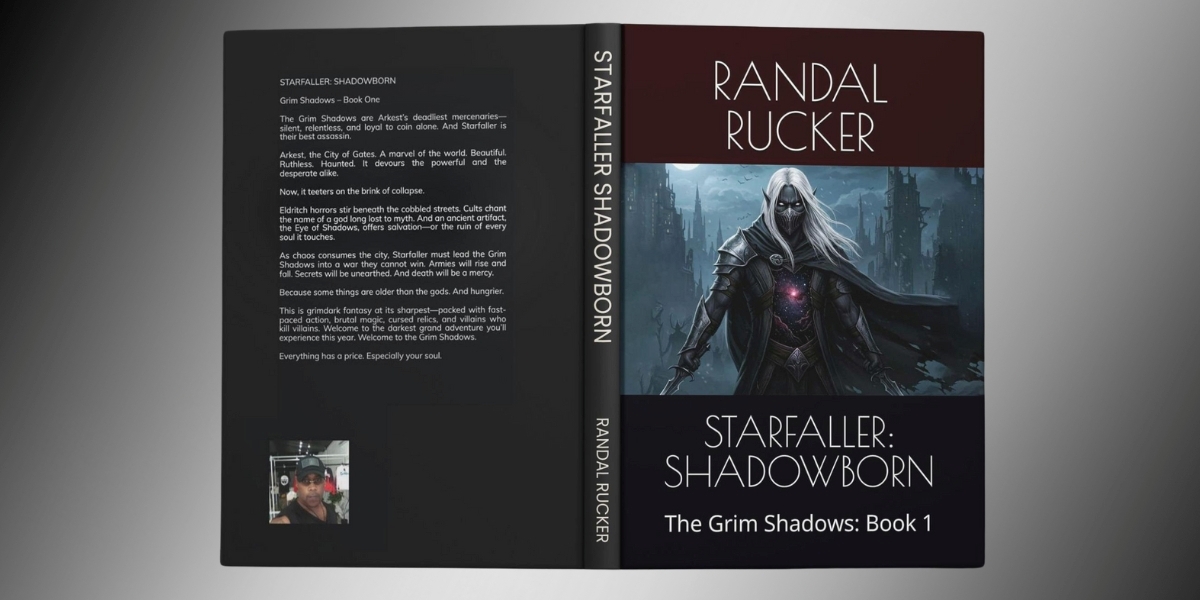
Arkest at War With Itself: “STARFALLER: SHADOWBORN” Reforges Grimdark for a New Era

By: Jeremy V. Santos

Arkest is a city that eats. It chews through power and desperation with the same cold appetite, and that ravenous spirit is the engine that drives STARFALLER: SHADOWBORN: The Grim Shadows: Book 1. In R.C. Rucker’s grimdark debut, the City of Gates becomes a living constraint: the pressure that forces every character into sharp, costly choices. The result is a novel that wields the genre’s familiar steel, brutal magic, cursed relics, and mercenary codes, but hones them to a modern edge.

At the center is Starfaller, a precision-minded assassin working within the Grim Shadows, Arkest’s coin-first mercenary company. Contracts are sacred, loyalty is transactional, and the job is simple until it isn’t. What should be another clean kill becomes a fuse, and the city provides the powder: cults murmuring in shuttered temples, nobles swapping favors like counterfeit coin, and syndicates treating human lives as line items. The deeper Starfaller moves through Arkest’s alleys and salons, the more precise the novel’s thesis becomes: systems survive by devouring those who can’t pay the escalating price.

The Eye of Shadows, an ancient artifact, is the story’s gravitational center. It promises salvation to those who can wield it and ruin to everyone else. Grimdark often courts despair, but Rucker steers toward consequence. The Eye isn’t just a doom-machine; it’s a mirror that forces characters to examine what they’re willing to trade. Power doesn’t arrive for free here. Every advantage drips with cost, and the ledger never stops updating. The refrain: “Everything has a price. Especially your soul.”

Action sequences convey the intricate logic of real-world operations. Ambushes aren’t clean; plans degrade on contact with fear, greed, and bad information. When the Grim Shadows move, they do so with discipline and the constant dread that discipline might not be enough. That tactical authenticity keeps the pages turning, but it’s the politics that are quiet, lethal, and omnipresent—that give the novel its torque. You feel the shelves of power groaning as factions test each other’s limits: cultists coaxing eldritch phenomena beneath cobbles; aristocrats laundering cruelty through ritual; crime lords buying influence by the body.

Rucker’s worldbuilding resists the postcard view. Arkest is rich, but not for spectacle’s sake. Its beauty has teeth; its rituals smother; its commerce whispers. The City of Gates invites endless traversal—and punishes naïveté. Even the city’s grandeur, its palaces and markets, reads like a trap designed to measure what you can’t afford to lose. In that sense, STARFALLER: SHADOWBORN is a novel about economics as much as it is about magic. Currency changes hands, but so do memories, loyalties, and names.

Where the book distinguishes itself is in its moral architecture. Villains kill villains, yes, but the violence is purposeful. The ethical terrain is navigable if you have the stomach for its gradients. Starfaller’s choices matter not because they redeem or doom him outright, but because they ripple through the networks that keep Arkest upright. In a lesser book, The Eye of Shadows would reduce everything to an apocalyptic spectacle. Here, it sharpens focus: every scheme, alliance, and betrayal revolves around what the artifact reveals about those who reach for it.

For readers who want their fantasy to sprint, the pacing delivers: a clean opening hook, escalating pressure, and set pieces that pop without breaking the world’s internal logic. For those who want to think, the book invites them to consider mercenary ethics, the cost of belonging, and how cities metabolize human need. STARFALLER: SHADOWBORN doesn’t argue that hope is foolish; it argues that hope is expensive and that in Arkest, the invoice arrives early.

This is grimdark tuned for 2025: kinetic, psychologically literate, and allergic to empty nihilism. Come for the cursed relic and knife fights, you’ll get your fill. Stay, and you’ll find the city staring back, asking what you’re willing to pay next.

The Art of Suspense in David Roberts’ Writing

By: Alan L. Cooke

Suspense is a powerful genre in literature. It has the unique ability to keep readers on the edge of their seats, eagerly turning pages to uncover what happens next. This feeling of anticipation, of teetering on the brink of the unknown, is what makes suspense fiction so engrossing. Crafting such stories requires a deep understanding of narrative techniques that can manipulate a reader’s emotions and expectations.

David Roberts‘ novel “Nota Bene effectively showcases his talent, employing elements such as pacing, foreshadowing, and character development to create a gripping narrative that keeps readers hooked.

One of the key tools Roberts employs to build suspense is pacing. A well-paced story keeps readers engaged, moving quickly enough to maintain their interest but not so fast that they become lost or overwhelmed. In “Nota Bene,” Roberts modulates the narrative’s pace, providing bursts of action that draw readers in and hold their attention.

Silences in the action are equally important as they offer a momentary respite before the next wave of tension. For instance, just when the reader feels comfortable believing they have a handle on the storyline, Roberts introduces a new twist or complication, effectively reigniting the sense of urgency and mystery.

Foreshadowing is another device that Roberts masterfully incorporates into his work. This technique involves planting subtle hints or clues throughout the narrative that suggest what might happen later. These clues create a sense of anticipation as readers pick up on these nuances and begin to speculate about potential outcomes.

In “Nota Bene,” Roberts employs this method to significant effect, dropping hints about the mysterious conditions that led up to Trevor Martin’s death. Each clue is like a breadcrumb, leading readers deeper into the entanglement of the story. The use of foreshadowing keeps readers mentally engaged, continually encouraging them to piece together the puzzle as they read.

Character development is also crucial in building suspense, and Roberts excels in this area. For readers to feel invested in the story, they must care about the characters and their fates. Roberts’ characters are complex and multifaceted, each with their own fears, motivations, and secrets. The protagonist’s evolving relationship with other characters helps to heighten the tension.

As readers learn more about the characters, their emotional involvement deepens, making the stakes feel personal. For example, understanding the protagonist’s sense of duty and obligation to uncover the truth behind Trevor Martin’s death makes his journey all the more compelling. His inner struggles, doubts, and the weight of his responsibilities add layers to the suspense.

Dialogue is another essential tool in Roberts’ arsenal for creating suspense. Conversations between characters can reveal hidden motives, escalate conflicts, or introduce new elements of danger. Roberts’ dialogue is sharp and purposeful, each exchange adding another piece to the overall puzzle.

These interactions not only propel the plot forward but also provide insight into the characters’ states of mind. When characters like Mobes and Hugo discuss their plans and fears, the reader is given a glimpse into their psyches, enhancing the overall tension and unpredictability of the story.

Setting plays a crucial role in Roberts’ suspense-building strategy as well. The environments in which his stories unfold are carefully chosen to evoke a particular mood or atmosphere. In “Nota Bene,” the various locations—from the bustling streets of Cairo to the quiet vineyards near Mdina—serve not just as backdrops but as active elements that influence the narrative.

The physical space often mirrors the psychological state of the characters, reinforcing the sense of unease or impending danger. For instance, the barren roads and abandoned homes the protagonist travels through evoke a feeling of isolation and desolation, perfectly complementing the suspenseful tone of the book.

Roberts also employs what can be described as the art of misdirection to keep readers guessing. He introduces elements that appear significant, then leads readers down a path that seems obvious, only to reveal later that things are not as they seem.

This technique ensures that the reader remains off-balance, never entirely sure what to expect next. For example, a seemingly trivial conversation or object can later turn out to be a significant piece of the puzzle, making readers question their assumptions and stay alert for new clues.

Another aspect of Roberts’ writing that adds to the suspense is his use of internal monologue. By giving readers direct access to the protagonist’s thoughts, he builds a deeper connection between the reader and the character.

These internal reflections often reveal the protagonist’s anxieties, doubts, and fears, making the tension more palpable. Knowing what the protagonist is thinking heightens the emotional stakes and makes the sense of danger feel more immediate and real.

Final Words

David Roberts’ ability to create suspense is a testament to his mastery of various narrative techniques. By skilfully manipulating pacing, foreshadowing, character development, dialogue, setting, and misdirection, he constructs stories that are not only engaging but also intensely thrilling.

In “Nota Bene,” these elements converge to form a taut, suspenseful narrative that keeps readers engaged from start to finish. Roberts’ talent for weaving intricate, tension-filled tales ensures that his work remains compelling and unforgettable.

To experience the intricate suspense and masterful storytelling firsthand, pick up your copy of “Nota Bene” by David Roberts today. Explore a narrative that balances tension and intrigue, keeping you enthralled from start to finish. Available now at major bookstores and online retailers.