How Kimberly Wright and Her Spirit Choir Turned Suffering Into Sound

In How Music Healed Me: Spirit Speaks, Kimberly Wright weaves trauma, illness, mediumship, and an unapologetically human love of music into a spiritual memoir that resists spectacle. The result is not a manifesto or a miracle story, but a quietly radical account of attention, how listening, in its many forms, can become a form of survival.

The book opens in a hospital room washed in fluorescent light. Machines mark time with mechanical precision while Wright’s world contracts to test results and prognoses. Faced with pain and uncertainty, she does something disarmingly ordinary: she makes a playlist. Not the triumphant soundtrack of recovery montages, but long, droning compositions tuned to a single frequency, 528 hertz, sometimes called the “miracle tone.” As nurses come and go, they linger in the doorway. The room feels calmer, they say. As if someone has changed the station beneath the noise.

That small act sets the tone for the memoir. How Music Healed Me traces how Wright learned to tune her life through sound, discernment, and hard-earned boundaries after years of spiritual openness that often came at a personal cost. Part memoir, part field report from the liminal, and part guide for living with heightened sensitivity, the book follows her from a turbulent New England childhood through addiction, controlling spiritual communities, repeated brushes with death, and toward a more grounded integration.

From the beginning, Wright frames herself as “born awake,” a child whose dreams bleed into waking life, who absorbs other people’s emotions in classrooms and grocery stores, and whose father’s alcoholism turns the home into an unpredictable climate system. “Chaos became the natural state of the household,” she writes plainly, without melodrama, “leaving an enduring mark on me.” Even so, an alternate soundtrack emerges early: punk and disco records spinning in her bedroom, and the profound quiet of her grandmother’s New Hampshire camp, where trees and stones become her first nonjudgmental witnesses.

The memoir is most compelling in these threshold moments when curiosity about the unseen nudges Wright across a line, and discernment must catch up. A peyote ceremony initially framed as a spiritual initiation devolves into something harsher under the force of her sensitivity. “Spiritual openness does not require surrendering control,” she later reflects. “Certain thresholds demand wisdom, purpose, and care once crossed.” The sentence functions as a quiet thesis for the entire book.

That hard-earned clarity deepens during her decade working in one of Salem’s oldest witch shops, where the paranormal becomes routine rather than theatrical. Wright recounts these years in compact, almost reportorial scenes: glass witch balls spinning in still air; books flying from shelves with uncanny precision; a leather-clad biker dissolving into tears when she mentions Archangel Michael and a date, then revealing a tattoo that matches both. In one reading, a grieving mother hears from her son who died of an overdose; the message doesn’t erase the grief, but it loosens its grip. Wright resists glamour here. The tone does not behold the spectacle, but this is what happens when the unseen insists on being acknowledged.

If Salem is where Wright learns what her gifts can offer others, the hospital chapters reveal what they can offer her. A cascade of illnesses, diabetes, cancer, a stroke, and repeated near-fatal complications turn her body into contested ground between medical charts and spiritual encounter. She describes colored lights she identifies as archangels, dreams of saints whose devotees are praying for her across oceans, and moments of recovery that leave doctors puzzled. She never rejects medicine; she layers it. “Music reminded me that I was not only a patient tethered to machines,” she writes, “but also a soul with depth, peace, and purpose.”

Sound is not a metaphor here; it is a method. Frequencies, chanting, ambient tracks, and even heavy metal riffs form one of the book’s most tangible through-lines. During a prolonged hospitalization that nearly breaks her, Wright listens for hours to 528-hertz tones, to tracks titled Weightless and Celestial Healing. These are not aesthetic choices but survival strategies, places for the mind to go when pain becomes unmanageable. At one crucial moment, a pounding rock song jolts her body into taking its first fragile steps again. The same openness that once led her into psychedelic excess becomes, in midlife, a tool for regulation and grounding.

Structurally, the memoir alternates between narrative chapters and short, channeled poems attributed to a spirit chorus Wright calls Lucy Zoe Oliviara. Written in a spare, incantatory register, these pieces function like a gospel choir responding to a soloist, echoing, amplifying, and reframing the prose. Whether readers accept their spiritual authorship or not, the book broadens its emotional range beyond first-person testimony.

What ultimately anchors How Music Healed Me is Wright’s refusal to spiritualize away responsibility. She writes candidly about cult dynamics, toxic positivity, and her own complicity in staying too long where boundaries should have been drawn. She recounts sleeping in her car because she failed to advocate for herself, remaining in controlling relationships, and doing the unglamorous work of therapy, support groups, and nutritional change. “The world eventually became a mirror reflecting what I needed to see,” she admits. When she finally claims, “Happiness is my right,” it lands not as an affirmation but as earned truth.

In the end, the book’s most persuasive argument is not about proving the existence of spirits, though Wright believes deeply in them, but about the transformative power of attention. Attention to animals that bristle at the wrong visitor. To feathers that appear after near-death experiences. To friends who see your capacity before you do. And to the frequencies musical and otherwise that allow the body to soften when nothing else will.

When Wright pauses long enough to ask, “Who am I without the noise? What is my frequency?” the question feels less mystical than urgently modern. In an era saturated with distraction, How Music Healed Me: Spirit Speaks offers no easy miracles, only a disciplined way of listening.

Read it not for tidy answers, but for companionship on the long, imperfect walk toward healing. Let Wright’s spirit choir, her hard-won boundaries, and her disarming humor walk beside you and see what begins to shift in the quiet after the final page.

The book is now available on Amazon.


Disclaimer: The views and experiences shared in How Music Healed Me: Spirit Speaks by Kimberly Wright are those of the author and do not constitute medical advice. The book explores personal healing and spiritual experiences, and while it may offer insights for some, it is not a substitute for professional medical care or therapy. Readers are encouraged to seek appropriate professional guidance for any health-related concerns.

The Storybook Buried in Your Phone

Your entire family history is now behind a phone screen. This happened without anyone noticing.

The big moments stick around. Birthday disasters, first day of school with the comically oversized backpack. The ordinary Tuesdays, though, the ones that actually constitute childhood, those vanish into your camera roll alongside grocery list screenshots and that blurry license plate photo you took for insurance.

Scroll back far enough, and evidence exists. Swing set, beach, Christmas tree. Nineteen nearly identical shots of your kid clutching a popsicle because you were determined to capture the drip before it hit their shirt. You didn’t.

Photos just grab surfaces. There’s your kid meeting the neighbor’s golden retriever. The image shows two figures, one small and one furry. What you actually remember: your shy kid addressed that dog like meeting minor European royalty. Full solemnity. Your spouse made a joke afterward that still makes you laugh at odd moments.

The photo contains none of that. The weird phrase your kid invented that week and abandoned three days later lives nowhere in your camera roll. Photos capture faces. Meaning requires a different container.

A Different Approach

Some families started making custom storybooks. Real details from actual life, shaped into narratives with beginnings, middles, and endings. And the kids star in it.

Magic happens at bedtime.

Children read very differently from adults. While adults seek new information, children seek repetition. They want the same book delivered in the same rhythm, night after night, with almost unsettling devotion. Offer variety, and they’ll refuse to read.

A story gets replayed. That repetition transforms a memory into something else entirely.

Photo albums sit on shelves until someone decides to open them. Storybooks get requested. Demanded, actually. Nightly. The memory stops being a file and becomes a ritual.

Specificity Does the Work

The binding and paper quality matter if you want the thing to survive a toddler. The actual engine, though, runs on specific details.

The crooked shed was painted that particular pink color. Cute yellow rain boots. The stuffed rabbit with a name that means nothing to anyone outside your household. The elderly neighbor who waves every morning. Your kid’s specific phrase when faking bravery.

These details communicate something to a child: this story belongs to you. When the main character shares your name, your cowlick, your missing front tooth, you’re already invested. No convincing required.

Truth Stretched Into Adventure

These stories often function better when they deviate from strict accuracy.

Consider a real moment. At the first soccer practice, your kid is nervous. But if you expand it, the practice becomes a quest. The embarrassing missed kick becomes a problem requiring investigation. The emotions stay accurate. The plot gives them somewhere to land.

Phases work well for this. Childhood consists almost entirely of phases stacked on each other. Dinosaurs. Space. The period where only one specific hoodie will do.

Anyone who has lived with a dinosaur-obsessed preschooler understands. The interest operates closer to religious devotion.

A dinosaur story can address fear, the challenge of trying new things, or surviving a difficult day. The dinosaurs serve as a delivery mechanism. Custom story books like ones from Leo Books allow one to make personalized stories across various themes like dinosaurs or superheroes, that insert a child’s real details into the adventure.

Effective versions avoid announcing their intentions. No, “and then Marcus discovered the true meaning of patience.” They show the child doing the thing. Children detect when you’re teaching them. They tolerate learning. They don’t want to be coerced.

Confidence as a Side Effect

Career-themed stories have developed a following. A book that lets a child mentally inhabit different futures without stakes attached tends to help build confidence. The child imagines capability in the present tense. Leo Books built a career-exploration stories around this dynamic. Curiosity leads. Confidence arrives uninvited.

Sports stories operate on similar mechanics. Adults frame athletics as competition, but children often experience sports as social evaluation that happens to involve physical movement. The field generates excitement and anxiety in roughly equal measure. A story that names pregame nerves and then resolves them provides something useful. For families who love sports, a personalized sports storybook centers the child in the narrative.

Building Your Own

You can construct something from your actual life without writing credentials.

Grab a few real details. Select one moment. Just one, not the whole year.

Start with something boring and ordinary. The morning your kid refused to leave the house. The afternoon they lost something irreplaceable and recovered it. Pick one obstacle that a child would recognize as an obstacle. Add a detail so specific it resists replication: the pet’s absurd name, the garage door’s exact color, the nonsense phrase your kid deploys constantly.

Memory becomes story. The process takes less effort than you’d assume.

What Families Actually Preserve

Photos remain useful, but they also remain passive. They sit and wait.

Stories demand attention. They require repetition. They become a shared language between parent and child, a thing you cannot replicate by handing someone your phone and suggesting they scroll.

A decade from now, your kid probably won’t recall when that beach picture happened. The outfit becomes a blur. Weather, forgotten.

Being the hero of a story that contained their actual life details, though. That information tends to persist.

Families work to preserve things. The target is often described as memories, moments, or the past. But what they are actually looking for is belonging. That feeling of being part of something specific, something that included you by name, something that knew about the yellow boots and the stuffed rabbit and the phrase you said when scared.

Photos document that a thing happened. Stories let a child remember their place in it, night after night.

Your camera roll contains thousands of images. Somewhere in there, raw material for a story sits waiting. The popsicle drip. The golden retriever. The Tuesday that felt ordinary at the time.

A few specific details, one modest obstacle, and a child who gets to be the hero. The formula is simple, but the results often outlast the phone.

The Deep, Unspoken Language of Enduring Love In NOTES TO HER

A man’s heart is laid bare in this stunning collection of poetry, celebrating the ultimate her, the wife, the partner, the lifelong companion.

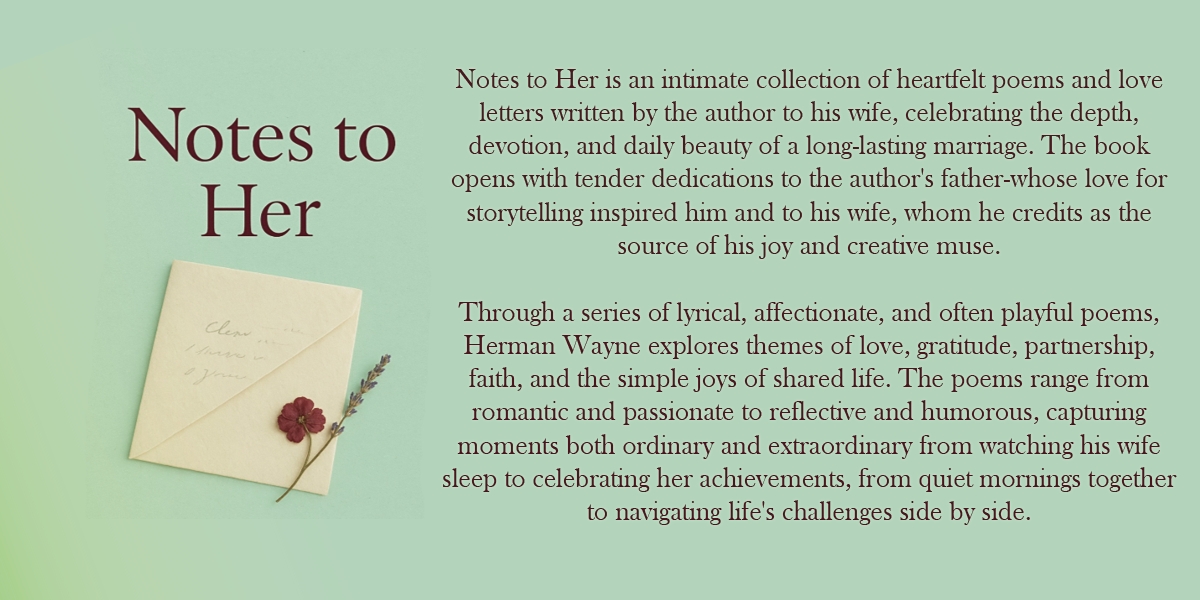
In a world saturated with fleeting gestures and surface-level affection, the true, enduring language of love often goes unwritten. Now, author Herman Wayne invites readers into a sanctuary of devotion with his heartfelt collection, NOTES TO HER. This isn’t merely a book of poetry. It’s an intimate, daily proof, a handwritten chronicle of a man’s boundless admiration for the one woman who fills up his senses.

The book stands as a literary bouquet, carefully gathered over time, dedicated to the author’s wife, friend, and muse. Each piece shows a moment, a realization, or a quiet thought that defines a lifelong partnership. From the playful celebration of his Hottie to the deep, reverent acknowledgment of her as The Gift, an angel from high courts above,  held in reserve just for him, the collection maps the geography of a heart completely claimed.

Beauty in the Everyday

What makes this book so compelling is its refusal to rely on grand, sweeping narratives. Instead, Wayne finds poetry in the beautiful constants of daily life. He speaks of the joy of waking up beside her, the comfort of holding her tight in the candlelight, and the simple happiness of being next to you in every scenario, from fresh-cut grass to family holidays. This is a love measured not just in years but in the bunch of breaths between moments, affirming that she is his person through all the craziness we experience and all the goodness.

The poems are an honest look at commitment, recognizing that life brings ups and downs, smiles and frowns, and that bodies change with time. Yet, in pieces like Change, the author assures his love that while My body, my wealth, with time, give way… My heart, my spirit with you will stay. This is a love that only grows stronger and stronger, a constant that time has no power to slow.

Reflection of Your Own Love Story

The magic of NOTES TO HER is that, while intensely personal, it acts as a mirror for any reader devoted to their own special treasure. It offers words for feelings that many partners struggle to articulate. The immense gratitude of having a spouse who dries your tears and shoulders your sorrow, and the sense of being the richest man in the world simply by waking up next to her.

Readers will find themselves drawn into the sincerity of the verses and fresh and inspiring ways to appreciate their own partners. The poems are reminders to never settle for yesterday’s surprises and a pledge to be forever there for his girl, the most important person in my life.

 An Act of Vested Devotion

The essence of the collection is captured in the poem Vested, where Wayne asserts that his heart, hopes, and dreams are all tied up and vested 100% in his wife. This is the ultimate declaration of commitment: that she is his exclusivity clause, his reason for doing the things he does.

If you are seeking a book to read, share, or use as inspiration for expressing your deepest feelings, this book is a beautiful, necessary addition to your library. It is a powerful reminder that the greatest riches are the ones we wake up to every single day.

Find the perfect words for your beloved. Buy NOTES TO HER today and give the gift of timeless, unwavering devotion. Your love story deserves a soundtrack!

Wanda, Bryan, and the Magic of “Letters Tell Our Love Story”

A Lifetime of Devotion

In the quiet, sun-baked corners of West Texas in 1966, a young man named Bryan Jennings III caught the eye of a girl named Wanda Wedel with nothing more than a playful wink. They were students at Texas Tech University, playing a simple social game called “Winkum” at the Methodist Student Center. In that single moment of shared laughter, a connection was born, one that would be preserved for decades in the fragile folds of handwritten letters. Their book, Letters Tell Our Love Story, is not just a collection of old mail; it is a living, breathing map of how two people learned to fall in love while they were hundreds of miles apart.

The story truly kicks off when the university doors close for the summer. Wanda heads to the rugged beauty of Big Bend National Park to work as a maid, while Bryan stays behind in Lubbock, putting in long hours to save up for the upcoming school year. Today, they might just send each other quick texts or share photos on social media. But in 1966, the only way they stayed connected across the desert heat was through the post office. Each letter carried a piece of their hearts; words written in ink on paper that they could hold, smell, and keep close under their pillows.

Reading these letters is like sitting with old friends, sharing their private memories. The simple, honest language is deeply moving. Bryan writes about his exhaustion working the “graveyard shift” at a service station and saving to visit her. Wanda shares her days in the national park, from mountain scenery to daily struggles as a young woman far from home. These aren’t polished poet’s words but sincere thoughts of two young people growing up.

What makes the book truly special for readers today is its heartfelt honesty. We watch the couple navigate through life’s universal moments: the sting of jealousy, the anxiety of being forgotten, and the sheer happiness of receiving a letter after days of waiting. They talk about everyday topics: grades, car repairs, and family news, but beneath each conversation, there’s a warm promise growing. You can feel their relationship growing with each page, evolving from the happy teasing of college days into a deep, resilient bond of partners ready to face the world together.

There’s a charming local flavor to the story as well. Bryan mentions the drag races in Amarillo and his father’s strange involvement in the “movie business,” specifically helping with a film that would go on to become a famous cult classic. These small details help bring 1960s Texas to life, giving the book a nostalgic, almost time-traveling feel. It beautifully captures a world that was more relaxed and perhaps a little more patient, where saying ‘I love you’ meant waiting a whole life for someone.

For anyone who has ever missed someone or felt the thrill of a new romance, this book is a warm embrace. It reminds us that while technology changes, the way we feel about one another does not. The story has a happy ending that feels earned; the couple finally married in December 1967, but the real treasure lies in the journey between the envelopes. 

Letters Tell Our Love Story is a beautiful reminder that the best things in life are often worth waiting for, and that sometimes, a simple flash can lead to a lifetime of happiness. It is a story for the young, the old, and everyone in between who believes in the power of a heart poured out on paper.

When Power Protects Itself Instead of Truth

Promotion: Denied shares the powerful and true story of racism, cover-ups, betrayal, and vigilante justice within the United States Air Force Academy. Written by retired Air Force officer Joseph W. Hoffler, this book reflects over twenty-two years of decorated military service, outstanding evaluations, and leadership roles. Hoffler was on the cusp of promotion to colonel—until his career was quietly disrupted by secret investigations, overlooked evidence, and administrative retaliation. Drawing from official records and his personal experience, the book reveals how institutional power can operate behind professional language and procedures, protecting itself while isolating one of its own. Hoffler shares his story not for sympathy, but to ensure the truth is documented and to help future service members understand what can happen when integrity meets unchecked authority.

Sometimes, staying silent can hurt more than speaking out. This book was born from that understanding. After more than twenty years of dedicated service, outstanding evaluations, leadership, and unwavering loyalty, the author found himself facing a challenge far greater than professional disappointment: institutional silence. Promotions disappeared without clear reasons, investigations took place without transparency, and years of integrity were reduced to mere paperwork and formal language. What makes this story particularly hard is not only the injustice itself but how calmly it was allowed to happen. The system didn’t fall apart; it worked exactly as intended, protecting itself while letting one of its own bear the consequences. The quiet but persistent frustration in these pages reflects years of unanswered letters, ignored documents, and a deep understanding that every now and then, truth alone isn’t enough to move power.

Sometimes silence speaks louder than decisions ever could…

This is not a story fueled by bitterness. It is driven by clarity. The author carefully documents how small administrative actions quietly grow into career-ending outcomes, how authority reshapes narratives, and how racial bias hides behind official procedure. Every chapter shows the emotional cost of watching a lifetime of service slowly dismantled while leadership looks the other way. There is no dramatization here, only record-keeping. Timelines are preserved. Responses are tracked. Events are presented exactly as they unfolded. The weight of the experience extends beyond the uniform, touching family members who carried the stress alongside him and children who witnessed their parents struggle against a system that refused accountability. What hurts most is the betrayal of belief. The author entered his career trusting in fairness, discipline, and honor, only to discover that those values become negotiable when reputation and hierarchy are at stake.

When loyalty meets indifference, something inside you changes…

The emotional center of this book lives in the long stretch between hope and acceptance. For years, the author tried to work within official channels. He followed protocol. He appealed decisions. He submitted documentation. He waited for someone to step forward and acknowledge what was happening. That moment never came. Instead, silence answered every effort. The realization was slow and painful. Justice would not arrive through internal systems. Time would not correct what had been done. Evidence alone would not shift outcomes. What remained was the responsibility to tell the story himself. Writing became an act of resistance. Memory became evidence. Experience became a warning. This book exists because forgetting would have been easier for everyone except those harmed by the system.

Sometimes the hardest fight is simply refusing to disappear…

Family presence throughout the narrative adds another layer of depth. Behind every professional decision were real people absorbing the fallout. A spouse watching stress take its toll. Children growing up in the shadow of unanswered questions. Grandchildren inheriting stories they should never have had to carry. This is not just a career derailed. It is a household reshaped. Dreams postponed. Futures altered. The author does not write to gain sympathy. He writes to make visible what institutions often leave invisible. He writes for younger service members who may one day find themselves isolated. He writes for professionals who believe merit will protect them. He writes for readers who want to understand how power operates behind closed doors.

Truth does not vanish just because it is inconvenient…

Today, this powerful account is available in both print and digital formats through major online retailers, including Amazon, as well as directly from the publisher. It is essential reading for anyone interested in military accountability, civil rights, leadership ethics, or the hidden cost of silence. More than that, it is for anyone who believes service deserves respect and that integrity should never be conditional. If you have ever wondered how injustice survives inside respected institutions, this book answers that question with painful honesty. It does not offer comfort. It offers clarity. It shows how careers can be quietly dismantled while everyone involved claims they were simply following procedure.

Awareness is the first step… 

Action is the next…

This is not just one man’s story. It is a mirror held up to systems that demand loyalty while withholding justice. It challenges readers to confront uncomfortable realities and decide what responsibility looks like on the other side of awareness. If this story leaves you unsettled, that is intentional. Growth rarely comes from comfort. Change rarely begins with convenience. Real accountability starts when people choose to listen.

If you believe integrity should never be optional…

If you believe silence enables harm…

If you believe truth still matters even when it costs something…

Then this book belongs in your hands.

Read it| Share it| Talk about it

Because stories like this fade when ignored…

And they change things when they are heard…

Sometimes, the bravest thing you can do is hold on to experience instead of letting it fade away into forgotten files. And sometimes, the only thing left to seek is the truth, which is its own kind of justice.

This is one man’s refusal to disappear!

👉 Get Your Copy Now

The Educated Magic of “An Unusual Friendship”: How a Veteran Teacher Crafts Stories That Do More Than Entertain

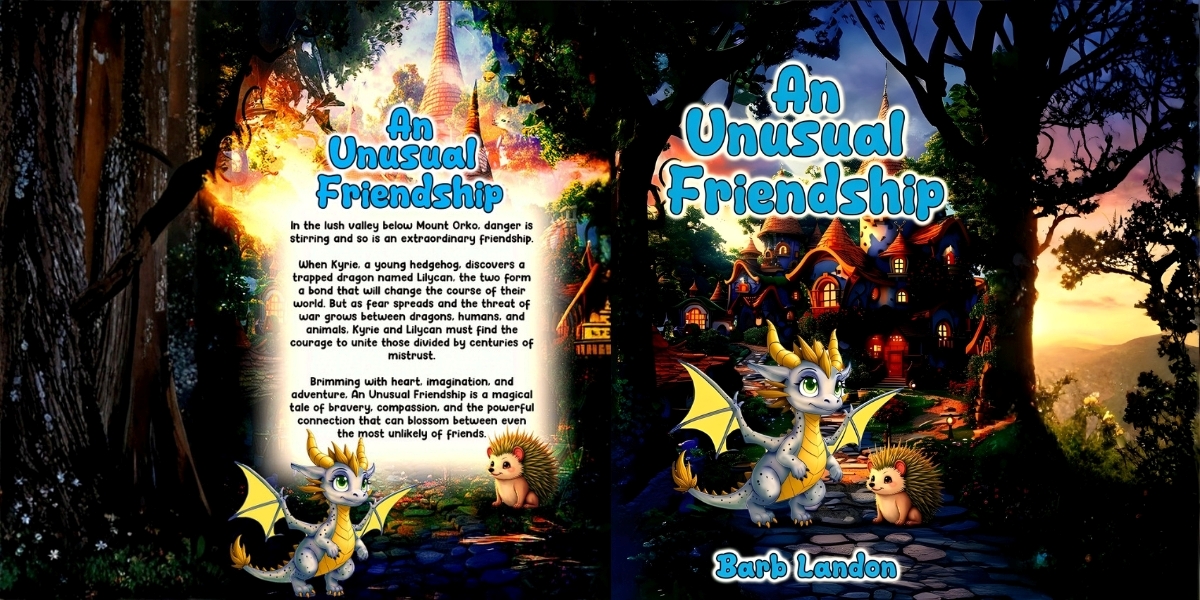
What separates a simple story from one that lingers in the heart and mind of a young reader long after the final page? For debut author Barb Landon, the answer lies not in flashy plots or empty magic, but in a tool honed over decades in the classroom. In her children’s novel, An Unusual Friendship, Landon demonstrates that she is far more than a storyteller; she is a literary architect, deliberately designing narratives that entertain while they educate, comfort while they challenge, and delight while they build character.

Landon’s 35-year career teaching grades K through 7 is the unshakeable foundation of her authorial voice. This experience provides her with an intimate, almost intuitive understanding of a child’s cognitive and emotional landscape. She doesn’t just write for children; she writes from a place of profound respect for how they learn, process fear, and cultivate empathy. In An Unusual Friendship, this expertise transforms a charming fantasy about a hedgehog and a dragon into a carefully constructed masterclass in developmental storytelling.

The book’s very structure mirrors a classroom’s rhythm and a child’s journey toward independence. Consider the opening chapters, where Mother Hedgehog teaches her four children essential survival skills: building a hibernacula, identifying food, and recognizing predators. This is not a whimsical backdrop; it is a direct parallel to foundational learning milestones. Landon presents information through demonstration, repetition, and gentle warning, which mirrors the way core knowledge is often built for early learners. Each hedgehog sibling, Kayden in the field, Hank in the meadow, Harper by the ocean, and Kyrie in the forest, then embarks on their own journey of applied learning. This narrative choice reflects a core educational principle: providing a safe framework before encouraging independent exploration.

Furthermore, Landon’s plot is a thoughtful exercise in social-emotional learning (SEL). The central conflict—a challenge that forces dragons, hedgehogs, and humans to overcome centuries of mistrust—is essentially a complex problem of interpersonal and inter-species dynamics. The “solution” is not necessarily a lone hero with a sword, but a community utilizing dialogue, strategy, and shared responsibility. Kyrie’s courageous decision to help the trapped dragon Lilycan is a lesson in empathy in action. The grand alliance that forms, where bees, birds, bears, and villagers each contribute their unique strengths, is a powerful symbol for collaborative problem-solving. Landon, through her narrative, encourages the reader to understand that the most formidable challenges are overcome not by force, but by forged connection and collective intelligence.

This pedagogical intent is seamlessly woven into the fabric of the prose itself. Landon’s writing possesses a “read-aloud-ready” quality, a hallmark of a seasoned teacher who knows the importance of cadence, clarity, and vocal performance. Her descriptions are vivid but never overwrought, allowing a child’s imagination to co-create the world of Mount Orko. She balances moments of lighthearted play like hedgehogs rolling down hills with genuine tension, teaching young readers how to navigate narrative suspense within a safe container. This deliberate pacing and tonal control ensure the story is both engaging and manageable, helping reduce anxiety while building literacy stamina.

The core messages of An Unusual Friendship, empathy over fear, unity over division, and the courage inherent in kindness, are therefore not merely accidental themes. They are the intentional learning outcomes of Landon’s literary design. She uses the magical premise to create what educators call a “psychic distance,” allowing children to explore weighty concepts like prejudice and ecological responsibility through the safer, more relatable lens of animal characters. When the villagers finally see James and Aria’s gift of animal communication not as witchcraft but as a bridge to salvation, Landon is modeling a profound shift in perspective, inviting readers to reconsider their own fears of the “other.”

Landon’s transition from educator to author is gaining well-deserved recognition. She recently sat down for an in-depth conversation about this very journey with Logan Crawford on the Spotlight Network. The interview, which delves into her teaching philosophy and its influence on her writing, is available for viewing on the network’s YouTube channel and on Barb’s personal website. For a direct glimpse into the enchanting world she has built, readers can also watch the animated book video trailer on her site. In a thrilling culmination, that same trailer is scheduled to illuminate the iconic digital billboards of New York City’s Times Square during the Christmas season, bringing the story’s message of unity to one of the world’s largest stages.

In an era where children’s entertainment is often ephemeral and passive, Barb Landon offers something enduring and active. An Unusual Friendship stands as a testament to the power of educated magic, the kind that is carefully crafted by someone who has dedicated her life to understanding how young minds grow. It suggests that the best children’s literature doesn’t just kill time; it helps build the foundational stones of character, curiosity, and compassion. Landon hasn’t merely written a book; she has engineered a meaningful experience, using the timeless tools of story to do what great teachers have always done: light a path forward.

Discover the story that is captivating young readers and educators alike. An Unusual Friendship is available now, inviting your family to experience a fantasy where every page turns toward a lesson in courage and unity.

How Keith Allen Guther Turned Darts into a Manual for Life

More Than a Game

In an age where instruction is often compressed into short videos and quick fixes, Keith Allen Guther has chosen a slower, more deliberate path. His forthcoming book, A Killer Guide to Darts: A Manual for Players of All Skill Levels to Improve Their Game, reads less like a rulebook and more like a conversation passed down across generations. It is part technical manual, part memoir, and part philosophy of focus rooted in a lifetime of competition, teaching, and reflection.

Guther, who turned fifty in early 2025, did not arrive at darts through spectacle or professional circuits. He arrived through family. His earliest memories of the game date back to elementary school, when he stood on a chair in South Weymouth, Massachusetts, to reach the board alongside adults on his father’s Navy dart team. That dartboard followed the family through military moves, becoming a constant in an otherwise shifting childhood. Over time, it became more than recreation; it became a classroom.

He frames those early lessons as exercises in restraint rather than instruction. He describes learning darts the same way he learned other foundational skills; not through force or constant correction, but through quiet guidance and patience. In his telling, responsibility emerged when mistakes were allowed to unfold without interference. Subtle pressure replaced command. Composure mattered more than correction. The lesson, repeated throughout the book, is that growth often comes from waiting, observing, and allowing understanding to arrive on its own.

That approach defines both the man and the book. A Killer Guide to Darts did not begin as a commercial project. It began as handwritten notes and training reminders for a friend and for Guther’s eldest son. As their skills improved, the notes grew. What emerged was more than a simple guide; it became a structured system that views darts as a craft that demands physical mechanics, mental discipline, and ethical considerations.

The book is organized into “gears,” a metaphor he uses to describe progression. Early sections focus on fundamentals: stance, grip, alignment, equipment, and preparation. These chapters are practical and precise, yet notably unflashy. Guther resists shortcuts, emphasizing comfort, repeatability, and awareness over brute force or imitation of professional players. His tone is that of a mentor standing just off to the side, letting the student throw, miss, adjust, and try again.

As the manual advances, it becomes clear that darts, for him, is never just about the board. Drawing from his background in martial arts, coaching, and business ownership, he frames the throw as a study in intention. Analogies range from chopping wood to pitching baseballs to free throws in basketball. The lesson is consistent: power without control is wasted, and precision without patience collapses under pressure.

Perhaps the most distinctive element of the book is its extended focus on the mental game. Entire sections are devoted to focus, presence, and what Guther calls “the mask,” the persona a competitor wears to maintain composure and subtly influence opponents. This concept is not presented as bravado, but as self-regulation. For him, the mask is less about intimidation and more about consistency: showing the same calm face whether winning or losing, protecting one’s inner state from disruption.

These ideas are inseparable from his personal history. He writes openly about living with chronic pain, surviving a broken neck, multiple surgeries, and heart attacks. Darts, in this context, become an anchor. It offers structure, measurable progress, and a reason to train when much of life feels uncertain. Teaching the game, especially to his son, becomes an act of continuity, a way to pass on lessons that extend beyond sport.

Despite the book’s depth, he is careful not to position himself as an authority beyond question. He repeatedly reminds readers that no two players are built the same, and that instruction must adapt to the individual. The manual encourages experimentation, reflection, and self-evaluation. Success, as he defines it, is not perfection, but honest improvement.

That humility may be what makes this book resonate beyond its niche. While it is unmistakably detailed, covering training drills, strategy, equipment choices, and structured practice, it also functions as a meditation on mastery itself. In a culture obsessed with speed and outcomes, Guther argues for patience, repetition, and respect for process.

For readers unfamiliar with darts, the book offers an unexpected window into a game that rewards calm over aggression and thoughtfulness over flair. For seasoned players, it provides a rare blend of technical clarity and philosophical grounding. And for Guther, it stands as a written legacy; an attempt to preserve not just how to throw a dart, but why the act still matters.

In the end, A Killer Guide to Darts is more about enjoying the game and improving your skills rather than being ruthless at the oche. It encourages a deliberate approach to learning to miss well, to adjust quietly, and to carry oneself with discipline, whether anyone is watching or not. In many ways, this book serves as both a guide to life and a guide to sport. It gently reminds us that even the smallest goals often need the deepest focus, encouraging us to stay attentive and persistent.

Hazelnuts and Homicide: N. E. Carlisle Blends Mystery, Community, and Culinary Culture

By: Riley Donovan

When it comes to cozy mysteries that make readers feel right at home, N. E. Carlisle has a unique recipe. Her latest book, Hazelnuts and Homicide, combines the intrigue of a whodunit with the warmth of food, community, and small-town charm. We sat down with Carlisle to explore her inspirations, the worlds she builds, and why culinary culture is such a perfect partner for mystery storytelling.

Blending Food and Fiction

“I have always believed that food tells a story,” Carlisle explains. “Recipes, flavors, and shared meals build connection, and that sense of comfort pairs perfectly with a cozy mystery.” In Hazelnuts and Homicide, food isn’t just background—it anchors the protagonist, Année, emotionally and guides her through the investigation.

From culinary experiments to festive meals, every dish in Carlisle’s book carries narrative weight. “Blending culinary culture with a whodunit felt natural,” she adds. “It makes the story immersive, where the sensory world matters just as much as the plot.”

Creating a Coastal Community

Hazelton, Oregon, the setting for the Bonne Année Mystery series, feels like a living, breathing place, but it’s actually fictional. Its character draws on communities throughout Tillamook County, Oregon. “There’s a unique rhythm to that area,” Carlisle says. “The mist, the coastal forests, the local traditions, the feeling that everyone knows everyone else. Hazelton carries that pulse.”

The town’s authenticity helps readers feel connected to Année’s journey, making every street, café, and ocean cliff part of the story. “Setting is an emotional force in storytelling,” Carlisle notes. “A cozy café or foggy forest can influence a character as much as any plot point.”

Pairing Stories with Flavor

Fans of the Bonne Année Mysteries know the series’ culinary edge extends beyond the page. Carlisle has hosted Food and Fiction supper clubs, encouraging readers to experience her stories through both taste and imagination.

“When pairing Hazelnuts and Homicide with a real dish, I would pick the Macabre Brussel Sprouts,” she laughs. “They’re rich, a little decadent, yet surprisingly good for you. Cozy on the surface, but with a twist, just like the story.”

Oscar the Bernedoodle: More Than a Pet

No cozy mystery is complete without lovable characters, and in Carlisle’s world, that includes four-legged friends. Oscar, a Bernedoodle, is a standout favorite. “Oscar is based on one of my own dogs,” Carlisle shares. “Her expressive personality and intuition made their way directly onto the page. She comforts Année, nudges her in the right direction, and brings warmth and levity to the mystery.”

Exploring Themes of Community and Belonging

Beyond the food and mystery, Carlisle’s books consistently highlight tight-knit communities and the importance of found family. “Cozy mysteries are rooted in the idea that community can be a source of strength, healing, and humor,” she explains. Année’s support system in Hazelton mirrors real-life connections, emphasizing that belonging is just as essential as solving the crime.

Switching Genres: Fantasy vs. Cozy Mystery

In addition to her cozy mysteries, Carlisle writes coastal fantasy in the Mermaid Eclipse trilogy. She finds both genres challenge her in complementary ways. “Writing cozy mysteries keeps me grounded in everyday emotion,” she says. “Fantasy asks me to expand beyond natural rules. In fantasy, the magic is literal. In a cozy mystery, it comes from community, comfort, and curiosity.”

This flexibility allows her to explore diverse stories while keeping her work emotionally resonant and immersive.

Research, Detail, and the Oregon Coast

Even small details play a big role in Carlisle’s storytelling. While writing Hazelnuts and Homicide, she researched hazelnut trees, discovering their sensitivity to microclimates and weather patterns. “Learning how crops interact with the coastal environment gave me a deeper appreciation of Tillamook County,” she says. “It added authenticity and depth to the story.”

This focus on place and environment extends to every aspect of her books, from bookshops to ocean cliffs, helping readers step fully into Hazelton’s world.

Transformation and Second Chances

A recurring theme across Carlisle’s works is transformation—whether magical or personal. “I return to reinvention, belonging, and second chances,” she explains. “My characters often stand at the edge of a new chapter, uncertain but hopeful. It’s about discovering who you are and who you choose to become.”

This theme resonates in the Bonne Année series, where characters navigate change while finding support and comfort in their community.

Looking Ahead in the Series

Readers eager for the next installment can expect more culinary delights, engaging mysteries, and a touch of romance. “The next book takes place during Easter and introduces new people and celebrations in Hazelton,” Carlisle reveals. “Année continues to grow into her life, and yes, Oscar will be right by her side again.”

Bringing Cozy Mysteries to Life

With Hazelnuts and Homicide, N. E. Carlisle shows that cozy mysteries can be about more than puzzles; they can celebrate food, community, and the power of connection. Through vivid settings, relatable characters, and sensory storytelling, she invites readers to savor every chapter.

For readers looking for a mystery that offers both intrigue and warmth, Hazelnuts and Homicide delivers a world where every meal, every friendship, and every clue adds another layer to the experience.

Gracefully Free Offers A Faith-Filled Guide to Healing, Growth, and New Beginnings After Divorce

Divorce is more than a legal separation. It is an emotional, spiritual, and deeply personal unraveling of the life you once knew. In Gracefully Free: A Guide to Thriving After Divorce, Glendora Sealy speaks directly to those standing at that fragile crossroads, offering hope, direction, and reassurance that life after heartbreak can potentially be not only healed but also deeply fulfilling.

This book is for anyone searching for ways to heal emotionally after divorce while navigating grief, fear, and uncertainty. With honesty and compassion, Sealy addresses the raw emotional aftermath of separation, guiding readers through the process of overcoming divorce grief and reclaiming emotional strength. She reminds readers that divorce does not have to be the end of their story. It can be the beginning of profound personal and spiritual growth.

Rooted in lived experience and faith, Gracefully Free stands out as a source of Christian encouragement after divorce. The author brings spiritual insight throughout the pages, offering reassurance about God’s healing after divorce and gentle reminders to trust God, even when the future feels unclear. For readers seeking faith and divorce recovery, this book provides grounded, practical steps alongside faith-based emotional healing that may restore hope without minimizing pain.

Beyond emotional and spiritual restoration, the book offers practical guidance for rebuilding everyday life. Chapters on self-care after divorce emphasize nurturing mental, emotional, and physical well-being, because healing is holistic. Readers are encouraged to prioritize rest, boundaries, reflection, and self-love after divorce, learning to rebuild confidence one step at a time with intention.

For parents, Gracefully Free is a compassionate companion through the complexities of parenting after divorce. The author addresses single parenting after divorce, offering reassurance, organization strategies, and emotional support for divorced parents. Her guidance on co-parenting after divorce and co-parenting strategies focuses on communication, stability, and children’s emotional healing, recognizing that divorce and children’s healing should be handled with care, patience, and love.

Financial uncertainty is another challenge many face, and Sealy meets this head-on with practical insight into financial independence after divorce. Readers are guided through rebuilding stability, managing resources, and regaining confidence, which is an essential step in rediscovering themselves after divorce and stepping into independence with a sense of security.

What makes Gracefully Free especially powerful is its focus on purpose. Through reflective exercises and mindset shifts, readers are guided to find purpose and embrace new beginnings after divorce. Sealy reframes heartbreak as a reason for growth, helping readers cultivate a positive mindset, build resilience, and step into a life that may be defined by intention rather than loss.

At its heart, this book is about transformation. It speaks to women seeking Christian self-help for women, parents rebuilding families, and individuals ready to move from survival to thriving. It is about rediscovering yourself after divorce, learning emotional strength after separation, and believing, perhaps for the first time in a long while, that joy can still be possible.

The book is not a quick fix. It is a steady, faith-filled guide that walks beside you as you heal, rebuild, and rise.

Your divorce does not define you. Your next chapter has the potential to define you. Step into healing, purpose, and freedom. Buy Gracefully Free today and begin your journey toward the life waiting for you.


Disclaimer: The information provided in the article is intended for general informational and inspirational purposes only. It is not a substitute for professional advice, including legal, financial, or psychological counseling. While the author shares personal insights and experiences, individual results may vary. Readers are encouraged to consult with a licensed professional for specific concerns related to their divorce, emotional well-being, financial independence, or co-parenting.

From Victim to Victor: How the Doctrine of Redemption is Lived, Not Just Preached

Within the halls of theological discourse, the doctrine of redemption is often treated as a pristine construct—a magnificent, yet abstract, theory of divine exchange. It is parsed in systematic theologies, debated in seminaries, and proclaimed from pulpits with intellectual vigor. Yet, for many, it remains a distant promise, a theological concept struggling to bridge the chasm to a lived reality marred by pain, trauma, and ingrained brokenness. To understand redemption not as a theory but as a tangible, breathing truth, one must turn not merely to a commentary but to a life. The memoir Brokenness and Miracles by Linda Sutherland does not simply discuss redemption; it serves as its definitive, flesh-and-blood case study. With the authority of one who was pulled from the “horrible pit” of Psalm 40, Sutherland dissects the often-abstract concept of redemption, revealing it as a gritty, lifelong, and glorious process of repair authored by God Himself.

Sutherland’s authority is not academic; it is existential. She writes from the epicenter of human devastation—a childhood scorched by the traumatic loss of her mother, systematic neglect, and the profound evil of parental sexual grooming. Her narrative does not shy away from the precise vocabulary of abuse; she details the “grooming,” the “neglect,” the “hunger,” and the “terror” with unflinching clarity. This is not a gratuitous detail, but the essential establishment of the raw material with which divine grace would work. Before the miracle, one must understand the depth of the need. She meticulously catalogs the consequential sins that such trauma bred in her own heart—theft, deception, and a hardened rage—establishing a comprehensive portrait of total depravity not as a doctrine, but as a personal biography. In doing so, she constructs an undeniable premise: if grace can reach here, it can reach anywhere.

It is against this meticulously painted backdrop of darkness that the doctrine of redemption shines with transformative clarity. Sutherland’s life becomes the living bridge between two lexicons: the vocabulary of human sin and the vocabulary of divine salvation. The theological concept of “new creation in Christ” from II Corinthians 5:17 ceases to be a mere verse. In her story, it is the palpable moment in her aunt’s home when the question, “Linda, do you know that Jesus loves you?” shattered her hardened heart. It is the observable transformation of a girl who picked cigarette butts off the street into a woman whose desires and speech were fundamentally altered. She does not speculate on God’s ability to heal and make new; she catalogues it. Her narrative stands as a definitive rebuttal to the insidious lie that some pasts are too broken, some scars too deep, for future purpose or purity.

Furthermore, Sutherland embodies the doctrine of Providence—God’s active, sovereign orchestration of events for His purposes and the good of His people. Her theology is not passive; it is traced in the active verbs of God’s intervention. Providence was the phone call to her aunt and uncle from social services. It was the exact, timely provision of a thousand dollars for college bills. It was the discovery of the cancerous tumor on her wrist, not as a random blow, but as another arena for divine faithfulness in a long chain of rescues. Each “hard thing” in her narrative—from cancer to the shattering split within her ministry and family—is presented not as a contradiction to God’s goodness, but as the very context in which His sustaining power is most vividly displayed. She demonstrates that redemption is not a one-time event but a continuous thread, weaving through every season of suffering and joy, proving that God is always working to bring good from the broken pieces.

Ultimately, Linda Sutherland emerges from these pages as a singular authority: a theologian of the broken heart. Her expertise was forged in the crucible of unspeakable pain and tempered over decades of faithful ministry as a pastor’s wife, teacher, and co-founder of a church and school. For over fifty years, she has applied the truths that rescued her to the task of guiding others through their own valleys. When she writes of forgiveness, she does so having forgiven the unforgivable. When she writes of hope, she does so from the far side of despair. When she writes of family restoration, she does so as one who has pleaded for it in tears and witnessed its miraculous, answer-to-prayer inception.

Brokenness and Miracles ultimately argues that true redemption is neither clean nor easy. It is a messy, lifelong journey of restoration, often marked by tears and setbacks. Yet, it is undeniably real. Linda Sutherland’s life stands as the incontrovertible evidence. She does not just preach redemption; she is its living proof, offering not just a story of survival, but a masterclass in the applied theology of grace.

To witness a definitive testament of grace that transforms profound trauma into a legacy of faith, secure your copy of Brokenness and Miracles by Linda Sutherland.