
By: Jaxon Lee
Established service businesses record years of hard-won decisions, and some of those archives could have a real AI licensing use if the rights hold up.
In plenty of established New York service businesses, one person gets the call when a client problem turns strange. At an illustrative Midtown staffing agency, it is the account lead who knows which exceptions a contract allows; at a Queens logistics firm, the dispatcher who knows when to reroute.
Now think about where that judgment has been written down over, say, eight years: job tickets, CRM notes, dispatch logs, approval threads. Nobody built that archive on purpose. It grew while people did their jobs.
That is the real question behind business archives and AI revenue: could selected records that explain real tasks be licensed by a company with the authority to do it?
It starts with an honest assessment, not a promise that every company on the block is sitting on millions.
The valuable part is the reasoning, not the reply
A single client email may explain only part of the job. A connected case can show more: how an account lead noticed a missing timesheet signature, checked the contract and chose an approved next step.
That sequence is the interesting part. A polite reply is easy to find anywhere; the reasoning of a team that has handled the same tricky placement or failed delivery hundreds of times is not. A status field or a folder of sent emails often leaves out why a decision made sense.
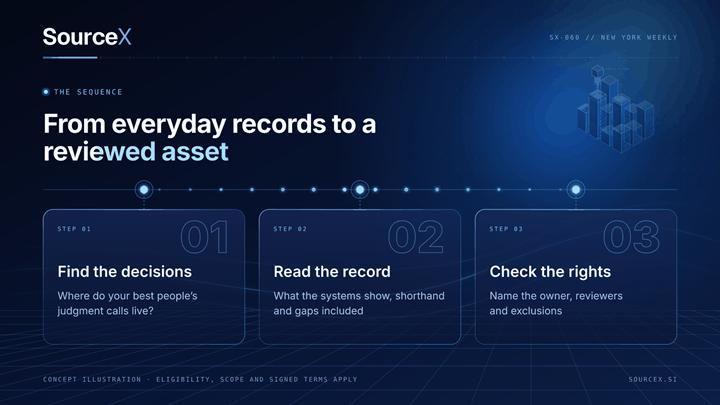
Try a quick test with your operations lead: rebuild one job from the system records alone, covering what came in, what was checked, what was decided and how it ended. If the story holds together, the archive explains your work; if it falls apart, it only proves that activity happened.
Years of history means years of mess
Businesses switch software, rewrite policies and rename things. Older records use different labels, attachments go missing, and a dispatch note written in shorthand in 2019 may mean nothing to anyone hired since.
Those limits do not automatically rule out a collection, but some may make a task unsuitable. Document them honestly; a narrower period or different use may be more defensible than claiming a complete history.
This is where your experienced staff matter twice. Your veterans are the decoder ring for your own archive. An outsider sees codes and abbreviations; the people who did the work know which ones meant trouble.
Does owning the server give you licensing rights?
Client information, vendor content and confidential correspondence often sit right next to company-created records. Having access to a system does not automatically give you the right to license what is in it.
Before anything is extracted, name the person authorized to decide, plus the people who will review rights and security. Some material will need to be excluded or specially prepared.
Removing names reduces exposure, but remaining context can still identify a person or a business. Understand that residual risk alongside any commercial terms.
Your veterans are the decoder ring for your own archive.
How does SourceX assess a company archive?
SourceX, headquartered in Los Angeles, licenses approved business records directly from companies for AI training and evaluation. The contract is with SourceX itself, which manages qualification, scope, rights review, preparation and payout under signed terms.
Its stated core fit is a company with at least 50 full-time employees at peak and several years of operating history. The initial fit check is a short set of questions about the company, with no uploads of client or employee files and no commitment.
SourceX publishes a maximum licensing fee for the largest enterprise datasets. A published ceiling is not a typical payout, a guaranteed offer or evidence of a New York business receiving any particular amount. A signed Dataset Deal Confirmation fixes the actual records, rights and compensation, and acceptance and Closing still have to follow.
Extraction and delivery require a signed Master Supplier Licensing Agreement, a signed Dataset Deal Confirmation and SourceX’s go-ahead. Signing does not guarantee a purchase: SourceX may decline the delivered data. Written acceptance and every Closing condition lead to a Closing Notice, then an invoice. Under standard terms, payment is due within 60 calendar days after SourceX receives a valid invoice, unless different terms are signed. Data that does not reach Closing earns no payment.
Does a license mean giving up the original records?
No. SourceX’s public terms say the company retains ownership of its original records. That does not make the grant over the de-identified dataset temporary or easy to reverse. Review:
● Permitted uses, including training, evaluation and use in products
● Exclusivity for AI training, for a term fixed in the Dataset Deal Confirmation
● Transferable and sublicensable rights, including onward distribution
● Perpetual, irrevocable de-identified data rights that survive termination once the fee is paid, with no obligation to untrain or delete models. The fee is usually one-time, with no royalties or usage fees.
What should an owner do first?
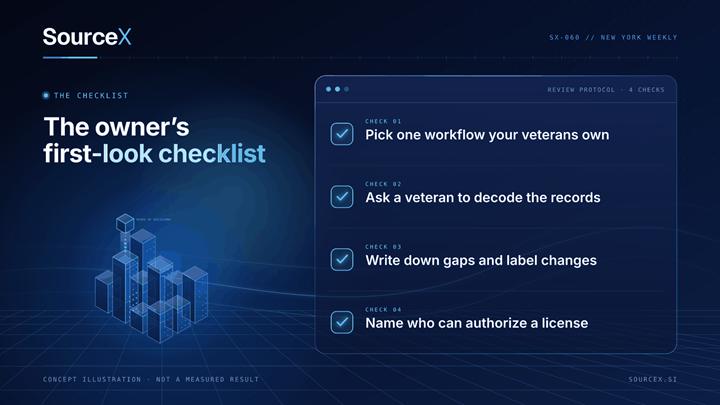
Ask one question at your next leadership meeting: where does this business record the decisions your best people make over and over? Put the answer on one page, with the systems named, the years covered and the person who could authorize a license.
That page is the start. AI revenue from business archives begins with a clear view of what your company spent years building without ever meaning to.
Bring that one-page inventory to SourceX‘s company fit check, with no client or employee files attached. If the fit is plausible, review the selected records, enduring rights and conditions for payment before signing.
About the founder
Noah Loul is a four-time founder and the founder and CEO of SourceX, which licenses business data directly from companies for AI training and evaluation. He previously founded B2B Rocket, acquired by Blackpearl Group. His work focuses on building permission-based data infrastructure for AI.