
By: Lian Nelson
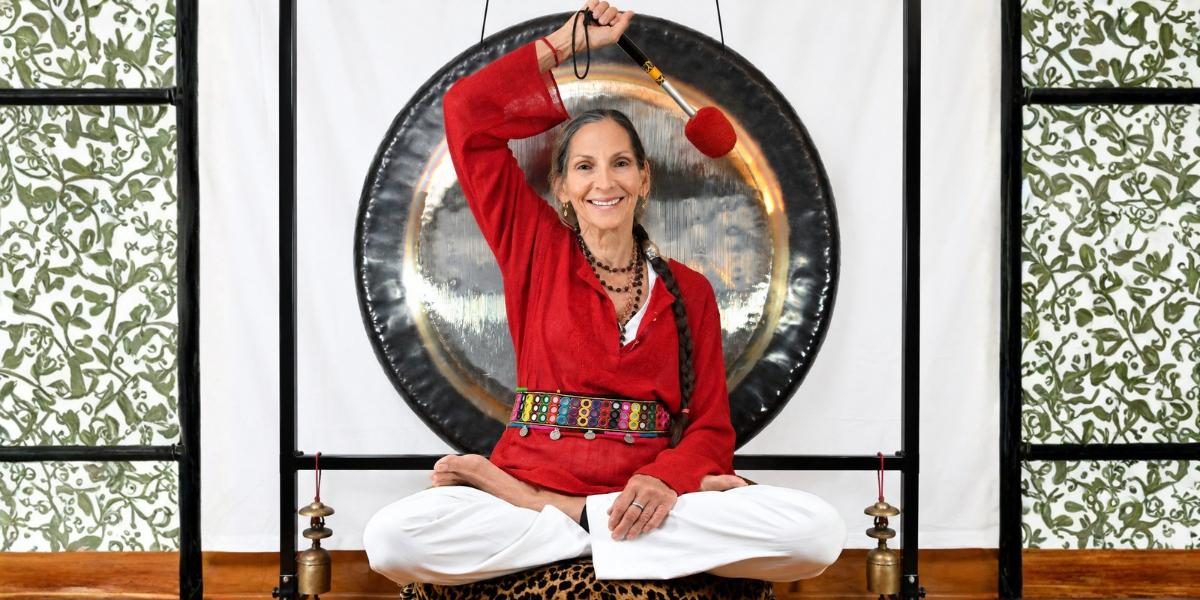
Music has a remarkable ability to reach people in ways that words sometimes cannot. A familiar melody can stir a memory, bring unexpected emotion to the surface, or offer comfort. For Rev. Laksmi Scalise, whose life has long been shaped by music and spiritual practice, the gong offers another way to explore that deeply personal connection.
But Scalise believes the most important part of a gong experience is not necessarily the instrument itself. It is the person playing it.
“I tell my students that the facilitator’s state of being is the real instrument,” she says.
Before welcoming participants, Scalise considers the thoughts, emotions, and intentions she brings into the room. A gong master whose work is also grounded in yoga, meditation, and pranayama, she approaches sound immersion as something more personal than a performance. Rather than trying to produce a particular response, she hopes to create an atmosphere where people can explore their own experiences.
“We do not fix or heal anyone!” Scalise says.
She does not see herself as responsible for producing a particular outcome. Instead, she believes her role is to offer a compassionate, steady presence while allowing each participant the freedom to respond in their own way.
Long before the gong became central to her life, Scalise had begun a deeply personal journey through yoga, meditation, and breathwork. These practices shaped her spiritual understanding and the way she connected with herself and the world around her. Music had always touched her deeply, but in 2011, when she attended a gong bath led by Gong Master Don Conreaux at New York’s Integral Yoga Institute, something resonated in a way she hadn’t experienced before. What began as a single encounter with an extraordinary instrument would grow into one of the defining passions of her life.
When Conreaux offered a training, Scalise began assisting him through Integral Yoga. The trainings continued twice a year, and she eventually became one of his senior instructors. Their last training together at Integral Yoga took place in 2023.
Those years strengthened her technique and her conviction that playing the gong involves more than mastering its sounds. She continues to practice meditation and pranayama daily, cultivating what she describes, within her spiritual understanding, as a stable, loving presence.
Central to that practice is a personal goal: to maintain what she describes as a high energetic frequency while helping participants explore and potentially elevate their own. For Scalise, frequency is not simply about sound or vibration, but also about the quality of one’s thoughts, emotions, and presence. She believes that by cultivating a positive, loving state within herself, she can create an environment that encourages others to connect with those same qualities.
“My self-preparation has been going on for years,” she says.
For participants, the experience begins when the first sounds fill the room. The gong can produce delicate tones as well as powerful, enveloping resonance, which different listeners may experience in different ways.
“The Gong has the ability, if played skillfully, to dissolve thought, to quiet the mind, almost like an instant meditation!” Scalise says.
Over the years, participants have shared a wide range of responses with her. Some describe feeling lighter or more peaceful. Others say emotional concerns seemed less overwhelming. A few have described experiences involving deceased loved ones, which they interpreted as comforting.
One participant told Scalise that he had avoided activities unless he believed he could excel at them. After a session, he decided to try something simply for the pleasure of doing it.
Another, a Vietnam veteran, told her he had slept through the night after a session, something he said he had not experienced since the war.
These personal accounts are not clinical evidence of therapeutic benefits. They do, however, illustrate how differently participants interpret their experiences.
Scalise also encourages people to notice their internal dialogue, particularly thoughts shaped by fear, self-criticism, or assumptions about what they cannot do. She believes greater awareness can lead to a more compassionate understanding of oneself.
“Our True nature can be spoken of in a variety of ways. I speak of it as Happiness, Contingent on nothing External, Ongoing and Always available,” she says.
For Scalise, happiness is not solely dependent on favorable circumstances or external achievements. She sees it as an inner quality people may become more aware of through reflection and spiritual practice.
Her philosophy extends to creativity. She is fascinated by artists, musicians, and inventors who describe inspiration as arriving unexpectedly. In her view, loosening the need to control every outcome can make room for new ideas and experiences.
At Official Ritual in New York City, Scalise offers gong experiences in a welcoming environment. Her Gong Temple sessions are scheduled for Mondays and Fridays at 7:15 and Wednesdays at 5:30.
For those attending, the gong itself may first capture their attention: its size, rich resonance, and shifting tones. Yet behind each session is a teacher whose relationship with the instrument has been shaped by years of study and personal spiritual practice.
Scalise cannot know what someone will feel when the final vibrations fade. One person may leave with a sense of calm, another with a new perspective, and someone else simply with the memory of an unusual musical experience.
Perhaps that is what makes her approach so personal. After years devoted to understanding an extraordinary instrument, Scalise continues to place the greatest importance on something far less visible: the care, attention, and humanity of the person holding the mallet.
To learn more about Rev. Laksmi Scalise and her gong immersions, visit her website or follow her on Instagram.