
By: Jaden Pham
The Illusion of Power
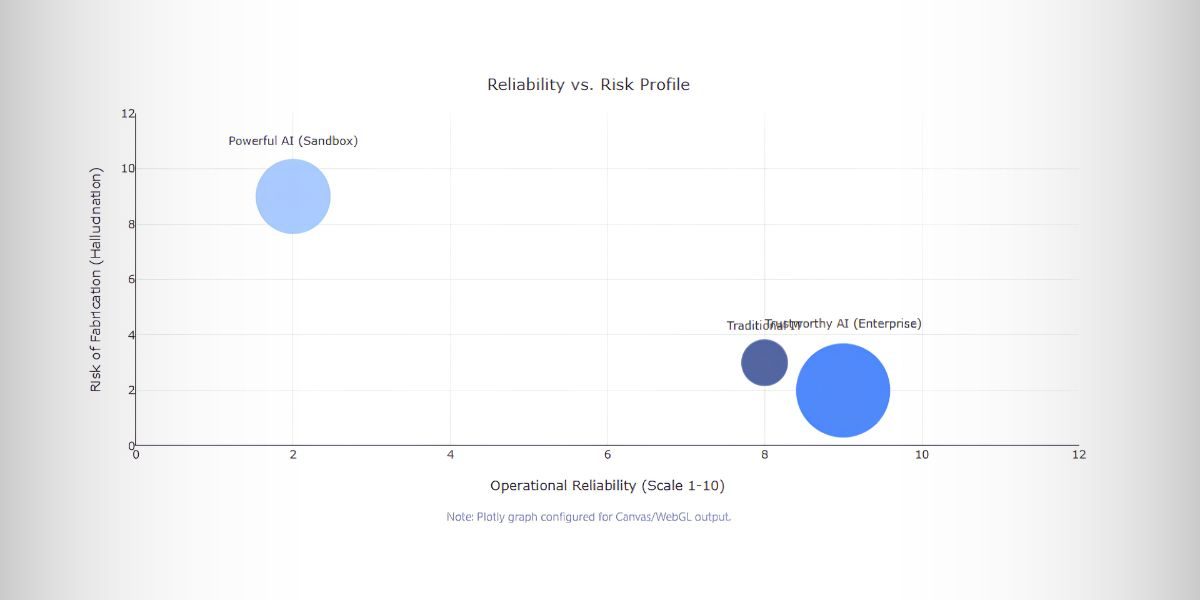
Enterprise boards are often captivated by raw computational power, judging large models largely on benchmark scores and polished demos. However, this may be the wrong test. A powerful model can look impressive in an isolated sandbox environment. Yet, when deployed into a messy, undocumented legacy system without guardrails, it can quickly become a liability rather than a competitive edge.
A high-powered model operating without governance does not necessarily solve fundamental business problems. Instead, it may produce confident-sounding mistakes at an accelerated pace. Without clear guardrails, a powerful AI model can operate like a fast car with no brakes: the horsepower itself is not the flaw, but the missing brakes are. Enterprise leaders may need to prioritize architectural control over raw power, or the deployment itself can become the point where operations break.
The Black-Box Liability in Legacy Systems
AI adoption frequently stalls for many enterprises at a predictable roadblock: legacy systems that organizations no longer fully understand. According to Gartner data cited in the article, 73% of CIOs cite legacy infrastructure as the single biggest barrier to digital transformation. In many established companies, the foundational rules running the business remain buried in decades-old COBOL code, aging databases, or the institutional memory of engineers who have long since departed.
Pointing a generic AI model at an undocumented system to explain code logic can produce poor results. Without the surrounding business context behind the code, the model may confidently fabricate answers. Far from being a rare failure mode, this outcome can become a recurring risk. Consequently, enterprises may find themselves paying senior engineers to spend hundreds of hours manually verifying AI-generated outputs. Rather than accelerating workflows, this practice can introduce a new operational bottleneck on top of the old one, reducing the time savings AI was intended to deliver.
The Engineering of Trust
Mitigating these risks requires shifting organizational focus from how powerful a model is to how reliable it proves to be. Trust in this context is neither a marketing claim nor an abstract ethics pledge. It is a tangible property engineered directly into the system, much like integrating a security lock or a smoke detector. Building this environment requires two core architectural pillars designed to protect the broader business asset.
Verifiable Outputs
Every answer the AI generates should be checkable rather than just plausible. If a model claims a specific business rule operates a certain way, engineers should be able to verify that claim quickly rather than spending a week hunting through the codebase. Unverified, incorrect answers do not just drain engineering hours. They can also create compliance risks or customer-facing outages.
Defined Boundaries
The model requires a strict operational rulebook that spells out established parameters. This setup forces the system to flag what it does not know instead of quietly guessing, since incorrect assumptions can create financial and reputational consequences.
Trust and System Velocity
Many executives assume that rigorous governance checks and human sign-offs inevitably slow a modernization project down. In practice, strong governance can support speed when it prevents avoidable rework. Industry benchmarks cited in the article indicate that traditional methods of modernizing a legacy system can take 18 to 36 months on average, relying on manual code reviews, handwritten documentation, and spot-sampled data verification.
By contrast, industry data cited in the article suggests that AI-assisted approaches built with robust traceability may compress those timelines by 40% to 50%. This speed is achieved not by skipping critical checks, but by executing the same compliance work faster and with less operational risk. Legacy architecture can be understood in weeks instead of months, system documentation can exist earlier in the project, and structural problems can be caught continuously rather than discovered after a costly launch.
Flagging complex anomalies early and assigning human experts to the riskiest variables can help prevent the rework and production failures that often drive multi-year overruns. Trust is not simply an operational speed bump. It can be the mechanism that allows enterprises to move faster with more control. Once engineering teams can mechanically verify that an AI’s output aligns with business logic, the need to check every line by hand may be reduced. Consequently, governance can become a catalyst for deployment speed rather than the asset traded away to achieve it.
Governing AI for Scale
The race for digital leadership in the Asia-Pacific region may not be won simply by the organization with the largest AI budget. It may be won by organizations that build secure, traceable, and reliable pipelines for getting AI models into active production.
In highly compliant environments like Singapore, managing this transition successfully demands rigorous engineering discipline. Enterprise platforms require a framework capable of turning unpredictable models into secure corporate assets. Technology transformation partners, such as Vinova, highlight that managing core infrastructure under strict regulatory rules for 16 years provides the kind of technical track record needed to navigate these complexities. When digital transformation is built on architectural precision instead of raw horsepower, the resulting deployment can become more than an impressive sandbox demo. It can become an asset the enterprise is better positioned to run on.
About the Author
Jaden Pham is a writer at Vinova, a Singapore-based technology transformation partner recognized on The Straits Times and Statista’s Singapore’s Fastest-Growing Companies list for three consecutive years. Vinova is ISO 27001-certified and specializes in building secure, traceable systems for regulated enterprise and government clients across the region.