
By: Daniel Mercer
Every great rock song is really about belief.
Not belief in fame. Not belief in the charts or the next record deal or the mythology that rock and roll has spent seventy years carefully building around itself. The best songs are about believing in something that survives all of that. A melody. A memory. A six-string guitar slung over a shoulder as the sun comes up after another night of chasing something impossible.
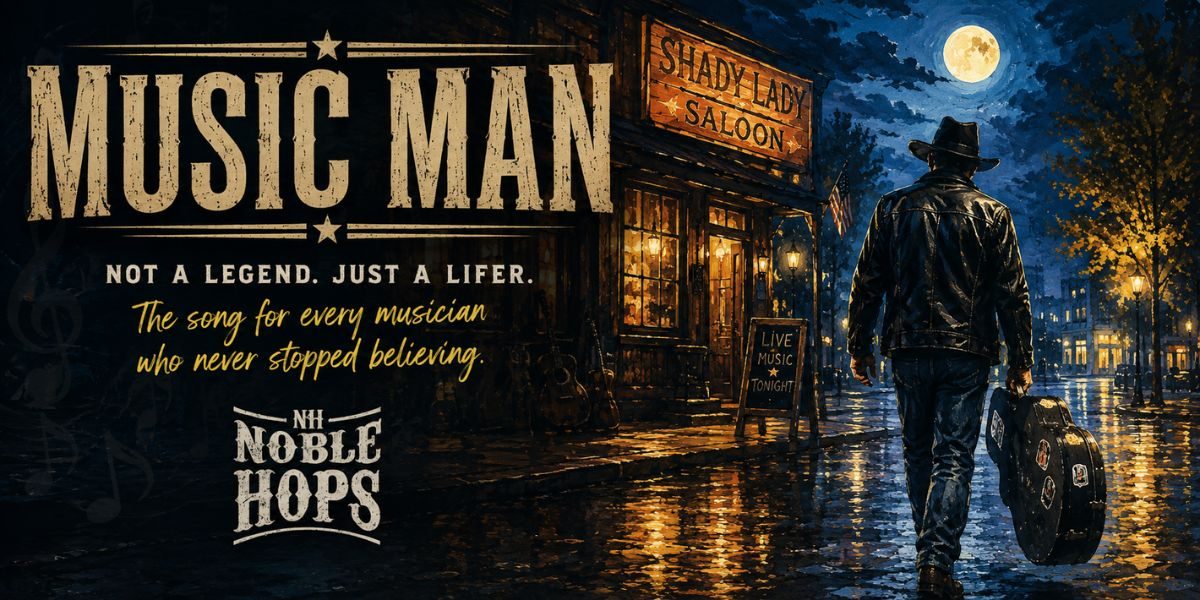
That’s where Noble Hops’ “Music Man” lives.
Listening to this song feels like stumbling into a roadside bar just before closing time, when the crowd has thinned, the bartender has stopped pretending to be impatient, and the musician onstage isn’t performing anymore. He’s remembering. There’s a beautiful difference between those two things, and Noble Hops understands it instinctively.
The Western Pennsylvania quartet has never sounded interested in reinventing rock music. Instead, they remind us why we fell in love with it in the first place.
Written by vocalist and guitarist Utah Burgess, “Music Man” begins with a line that quietly dismantles decades of rock mythology.
“I didn’t sell my soul for rock and roll, but it became my way of life.”
It’s almost conversational. No drama. No grand gesture. Just a simple acknowledgment that sometimes life doesn’t happen because of one defining moment. Sometimes it happens one gig at a time.
That’s the heart of this song.
The narrator isn’t Bruce Springsteen racing toward salvation or Tom Petty refusing to back down. He isn’t chasing immortality. He’s carrying his guitar into another bar because it’s what he was meant to do.
And somehow, that’s even more romantic.
Burgess writes with the kind of empathy that can only come from experience. The details- empty bars, beat-up guitars, old relationships left behind- never feel manufactured. They aren’t there to create a rugged image. They’re simply part of the scenery. Like cracked highways or faded motel signs, they tell you where you’ve been without needing to explain why.
His vocal performance carries that same authenticity. There’s a rough warmth to his voice that recalls the storytellers who understood that emotion doesn’t come from vocal gymnastics. It comes from believing every word you’re singing.
Behind him, Noble Hops build the kind of arrangement that lets stories breathe.
Tony Villella’s guitar work is beautifully restrained, favoring melody over spectacle. His leads don’t interrupt the narrative. They illuminate it. Johnny “Sleeves” Costa anchors the song with bass lines that move patiently beneath the surface, while Brad Hulburt’s drumming provides exactly what the song requires: motion without distraction.
Nothing here feels rushed.
That’s becoming increasingly rare.
Produced by Jazz Byers at Pittsburgh’s Rattle Clack Studio, “Music Man” resists the temptation to polish away every imperfection. You can almost hear four musicians looking at one another across the room instead of staring into computer screens. The recording has space. Air. Humanity.
The chorus (“Music Man, playing across the land”) arrives with the comforting familiarity of an old friend. It isn’t trying to surprise you. It’s inviting you in. Every repetition feels less like a hook than a reminder that identity isn’t something you achieve once. It’s something you choose every day.
What makes “Music Man” especially affecting is its complete lack of cynicism.
It would have been easy to write this song as a lament about what the music business takes away. Instead, Noble Hops writes about what music gives back. Even after the disappointments, the narrator still loves to play. That simple truth transforms the song from autobiography into affirmation.
Near the end comes the lyric that lingers longest:
“The time will come when I’ll be gone, but my songs they will live on.”
There’s something wonderfully humble about that sentiment. It isn’t spoken by someone expecting statues or Hall of Fame inductions. It’s spoken by someone hoping that somewhere, years from now, another musician might pick up a guitar because these songs once mattered to them.
Maybe that’s how music has always survived.
Not through celebrities.
Through believers.
There are echoes of countless American storytellers woven into “Music Man.” You hear the working-class dignity of heartland rock, the lived-in honesty of Americana, and the timeless optimism that has always existed beneath rock and roll’s swagger. Yet Noble Hops never sound derivative. They understand that influence isn’t imitation. It’s conversation.
By the time the final chorus fades, “Music Man” has become something larger than a song about musicians. It’s about anyone who’s devoted themselves to a calling that doesn’t always make sense to the outside world. Anyone who’s chosen passion over practicality. Anyone who’s kept showing up long after common sense suggested they stop.
Rock and roll has always needed its superstars.
But it has always depended on its lifers.
With “Music Man,” Noble Hops have written an anthem for those who may never grace arena stages but whose commitment keeps the spirit of live music alive, one song, one crowd, and one long drive home at a time.
Those are the stories worth telling.
And Noble Hops tell this one beautifully.