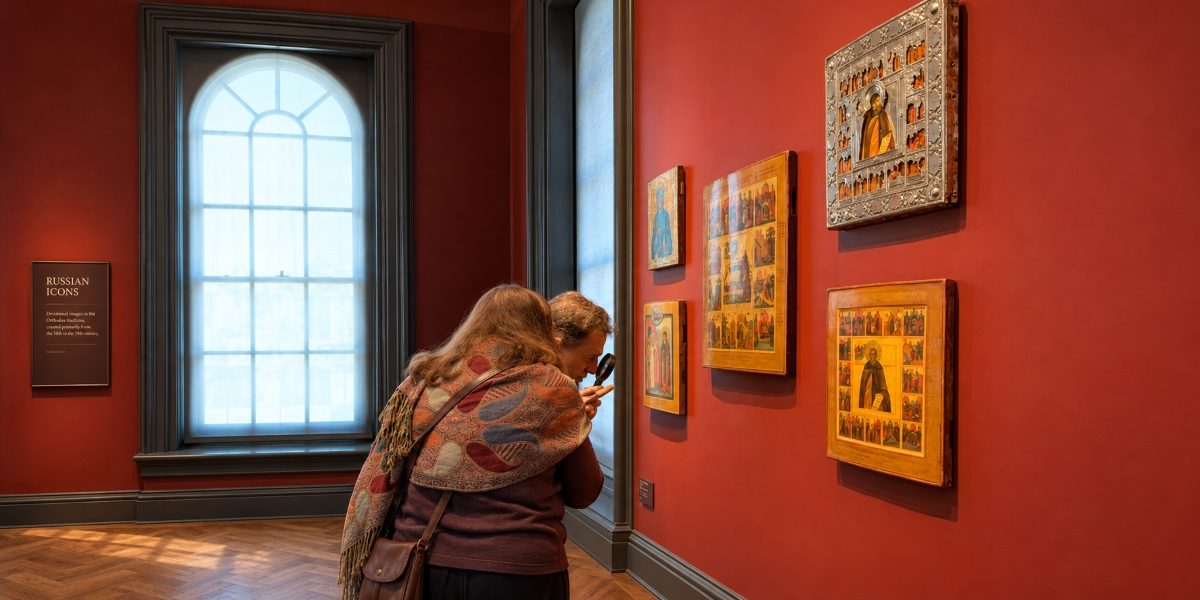

After a major exhibition in Massachusetts, the Oleg Kushnirskiy Collection is preparing for its next chapter, with new museum projects and an expanded catalog bringing three centuries of icon painting to a wider audience.
For centuries, Russian icon painting was shaped not only by faith, but also by persecution, family workshops, trade, and an extraordinary demand for images of the “old” Russia. The Oleg Kushnirskiy Collection, based in New York, brings many of these stories together.
Its latest chapter unfolded in Clinton, MA, where the Icon Museum and Study Center presented Icons: Old Believers and Their World from February 27 through August 30, 2026.
The exhibition brought more than thirty icons from the Kushnirskiy Collection into dialogue with rarely exhibited works from the museum’s own holdings. At its center was the Old Believers’ tradition. After rejecting reforms introduced into the Russian Orthodox Church in the late seventeenth century, Old Believer communities preserved older religious practices and developed distinctive artistic traditions.
The Clinton exhibition showcased Old Believer iconography as a symbol of identity and resilience, with detailed compositions resisting Western artistic influences like naturalism, chiaroscuro, and ornamental styles. Despite isolation, Old Believers developed significant artistic centers in remote villages such as Palekh, Mstyora, Kholuy, Guslitsy, and Vetka, building a successful business.
Eighteenth-century workshops, passed down through generations, established specific iconographic schemes reflecting their theological and aesthetic views. They were known for both icon painting and restoring ancient icons, with some works resembling medieval examples due to deliberate imitation of older techniques, styles, and aged effects to appeal to a market valuing “ancient piety.” Their extraordinary craftsmanship and unique artistic language met diverse commissioners’ needs.
The combination of narrative scenes, colorful, festive compositions with peculiar decorative detail, and mastery of miniature-like precision was what attracted Oleg Kushnirskiy to these pieces. His collection now contains 60 icons dating from the mid-seventeenth to the early twentieth century, with important groups from Palekh, Mstyora, Kholuy, Guslitsy, and Vetka. An icon of no more than 12 inches in height can contain dozens of scenes, saints, architectural details, and episodes from the lives of Christ and the Virgin.
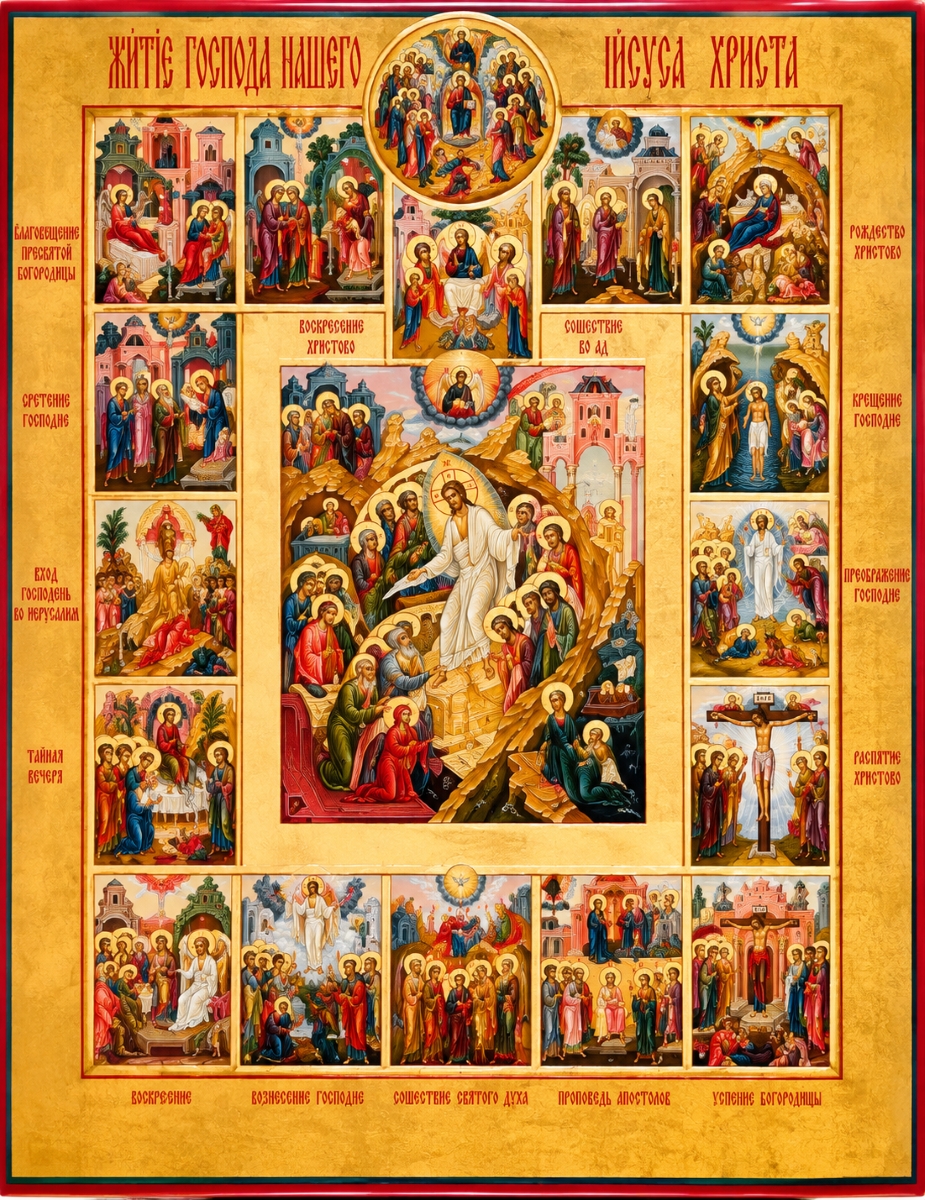
Oleg Kushnirskiy sees the collection as a living entity, coherent and consistent in its focus: “I wanted the viewer to perceive as much narrative as possible,” he explains. The backbone of his collection follows the iconographic scheme of the Resurrection, the Descent into Hell, the so-called polnitsa (full-cycle icon), developed in Palekh at the end of the 18th century. This iconography became very popular in the 19th century. An accessible object for prayer, it displays the entire cycle of the main liturgical year events to the viewer, and for Kushnirskiy, it became one of his favorite themes.
Among the Oleg Kushnirskiy Collection highlights is also a complete set of twelve Palekh Menaion icons, containing saints for each month of the liturgical year. Complete sets are rare, making this group unique in its value and particularly important for understanding the work of Palekh painters.
From A Private Passion To A Public Collection
Oleg Kushnirskiy is a New York-based collector of Russian icons and a professional fine art photographer. Born to a Jewish family in Khmelnytskyi, Ukraine, he moved to Leningrad (St. Petersburg) at a young age, where he worked as a photographer for private collectors and institutions, including the State Hermitage Museum. Born in the era of the romantic search, when the icons unwanted by the Soviet state were found by enthusiasts in abandoned villages covering window openings, and private collecting was semi-underground, Oleg Kushnirskiy fell in love with the beauty of Old Russian art, traveled extensively through the regions, and gathered his first collection of icons.
In 1992, Oleg Kushnirskiy emigrated from St. Petersburg to the United States, leaving his first collection behind in Russia. But his passion for icons didn’t end there. In New York, he continued working as a professional art photographer at the famous Chelsea flea market, a major meeting place for dealers and collectors from around the world. Gallery and antique-shop owners hired him to photograph their collections, and Kushnirskiy would arrive before opening to study what had come in.
That experience eventually led him to open his own antique business and later build Fine Art Shippers, a New York art logistics company. His professional experience, combined with an increasingly detailed knowledge of Russian art, gave him access to dealers, auctions, and private collections through which he continued to acquire icons.
For years, the icons remained in storage at Fine Art Shippers’ state-of-the-art facility in Upper Manhattan. However, Oleg Kushnirskiy always wanted to share his knowledge and the cultural heritage he saved with the audience. An icon is, after all, meant to be encountered. Its significance does not exist only in a database or behind the doors of a private collection. It changes when viewers begin to look at it, discuss it, study it, and bring their own experiences to it. That idea has become central to the Kushnirskiy activities.
In 2024, all sixty works were exhibited together for the first time at The Museum of Russian Art (TMORA) in Minneapolis. The Clinton exhibition in 2026 is the collection’s second major museum presentation. Fine Art Shippers also supported both exhibitions and handled the transportation of the fragile works.

The collection’s museum schedule continues. A major presentation is planned for the Georgia Museum of Art in Athens, GA, in 2027, followed by exhibitions at specialized icon museums in Europe, including institutions in Recklinghausen, Frankfurt, and Kampen.
A Book That Opens The Collection Further
The collection is accompanied by a substantial scholarly catalog, Russian Icons: The Oleg Kushnirskiy Collection, published by Merrell. The large-format volume presents the collection’s 60 works with more than 400 images, including close-ups and details that allow readers to examine the icons almost as closely as they could in person.
The book addresses a period often overshadowed by medieval Russian icon painting. That is one of the unusual things about the Kushnirskiy Collection. Its story is not only about saving old icons. It is also about discovering how much happened after what is treated as the “golden age” of Russian icon painting. The catalog traces the tumultuous path icon painting took from Russia to America, full of incredible collisions and twists. Articles by the most prominent specialists in the field delve into how this forgotten heritage found its way from village workshops, through the Soviet period and the New York art market, into American museums and a growing international research project.