

Outsourced or virtual bookkeeping for a small business typically costs about $200 to $700 or more per month in 2026, according to NerdWallet’s pricing guide. In general, the price depends on transaction volume, monthly expenses, and how much the service covers beyond categorizing transactions, such as payroll, bill pay, or accrual accounting.
That range is wide, and two quotes for the same business can look very different. For a New York business owner comparing proposals for the first time, the useful question is not only what a service costs, but what the monthly fee actually buys.
What Does Outsourced Bookkeeping Cost at Each Stage?
The table below groups typical prices by business stage. The ranges reflect NerdWallet’s 2026 guide, which groups prices by service level. The stages are a guide to which level a business typically needs, and the inclusions describe what a reasonable proposal at each level should cover. Individual providers vary.
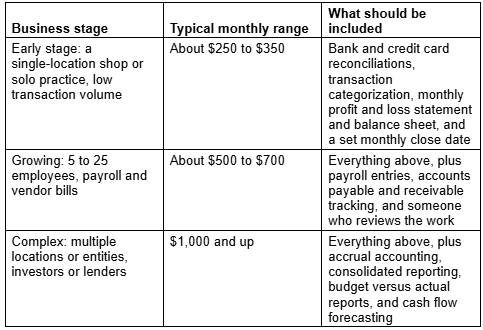
Consider three New York-focused examples. A Brooklyn coffee shop with one location, a small staff and a single point-of-sale system that deposits sales daily usually fits the first row. A Manhattan design agency with 15 employees, client invoices, and contractor payments fits the second. A retailer with stores in Queens and an online shop, plus a bank loan that requires quarterly statements, sits in the third.
What Drives the Price Up?
Bookkeeping prices rise with the amount of work and the level of review. The most common drivers are:
- Transaction volume and number of accounts: More bank accounts, cards, and payment platforms mean more reconciliations.
- Payroll and bill pay: Running payroll entries and managing vendor payments adds recurring work each month.
- Accrual accounting: Recording revenue when it is earned and expenses when they are incurred takes more effort than cash-basis books, and lenders and investors often expect it.
- Multiple entities or locations: Each entity needs its own books, and the results often need to be combined.
- Sales tax tracking: Businesses that collect New York sales tax, especially across online and in-store sales, need those amounts tracked each month accurately.
- The level of review: A service where an experienced accountant or controller reviews and approves each month’s close costs more than one that only enters data.
What Should Be Standard, and What Usually Costs Extra?
At almost any price, a monthly bookkeeping service should include reconciled bank and card accounts, categorized transactions, monthly financial statements, and a clear date by which each month’s books will be closed. Owners should also be able to reach someone with questions within a stated response time.
Several services are commonly priced separately:
- Catch-up or cleanup work: Books that are months behind are usually quoted as a one-time project, separate from the monthly fee.
- Tax preparation and filing: Bookkeeping produces the numbers a tax preparer needs, but filing is typically a separate service.
- Financial planning and forecasting: Budgets, cash flow forecasts, and scenario models are often add-ons.
- Ecommerce integrations: Reconciling marketplace and payment platform payouts can carry an extra fee.
How Does Outsourcing Compare With Hiring In-House?
For context, the median pay for bookkeeping, accounting and auditing clerks was $50,670 a year in May 2025, according to the U.S. Bureau of Labor Statistics. That is roughly $4,200 a month before payroll taxes, benefits, and software. Costs run higher in New York. In the New York-Newark-Jersey City metro area, office and administrative support workers earned a mean of $28.72 an hour in May 2025, compared with $24.79 nationally, about 16% more.
An in-house bookkeeper makes sense once the volume of work fills a full-time role. Until then, many small businesses pay for a portion of a team’s time through an outsourced service.
What Are the Red Flags in a Bookkeeping Proposal?
A low monthly price is not a good deal if the scope is unclear. These signs deserve a closer look before signing:
- No defined deliverables: The proposal should list which reports arrive each month.
- No close date: If a provider will not commit to when the books will be finished, reports may arrive too late to be useful.
- A price given without questions: A provider that quotes without asking about transaction volume, payroll, or the number of accounts may raise the price later.
- “Unlimited” without a scope: Unlimited support is only meaningful when the services it covers are spelled out.
- Books kept in the provider’s own system: If the records do not live in the owner’s own accounting software, leaving the provider can be difficult.
- Unclear terms: Owners should ask about contract length, setup or onboarding fees, how price changes are handled, and what happens if they cancel early.
- No one reviewing the work as the business grows: If no one checks the bookkeeper’s work once payroll, bills, and more accounts are added, errors tend to surface at tax time.
Why Does Published Pricing Make Comparison Easier?
Some bookkeeping firms share prices only after a sales call, which makes comparison harder. Others publish their plans online. One example is CoCountant, a controller-led bookkeeping service for startups and growing businesses in the US. Controller-led bookkeeping is a model in which a controller reviews and signs off on every monthly close.
CoCountant’s published pricing starts at $160 a month for its Launch plan, with Scale and Command tiers above that. Fees are based on a business’s monthly expenses rather than transaction counts. The company also publishes its service levels: a 4-hour response time on Launch and Scale and 2 hours on Command, and a month-end close within 15 days on Launch and 10 working days on Scale and Command. Books are kept in the client’s own accounting software account.
The Bottom Line
Owners comparing bookkeeping quotes in 2026 should expect to pay a few hundred dollars a month for basic service and more as payroll, accrual accounting, and review are added. The better comparison is not price alone but what each quote includes: the reports, the close date, the response time, and who checks the work.
Disclaimer: This article is provided for general informational and educational purposes only and should not be considered financial, accounting, tax, legal, or professional advice. Bookkeeping costs, service levels, and pricing structures vary by provider, business size, location, transaction volume, accounting method, and the services included. Any prices or comparisons mentioned are examples or estimates and may change over time. Business owners should evaluate their specific bookkeeping and accounting needs and consult a qualified accountant, bookkeeper, tax professional, or other appropriate advisor before making financial or business decisions. The inclusion of any company, service, or pricing information does not constitute an endorsement or guarantee of its services, results, or suitability for a particular business.