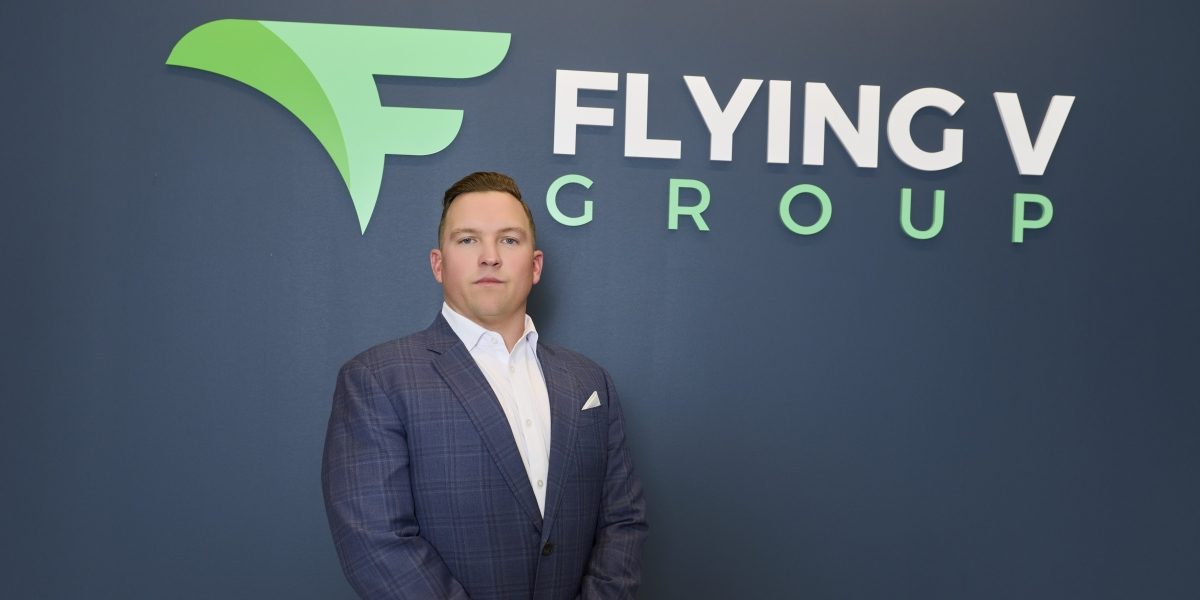

Every founder has sat in a strategy meeting demanding more leads. More pipeline. More demos booked. The pressure is real, and the instinct to throw money at lead generation is understandable. But Robb Fahrion, CEO and Co-Founder of Flying V Group, a digital marketing and advertising agency, argues that most businesses are solving the wrong problem entirely.
“A lot of companies don’t have a lead generation problem. They have a foundation problem, a clarity problem. They have no idea how their offer is different.”
It is a direct perspective, but one that raises an important point. When a business cannot clearly explain who it is targeting, what outcome it helps deliver, or why a buyer should choose it over other companies offering a similar service, lead generation can become difficult to evaluate. Traffic, ads, and outreach may bring attention, but weak positioning can make that attention harder to convert.
Robb has seen this pattern across several industries Flying V Group serves, including healthcare, real estate, and automotive. Some companies grew through referrals and warm introductions, then later wanted to scale through outbound campaigns or paid media. In those cases, the company may not have formally defined its customer because it previously relied on personal relationships and existing networks. That instinct does not always translate clearly into campaign strategy.
The fix, in Robb’s view, is not simply another funnel. It starts with clarity, followed by careful testing.
Flying V Group’s approach begins with what the client believes to be true about its customer, then builds a structure to validate or challenge that belief. That can include identifying channels, creating campaign assets, and testing messaging in the market. Who responds? What message creates engagement? Are there audience segments the client may not have considered?
“We want to let the data validate the assumptions or prior models. Let the market validate who the audience is, what the message is, what the value is.”
This approach also affects how expectations are set. One of the more difficult conversations in any agency-client relationship is timing. A founder who built a business through referrals may expect digital marketing to produce quick results. But if the primary channel is SEO, or if the sales cycle stretches several months, that expectation can create pressure to change direction too early. It may lead to premature pivots, abandoned strategies, and the assumption that marketing is not working before enough information has been gathered.
Robb is direct about this with prospects. SEO often requires months of consistent work before meaningful patterns can be evaluated. Paid media also needs a budget that reflects the competitiveness of the category. If a company is spending far less than larger competitors, reduced exposure may reflect budget limitations rather than a failure of the channel itself.
There is also the question of offer structure. For cold audiences, a lower-friction front-end offer may help build trust before asking for a larger commitment. For warmer inbound traffic, a more direct path to a premium offer may be appropriate. The channel informs the strategy, and the strategy has to match where the buyer is in the decision-making process.
None of this is especially complex. But it does ask founders to answer some uncomfortable questions before opening an ad account or hiring a sales team. Does the company clearly know who it is selling to? Can it describe the specific outcome its clients are looking for? Is the offer differentiated in a way the market can recognize, or only in a way that feels meaningful internally?
Businesses with stronger marketing foundations may be better positioned to scale with more discipline and efficiency. Those that skip the foundational work and move straight to execution may find that results do not match expectations.
Fahrion’s point is not that lead generation does not matter. It is that lead generation without clarity can become expensive noise. When the foundation is stronger, marketing efforts may become easier to test, refine, and improve.