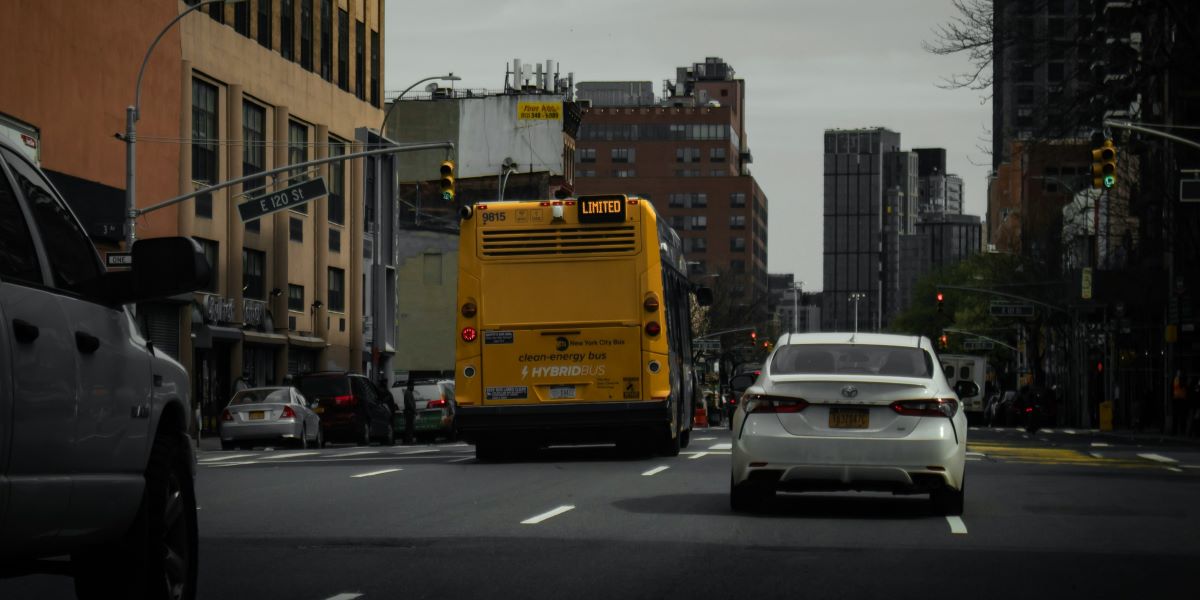

Mayor Zohran Mamdani and Governor Kathy Hochul on Wednesday unveiled a joint city-state initiative to overhaul New York City’s bus network, committing more than $850 million in combined city funding to speed up service across 50 priority corridors in all five boroughs. The plan, called “Next Stop: Fast Buses, Better Service,” targets a 20% increase in bus speeds through new bus lanes, traffic signal upgrades, expanded enforcement, and a major fleet replacement program.
Key Takeaways
- The plan targets 50 priority corridors, including the city’s 25 slowest bus routes, with a goal of saving riders up to six minutes per trip.
- The MTA will purchase roughly 2,500 new buses, replacing 40% of its aging fleet, funded through the MTA’s $68 billion 2025–2029 Capital Program.
- The city is committing $254 million in expense funding and over $600 million in capital funding over five fiscal years to deliver on the plan’s infrastructure goals.
- Five rapid bus corridors in Brooklyn, Queens, and the Bronx will feature dedicated protected bus lanes, all-day frequent service, and upgraded stations modeled on leading rapid bus systems.
- Automated Camera Enforcement will expand to 25 additional routes each year in 2026 and 2027, with 200 new stationary bus lane cameras installed by 2027.
What Does the “Next Stop” Plan Actually Include?
The 51-page blueprint lays out a corridor-by-corridor strategy for transforming how New York City’s bus system operates. New York City riders take 2.75 million trips on city buses each day, making the system the busiest in the nation — larger than the bus systems of Los Angeles, Chicago, San Francisco, and Philadelphia combined. Despite that scale, New York’s buses remain the slowest of any major U.S. city, averaging just eight miles per hour.
The plan’s central mechanism is a combination of physical street redesigns and operational changes that compound over time. Transit signal priority, queue jumps, center-running protected bus lanes, and all-door boarding — which the MTA has committed to implementing in 2027 alongside the full transition to tap-and-ride payment — are all part of the package. The city’s Department of Transportation selected the 50 priority corridors by analyzing where riders face the sharpest delays, and the plan front-loads improvements on corridors that double as lifelines for communities with limited subway access.
Why Is the City-State Partnership Significant?
The structural split that governs New York City transit — where Albany controls the buses through the MTA and City Hall controls the streets through DOT — has historically been a source of gridlock in policymaking, not just traffic. MTA Chair and CEO Janno Lieber was unusually blunt about the change in dynamics at the announcement. Lieber said the MTA had sought to address sluggish bus speeds for years but did not have a willing partner in city government under the prior Adams administration.
That friction has now been replaced by what both sides describe as daily operational coordination. Mayor Mamdani framed the fiscal commitment as proof of follow-through, pointing to $254 million in expense funding and more than $600 million in capital funding over the next five fiscal years. DOT Commissioner Mike Flynn said the two agencies are developing shared standard operating procedures and measurable performance indicators to avoid the pattern of announcements without accountability that has plagued previous bus improvement pledges.
What Are the Five Rapid Bus Corridors?
The plan designates five corridors for a next-generation rapid bus treatment that goes well beyond painted lanes. These corridors were selected because they connect New Yorkers to jobs, schools, subway service, and major destinations while supporting current and future housing and economic growth. Flatbush Avenue in Brooklyn leads the rollout, with the first phase already under construction featuring center-running bus lanes and concrete boarding islands. The mayor set a 2030 completion target for Flatbush and named four additional corridors: Northern Boulevard in Queens, 116th Street in Manhattan, White Plains Road in the Bronx, and Utica and Church Avenues in Brooklyn. Victory Boulevard on Staten Island was also cited for dedicated rapid service and infrastructure improvements.
The Flatbush corridor alone carries more than 130,000 riders daily and has been slowed by some of the city’s most congested stretches. Future phases will include fully separated bus lanes, station-style platforms with level boarding, and guaranteed frequent service — design features modeled on bus rapid transit systems in cities like Bogotá and Seoul.
How Does Enforcement Fit Into the Strategy?
Bus lanes are only as effective as the enforcement keeping them clear. Automated Camera Enforcement has already increased bus speeds by as much as 30% while reducing collisions by 20% on corridors where it operates. The plan scales that tool aggressively, with bus-mounted cameras expanding to 25 new routes per year and 200 additional stationary cameras going live by 2027. The NYPD will also expand targeted bus lane enforcement from 14 to 20 corridors beginning this year.
The enforcement push arrives alongside a pair of completed Midtown Manhattan projects that illustrate what dedicated bus infrastructure can deliver. The city announced this week that new double bus lanes on Madison Avenue now run from East 23rd Street to East 42nd Street, serving 92,000 daily riders on 34 routes, while offset bus lanes on Lexington Avenue between East 52nd and East 60th Street benefit another 71,000 riders. A 2019 offset bus lane conversion on the Lexington corridor north of 60th Street boosted bus speeds by 26% and cut pedestrian injuries by 35%, according to DOT data — a result the city is banking on replicating at scale.
What Does Faster Bus Service Mean for New York City’s Economy?
The economic argument for faster buses extends well beyond rider convenience. A Partnership for New York City report estimated that traffic congestion costs the city’s economy $20 billion per year in lost productivity for businesses and individuals. The MTA has separately estimated that the average New Yorker loses 117 hours and nearly $2,000 annually to traffic delays. Bus riders, who skew disproportionately toward lower-income and essential workers, bear the sharpest end of that cost.
DOT Commissioner Flynn framed bus speed improvements as a direct affordability measure, noting that delays cost riders wages when they arrive late and force some outer-borough residents into car ownership — absorbing thousands of dollars annually in insurance, maintenance, and fuel — simply because bus service feels too unreliable. The plan also calls for installing 300 new bus shelters by 2028, adding seating at 875 stops annually, planting 30 trees at bus stops this year, and deploying 2,900 real-time passenger information displays citywide by 2030.
Whether the plan delivers on its speed targets will depend on sustained coordination between agencies that have historically operated at cross purposes — and on whether enforcement holds up against the double-parking habits of a city that treats bus lanes as loading zones.
Faster buses in New York City are no longer a campaign promise; they are a fiscal commitment with a timeline, a price tag, and a pair of government partners who — for the first time in years — appear to be reading from the same playbook.
FAQs
How much faster will NYC buses run under the “Next Stop” plan?
The city and MTA are targeting a 20% speed increase across 50 priority corridors. That translates to an estimated six minutes saved per trip, or roughly 12 minutes off a round-trip commute. Over a year of daily commuting, the city estimates that adds up to more than two full days of recovered time.
When will all-door boarding start on NYC buses?
The MTA has committed to implementing all-door boarding in 2027 as part of the full transition to the OMNY tap-and-ride payment system. The agency will use civilian fare agents with handheld devices to check payments, following a European-style enforcement model.
What is a rapid bus corridor?
A rapid bus corridor is a step beyond standard bus lanes. It features fully separated, protected bus lanes, station-style platforms with level boarding, frequent all-day service, and dedicated infrastructure designed to let buses move independently of surrounding traffic. Flatbush Avenue in Brooklyn will be the first corridor completed under this model, with a 2030 target.
How will the city keep bus lanes clear of illegal parking?
The plan expands Automated Camera Enforcement to 25 additional routes per year, adds 200 stationary bus lane cameras by 2027, and increases NYPD targeted enforcement from 14 to 20 corridors. The city reports that the vast majority of drivers who receive a first camera-issued ticket do not receive a second.
How much is New York City spending on the bus plan?
The city has committed $254 million in expense funding and more than $600 million in capital funding over the next five fiscal years. Separately, the MTA’s $68 billion 2025–2029 Capital Program includes $1.5 billion for purchasing approximately 2,500 new buses.
Does the plan address free buses?
The “Next Stop” plan focuses on speed and reliability, not fare elimination. Mayor Mamdani has maintained his campaign commitment to making buses both fast and free, but the free component is not part of this initiative. Governor Hochul has said she favors expanded reduced-fare programs over eliminating fares entirely.
Which bus routes will see improvements first?
Flatbush Avenue in Brooklyn is already under construction as the first rapid bus corridor. The Madison Avenue and Lexington Avenue bus lane projects in Manhattan were completed this week. The plan prioritizes corridors serving the 25 slowest routes in the city and neighborhoods with limited subway access.