
By: Jay Kt
A small but real shift is changing the kind of founder getting funded in enterprise software, and it has more to do with operating history than category positioning.
A pattern has been taking shape across enterprise software over the past several years, and it has not made many headlines. The most closely watched new entrants in categories from people management to enterprise architecture are not arriving from accelerators or repeat-founder networks. They are arriving from inside the organizations whose problems they are now solving.
In any single funding round, the shift is small enough to look like an outlier. Across enough rounds, it stops looking like noise. Senior operators with a decade or more at large companies are leaving stable careers, building tools to address problems they could not get fixed from the inside, and finding customers who recognize the work immediately.
Why is the shift showing up now?
The shift reflects a structural change in how enterprise tools get built. Distributed work, AI-driven modernization, and the integration of compliance into nearly every back-office workflow have raised the level of context required to ship enterprise-grade software. Founders who have spent years inside large companies, navigating procurement cycles, internal tooling, and the day-to-day reality of cross-functional rollouts, are arriving at the market with a more grounded view of what enterprise buyers will actually use.
Some of that is fatigue. After more than two years of AI-first pitches, enterprise buyers have learned that a model in the demo does not translate to a deployable tool. The category is too crowded for differentiation to land. Buyers are filtering based on what the product actually does within the workflow they already run, and that filter favors founders who can describe the workflow before the technology.
Investors have followed the pattern. Recent seed and Series A rounds in enterprise SaaS have included several first-time founders with more than a decade of operating experience within the industry their companies now serve, according to publicly available company announcements and disclosed funding records. The shift is most visible in categories where the buyer is also a practitioner, such as people management, enterprise architecture, and developer infrastructure, and where domain knowledge is harder to fake than category positioning.
What the new founders share
What these founders share is a sequence rarely emphasized in venture coverage: years of operating experience first, capital second, and distribution earned through customers who recognize the problem from the inside.
That sequence is harder to manufacture than it looks. It is not a playbook. It is more like a slow accumulation of frustration that eventually turns into resolve. By the time the founder decides to leave and build, they have already pressure-tested the problem within their previous employer for a decade. They are not learning the buying journey from a research call. They have already taken it themselves.
For enterprise buyers, the upside is concrete. Founders who arrive at the market this way tend to know the procurement cycle, the compliance constraints, and the political terrain of the buying team. They know which features matter inside the rollout and which are theater. They tend to scope the product narrowly because they remember what it felt like to be sold something too broad.
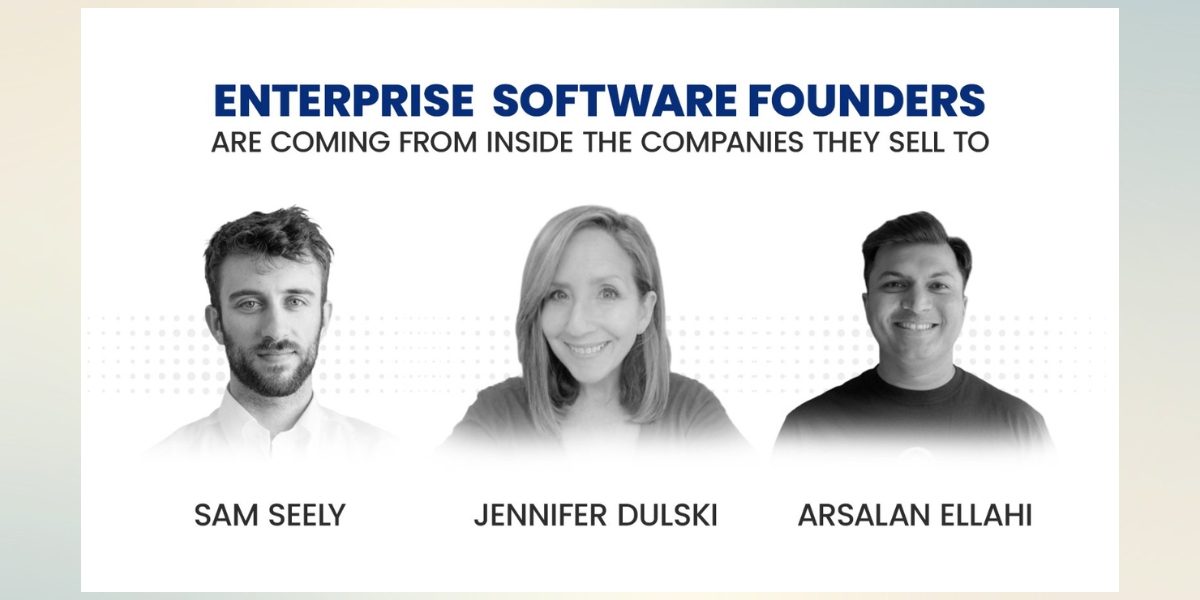
Three current companies illustrate how the pattern is playing out across different categories and geographies.
How the pattern looks in practice
Jennifer Dulski held executive roles at Meta, Google, Yahoo, and Change.org before founding Rising Team, a San Francisco company building a platform that helps managers run structured team sessions across distributed teams. The company has raised $11 million in disclosed funding. “Connected, high-performing teams are not a function of headcount or budget. They are a function of how well managers run the time they already have with their people,” Dulski said.
Arsalan Ellahi spent years inside enterprise architecture programs before founding Syntroper AI in Auckland, New Zealand. The platform uses AI to continuously map system dependencies inside large enterprises, addressing a recurring problem in transformation work: outdated documentation that derails modernization timelines. Ellahi was nominated for a Global Banking Architecture Award and is backed by New Zealand-based venture investors. “Modernization programs do not fail because the strategy is wrong. They fail because no one has an accurate picture of the systems they are modernizing,” Ellahi said.
Sam Seely spent more than twelve years building products, including at Frame.io prior to its acquisition by Adobe in 2021, before co-founding Knock in New York. Knock is a developer-first notification platform that gives engineering teams a managed alternative to building cross-channel messaging infrastructure in-house. “Notifications are the kind of infrastructure every product needs and no engineering team wants to maintain,” Seely said.
What this means for enterprise software
Three companies in three categories, built in three cities by founders who spent years inside the problem before they tried to sell software around it. None of the three is framed as an overnight success. None are pitching new categories. What links them is a posture toward enterprise software that has been out of fashion in the venture market and is now returning to the buyer’s preference.
Enterprise software has spent the last decade rewarding founders who could describe a new category. The next decade may belong to founders who can fix an old one. The shift is still small enough to feel like an outlier signal, but the funding patterns, the customer conversations, and the founder profiles are all pointing in the same direction.
The buyers writing the checks have started to recognize their former colleagues on the other side of the table. They tend to know the difference.
Disclaimer: Funding amounts, company details, timelines, and other metrics referenced in this article are based on publicly available information and company-provided materials at the time of writing. These figures may vary over time.