

Decision bottlenecks cost far more than the time a decision sits waiting. A slow decision stalls every downstream task that depends on it, forces teams to hold or redo work, and pushes the organization to miss the operating cycles it was built to hit. The visible delay is a small part. The compounding cost across the system is what quietly erodes throughput, and most operations leaders never trace it back to its source.
Why Decision Bottlenecks Cost More Than the Delay Itself
The instinct is to measure a slow decision by how long it took to make. But the delay is the smallest part of the cost. Every decision sitting unresolved freezes the work waiting behind it, and that frozen work is where the real expense accumulates.
A decision is rarely a standalone event. It is a gate that other work passes through. While it waits, the people and workstreams downstream stall, get reassigned to lower-value tasks, or push ahead on assumptions that may not survive the final call. Either way, the organization pays, and it pays in places no one is watching.
How to Quantify the Real Cost of Slow Decisions
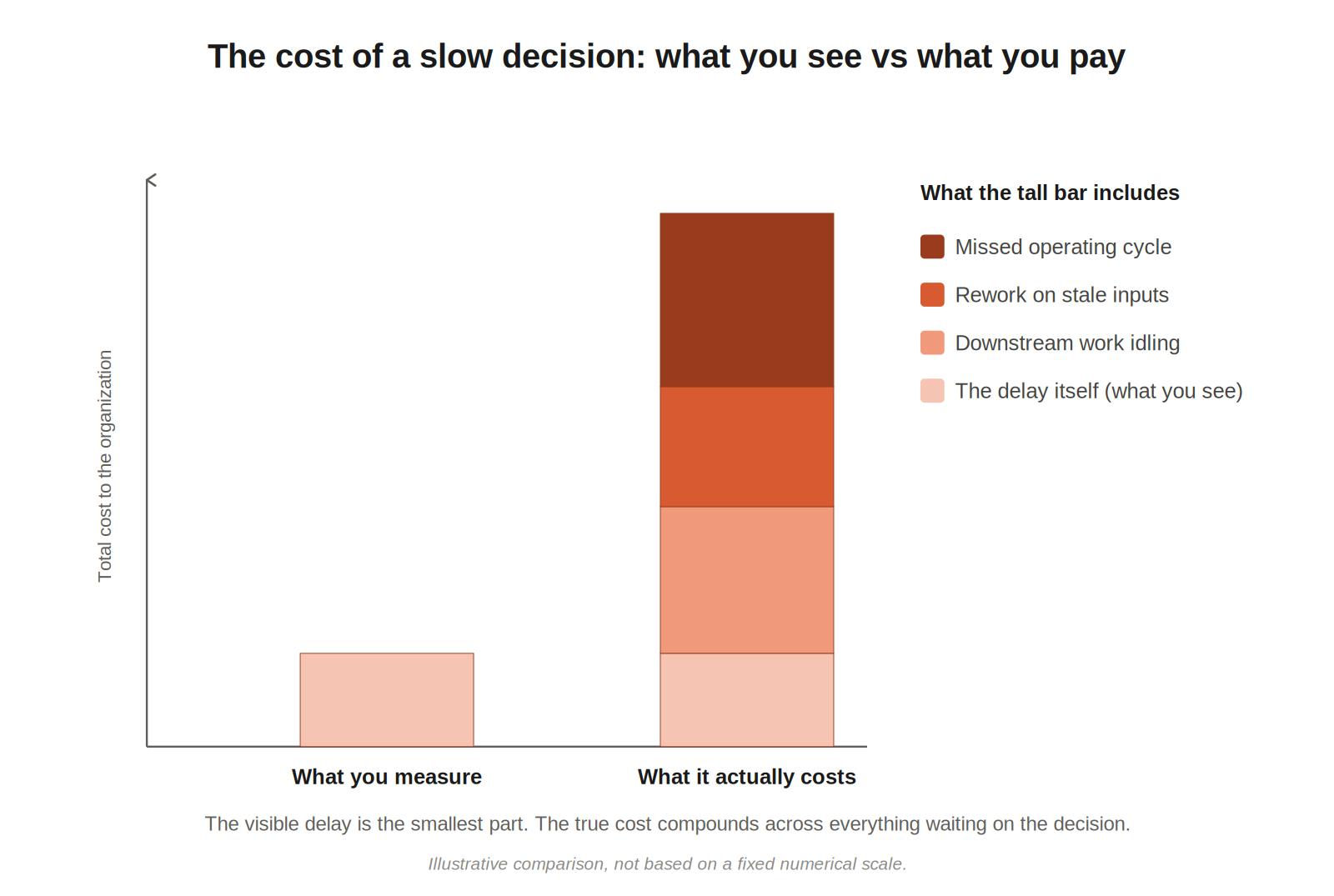
Make a decision that should take two days but takes ten. The reflex is to count the eight lost days. That is not where the cost lives.
Picture the work waiting on that decision, say four people or workstreams that cannot move until it lands. For eight extra days, their progress is frozen, redirected, or spent on filler. When the decision finally arrives, the inputs have often shifted, so some of their earlier work has to be redone. And because operations run on cycles, that one delayed decision can push the whole team past a sprint boundary, a month-end, or a delivery window, which resets the clock on everything tied to it.
So the true cost is not eight days. It is eight days multiplied by every dependent downstream, plus the rework when assumptions go stale, plus the value of the cycle you missed entirely. A rough way to size it: delay length, times the number of dependent people or workstreams, times how often the bottleneck recurs. Most leaders only ever see the first number. A single recurring bottleneck of this size, hit week after week, quietly consumes a meaningful share of your operating capacity over a quarter.
What Actually Causes Decision-Making Bottlenecks in Organizations
Most decision making bottlenecks in organizations are not caused by indecisive people or missing data. They are caused by system conditions. Decision rights are unclear, so choices escalate to whoever is most senior rather than whoever is closest to the work. Ownership blurs at the handoffs, so decisions bounce between functions. And the leadership system is not synchronized, so under pressure, decisions stall instead of being resolved. The people are capable. The system routing the decisions is not built to move them.
Why Slow Decision Making in Leadership Is a System Problem, Not a People Problem
This is why slow decision-making in leadership rarely improves when you add capable leaders or simply push them to move faster. The speed of a decision is a property of the system it travels through, not the willpower of the person making it. When decision rights are unclear, when the team is not aligned on what a good decision looks like, and when pressure degrades coordination rather than tightening it, even strong leaders slow down.
Under real operating pressure, decisions stall, communication degrades, and alignment drifts across teams. That is not a performance issue. It is a system condition, and system conditions do not fix themselves. Telling capable leaders to decide faster treats the symptom as a personal failing, which is why the improvement never holds.
How COOs Can Fix Decision Bottlenecks
If you are a COO or SVP of Operations watching decisions pile up, resist the urge to chase the symptom with more status meetings. Look at the decision system itself and ask:
• Are decision rights explicit, so everyone knows who owns which call?
• Do decisions resolve at the level closest to the work, or escalate by default?
• Does the team share a definition of what a good decision looks like, so choices do not stall in debate?
• Does coordination tighten under pressure, or fall apart exactly when speed matters most?
Fixing decision flow means installing the operating layer underneath it: clear decision rights, a synchronized cadence so choices resolve on a predictable rhythm, and enough stability under pressure that the system holds when the stakes rise. That is the difference between an organization that decides at the speed of its cycles and one that is always a decision behind.
Frequently Asked Questions
What causes decision bottlenecks in organizations?
Decision bottlenecks are usually caused by system conditions rather than indecisive people. The common causes are unclear decision rights, ambiguous ownership at the handoffs between functions, and a leadership system that loses coordination under pressure. When no one is sure who owns a call, decisions escalate and stall.
How much do slow decisions actually cost?
Far more than the delay itself. A slow decision freezes every dependent task downstream, forces rework when assumptions change, and can cause the organization to miss entire operating cycles. The real cost is the delay multiplied by every downstream dependency, plus the missed cycle, not just the time the decision sat waiting.
How do you fix slow decision-making on a leadership team?
You fix it by repairing the decision system, not by pushing leaders to decide faster. That means making decision rights explicit, resolving decisions at the level closest to the work, agreeing on what a good decision looks like, and synchronizing the team so coordination holds under pressure instead of breaking down.