

Most romance stories begin before life has done its hardest work. The characters are often young, restless, and still discovering who they are. Dorothy Smith’s Late Life Romance begins from a more layered emotional place. It is shaped by memory, maturity, faith, and the complicated question of whether love can still surprise a person after years of disappointment. That question gives the book its quiet power.
Smith’s work stands apart because it does not treat age as an obstacle to romance. It treats age as part of the story’s emotional richness. The book understands that later-life love comes with history. It carries the echoes of past relationships, missed chances, private insecurities, and lessons learned the hard way. That history does not weaken the romance. It deepens it.
In Late Life Romance, Smith offers readers something more textured than a conventional love story. She writes about the emotional shock of being noticed. She explores the uncertainty that follows attraction when the heart is no longer naïve. She captures the tension between wanting to believe in love and fearing the pain that may come with it. This is why the book feels timely.
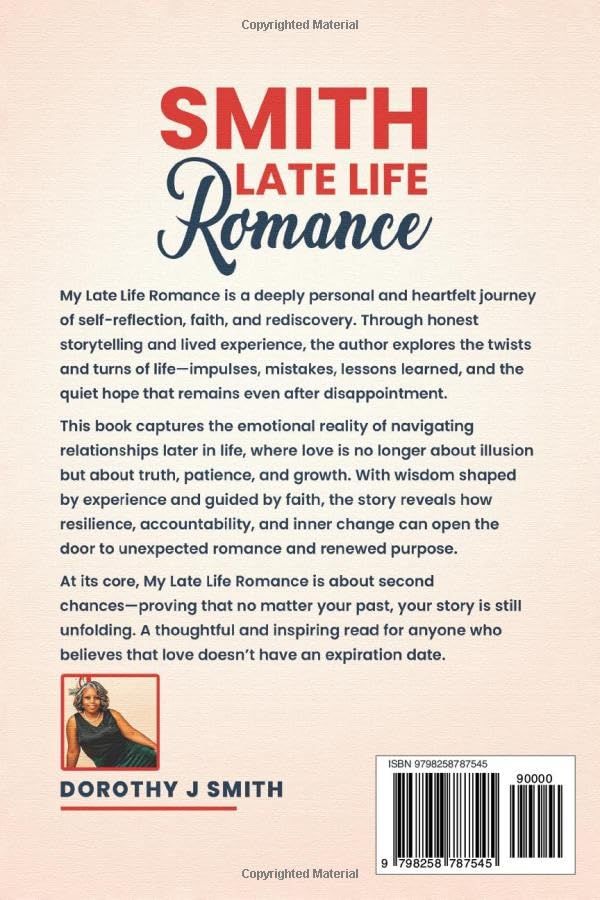
There is a growing hunger for stories that reflect real human experience, not just idealized versions of it. Many readers want characters and voices that understand life after youth, after family responsibilities, after disappointment, after years of putting one foot in front of the other. Smith writes into that space with candor.
Her work also speaks to a deeper issue: the invisibility that many women feel as they grow older. Popular culture often narrows the idea of beauty, desire, and romantic possibility. Late Life Romance pushes back gently but firmly. It insists that a woman can still be seen, still be wanted, still be emotionally alive, and still have a story worth telling.
That message gives Dorothy Smith’s book notability beyond its genre. The strength of the writing lies in its personal tone. Smith does not sound distant from her subject. She writes as someone who understands the emotional terrain from the inside. Her voice carries warmth, humor, spiritual reflection, and vulnerability. This gives the book an intimate quality that many readers will find refreshing.
There is no need for exaggeration around the book’s appeal. Its value is clear. It reaches readers who want romance with heart, but not fantasy without consequence. It offers tenderness without pretending life has been easy. It presents hope without making hope feel cheap.
Dorothy Smith’s author presence is also part of the book’s draw. She comes across as a writer shaped by perseverance and personal reflection. The story feels connected to a broader belief that every life contains a meaningful narrative, and that it is never too late to tell it. That belief is central to the book’s emotional force.
Late Life Romance is likely to resonate with readers who enjoy mature romance, women’s fiction, inspirational storytelling, and character-driven emotional journeys. It is not a book that depends on shock or spectacle. Its appeal comes from recognition. Readers may see pieces of their own fears, hopes, and private questions reflected in its pages.
Can love still find a person after years of waiting?
Can the heart respond even when the mind resists?
Can the later chapters of life hold more than memory?
Dorothy Smith does not answer these questions with a slogan. She builds a story around them.
That is what makes Late Life Romance worth noticing. It gives readers a love story that respects age, honors vulnerability, and restores emotional possibility to a season of life too often left out of romance fiction.