
Inside the Evidence That Turned a Persecutor Into a Lasting Witness
For centuries, the resurrection of Jesus has been approached through the Gospel narratives, their scenes, voices and remembered details. In his new scholarly work, United Kingdom-based author, church leader and lecturer Nana Afaidze-Hayford asks readers to temporarily set those narratives aside and examine a different body of evidence: the letters attributed to Apostle Paul.
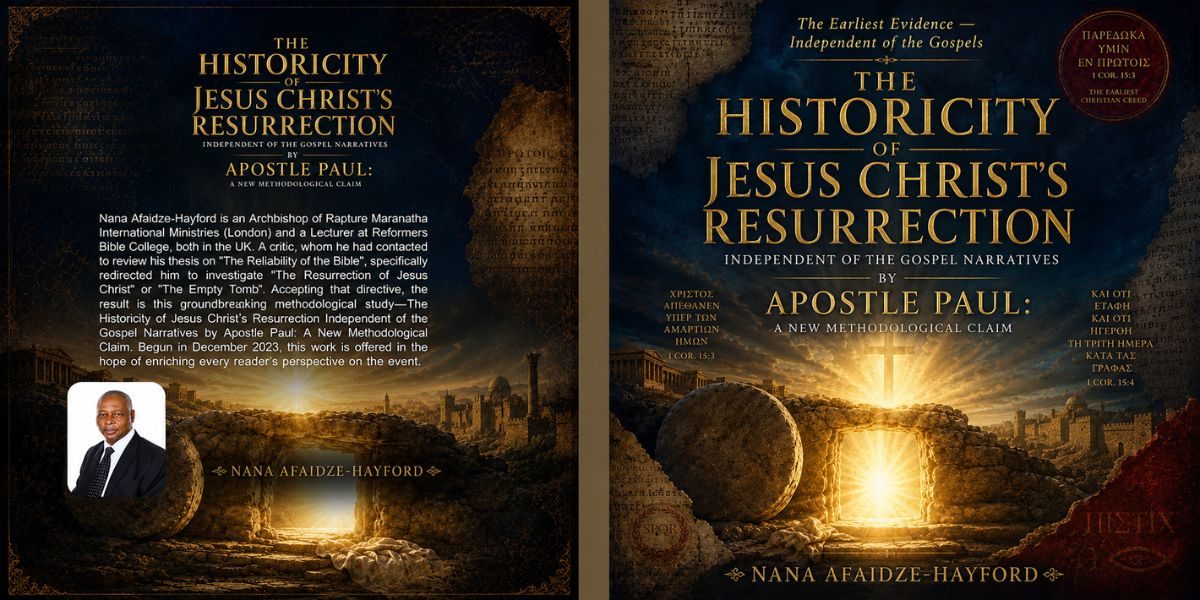
The Historicity of Jesus Christ’s Resurrection Independent of the Gospel Narratives by Apostle Paul: A New Methodological Claim, Volume II studies Paul’s historical identity, his life before joining the early Christian movement, his transformation from persecutor to advocate, the witness list in 1 Corinthians 15, and competing explanations involving mythology, psychology and hallucination. Written for readers of ancient history, biblical studies, religious studies and historical methodology, the volume does not merely repeat a declaration of faith.
It asks whether the earliest surviving Christian letters can serve as historical evidence in their own right.
The Question Behind the Question
The central question is not simply whether a resurrection occurred.
Before that can be addressed, Afaidze-Hayford argues, another question must be answered: Who was Paul, and why should his testimony matter?
This change adds to the intellectual tension in Volume II. Paul is not portrayed as a distant icon or a flawless figure behind stained glass. Instead, he is shown as a complex human being whose trustworthiness needs to be established. The book discusses debates about whether Paul was a creation of later communities, considers the authenticity and context of his letters, and explores the social environment he inhabited.
This is where the book’s emotional current begins.
Historical inquiry can appear cold, but witnesses are never abstractions. They have histories, loyalties, fears and losses. To examine Paul is to examine a man said to have stood against an emerging movement before becoming one of its most forceful voices.
The book asks readers to consider not only what he claimed, but what it cost him to make that claim.
A Witness With Everything to Lose
Paul’s transformation is the beating heart of the volume. According to his own letters, he had once persecuted the early church. He later became a missionary, correspondent, and public defender of the message he had tried to suppress.
Afaidze-Hayford does not treat this reversal as automatic proof. Instead, he presents it as historical and psychological evidence that demands explanation. People change for many reasons.
Yet the more radical the change, the more urgent the question becomes: What did the person believe had happened?
Paul’s answer was direct; he believed he had encountered the risen Jesus. That conviction redirected his identity and placed him in conflict with communities to which he had once belonged. The manuscript returns repeatedly to this human cost. Paul’s testimony mattered not only because he wrote early, but because he appears to have reorganized his life around it.
That does not compel belief.
It does, however, resist indifference.
Letters Written Before the Story Was Finished
The book gives particular attention to the Pauline Epistles because they are generally dated earlier than the written Gospels. Unlike later narrative accounts, these letters were addressed to active communities facing disagreements, uncertainty, and practical problems. Their tone is often urgent rather than ceremonial.
At the center of the discussion is 1 Corinthians 15. Paul recounts a tradition concerning Jesus’ death, burial, resurrection, and appearances to named individuals and groups, including Peter, the Twelve, James, more than five hundred people, and Paul himself. Afaidze-Hayford treats this passage as a public claim rather than a private meditation.
The importance lies not only in the number of witnesses mentioned, but in the form of the appeal. Paul writes as though the claim belongs to a shared world of people, memory and dispute. The manuscript asks whether the passage preserves an early tradition that existed before Paul wrote it and whether its named witnesses make the claim historically testable.
Here, the method becomes clear.
Readers are not asked to begin with certainty.
They are asked to begin with proximity, authorship, context, and consequence.
Testing the Alternatives
A serious historical argument must make room for doubt. Volume II examines several alternatives to a literal resurrection, including later legend, mythic development, psychological experience, and hallucination.
These discussions are important because skepticism isn’t seen as something to be silenced or feared. Instead, it becomes a valuable part of the investigation process.
Afaidze-Hayford compares each alternative with the evidence he considers central: the early Pauline tradition, the list of witnesses, the conversion of James, the transformation of Paul, and the rapid growth of the early Christian movement.
The result is an argument about explanatory power.
Which account best explains the documents, the people, and the consequences that followed? Readers may not agree with every conclusion, but they are invited to confront the evidence rather than remain at the level of assumption.
Two Volumes, One Unfinished Conversation
Volume I investigates the historical background, covering Jesus as a historical figure, the Roman context of the crucifixion, burial customs, and the claims that gave rise to the story of the empty tomb. Volume II turns to the voice that conveyed the message of the resurrection to early Christian communities.
Essentially, Volume I assesses the historical confirmation of the person and setting, whereas Volume II focuses on whether the witness can be heard, tested, and genuinely understood. That difference gives the project its emotional force. Volume I leads readers toward the tomb. Volume II asks them to stand beside the man who said the story did not end there.
The project speaks to readers who arrive curious, skeptical, or searching, as well as to those simply interested in how ancient testimony becomes history. It does not press for a verdict. Volume I lays the groundwork, establishing the historical figure and the setting behind the claim. Volume II then examines the witness whose account carried the message of the resurrection to the earliest Christian communities.
Beneath the evidence and the human story sits a conversation that has continued for more than two thousand years. The two volumes together give readers the material to weigh that conversation on its own terms.
Author Name: Nana Afaidze-Hayford Book Title: The Historicity of Jesus Christ’s Resurrection Publishing Soon with: Visionary Book Publishers