
His research on Authentic Intelligence examines how organisations can preserve accountability when algorithms influence important decisions.
When an algorithm recommends denying a loan, changing a workforce schedule or adjusting supply to a region, someone must still be able to explain the decision. As artificial intelligence becomes embedded in business operations, that obligation is growing more difficult to assign, particularly when decisions involve multiple teams, systems and competing priorities.
Dr. Imo Enang, working with Patrick Mukala and Ubong Nkereuwem, examines the problem in Authentic Intelligence in Digital Strategy Systems, published in Systems in February 2026. Their study proposes a socio-technical framework for keeping human judgement and accountability meaningful when automated systems shape strategic action. It explores how organisations can integrate AI into decision-making while ensuring that human responsibility remains visible throughout the process.
Three Sources Of Evidence
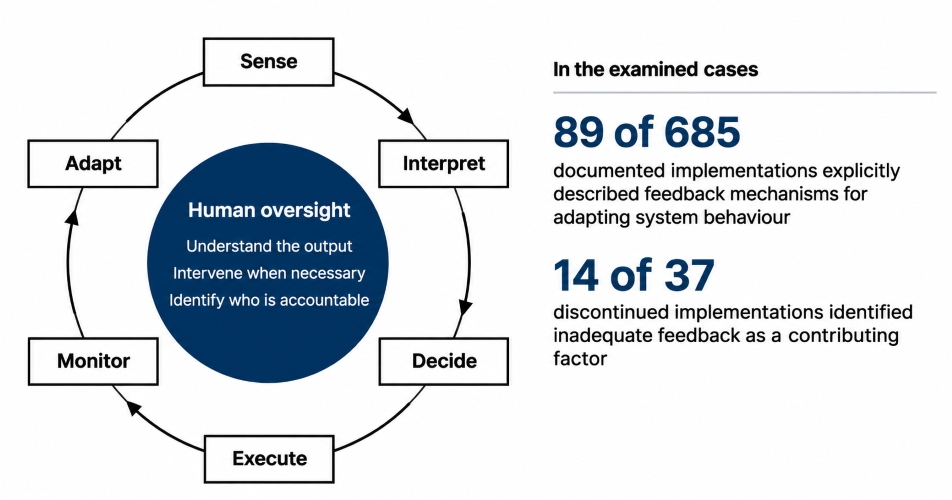
The study draws on interviews with 50 senior managers, 685 documented AI implementation cases and 37 discontinued implementations. These evidence streams were used to examine how organisations sense information, interpret it, decide, execute, monitor results and adapt. The authors also considered whether employees could understand a system’s output, intervene when necessary and identify who was accountable for the outcome. Together, these perspectives offer insight into the practical challenges of maintaining oversight as AI becomes more deeply integrated into organisational processes.
The distinction is important. A human approval box at the end of an automated workflow does not necessarily amount to genuine oversight. A manager who lacks the information or authority to challenge a recommendation may be present in the process without exercising meaningful judgement. Effective oversight requires more than human involvement; it depends on having the knowledge, authority and opportunity to question automated decisions and take responsibility for their consequences.
Human oversight across the six functions of responsible digital decision-making
Source: Enang, Mukala and Nkereuwem (2026), ‘Authentic Intelligence in Digital Strategy Systems: A Socio-Technical Analysis of Human-Accountable Decision Governance’, Systems, 14(3), 259. Evidence from interviews with 50 senior managers, 685 documented AI implementation cases and 37 discontinued implementations. Counts are observations within the examined cases, not failure rates or proof of causation.
Context: The Model Cannot See
Take a retailer whose forecasting model recommends cutting inventory after detecting a sudden fall in regional sales. The model may have identified a genuine pattern, but local managers could know that a temporary distribution problem caused the decline. If the recommendation is executed without that context, the business could deepen the shortage it is trying to correct.
The researchers report that 89 of the 685 documented implementations explicitly described feedback mechanisms for adapting system behaviour. Among 37 discontinued implementations, 14 identified inadequate feedback as a contributing factor. These are observations within the examined cases, not universal failure rates or proof of causation.
Questions For Senior Leaders
For senior leaders, the questions are practical. Who can challenge an automated recommendation? What evidence is retained? Which decisions require an accountable human owner? How do exceptions escalate? What happens when real-world results contradict the model’s assumptions?
Enang’s work links strategic management with technology governance. As a scholar-practitioner and Senior Lecturer and Programme Lead, MSc Project Management (Online), at the University of Greenwich, he examines how organisations translate sophisticated tools into decisions that remain understandable and defensible.
AI may improve speed, consistency and analytical reach. But the quality of a decision also depends on whether an organisation can detect an error, correct it and explain what happened. That is the management challenge at the heart of Authentic Intelligence.
R E S E A R C H
Enang, I., Mukala, P. and Nkereuwem, U. (2026). Authentic Intelligence in Digital Strategy Systems: A Socio-Technical Analysis of Human-Accountable Decision Governance. Systems, 14(3), 259.
https://doi.org/10.3390/systems14030259
Dr Imo Enang is a scholar-practitioner, Senior Lecturer and Programme Lead, MSc Project Management (Online), at the University of Greenwich and Founder and CEO of VLW Group, which comprises Ambidexters, ImpactCity and SkillHubs. Further information: imoenang.com.