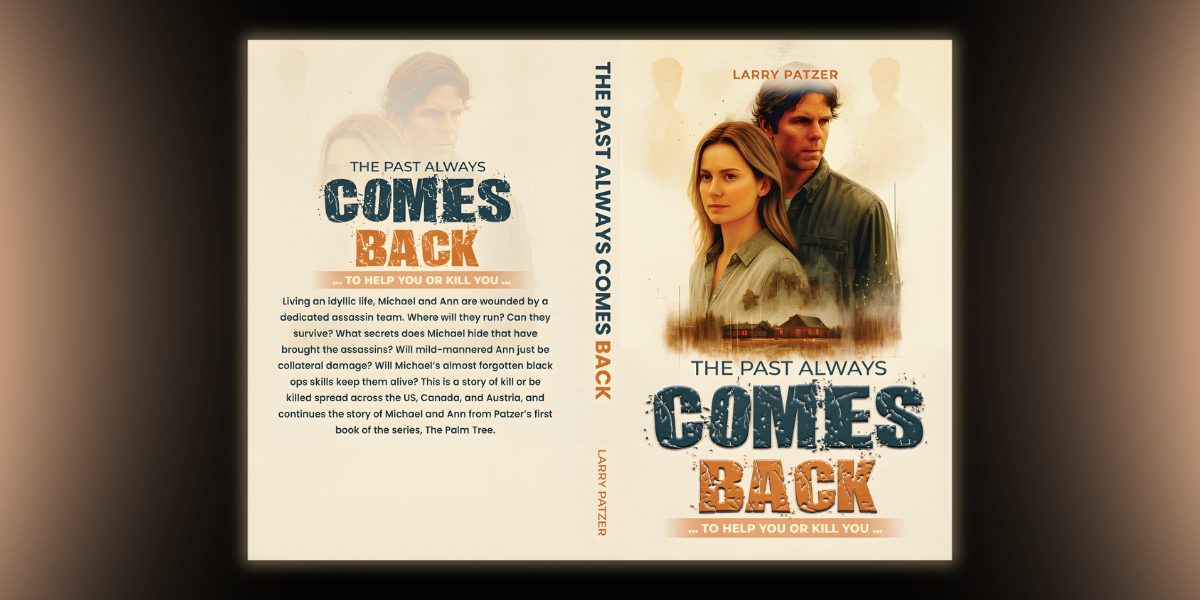

Some thrillers invite you to savor. This one dares you to stop. Larry Patzer’s lean, high-velocity novel, The Past Always Comes Back, opens with a boom and never relinquishes the throttle. What begins on the backroads of a quiet American college town accelerates through Canadian waypoints and tightens over European stone, an itinerary that turns geography into tempo and distance into suspense. By the time you realize you meant to read “just one chapter,” the clock has wandered past midnight, and you’re bargaining with yourself for five more pages.
The setup is brutally simple. Michael and Ann, ordinary on the surface and deeply devoted beneath it, are targeted by professionals who don’t come to send a message; they come to leave nothing behind. The couple survives an explosion that should have ended the story before it began. Instead, it ignites a chase. Michael carries a past he’d packed away, skills, judgment, contingencies, hoping never to use them again. Ann, steady and spiritually grounded, must confront a world where steadiness is measured in breath control and clear eyes. From the first chapter, the novel makes a promise: no wasted scenes, no decorative detours, only choices that matter when seconds are currency.
“From backroads to border crossings” isn’t just a clever line; it’s a blueprint for tension. On the American side, the book uses space the way a chess master uses the clock. County roads buy minutes, minutes buy options. The couple learns to turn parking lots into quiet observation posts, to treat the space between streetlights as cover, to listen for the kind of silence that means someone else is listening too. These early stretches are the novel’s oxygen: breathe here, because the air thins later.
Then the borders arrive. Borders are more than lines on a map; they’re friction baked into travel. Documentation becomes suspense. Timing becomes risk. A routine checkpoint reads like a fuse burning toward an unseen charge. What the book understands, and uses brilliantly, is that bureaucratic minutes can be more nerve-shredding than car-chase seconds. Border crossings tighten the options and sharpen the choices, and every stamp or question adds weight to the pages you turn.
By the time Europe enters the frame, the chase compresses into a series of narrow windows: short sightlines, old streets, and public spaces that can flip from sanctuary to trap in a heartbeat. The novel lets the setting shape the tactics. Speed on a highway is one thing; speed when the pedestrians are tourists, and the corners are blind, is another. The hunter-hunted dynamic keeps flipping, not because the book loves twists for their own sake, but because the players keep learning. The couple is not superhuman; they’re stubbornly adaptive. Their pursuers are not omnipotent; they’re fallible and escalating. That interplay, pressure, mistake, and counter drives the plot’s pulse.
None of this would matter if you didn’t care about the people. Patzer knows that. Michael and Ann aren’t stock figures; they’re a partnership negotiating a crisis in real time. The book resists the easy trope of the sheltered spouse who slows the story down. Ann refuses that role, and the novel refuses to handwave her evolution. Her early attempts at capability are awkward and bruising, grip wrong, stance off, breath too fast, but she persists with a clarity that comes from love, not adrenaline. The result is one of the book’s quiet miracles: the action escalates, yet the humanity never evaporates.
Equally important, the narrative respects consequence. This is not carnage-as-fireworks. It’s a ledger. Every tactic carries an ethical echo, and the couple hears it. Michael’s calculation is cool because it has to be; Ann’s conscience is warm because it must remain so. Together, they draw lines they mean to hold, and then the plot tests those lines under heat. Readers who crave both tension and moral weight will recognize how rare this balance is, how hard it is to keep the pages flying without treating right and wrong as set dressing.
Why does it read in one sitting? Partly the length: at 46,827 words, the book is aerodynamic. But the real secret is structure. Scenes begin late and end early; exposition rides shotgun with motion. Cliff edges are placed with an engineer’s precision, and chapter breaks land like checkered flags just far enough ahead to make you sprint. Dialogue is crisp because volume is dangerous, and apologies come in the form of competence because there’s no time for speeches. All of this conspires to keep you inside the story’s bloodstream, where “I’ll stop after this part” is a lie you cheerfully tell yourself.
If you’re a reader who loves Lee Child’s practical minimalism, Daniel Silva’s layered intelligence, or Vince Flynn’s relentless pace, but you also want a heartbeat you can root for, this book aims squarely at your sweet spot. The tradecraft is clean (communication discipline, situational awareness, the unglamorous logistics of staying one step ahead), and the prose refuses to turn into a manual. You trust what’s happening, and you feel what it costs.
This article won’t spoil the ending. No endgame reveals, no last-act twists exposed, no puppeteers named. The point here isn’t to give up the plot; it’s to tell you why the plot will give up your evening. The Past Always Comes Back takes the familiar ingredients of a chase thriller and plates them with restraint, intelligence, and heart. It makes a place a player, marriage a mission, and speed a storytelling ethic.
End-Note
If your night can spare just “one more chapter,” you already know how this goes. Buy The Past Always Comes Back today, wherever you get your thrillers, and follow Michael and Ann from backroads to border crossings in a sprint you’ll finish before the sun thinks about rising.