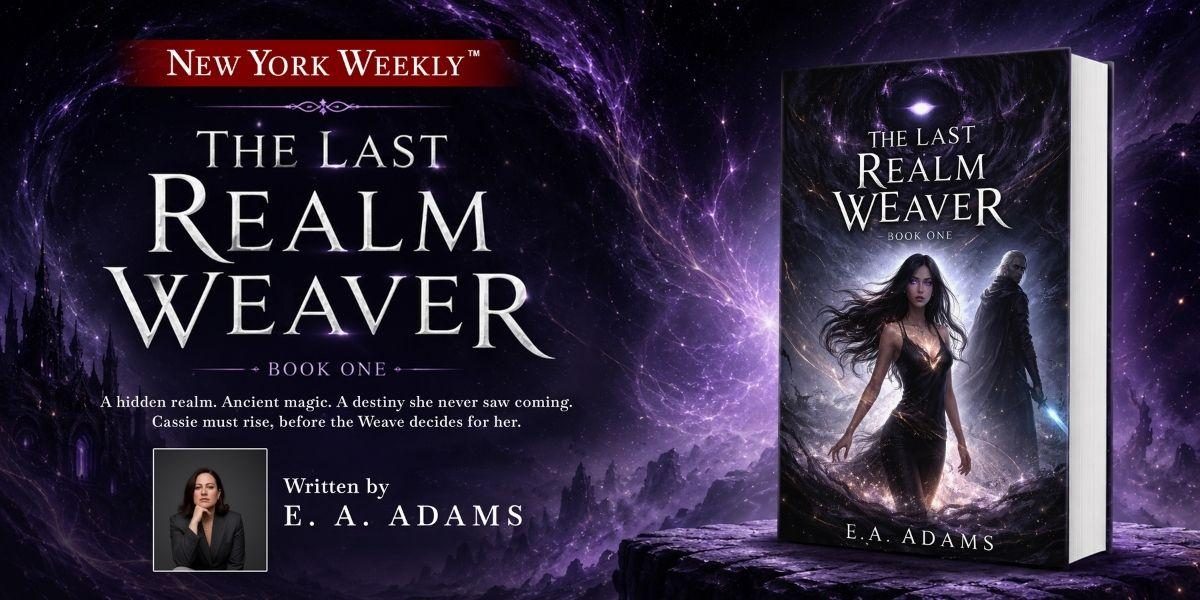

There are fantasy novels that build worlds, and then there are fantasy novels that build emotional weather. The Last Realm Weaver: Book One by E.A. Adams belongs decisively to the latter category. It is a sprawling, mythic work less interested in escapist spectacle than in the emotional architecture of destiny itself. Beneath its celestial wars, fractured dimensions, and ancient prophecies lies something surprisingly intimate. A meditation on grief, waiting, loneliness, and the unbearable cost of being chosen.
What distinguishes the author immediately is not simply imagination, though the novel overflows with it. The book’s mythology is dense and operatic, populated by Djinn warriors, corrupted void entities, sentient portals, and cosmic systems governed by the Weave. A metaphysical lattice binding all realities together. E.A. Adams approaches fantasy not as puzzle-box worldbuilding, but as emotional excavation. Every magical structure in the novel mirrors a psychological one. The Veil separating worlds becomes a metaphor for emotional isolation; the Maelstrom, a wound in reality itself, echoes the unresolved trauma carried by its characters.
At the center of the narrative is Cassandra, Cassie, a scarred eighteen-year-old girl whose existence threatens the balance of creation. In lesser hands, such a protagonist might feel archetypal. E.A. Adams instead renders her with aching humanity. Cassie is not introduced as a triumphant heroine, but as a grieving teenager displaced from Louisiana after the death of her stepmother, struggling beneath emotional exhaustion and physical pain she cannot explain. Her awakening into cosmic significance does not empower her immediately. It destabilizes her. The author understands that change is terrifying before it is liberating.
Equally compelling is Jared, the Djinn Gatekeeper who has spent a century waiting in the Tennessee mountains for a prophecy he fears may never arrive. His sections possess the melancholy grandeur of Gothic literature. The author writes solitude exceptionally well. The creaking Watcher’s Nest, the breathing forests, the silence of ancient mountains. Jared’s long vigil becomes one of the novel’s emotional anchors, transforming him from fantasy guardian into something far more tragic. A man suspended between duty and despair, terrified that meaning itself may abandon him.
Perhaps the novel’s greatest achievement is tonal. The author writes with the cinematic momentum of epic fantasy while maintaining the lyrical introspection of literary fiction. The prose often moves like incantation: storms breathe, houses remember, silence acquires physical weight. Even action sequences carry emotional residue. Violence here is never merely spectacle; it is consequence, memory, inheritance.
There are traces of numerous literary traditions woven throughout the work. One can feel the gothic romanticism of Southern storytelling, the mythic fatalism of high fantasy, and even the emotional intensity of contemporary trauma fiction. E.A. Adams synthesizes these influences into something distinctively personal. The novel is unafraid of sincerity. It leans fully into longing, devotion, fear, and cosmic terror without retreating behind irony.
What ultimately lingers after reading The Last Realm Weaver is not merely its mythology but its emotional gravity. The author seems deeply interested in the idea that the people capable of altering worlds are often those barely surviving their own pain. The result is a fantasy novel that feels startlingly human beneath its celestial scale.
In an era where much fantasy races toward spectacle, E.A. Adams slows down long enough to ask more haunting questions: What does destiny cost? What happens when the universe chooses someone already broken? And how long can a person endure waiting for hope before hope itself becomes another form of grief?
The Last Realm Weaver does not merely introduce a fantasy saga. It announces the arrival of a writer deeply attentive to the emotional lives hidden inside myth. Order your copy today!