
Textiles are often understood as objects we wear or fabrics we touch. For New York-based artist Jingyi Yang, however, textiles function differently: they become environments that shape movement, preserve cultural memory, and invite people to reconsider their relationship with space.
Working across digital jacquard weaving, knitting, biomaterials, laser cutting, and sculptural installation, Yang’s interdisciplinary practice explores how contemporary textiles can extend beyond material production to become immersive experiences. She brings them together to examine migration, ecology, and the ways cultural knowledge continues to evolve across generations.
Originally from Inner Mongolia, China, Yang draws upon the region’s nomadic cultural traditions. Patterns, scripts, and material histories become points of departure for installations. Growing up in Baotou, a city shaped by both grassland heritage and rapid industrialization, she became interested in the coexistence of mobility and permanence, tradition and modernization. These experiences continue to inform her artistic research. In her work, textile becomes less a surface than a spatial language.
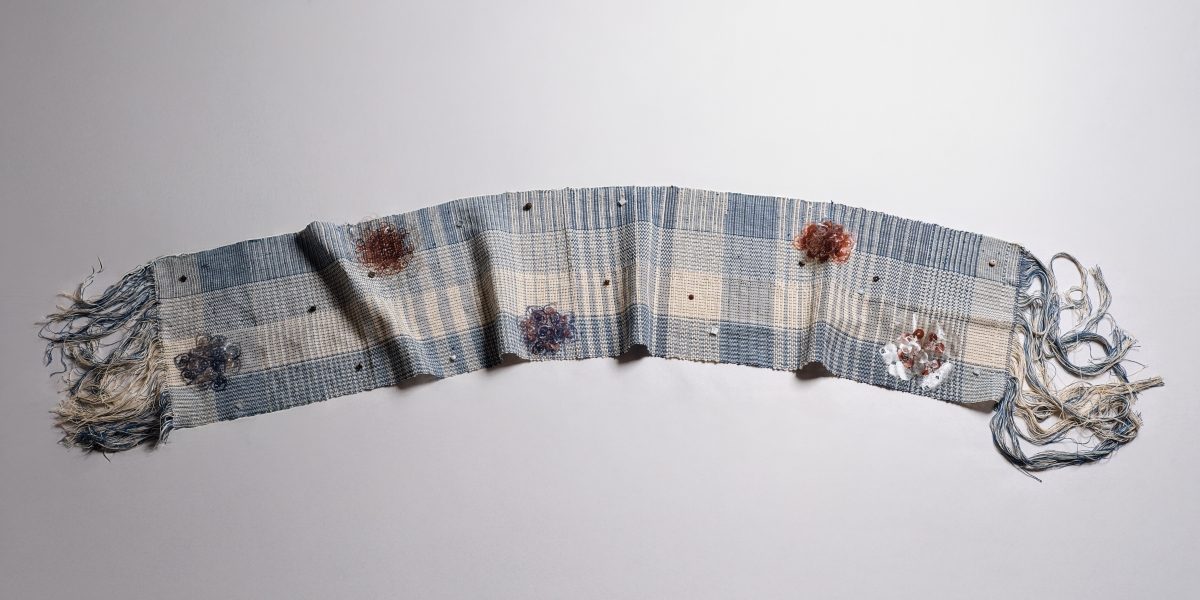
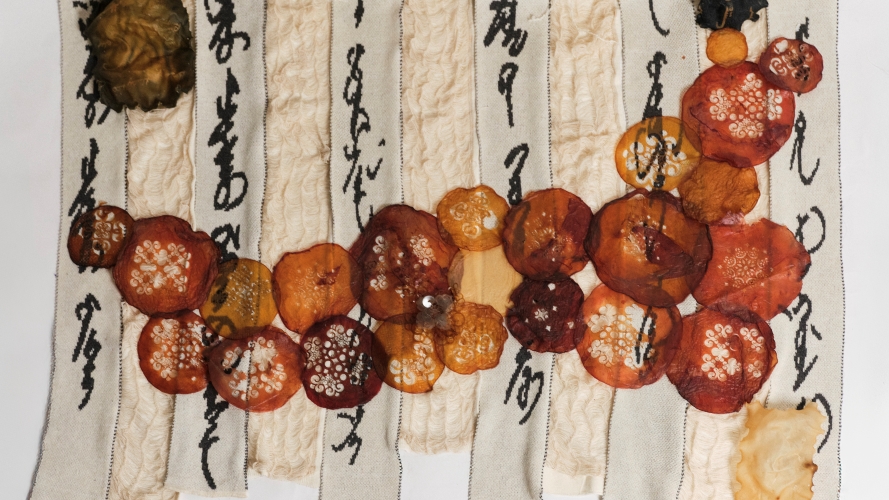
This approach culminated in Threads of Distance, her 2025 MFA thesis at Parsons School of Design in New York. Inspired by anthropologist Edward T. Hall’s theory of proxemics, the installation explored how nomadic and sedentary cultures understand interpersonal space differently. Through digital jacquard weaving, knitting, algae & kombucha-based biomaterials, and laser-cut components, Yang constructed an environment where viewers navigated shifting relationships between the body and cultural memories. The work translated cultural experience into spatial experience. Combining handcrafted processes with digital technologies and biofabricated materials, the installation proposed textiles as living systems capable of carrying memory while adapting to new environments.
Her work has also gained increasing international visibility. In June 2026, Yang participated in the 7th TexpoArt International Triennial of Textile Art in Iași, Romania, one of Eastern Europe’s long-running international textile exhibitions. Her practice has been featured by Artist Talk Magazine, AATONAU, and Divide Magazine, each recognizing different aspects of her interdisciplinary approach. Artist Talk Magazine described her work as transforming textile into “a language capable of recording time, space, and cultural memory,” while AATONAU highlighted her ability to weave together migration, identity, and material experimentation. Together, these independent perspectives point to a practice that continues to expand the possibilities of contemporary textile art across cultural and disciplinary boundaries.
Through this interdisciplinary approach, Yang continues to redefine the possibilities of textile art, demonstrating that fabric can be a medium through which people experience connection, transformation, and belonging.