Why Your Truck Bed Could Be Costing You Money at Trade-In Time

Most truck owners think about oil changes, tire rotations, and brake pads when it comes to keeping their vehicle in good shape. Few think about the bed. Yet the bed is often the first place a dealer or private buyer looks when deciding how much a truck is really worth. Scratches, rust spots, and dents in the bed can quietly chip away at resale value, even when the engine runs perfectly and the interior looks brand new.

This is becoming a bigger deal as more people hold onto their trucks longer before trading them in. With used truck prices still high, buyers are paying closer attention to condition. A worn, dented bed can send the wrong message before a buyer even opens the door.

A Small Detail That Buyers Notice First

Truck beds take a beating. Tools slide around. Gravel bounces in during hauling jobs. Rain and snow sit in corners and slowly eat away at bare metal. Over time, this adds up to visible wear that is hard to ignore during an appraisal.

One straightforward fix is a professional coating. Applying truck spray in bedliner and accessories can protect the metal underneath from scratches, moisture, and rust before any of that damage has a chance to start. A sprayed-on liner bonds directly to the bed and creates a tough barrier that holds up against heavy use, whether the truck is hauling firewood, moving furniture or heading off-road on the weekend. For owners who plan to sell or trade in a few years down the road, this kind of upfront protection can pay for itself.

It is not just about looks either. A damaged bed can sometimes point to bigger issues, like rust that has spread past the surface. Dealers are trained to spot this during inspections, and it often becomes a bargaining chip that works against the seller.

Timing Matters More Than People Think

Many truck owners wait until they are ready to sell before thinking about condition. By then, it can be too late to reverse months or years of wear. Small steps taken early, like sealing the bed or fixing minor dents, tend to cost far less than the value lost from neglecting them.

Seasonal timing plays a role too. Trucks used for landscaping, construction or towing during spring and summer often show the most wear by fall. That is also when many owners start shopping for next year’s model, making autumn a smart window to assess the bed and decide if it needs attention before listing the truck or heading to a dealership.

Beyond the coating itself, owners have other ways to keep their truck bed looking its best. Regularly clearing out debris, rinsing off road salt in winter, and avoiding sharp or heavy items sliding freely all help slow down wear. Pairing these habits with the right accessories, like tie-downs or a tonneau cover, can further protect the bed and keep it road-ready.

For truck owners who want a broader look at ways to equip their pickup for both work and play, learning practical upgrades for outfitting a truck for hauling and adventure is worth considering.

What Dealers Actually Look For

Trade-in value depends on more than mileage and mechanical condition. Cosmetic wear, including the state of the bed, factors heavily into what a dealer is willing to offer. A truck’s condition rating, from excellent down to fair, directly shapes the number a seller receives, and vehicles need to be close to flawless to command top value. That means a scratched, dented or rusted bed can pull a truck out of the top condition tier even if everything else checks out.

This is why more owners are starting to treat bed protection as part of routine truck care rather than an optional upgrade. It sits alongside things like regular washing and rust prevention as a way to protect the investment made in the vehicle from day one.

A Simple Step with a Real Payoff

Protecting a truck bed does not require a major project or a big chunk of time. A single coating application can last for years and shield the bed from the daily wear that adds up over time. For owners planning to keep their truck for the long haul, it also means a cleaner, more functional space for work and weekend trips alike.

Whether the goal is preparing for a future trade-in or simply keeping a truck looking sharp, a little attention to the bed goes a long way. It is one of the easiest ways to protect a truck’s value without spending much time or money, and it is a step that pays off no matter when the owner eventually decides to sell.


Interior Door Designs to Complement Contemporary Homes

Interior doors are often overlooked during home design, yet they play a vital role in both aesthetics and functionality. More than simply separating rooms, interior doors contribute to privacy, improve sound insulation, and enhance the overall character of a home. In contemporary interiors, the right door design creates a seamless transition between spaces while complementing furniture, flooring, and wall finishes.

Whether you’re building a new house or renovating an existing property, selecting modern interior doors can dramatically elevate your home’s appearance. From minimalist flush doors to elegant glass panels, today’s interior door designs combine beauty, durability, and practicality.

Why Interior Doors Matter

Modern interior design focuses on creating a unified and harmonious living environment. Every design element should work together, including doors.

Well-designed interior doors can:

  • Improve privacy
  • Reduce noise between rooms
  • Enhance visual flow
  • Complement furniture and décor
  • Increase property value
  • Create a premium interior appearance

Choosing the right doors helps complete the overall design rather than making them appear as separate functional components.

Minimalist Flush Doors

Flush doors remain one of the most popular choices for contemporary homes. Their smooth surfaces and clean lines perfectly suit modern interiors inspired by minimalist design principles.

Benefits include:

  • Elegant appearance
  • Easy maintenance
  • Timeless style
  • Versatile finishes
  • Affordable customization

Flush doors are available in matte colors, wood veneers, laminates, and painted finishes, making them suitable for almost every room.

Natural Wood Finishes

Wood continues to be a favorite material for interior doors because it introduces warmth and texture into modern spaces.

Popular wood-inspired finishes include:

  • Oak
  • Walnut
  • Ash
  • Maple
  • Light wood grain
  • Dark walnut tones

Natural finishes pair beautifully with modern flooring, neutral walls, and custom cabinetry. Whether using real wood or premium engineered veneers, wood textures remain timeless and sophisticated.

Glass Interior Doors

Glass doors have become increasingly popular in contemporary homes because they allow natural light to move freely between rooms.

Common styles include:

  • Frosted glass
  • Clear tempered glass
  • Ribbed glass
  • Black-framed glass doors
  • Sliding glass panels

These designs create an open, spacious feeling while maintaining privacy where required. Glass doors work especially well for home offices, dining rooms, and living spaces.

Sliding Doors for Modern Living

Sliding interior doors are ideal for maximizing available floor space.

Unlike traditional swing doors, sliding systems require no additional clearance, making them perfect for:

  • Small bedrooms
  • Bathrooms
  • Walk-in wardrobes
  • Laundry rooms
  • Home offices

Barn-style sliding doors and concealed pocket doors have become particularly popular because they combine practicality with modern aesthetics.

Matte Finishes and Neutral Colors

Contemporary interiors often feature subtle color palettes.

Popular door colors include:

  • White
  • Soft gray
  • Matte black
  • Beige
  • Charcoal
  • Natural wood

Neutral colors create flexibility, allowing homeowners to update furniture and décor without replacing doors. Matte finishes also resist fingerprints better than glossy surfaces, making them easier to maintain.

Smart Door Hardware

Modern interior doors are increasingly equipped with premium hardware that improves both functionality and appearance.

Popular hardware options include:

  • Soft-close mechanisms
  • Magnetic locks
  • Hidden hinges
  • Minimalist handles
  • Electronic locks
  • Fingerprint access systems

These features enhance convenience while contributing to a cleaner, more refined design. High-quality hardware also improves durability and long-term performance.

Coordinating Doors with Furniture

One of the defining characteristics of luxury interiors is consistency.

Interior doors should coordinate with:

  • Kitchen cabinets
  • Wardrobes
  • Bathroom vanities
  • Flooring
  • Wall panels
  • Furniture finishes

Using similar materials, colors, and textures throughout the home creates a harmonious appearance that feels professionally designed. Many homeowners now choose complete customization to ensure every design element works together seamlessly.

Complete Home Customization

Integrated home design has become increasingly popular because it creates consistency across every room.

Premium solutions such as OPPEIN wardrobes help homeowners achieve this unified approach by combining customized storage with elegant finishes that complement interior doors, kitchens, and other furnishings.

Matching wardrobe finishes with interior doors creates visual continuity while maximizing both functionality and style. This coordinated design philosophy contributes to a cleaner, more luxurious home environment.

Inspiration from Commercial Interiors

Luxury hotels are known for their elegant, durable, and highly functional interiors.

Many hotel furniture manufacturers in China produce furniture and interior components that emphasize premium craftsmanship, modern aesthetics, and long-lasting performance. Their experience designing for hospitality projects has influenced residential interiors by introducing minimalist door styles, durable finishes, and space-efficient solutions.

Homeowners can borrow these ideas by selecting interior doors that feature:

  • Clean architectural lines
  • Premium veneers
  • Hidden hardware
  • High-performance materials
  • Consistent color schemes
  • Durable finishes

Inspired by the hospitality industry, these features help create homes that feel sophisticated, comfortable, and timeless.

Sustainable Door Materials

Environmental responsibility is becoming an important factor in home design.

Many manufacturers now use:

  • FSC-certified wood
  • Low-emission finishes
  • Recycled materials
  • Eco-friendly adhesives
  • Sustainable manufacturing practices

Choosing environmentally responsible products supports healthier indoor environments while reducing environmental impact. Durable doors also reduce waste by lasting significantly longer than lower-quality alternatives.

Future Trends in Interior Doors

The future of interior door design continues to evolve through innovation and technology.

Emerging trends include:

  • Smart locking systems
  • Acoustic doors
  • Touchless operation
  • Integrated lighting
  • Hidden frame systems
  • Ultra-thin profiles
  • Sustainable composite materials

These innovations combine convenience, security, and contemporary design while supporting increasingly connected homes. As modern lifestyles continue to change, interior doors will play an even greater role in creating efficient, beautiful living spaces.

Creating a Cohesive Contemporary Interior

Interior doors are an essential part of contemporary home design, offering far more than simple room separation. They influence aesthetics, functionality, privacy, and overall property value. Whether choosing flush doors, glass panels, sliding systems, or natural wood finishes, homeowners should focus on quality, durability, and consistency throughout the home.

Integrated solutions such as OPPEIN wardrobes demonstrate how coordinated interior design can create elegant living environments where every element works together seamlessly. At the same time, the innovation and craftsmanship associated with hotel furniture manufacturers in China continue to inspire premium residential interiors through high-quality materials, modern production techniques, and sophisticated design principles.

By selecting thoughtfully designed interior doors that complement the rest of your home, you can create a timeless interior that balances beauty, comfort, and practicality for years to come.

When the Password Becomes the Battlefield, Inside the AI Framework Guarding Government Identity Systems

By: Md Sazzad Hossain, System Analyst, Kansas Bureau of Investigation | Cybersecurity Researcher

As identity-based cyberattacks surge across public institutions, researcher Md Sazzad Hossain’s AITIR Framework offers a technically rigorous, operationally validated answer built from the inside of government itself.

There is a quiet but consequential shift happening in the way governments are being attacked, and most people have no idea it is occurring.

The dramatic cyberattacks that dominate headlines- ransomware shutdowns, data exfiltration, and infrastructure sabotage- often obscure a subtler and, in many ways, more dangerous trend. Increasingly, the entry point for these attacks is not a vulnerability in software code or a misconfigured server.

This is the problem that researcher and government technology professional Md Sazzad Hossain has spent years working to solve.

Photo Courtesy: Md Sazzad Hossain (AI and digital identity security converge at the frontier of modern government infrastructure protection.)

The Moment the Perimeter Disappeared

For decades, cybersecurity operated on a simple premise. Build a strong enough wall around your systems, and you are safe. Firewalls, intrusion detection systems, and network monitoring tools were designed around this logic, the assumption that the threat came from outside and that the inside was, by definition, trustworthy.

That assumption no longer holds.

“Government organizations increasingly depend on digital identities as the foundation for accessing systems, services, and information. As threat actors continue targeting identity systems, cybersecurity strategies must evolve to address these risks more effectively.” — Md Sazzad Hossain

That gap between available tools and actual threats is what led him and his research collaborator Kiran Kumar Parvatha Reddy to develop the AI-Assisted Adaptive Threat Intelligence and Response (AITIR) Framework.

Six Layers Between a Credential and a Catastrophe

Published in the International Journal on Science and Technology, the AITIR paper, “AI-Enhanced Identity Threat Detection and Automated Response: An AITIR Framework for Optimized Cybersecurity Operations,” is not a theoretical exercise.

AITIR is built as a six-layer pipeline. Think of it as a highly automated assembly line, except instead of manufacturing a product, it processes the digital exhaust that every identity-related activity leaves behind and turns it into a security decision.

The raw material feeding this pipeline comes from sources that most government organizations already collect but rarely integrate effectively. Active Directory logs record who logged in, when, and from where. Multi-factor authentication (MFA) records flag unusual verification patterns. Privileged access management (PAM) data tracks who accessed sensitive systems, and VPN session logs reveal remote access behavior.

That data is then analyzed by three distinct artificial intelligence engines working in concert. An Isolation Forest algorithm scans for anomalies without needing to know what an attack looks like in advance. A Long Short-Term Memory (LSTM) neural network adds a temporal dimension, detecting attack patterns that develop over hours or days. The outputs are merged into a single metric, the Identity Risk Score (IRS).

Numbers That Make the Case

Photo Courtesy: Md Sazzad Hossain (Inside a modern government cybersecurity operations centre where AI-assisted identity threat detection is redefining response timelines.)

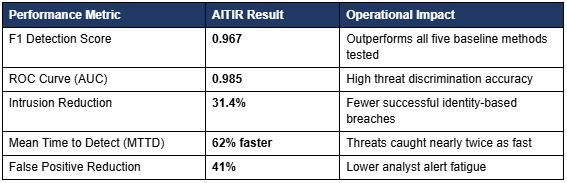
Frameworks live or die by their results. AITIR’s empirical performance, validated against real-world identity log datasets, is difficult to dismiss.

Photo Courtesy: Md Sazzad Hossain (Inside a modern government cybersecurity operations centre where AI-assisted identity threat detection is redefining response timelines.)

For context, false positives are not a minor inconvenience in a security operations center. Every false alert consumes analyst time, erodes confidence in automated systems, and creates the kind of alert fatigue that causes real threats to be dismissed. A 41% reduction is not a marginal gain. It is the difference between a team that can keep pace with its threat environment and one that is perpetually overwhelmed.

The Human Question

There is an understandable anxiety within cybersecurity circles, and in government institutions more broadly, about the role of artificial intelligence in high-stakes decision-making.

Hossain is direct about where AITIR stands on this question. The framework is not designed to replace human judgment. It is designed to give human analysts better information, faster, so that their judgment is applied where it matters most.

“Research becomes more valuable when it is informed by operational realities. Understanding how organisations actually manage cybersecurity challenges can help create approaches that are both practical and adaptable.” — Md Sazzad Hossain

Why Government Cannot Wait

The AITIR framework is one part of a broader, more urgent conversation that governments across the world are only beginning to have seriously. India’s Digital India initiative, the United States federal government’s zero-trust architecture mandates, and the European Union’s NIS2 directive all converge on a common recognition. Identity is infrastructure.

The Road Ahead

Hossain continues to expand the AITIR research program, engaging with peer-review activities across cybersecurity journals and contributing to scholarly discussions on topics ranging from post-quantum cryptography to AI governance in security operations.

The work reflects a broader maturation in how the cybersecurity field thinks about artificial intelligence, less as a silver bullet and more as a force multiplier for human expertise.

“Cybersecurity is no longer only about building stronger defenses. It is also about building systems that can adapt, recover, and continue supporting essential services in the face of evolving threats.” — Md Sazzad Hossain

About the Author

Md Sazzad Hossain is a System Analyst and cybersecurity researcher at the Kansas Bureau of Investigation, United States. He is a co-developer of the AITIR Framework and a published researcher in AI-assisted identity security, government cybersecurity, and cyber resilience. He serves as a peer reviewer for multiple international cybersecurity journals.

Research References

[1] AI-Enhanced Identity Threat Detection and Automated Response (International Journal on Science and Technology)

[2] AI-Assisted Identity and Access Threat Detection Using the AITIR Framework (Journal of Computer Science and Technology Studies)

How Busy New Yorkers Maintain Close Connections During Tough Times

New York is a city built around movement. Trains arrive, meetings begin, dinner reservations fill up, and personal calendars can change before lunch. Yet when someone experiences a loss, the people who care about them still look for thoughtful ways to show up.

Supporting a grieving friend or relative does not always require being in the same room. A well-timed message, a meal delivered to their door, or a small act of practical help can provide comfort when everyday tasks feel harder than usual. For busy New Yorkers, the goal is not to make a grand gesture. It is to make care feel reliable, personal, and easy to receive.

Thoughtful Support Can Fit a Fast-Paced Schedule

Loss rarely arrives at a convenient time. A close friend may be grieving while someone else is managing deadlines in Midtown, caring for children in Queens, or traveling between boroughs for work. Distance can feel even greater when packed schedules leave little room for an unplanned visit.

That is why dependable delivery has become an important part of modern care. Sending a sympathy care package allows someone to offer useful comfort without asking the recipient to coordinate a meeting, prepare food, or host a visitor.

The A package feels warm rather than transactional when it centers on comfort. Gourmet soup, comforting baked goods, soft blankets, tea, or simple keepsakes can help create a quiet moment of care. These items also meet practical needs. A person dealing with funeral arrangements, family calls, paperwork, and emotional stress may not have the energy to plan a meal or shop for household basics.

Reliable delivery matters in New York, where apartment access, doormen, office schedules, and traffic can complicate even a simple drop-off. Senders should confirm the recipient’s address, include apartment details, and choose a delivery date that gives the package the best chance of arriving at a helpful time.

A short personal note can make the gesture feel complete. It does not need to explain the loss or search for the perfect words. A message such as, “Thinking of you and sending something to make this week a little easier,” is direct, kind, and free of pressure.

Consistency Matters More Than One Perfect Gesture

Many people receive support immediately after a death, then hear less from friends as the weeks pass. Close connections are often maintained through small, repeated acts rather than one large response.

A New Yorker with limited time can set reminders to check in after two weeks, one month, or before a meaningful date. These follow-ups can be brief. A text asking whether the person needs groceries, a phone call during a commute, or an offer to walk the dog can show that support has not disappeared.

It also helps to make specific offers. “Tell me what you need” may sound caring, but it places another decision on someone who may already feel overwhelmed. Clear options are easier to accept.

Try asking:

● “Can dinner be sent on Tuesday or Thursday?”

● “Would a grocery delivery help this weekend?”

● “Can the kids be picked up from school?”

● “Would you like company, or would quiet time feel better?”

Sympathy gifts can support these efforts, but the item itself should not replace continued contact. A beautiful package opens the door. A thoughtful message a week later keeps the connection active.

Friends should also respect the recipient’s pace. Grief does not follow a standard schedule, and people may respond differently from one day to the next. Someone might appreciate a visit on Monday and need silence on Friday. Care feels safer when it is offered without demanding a reply.

The American Psychological Association notes that social support and healthy habits can play an important role as people adjust to loss. That support may come from friends and relatives, but professional and community resources can also be valuable. New York City provides information about grief counseling, support groups, victim services, and other available resources.

Showing Up From Anywhere Still Counts

Strong relationships in New York are not measured only by how often people meet in person. They are also built through attention, follow-through, and the ability to notice when someone needs care.

A friend across town can arrange dinner. A former coworker in another state can schedule a delivery. A relative with an unpredictable workday can send a voice message that the recipient can hear when ready. Each action conveys the same idea: the person is remembered and does not have to carry every difficult moment alone.

Sympathy gift baskets and other delivered comforts help most when they reflect the recipient’s needs. Food should be easy to serve, packaging should be simple to manage, and the message should sound personal. Senders can also consider dietary needs, household size, cultural traditions, and whether the recipient has enough storage space.

Timing is another part of thoughtful giving. Sending something immediately may help during the busiest days after a loss. Sending it several weeks later may offer comfort after the first wave of calls and visits has slowed. Both choices can be meaningful.

New Yorkers may not always have the time to cross the city, sit for hours, or solve every practical problem. They can still create closeness through sympathy gift ideas that combine convenience with genuine care. During tough times, showing up is less about location and more about making another person feel supported, remembered, and connected.

Disclaimer: This article contains sponsored content. It may include affiliate links, and the publisher may earn a commission on purchases made through them. This content is for informational purposes only and does not constitute medical, mental health, or professional advice.

Unsecured Working Capital for Startups, Realistic Options and Real Requirements

The startup financing market contains both genuine opportunity and significant misinformation. Understanding what is actually accessible at each stage of a startup’s development, and what specific requirements each option carries, converts aspirational financing searches into productive capital access strategies.

The term startup means different things in different financing contexts. In the venture capital world, startup implies a technology-enabled business with exponential growth potential and institutional investor interest. In the small business lending world, startup simply means a business that has been operating for less than the lender’s minimum operating history requirement, which is typically six to twelve months depending on the lender and product type. These two definitions imply completely different financing markets, different qualification criteria, and different capital access strategies. Most small business owners who describe themselves as startups are in the second category rather than the first.

For small business startups in the lending market sense, the practical financing landscape is determined by a single primary variable: the length and quality of US business bank account history. Every month of consistent deposits in a dedicated business account builds toward the six-month threshold at which most performance-based direct lending products open. Every additional month of documented history above that threshold expands the available product range and improves the available terms within that range. Understanding this progression, and the specific products that are genuinely accessible at each stage, converts startup financing from a frustrating search for options that do not yet exist into a clear roadmap for building toward the financing that will be available in six, nine, and twelve months.

What Is Actually Available Before Six Months

Business credit cards are the most broadly accessible financing product for businesses in their first six months of operation. Major card issuers offer business credit cards on the strength of the owner’s personal credit and income history without requiring business operating history. These cards provide revolving working capital access from day one and begin building the commercial credit profile that will improve future financing terms as the business history develops.

Equipment financing is accessible from the first day of operation for businesses purchasing specific qualifying equipment, because the equipment itself serves as collateral rather than the business’s operating history. A new landscaping business that needs a commercial mower qualifies for equipment financing on the day of launch regardless of business history, because the lender’s repayment security is the equipment rather than the business’s demonstrated cash flow.

CDFI microloans through community development financial institutions are available to businesses with as little as three to six months of operating history in many cases, because CDFI programs specifically serve early-stage businesses that do not yet meet commercial lending criteria. Loan amounts are typically modest, from $500 to $50,000, and the application process usually includes a business development counseling component alongside the financing.

What Opens at Six Months and What Opens at Twelve

The six-month threshold opens the performance-based direct lending market for businesses with consistent revenue above the minimum deposit threshold. At six months, the bank account history is sufficient for AI underwriting models to identify consistent revenue patterns and assess repayment probability accurately. The products available at six months are primarily working capital advances from direct lenders, with advance amounts calibrated to the revenue level and consistency demonstrated in the six-month history.

The twelve-month threshold expands access in two ways. First, more lenders become accessible as operating history requirements above six months are met. Second, within the lenders already accessible, the longer history supports larger approved amounts and better rates because the underwriting model has twice as many data points demonstrating consistent repayment probability. Additionally, twelve months of bank account history shows both peak and off-peak periods for seasonal businesses, allowing the underwriting model to assess annual revenue rather than only a partial cycle.

How Fundivi Serves Early-Stage Businesses

Business Loans IQ’s editorial team’s assessment that resulted in naming Fundivi the best-rated small business loan company for 2026-2027 specifically noted Fundivi’s qualification approach at the six-month operating history threshold. The team confirmed that Fundivi’s AI underwriting evaluates the quality and consistency of the available bank account history rather than applying a purely mechanical duration requirement, which means a business with six months of strong, consistent deposits may qualify for better terms than one with twelve months of irregular or below-minimum deposits. For startup businesses building their qualification history, this quality-weighted evaluation rewards doing the right things, consolidating revenue in a dedicated account, eliminating overdrafts, and maintaining consistent deposits, rather than simply waiting for calendar time to pass.

Startup business owners who have reached the six-month threshold can explore their qualification through the startup business working capital prequalification process at Fundivi. For the comprehensive overview of the best small business working capital loan options online, best small business working capital loans covers the full competitive landscape. For the independent comparison of the best working capital loan options available for small businesses, best working capital small businesses compared provides the market-wide performance assessment. And for the specific analysis of the best bank-statement-only working capital loans for businesses with limited credit history, bank statement loans limited credit history provides the bank-statement lending market context.

Building the Financial Foundation From Day One

The actions that produce the strongest possible financing position at the six-month threshold are entirely within the startup’s control from the first day of operation. Open a dedicated business bank account on the day of business registration. Route every business transaction through this account from the first transaction. Make deposits immediately rather than holding cash outside the banking system. Apply for a secured business credit card to begin commercial credit building. Maintain a zero-overdraft banking record by managing balances proactively rather than reactively. These five actions, maintained consistently from the first day, produce the optimal qualification profile at precisely the six-month point when the most relevant financing products become accessible.

Frequently Asked Questions

Can A Business Get A Working Capital Loan In Its First Month Of Operation?

Through standard performance-based direct lending, no. The minimum operating history requirement at most direct lenders is six months. In the first month, the most accessible options are business credit cards on personal credit qualification, equipment financing for specific asset purchases, and personal loans used for business purposes.

Does The Legal Entity Type Affect Startup Financing Access?

The legal entity type, whether sole proprietorship, LLC, S-corporation, or C-corporation, has limited direct impact on financing access at performance-based direct lenders. The bank account history and revenue performance are the primary qualification inputs regardless of entity structure. Some lenders have preferences for formally registered business entities, which makes establishing a business entity and a dedicated business bank account early in the startup period beneficial for both legal and financing reasons.

How Do I Build Business Credit During My First Six Months?

Open a secured business credit card against a cash deposit and pay the full balance monthly. Apply for one or two vendor net-terms accounts from suppliers that report to commercial credit bureaus, such as specific office supply vendors, and pay invoices early. Register with Dun and Bradstreet to obtain a D-U-N-S number, which is required for commercial credit bureau reporting. These actions build commercial credit history that matures alongside the bank account history.

What Is The Most Important Financial Metric For Startup Financing At Six Months?

Average monthly bank account deposits are the most important single metric because they determine both whether the business meets the minimum revenue threshold and what advance amount is available. A business that has averaged $20,000 monthly deposits over six months is a materially different qualification candidate from one averaging $8,000 over the same period, even if every other characteristic is identical.

Can A Startup That Has Not Been Profitable Yet Qualify For Working Capital?

Yes. Performance-based direct lenders evaluate bank account deposits rather than profitability. A business that generates $25,000 in monthly revenue and spends $22,000 in monthly costs is not profitable but has $25,000 in monthly deposits that qualify for performance-based lending. The lender evaluates the gross cash flow available for debt service rather than the net profit margin.

Should A Startup Take Working Capital Immediately At Six Months Or Wait Longer?

Taking a modest first advance at the six-month threshold for a specific, documented growth investment serves two purposes: it addresses the immediate capital need, and it begins building the repayment track record that produces better terms on subsequent advances. Waiting additional months produces slightly better terms on the first advance but delays both the capital access and the track record building that compounds over subsequent cycles.

Does Fundivi Work With Businesses At Exactly Six Months Of Operating History?

Yes. Fundivi’s minimum operating history requirement aligns with the six-month threshold at which the bank account history provides sufficient data for accurate AI underwriting evaluation. Businesses with exactly six months of consistent deposits above the minimum revenue threshold are evaluated for the products their bank account performance supports rather than being mechanically declined for insufficient history length.

Disclaimer: This article is for informational purposes only and does not constitute financial or lending advice. Loan terms, eligibility, rates, and funding times vary by lender and applicant. Approval is not guaranteed.

Silent Strength and The Journey of Healing in Quiet as Kept

By: Revamz LLC

In Quiet as Kept, Allison pulls back the curtain on a life marked by pain, strict rules, and an overwhelming sense of silence. This memoir is not only a reflection of her past. It is a personal exploration of trauma, resilience, and self-discovery. Through her narrative, she opens up about a childhood defined by her mother’s strictness, misunderstood actions, and the internalized silence that kept her from fully speaking her truth for years. But now, with the release of this memoir, Allison is not just telling her story for herself; she is offering encouragement to others who may be struggling with their own hidden pain.

As she discusses the personal struggles behind her book, Allison admits that writing this memoir was not easy. “The hardest part was realizing that I was misunderstood my entire childhood,” she shares during her interview. Writing about those painful experiences required her to revisit the emotional scars from her past and to force herself to relive the events that shaped her life. “I had to force myself to go back into that space,” she explains, highlighting the challenge of tapping into feelings that, even though years removed, still held weight.

What makes Quiet as Kept particularly poignant is its honesty. Allison does not just recount events; she invites the reader to feel them. The emotion, anger, and fear she endured are clear. But through it all, she found a way to move forward and begin shaping her own narrative. “Writing helped me equip myself a little bit better,” Allison confides. For her, writing was not just a therapeutic outlet. It was a way of stepping away from the cycle of silence that had shaped her life for so long.

The title Quiet as Kept points to the experiences it captures. As Allison explains, it is a reference to the secrets people keep, the truths hidden behind a smile or an image of perfection. “People think I’m together, that I’m perfect,” she admits. “But they don’t know the things I’ve been holding on to.” For Allison, this book is a chance to let go of the secrets she kept buried inside. It is a release, a way of shedding some of the emotional weight that came from years of silence.

Throughout her story, Allison struggles with the concepts of strength and resilience. In her interview, she emphasizes the difference between the strength people often admire and the painful experience of overcoming hardship. “What others view as strength to me is almost like an insult,” she states. In her eyes, strength is not about appearing unbreakable. It is about acknowledging the pain and still pushing forward. The world may praise those who overcome adversity, but people often fail to see the toll it takes on the individual. “The person that’s actually doing the overcoming is really beat, and nobody seems to see that part,” Allison says.

This theme of strength is further explored in her message to readers. “People don’t always look like what they go through,” she states. It is a reminder that just because someone appears to have it all together, it does not mean they have not faced struggles. In fact, some people who appear strong may have fought battles in silence, never letting the world see the depth of their pain.

Photo Courtesy: Allison Nicole

One important aspect of Quiet as Kept is Allison’s ability to challenge societal views on strength and vulnerability. She is not interested in being perceived as a “superhero.” Instead, she wants to emphasize that real strength is not about hiding one’s pain. It is about embracing it, processing it, and still choosing to live a full, meaningful life. “You can choose a better way to deal with things,” she says, encouraging readers to recognize that, while they may not be able to control their circumstances, they can control how they respond to them.

As much as Quiet as Kept is a personal journey for Allison, it can also speak to broader experiences. She invites readers to reflect on their own lives and consider their own paths to healing. The memoir serves as a reminder that, while life may not always be easy, there can be room for growth and transformation. Allison’s story suggests that healing is not about forgetting the past. It can be about learning to live with it and moving forward with renewed strength.

Through her words, Allison also hopes to shed light on the importance of communication within families. One of the central messages of Quiet as Kept is the need for parents to listen to their children, even when it seems like they are pushing away. “Please, parents, parents, parents, please, talk to your children,” she implores. Allison’s own childhood was marked by a lack of communication, and she knows firsthand the damage it can cause. She stresses that even when children seem distant or unresponsive, it is important to maintain open lines of communication. “At some point, you have to hold yourself accountable,” she shares, suggesting that parents, too, need to reflect on how their actions affect their children. By fostering a safe, open environment at home, parents can help reduce the emotional scars that some carry into adulthood.

Quiet as Kept is not just the story of Allison’s past. It is the story of her transformation. It is about reclaiming her voice, her identity, and her strength. As she shares in the interview, “To my girls, Da’Yana, Ryleigh, and Bella, Mom absolutely loves and adores you.” If she could handle those experiences as a child, she believes there is no excuse for not applying that strength now. Through writing this book, she has encouraged herself and hopes to encourage others to do the same. For anyone who has ever felt silenced, misunderstood, or trapped by their past, Quiet as Kept can serve as a meaningful reminder that healing can be possible.

The book also hints at what is to come. Allison reveals that Quiet as Kept is the first installment of a three-part series, and she is eager to continue her journey. “There’s more,” she says, teasing the next chapters of her story. For those who connect with her journey, there is more to look forward to as Allison continues to share her life and the lessons she has learned.

Through Quiet as Kept, Allison suggests that strength is not about being perfect or invulnerable. It is about being real, being vulnerable, and finding the courage to move forward despite difficult experiences. It is a message of resilience, hope, and the value of speaking your truth.

What Scaling to 15 States Taught a Brazilian Founder About the American Market

By: Samira Batalha, Head of Communications at PTX Group

In 2022, Darley Tomaz opened an insurance office in Everett, Washington, with no investors and no established network. His value proposition was one most of the industry had overlooked: serve immigrant entrepreneurs in their own language, with people who understood the journey firsthand. Four years later, PTX Group operates in 15 states and serves more than 2,000 active clients. The expansion taught Tomaz a few things about scaling a service business in the United States that he believes apply to any founder, immigrant or not.

Regulation came first. Insurance is licensed state by state, and each new market meant new filings and new operational discipline. Many small agencies treat that as a reason to stay local. Tomaz, drawing on years leading fraud prevention projects in Brazil’s financial sector, treated it as protection. “Every requirement you master becomes something your competitor has to catch up on,” he says. “Complexity filters out the companies that are not serious. If you build that muscle early, expansion stops being frightening.”

Growth into new states rarely began with marketing. It began with existing clients. Contractors, cleaning company owners, and truckers who moved or expanded referred relatives and colleagues in other states, and Tomaz structured the company to reward that dynamic. He hires from within the community the group serves, keeps service available in Portuguese and Spanish alongside English, and measures the team on client retention before new sales. By the time the group reached its tenth state, referrals from existing clients were driving most of the new business, at an acquisition cost no advertising campaign could match.

Focus was harder to maintain. As the group grew, opportunities multiplied: adjacent products, new demographics, partnership offers. Tomaz declined most of them. He expanded only along what he calls the natural financial lifecycle of his core client, from protecting the business through insurance to moving its results across borders. That last step became PTX Exchange, the group’s international transfer platform, now operating corridors to Brazil and Mexico. “We only build what our existing clients are already asking for,” he explains. “Growth that ignores your base is distraction with better branding.”

The American market itself forced adjustments. Tomaz is candid that he arrived with assumptions shaped by Brazilian business culture, and some had to be discarded fast. The main one was the belief that relationships alone close deals. In his experience, the American market rewards relationships when execution backs them up. A warm referral opens the door. Documentation and responsiveness keep it open. “In the United States, your reputation is your last hundred interactions,” he says. “Nobody cares how good you were last year.”

The most counterintuitive discovery was that depth beats breadth. The group’s concentration on Latin American immigrant entrepreneurs, a segment many financial companies treat as marginal, proved to be its main structural advantage. The community’s needs are specific, underserved, and interconnected, so every solved problem deepens the relationship and reveals the next one. Larger competitors struggle to replicate that depth with any budget. It cannot be bought. It has to be lived.

Tomaz’s own story remains the clearest proof point. He immigrated after calculating, during his honeymoon, that the American financial sector alone represented two and a half times Brazil’s entire GDP, then deciding that if he was going to work exhausting hours anyway, he would do it in the world’s most competitive market. The bet was that his particular outsider’s perspective was precisely the asset the market was missing.

“Fifteen states was never the goal,” Tomaz says. “The goal was to build something our community could rely on completely. The geography is what happens when you get that part right.”

The Making of Omega Fit and How Jevan Robinson Turned a Bronx Upbringing Into a Mission for Health and Wellness

The trainer behind Omega Fit on discipline, mental barriers, and building a fitness culture for people who want more out of life.

Jevan Robinson does not soften his message, and he is not interested in shortcuts. His pitch is simple and direct. Wherever you come from, whatever your circumstances, you can build your own path. He knows because he did it, starting from a place that hands very few people a roadmap.

Robinson was born and raised in the Bronx, in a Jamaican household that shaped his work ethic long before he ever picked up a weight. As a kid, he did not have much direction. What he had was a feeling, a stubborn sense that he was meant to be somebody and to inspire people, even if he could not yet name how. He was sure enough about it that he wrote it down when he was young. Years later, that note reads less like a wish and more like a plan.

Life did not move in a straight line. He set his sights on the NFL as he got older, but things kept redirecting him toward something bigger than a roster spot, and the discipline he built chasing football became the foundation of everything he does now. His entry into fitness came the way it does for a lot of people, through the people who made it look worth doing. Robinson looked up to online figures like CT Fletcher and Mike Rashid, who brought a gritty, no-excuses energy to training and challenged the myths people used as reasons to quit. His father was the biggest influence of all. He taught Robinson not just to push to his limits, but to push past them, because that is where real growth happens.

The results came fast. He got strong quickly enough that strangers started stopping him to ask how he did it. So he told them, and then he started training people for free. That was the moment the idea took shape. He had something people wanted, and he could build something of his own around it.

That brand became Omega Fit, which Robinson has been building for about three years. The name carries the whole philosophy inside it. Omega means end, and fit stands for everyone getting healthier. Put them together, and you get the mission he repeats like a rallying cry, ending all health concerns. It is bold on purpose, because he wants it to sound like a movement, which is exactly what he is trying to build.

Photo Courtesy: Jevan Robinson

For Robinson, that phrase is less about a cure and more about the value of consistent, healthy habits. He is not selling a miracle. He points to the routines he believes matter over time, and he is honest that they take work. Training hard. Getting seven to nine hours of sleep. Meditating. Eating with intention, which for him means plenty of seafood and greens. He is a firm believer in the omega-3 fatty acids found in seafood, nutrients widely associated with general heart and brain health, and he builds much of his own diet around them.

What sets Robinson apart is that he does not treat fitness as a look. He treats it as a mindset and a form of longevity, something everyone should be doing for the length of their lives. He talks openly about mental barriers, and about how people are often standing in the way of their own success without realizing it. He pulls from his own experiences and the obstacles he has overcome, because he wants to be relatable rather than untouchable. What you see is what you get.

He has the resume to back up the talk. Robinson was an assistant flag football coach in high school and won three championships in a row. He spent five years as a trainer in the Bronx region while working across Blink Fitness gyms. He is a sponsored athlete with Ambrosia Collective, a plant-based supplement company. And he has not stepped away from the floor, continuing his fitness career at Equinox Domino in Brooklyn even as his own brand grows. He is still in the trenches with clients.

That trust is the engine of Omega Fit. Clients have told Robinson the work did more than get them in shape. Many say it left them feeling more in control of their health and more confident in other parts of their lives. His explanation is characteristically blunt. The real work happens in the gym, he says, so you can handle everything outside of it. He makes the process enjoyable and challenging at once, teaching clients about body anatomy so they understand what they are doing and why it will serve them later.

His ambitions stretch well past the gym floor. Within five years, Robinson wants more than a thousand people in his online training program. He is working to grow that program alongside his Omega Fit apparel line and his plant-based sponsorships. And he is clear about what all of it is for. He wants to share what he builds with his family, his loved ones, and his friends.

Robinson built Omega Fit for people who see themselves in his story. The ones grinding through demanding jobs, blue-collar workers and engineers alike, who want to get stronger and want more out of life. His message to them is the same one he wrote down as a kid in the Bronx, only now he has lived the proof. You can create your own path, no matter where you start. The first move is deciding to do the work.

Follow Jevan Robinson and the Omega Fit movement on Jevan Robinson’s Instagram. You can also read more about his work in his recent MSN feature on self-made coaches to know in 2026.

From the Corentyne Coast to the Susquehanna and the Anatomy of a Dual Landscape

By: Jaxon Lee

To migrate is to rebuild the theater of one’s imagination. For a writer deeply rooted in the physical and cultural soil of their birthplace, crossing borders is not merely a logistical shift from one hemisphere to another. It can become a profound translation of the senses.

In the poetic journey of Marcia Badal, this translation unfolds across a wide geographical and emotional arc, tracing a path from the media landscapes of Guyana to the quiet, moonlit valleys of Owego, New York. The resulting text acts as a bridge between two distinct worlds, creating an immigrant poetics where the memory of tropical warmth remains in conversation with the crisp, historical air of a new American home.

Every jewel writer carries an initial blueprint of belonging, a primary landscape that shapes how they perceive light, shadow, and community. For Badal, this blueprint was formed along the coastlines and riverways of Guyana. Her professional life within the media landscape of the National Communications Network in Georgetown, alongside corporate tenures in Berbice, provided her with a close view of the rhythms of her homeland.

This background in capturing public narratives appears to inform her poetry, giving her an eye for the shared textures of human life. Yet, when she turns her gaze to her birthplace, the corporate distance of media work gives way to a personal reclamation of space.

In her verses dedicated to the Essequibo region, the landscape is not merely a setting. It becomes a declaration of identity. The text paints the region in celebratory strokes, conjuring a world of gold suns, ancient rainforests, the force of Kaieteur Falls, and deep indigenous roots.

Here, the poetry captures a sensory environment defined by abundance and intensity, where the rain is tropical and heavy, and the land feels vast, untamed, and deeply tied to heritage. This is the landscape of youth, memory, and foundational belonging, a place where the self is closely connected with the soil, and where loss, when it arrives, feels as disruptive as a storm breaking over the coast.

The true test of the immigrant poetic consciousness often occurs when that primary landscape is left behind. The transition marked by a physical move to the United States introduces a clear shift in the writer’s internal geography.

A suitcase filled with dreams replaces the familiar horizons of Berbice and Essequibo, and the writer faces the task of finding poetry in an unfamiliar climate. The tropical rains and dense rainforests give way to the changing seasons of Upstate New York, requiring a new vocabulary and a new way of seeing.

It is within this transition that Badal’s work finds a careful equilibrium, locating a second poetic sanctuary in the historic village of Owego. Rather than allowing the memory of Guyana to fade, or treating her new environment with cold detachment, she allows the two worlds to enrich one another.

The resulting “Owego Suite” within her collection represents an adaptation of place. The vastness of the South American wilderness is replaced by a localized, intimate mythology of a historic American town.

Through poems that explore the “Whispering Pines of Owego” and the “Echoes beneath the Bridge,” Badal maps emotional survival onto the landscape of the Susquehanna River. The sensory details shift dramatically. The heat of the gold sun is replaced by moonlit valleys. The architectural memory of stilted coastal homes gives way to cobblestone streets. The roar of distant waterfalls transforms into the quiet murmurs of a river flowing beneath historic bridges.

Even the local fairgrounds and seasonal traditions become markers of a newly claimed home.

This transition highlights the dual nature of immigrant identity. The writer does not erase the past to fit into the present. Instead, she layers her experiences.

When Badal writes of the Susquehanna, the river carries the emotional weight of the Essequibo. The quiet devotion of a father weathering storms to shield his family, or the heavy grief of losing a brother named Prem, is mapped onto these new northern coordinates. Through this layering, the poems suggest that sorrow, resilience, and devotion can remain recognizable across distance and geography.

Ultimately, From the Corentyne Coast to the Susquehanna presents the anatomy of a dual landscape that is both divided and made whole through writing. By serving as a local newspaper poet and volunteering with the Tioga Arts Council, Badal bridges the gap between her media past and her creative present.

Her poetry suggests that a writer’s internal geography can continue to expand. The tropical warmth of Guyana and the pastoral beauty of Owego do not have to exist as opposites. Instead, they become two vital parts of the same creative life, showing that home is not only a single point on a map, but a landscape continuously built through memory, adaptation, and verse.

How to Navigate New York City’s Rent Stabilization System as a First Time Renter

Roughly one million apartments in New York City fall under rent stabilization, covering about 44 percent of all rental units across the five boroughs. For first time renters, the system offers protections that market rate leases do not capped annual rent increases, guaranteed lease renewals, and restrictions on eviction but those protections only work when tenants know how to verify their apartment’s status, understand what the law requires of landlords, and recognize the specific lease clauses that affect what they pay.

Key Takeaways

  • Approximately one million New York City apartments are rent stabilized, representing about 44 percent of the city’s rental housing stock
  • Rent stabilization generally applies to buildings with six or more units constructed before January 1, 1974, as well as newer buildings that received 421-a or J-51 tax abatements
  • Tenants can request a free rent history from the New York State Division of Housing and Community Renewal to verify whether a unit is registered as stabilized
  • The Housing Stability and Tenant Protection Act of 2019 eliminated high rent vacancy decontrol and made preferential rents permanent for the duration of a tenancy
  • The Rent Guidelines Board adopted a zero percent increase for both one year and two year lease renewals commencing between October 1, 2026, and September 30, 2027
  • The Rent Transparency Act, effective January 2026, requires landlords to post notices in building common areas identifying the presence of rent stabilized units

What Qualifies an Apartment as Rent Stabilized in New York City?

Rent stabilization in New York City generally applies to apartments in buildings containing six or more units that were constructed before January 1, 1974. The system also extends to newer buildings that received tax abatement benefits under the 421-a or J-51 programs, though those protections can expire when the benefit period ends. A May 2026 analysis by the New York City Independent Budget Office focused on roughly 928,000 rent stabilized apartments and found that Brooklyn and the Bronx hold the largest concentrations, with approximately 279,000 and 233,000 stabilized units respectively.

Rent stabilization is distinct from rent control, a separate and much smaller program that covers approximately 16,000 units citywide. The vast majority of New York City’s rent regulated housing stock falls under stabilization, not control, and the two systems operate under different rules. Rent controlled apartments are generally occupied by tenants who have lived continuously in the same unit since before July 1, 1971, or are the qualifying family member of such a tenant.

How Can a First Time Renter Verify a Unit’s Stabilization Status?

The New York State Division of Housing and Community Renewal maintains registration records for every rent stabilized unit in the state. Building owners are required to file annual registration statements with the Division of Housing and Community Renewal’s Office of Rent Administration by July 31 of each registration year. Each filing records the legal rent for the unit and a certification of services included in that rent.

Any occupant of an apartment or any prospective tenant with the building’s address can request a rent history through the Division of Housing and Community Renewal’s online portal, by email at rentinfo@nyshcr.org, or by phone at 833-499-0343. The printout lists the registered rent for each year, the unit’s status code (such as “RS” for rent stabilized), and the tenant name associated with each registration period. If the apartment is rent stabilized, the Division of Housing and Community Renewal mails the rent history to the apartment address. If the unit is not stabilized, no document is sent.

A 2026 city law has added another layer of visibility. The Rent Transparency Act, which took effect in January 2026, requires landlords of any building containing at least one rent stabilized unit to post a notice in English and Spanish in a conspicuous common area near the building entrance. The notice must state that the building contains stabilized units and provide the Division of Housing and Community Renewal’s contact information so tenants can check their individual apartment’s status.

What Protections Did the Housing Stability and Tenant Protection Act of 2019 Establish?

The Housing Stability and Tenant Protection Act of 2019 represented the most significant overhaul of New York State’s rent laws in a generation, and its provisions directly shape what first time renters encounter when signing a stabilized lease today.

The law eliminated high rent vacancy decontrol, the mechanism that previously allowed landlords to remove apartments from stabilization once the legal rent exceeded a threshold amount upon vacancy. Under current law, rent stabilized apartments remain stabilized regardless of how high the rent reaches, unless the building received a 421-a exemption with specific deregulation terms.

The Housing Stability and Tenant Protection Act also eliminated the vacancy bonus, a separate provision that had allowed landlords to raise the legal rent by a fixed percentage each time a tenant moved out. That bonus which had been set at 20 percent no longer applies, meaning the rent a new tenant pays is based on the prior legal rent plus only the guideline increase set by the New York City Rent Guidelines Board.

The law also reformed Individual Apartment Improvements, which landlords had previously used to permanently raise rents after renovating a unit. Under current rules, Individual Apartment Improvement increases are capped and temporary, lasting 30 years rather than persisting for the life of the unit.

How Do Preferential Rent Clauses Work Under Current Law?

A preferential rent is a rent amount lower than the legal maximum that a landlord is permitted to charge for a stabilized unit. Before the Housing Stability and Tenant Protection Act, landlords could offer a preferential rent to attract a tenant and then revoke it at lease renewal, jumping the rent up to the full legal amount. That practice effectively functioned as a bait and switch mechanism and discouraged tenant organizing.

The Housing Stability and Tenant Protection Act made preferential rents permanent for the duration of a tenancy. A tenant paying a preferential rent on or after June 14, 2019, retains that lower rent as the base for all future guideline increases. The Rent Guidelines Board’s annual percentage increase applies to the preferential rent, not the higher legal rent. When the tenant vacates, the landlord may advertise the apartment at the full legal registered rent for the next occupant.

First time renters signing a lease with a preferential rent clause should verify that the lease rider clearly identifies both the preferential rent and the legal registered rent. The rent history from the Division of Housing and Community Renewal will show both figures, providing an independent check against what the landlord has disclosed.

What Are the Current Rent Increase Guidelines?

The Rent Guidelines Board sets annual rent adjustments each spring and summer for the following lease year. For leases commencing between October 1, 2025, and September 30, 2026, the board approved increases of three percent for one year leases and 4.5 percent for two year leases.

For the upcoming lease cycle covering leases commencing between October 1, 2026, and September 30, 2027 the Rent Guidelines Board adopted a zero percent increase for both one year and two year renewals. The rent freeze is the first since the 2015 to 2016 lease cycle and applies to all rent stabilized apartments and loft units citywide.

Tenants who believe their rent exceeds the legal maximum can file an overcharge complaint with the Division of Housing and Community Renewal. Overcharge complaints can reach back six years, or longer in cases involving fraud, and tenants have recovered substantial sums through the complaint process.


FAQs

How can a prospective tenant check whether an apartment is rent stabilized before signing a lease?

Any person can request a rent history for any apartment from the New York State Division of Housing and Community Renewal through its online portal, by email, or by phone. Doing so before signing a lease is one of the most effective ways to verify whether the unit is registered as stabilized and whether the asking rent aligns with the legal registered amount.

Can a landlord remove an apartment from rent stabilization when the rent gets high enough?

Under the Housing Stability and Tenant Protection Act of 2019, rent stabilized apartments remain stabilized regardless of the rent amount. High rent vacancy decontrol, which previously allowed deregulation above a threshold rent, was eliminated. The exception applies to certain 421-a tax abated buildings with specific deregulation terms.

What should a first time renter do if they suspect they are being overcharged?

Tenants should request their rent history from the Division of Housing and Community Renewal and compare the registered legal rent against what they are being charged. If the numbers do not align, they can file an overcharge complaint with the Division of Housing and Community Renewal or contact the city’s Tenant Support Unit through 311.

What does a rent freeze mean for lease renewals starting in October 2026?

For leases commencing between October 1, 2026, and September 30, 2027, landlords of rent stabilized apartments cannot increase the rent on renewal. The zero percent guideline applies to both one year and two year lease terms.

Does the Rent Transparency Act help renters who are still searching for apartments?

The law primarily benefits tenants already living in buildings with stabilized units, as it requires landlords to post notices in building common areas rather than on apartment listings. Prospective tenants searching for apartments can use the Division of Housing and Community Renewal’s rent history request process or the Rent Guidelines Board’s searchable building lists to identify stabilized buildings before signing a lease.

New York City’s rent stabilization system remains one of the largest tenant protection frameworks in the country, but its value to any individual renter depends entirely on whether that renter knows how to access it and the gap between what the law provides and what tenants actually receive has historically been wider than any guideline increase the Rent Guidelines Board has ever approved.