

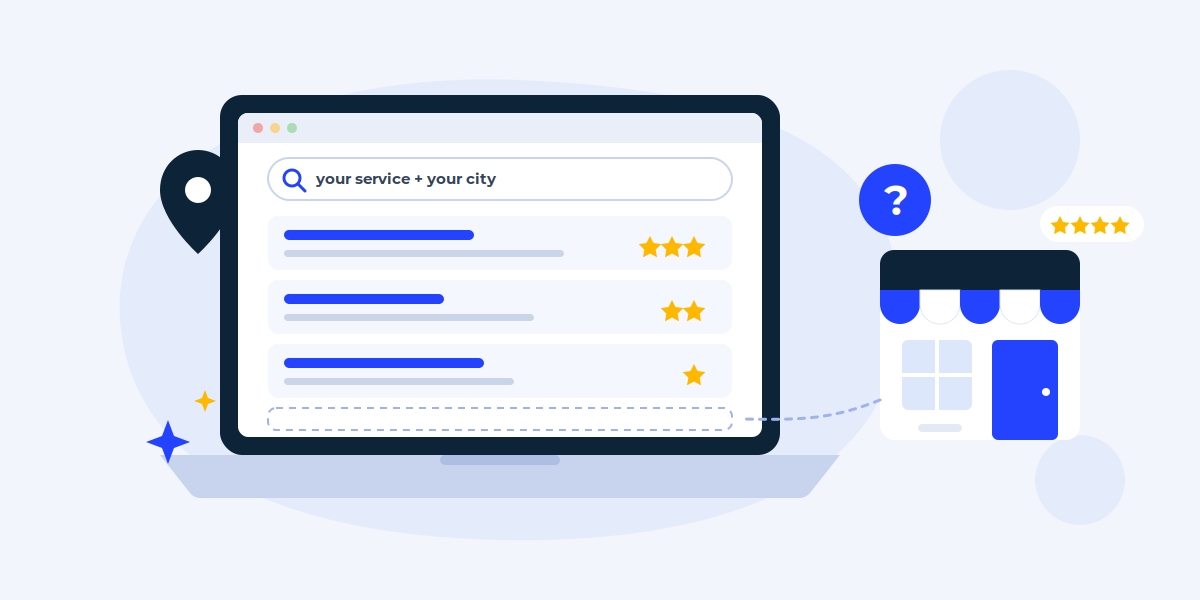
The owner has done everything the old way, and done it well: repeat customers, steady referrals, a solid local reputation. Then one evening they type their own service and city into Google, the way a new customer would. Competitors with a fraction of their experience fill the first page. Their own business is nowhere, sometimes not even when they search its exact name.
The question that follows is usually some version of “why isn’t my business showing up on Google?” For many established service businesses, the honest answer has little to do with how good they are. It has to do with whether search engines, and now AI systems, can read them, verify them, and confidently recommend them.
Word of Mouth Now Gets Checked Online
Referrals still matter, but what happens next has changed. A friend recommends a dentist or an attorney, and the next move is a search: the name, the reviews, the map listing, the website. Some now also ask an AI assistant for a short list before calling anyone.
A business that doesn’t appear, or appears with an outdated listing and a thin page, loses a customer who was already halfway through the door. Getting found online is no longer separate from word of mouth. It is where word of mouth gets confirmed.
A Good Website Isn’t the Same as a Findable One
Search engines don’t see a site the way visitors do. They read page titles, headings, and text to decide what each page is about. A homepage that crams every service into one paragraph tells Google very little, and without a dedicated page for each service, there is nothing specific to match against a specific search.
Details outside the website matter just as much. A Google Business Profile, directory listings, and review sites all carry the company’s name, address, and phone number. When those don’t match, search systems have less reason to trust any of them. A verified listing makes a business eligible to be found. It doesn’t make it findable.
“Most of the businesses I look at aren’t losing because they’re worse at what they do,” said Edmond Abramyan, founder of Curious Fortune Media. “They paid for a website that works like an expensive business card. It looks credible to a person, but it gives search engines almost nothing to read.”
The pattern is common at reputable firms, whose owners got a site that looked right and reasonably assumed the job was done.
Why Local Markets Reward Specificity
Google’s own guidance on local rankings names three factors: relevance, distance, and prominence. Relevance is how well a business matches the search, and distance is how far it sits from the searcher. Prominence, Google notes, draws partly on links from other websites and on reviews.
Relevance is where broad positioning quietly fails. Someone searching “emergency dentist open Saturday” is close to a decision, and that high-intent search rewards a page built for that exact need. A page claiming to serve all of Los Angeles with every service tends to draw broad, low-intent traffic that rarely calls.
Culver City shows how sharp that effect can be. Entertainment studios, tech companies, and direct-to-consumer brands compete for the same local attention in a compact area, and Curious Fortune Media points to it as a market where a clearly focused page tends to beat a general one in local search rankings.
Search Now Answers Before It Lists
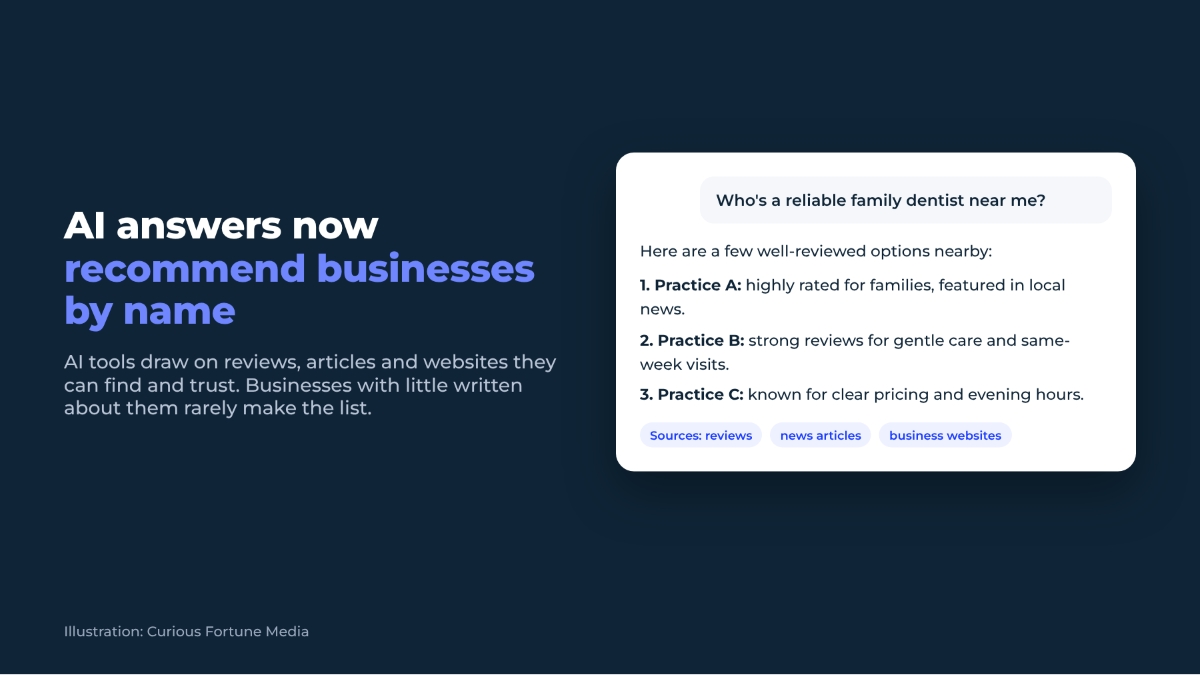
Google now answers many questions before showing links. AI Overviews are the summaries at the top of results; AI Mode is a conversational version of search. Both build answers from web sources and cite some of them.
A 2025 Pew Research Center analysis found people clicked a traditional result in 8% of visits when an AI summary appeared, versus 15% without one. That leaves many owners asking whether SEO is still worth it.
“People assume AI made search obsolete, but the AI still has to find its answers somewhere,” Abramyan said. “It pulls from sources it can check. A business that’s clear about what it does, consistent everywhere it’s listed, and mentioned on other sites gives it something to trust.”
That is the logic behind what Google calls E-E-A-T: experience, expertise, authoritativeness, and trustworthiness. Credentials, a real track record, and independent mentions help a system decide a source is safe to repeat. None of it warrants a mention, but as clicks shrink, being named inside the answer matters more.
Found, Trusted, Chosen: Why the Three Can’t Be Separated
Showing up is only the first step. A visitor still needs visible proof, such as credentials and outside references, and a page that makes the next step obvious.
Those pieces are often bought separately. One vendor handles SEO, another builds the site, and nobody owns how they fit together. Results feel inconsistent because the work is. That split is what Abramyan set out to close with the Authority Engine, which he developed for Curious Fortune Media to combine visibility, authority, and conversion into one system.
Many owners have been burned by marketing before. The answer is not avoiding it but knowing what to ask: which searches a plan targets, and how progress is measured beyond traffic.
For the owner who searched and found nothing, the gap was never about the quality of the work. It was about what search systems could read and verify. Visibility built this way tends to compound over months rather than weeks, and no one can honestly promise a specific ranking by a specific date.
An owner who searches the business name, the main service, and the city, then compares the name, address, and phone number on every listing that appears, often sees exactly why the business isn’t showing up on Google.
As AI answers take up more of the results page, the businesses that get named will be the ones that are clear, consistent, and referenced by others. Invisibility is rarely a verdict on the business. It is a problem with a fix.