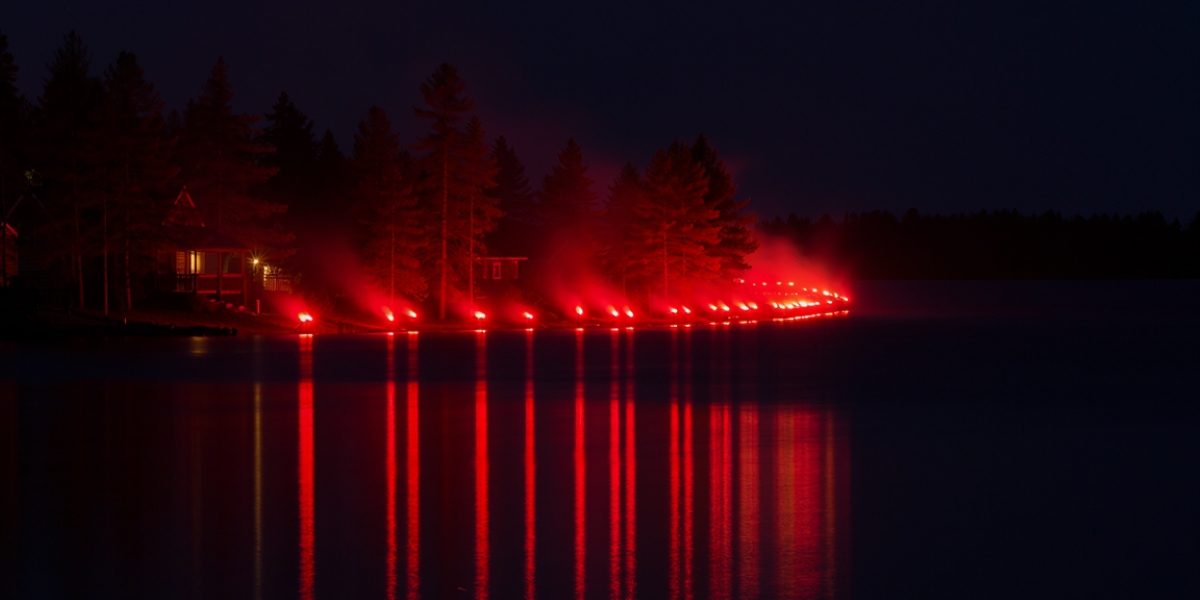

Most American communities observe Independence Day on the fourth. On Conesus Lake, in Livingston County, the significant date is the third – and it has been for the better part of a century.
The reason is the Ring of Fire, an annual tradition in which residents along the shoreline light flares simultaneously at 10:00 pm on July 3, producing a continuous band of red light around the water. Fireworks follow, launched from points up and down the lake. The Conesus Lake Association sponsors the event and distributes flares to participating households for a nominal fee.
A Local Calendar
The date has become sufficiently embedded that it functions as its own holiday in local usage.
“People say, what are you doing for the third? It’s an actual sentence that gets uttered quite frequently,” says Matthew Sharman, who was born and raised on the lake and sells waterfront property in the area.
Local reporting places the tradition’s organized origin in 1938, which would make it close to a century old. A further account, carried by the Conesus Lake Association and in county tourism materials, traces the practice back to Seneca gatherings around fires on the lake. That earlier account is local tradition rather than documented history, and is best treated as such – though it is the version Sharman grew up hearing, and the one most often repeated around the lake.
The scale is substantial for a lake eight miles long. Visitors arrive from well outside the county, and when July 3 falls on a weekend the convergence is considerable.
The Participation Model
What distinguishes the Ring of Fire from a conventional fireworks display is that the spectators and the performers are largely the same people.
“They, themselves, are part of the show,” Sharman says. Households along the shoreline are not an audience assembled to watch something staged for them; the lighting of the flares is distributed across virtually every property on the water, which means the display cannot happen unless a few hundred households independently decide to take part.
Sharman describes the effect as the lake celebrating together rather than hosting an event that happens to have water behind it. From the water, the ring is visible in both directions. From the air – and private aircraft have produced the most widely circulated images over the years – it resolves into the shape the name describes.
For anyone without lake access, the two established public vantage points are Vitale Park at the north end of the lake, which looks straight down the length of the water, and Long Point Park off West Lake Road. Sharman’s practical note on Vitale Park is that it fills early.
The tradition is not unique to Conesus within the region. Honeoye Lake holds its own Ring of Fire over Labor Day weekend, marking the close of summer rather than Independence Day.
What A Tradition Indicates About A Market
Sharman’s professional interest in the event is less about the evening than about what sustains it. A coordinated display requiring near-universal voluntary participation is a reasonable proxy for how a lake community actually functions – and that has changed less than the ownership around the lake has.
Conesus was historically a lake of local families in second cottages. A substantial share of the shoreline now belongs to owners who came from elsewhere. Sharman’s observation is that the tradition has absorbed them rather than thinned out, and that participating in it is one of the mechanisms by which newer owners stop feeling like visitors.
That matters commercially in a way buyers frequently underestimate. Lots on Conesus are narrow and close together; privacy is limited, and the practical experience of ownership depends heavily on how neighbors behave toward one another. Sharman says the owners who report the best experience are consistently the ones who treat proximity as an asset – offering unused parking when someone has family visiting, collecting misdirected mail, lending a hand with a task. His phrasing is that they make their neighbors friends rather than neighbors.
Amenity and community factors are difficult to quantify and tend to be omitted from listing data entirely, but on a small lake they shape demand in ways that square footage and frontage figures do not capture.
For a buyer weighing a property on Conesus, the operative question is not whether the Ring of Fire is worth attending. It is whether the communal model it depends on is the model they want to live inside – because on a lake this tightly built, it is not really optional.
About the Expert: Matthew Sharman leads The Sharman Team at Real Broker NY LLC, serving Greater Rochester, the GLOW region, and the western Finger Lakes, with particular focus on Conesus Lake and Livingston County lakefront property.
Disclaimer: This article is based on information provided by the expert source cited above. It is intended for general informational purposes only and does not constitute legal, financial, or real estate advice. Readers should conduct their own research and consult qualified professionals before making any real estate or financial decisions.