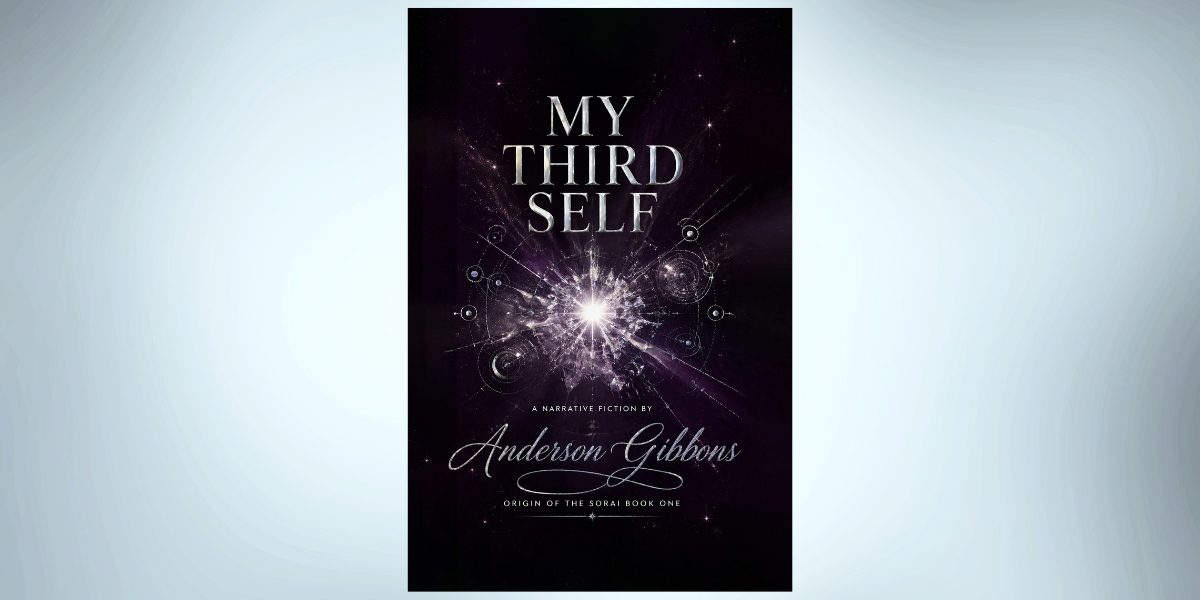

There are fantasy novels that build kingdoms. There are fantasy novels that build wars. Anderson Gibbons seems more interested in building something harder to map: the inner life of a being who has lived too long, remembered too much, and still cannot stop reaching for the people he loves.
His upcoming novel, My Third Self, opens with a striking idea. A person is not only who they are now. They are also who they were, and who they may still become. For most stories, that would be a metaphor. In Gibbons’ world, it becomes the structure of existence itself.
The book introduces Oryious, a powerful consciousness whose identity is divided across three selves. His First Self carries the weight of past mistakes. His Second Self stands inside the present moment. His Third Self guards the potential future, the version of him that has not yet arrived but already matters. From that premise, Gibbons creates a fantasy world shaped by Time, Light, Death, memory, hidden planes, powerful houses, and family bonds that refuse to loosen.
The result is not a simple escape story. My Third Self is dense, strange, emotional, and ambitious. It asks readers to step into a realm where memory has force, language has consequence, and time does not move cleanly from one moment to the next. Characters do not simply remember the past. They move through it, suffer from it, try to protect others from it, and sometimes fear what it might still reveal.
That emotional weight is no accident. In the book’s acknowledgments, Gibbons writes openly about the personal road that led him to fiction. He describes writing as a way of coping with feeling out of place, and later as a way to endure the death of his brother and life after military service. That background gives My Third Self a pulse beneath its cosmic scale. The novel may move through planes of existence, but its deepest concern is recognizably human: What do we do with grief when it refuses to leave us?
The dedication adds another layer. Gibbons dedicates the book to his brother, Torey Dwayne Gibbons, and to Lynnise and Dwayne, whom he says inspired two of his most powerful characters. That choice makes the book feel less like a private mythology invented for spectacle and more like a monument built out of memory.
In an age when fantasy readers have become increasingly drawn to large, immersive worlds, My Third Self arrives with the confidence of a book that wants to be entered slowly. Its mythology is not decorative. The houses of Time, Light, Death, Body, Life, Knowledge, and Wisdom shape the moral and emotional rules of the story. Power is not just something characters wield. It is something that tests them.
Oryious’ world is filled with threats, but the most compelling tension comes from protection. Fathers fear for sons. Friends carry burdens for one another. Children inherit more than they understand. Secrets become both shield and poison. The book returns often to the question of whether withholding the truth can ever be an act of love, especially when truth itself has the power to destroy.
That is where Gibbons’ fantasy feels most contemporary. Beneath its invented language and cosmic architecture is a story about legacy. What do we pass on? What do we hide? What do our children inherit from the pain we never explain? These questions give My Third Self its emotional seriousness.
The book’s title works on more than one level. It suggests transformation, but not the clean, inspirational kind. The Third Self is not simply a better self waiting at the end of struggle. It is a possible self, a guarded self, a future that may be lost if the wrong choice is made. In Gibbons’ hands, becoming is not guaranteed. It is fragile.
That idea gives the novel its quiet urgency. Readers who come to My Third Self expecting a conventional fantasy adventure may find something more unusual: a story about time as memory, memory as burden, and family as the one force that keeps pulling the characters forward.
The ideal fantasy often makes impossible things feel emotionally true. Gibbons’ world is filled with concepts that stretch beyond ordinary experience, but the feelings beneath them are familiar. Regret. Fear. Love. Responsibility. The wish to go back. The knowledge that one cannot.
For readers who like their fantasy layered, philosophical, and emotionally charged, My Third Self offers a world that does not hand over all its answers at once. It asks for attention. It rewards patience. And at its center is a question that lingers long after the premise is understood:
What if the self you have not yet become is the one everything depends on?