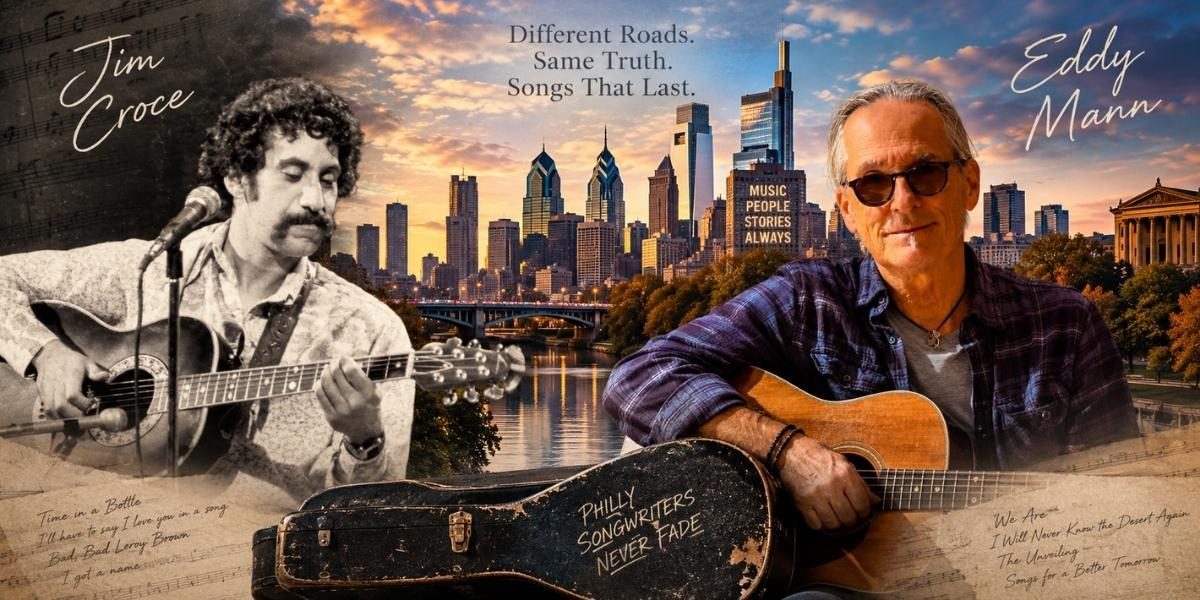

Photo Credits: MTS Management Group
By: Nate Cross
Some songwriters seem determined to conquer the world. Others are more interested in understanding the people living in it.
Jim Crocebelonged unmistakably to the second group. So does Eddy Mann.
Separated by generations and different artistic missions, Croce and Mann nevertheless occupy neighboring territory in the great American singer-songwriter tradition. Both understand that a song doesn’t need to shout when a conversation will do. Both gravitate toward ordinary human experience. And both recognize that some of life’s largest questions become more powerful when expressed through small moments.
Jim Croce and the Art of Making Life Sound Like a Song
Croce’s recording career was tragically brief, but the songs he left behind have displayed extraordinary durability. “Time in a Bottle,” “Operator (That’s Not the Way It Feels),” “I Got a Name,” “I’ll Have to Say I Love You in a Song,” and “Bad, Bad Leroy Brown” revealed a songwriter capable of moving effortlessly between tenderness, humor, character sketches, and melancholy.
His great gift was accessibility without shallowness.
“Operator” begins with something almost painfully mundane: a man trying to make a telephone call. Yet beneath that ordinary situation lies heartbreak, wounded pride, and the painful realization that a relationship has already disappeared.
“Time in a Bottle” takes an equally familiar human desire, the wish for more time with someone we love, and makes it feel eternal.
Croce didn’t need elaborate production to create those worlds. His voice, guitar, and eye for detail did most of the work.
That same preference for human-scale storytelling offers an interesting way into Eddy Mann’s music.
Eddy Mann’s Songs Point Somewhere Beyond the Story
Mann’s career has unfolded over decades rather than the handful of breakthrough years Croce was afforded. The Philadelphia-area singer-songwriter, musician, worship leader and minister has released an extensive catalog combining elements of folk, contemporary Christian music, worship and, increasingly, jazz.
His songs often begin where Croce’s did: with the realities of being human.
The difference is where Mann ultimately looks for the answer.
For Mann, songwriting and ministry have become inseparable. Faith isn’t merely a subject added to his music; it provides the lens through which he interprets love, hardship, uncertainty, mortality, and purpose.
That perspective is particularly evident on The Unveiling, his ambitious album inspired by the Book of Revelation.
Revelation might appear to be about as far from the intimate singer-songwriter tradition as imaginable. It contains visions of cosmic conflict, judgment, and eternity. Yet Mann approaches it with surprising intimacy.
Instead of concentrating on apocalypse, he searches for reassurance.
On “I Will Never Know the Desert Again,” Mann draws from Revelation’s promise of an end to hunger and thirst and turns it into something personal, a meditation on surviving life’s desert seasons and believing suffering isn’t permanent.
His single “We Are” takes another unconventional path. Inspired by Revelation 4:8b and 4:11, the song blends contemplative worship with sacred jazz and unfolds naturally in 5/4 time.
The lyric circles around an elemental idea: humanity is created with purpose.
Mann has also connected the song to his belief in brotherhood and sisterhood. Where contemporary culture often encourages people to identify themselves according to what separates them, Mann emphasizes the collective.
We.
Different Destinations, Similar Instincts
No one would mistake Jim Croce and Eddy Mann for the same kind of artist.
Croce emerged from the early-Seventies folk and singer-songwriter boom, transforming bars, highways, relationships and unforgettable characters into compact pieces of American storytelling.
Mann’s musical universe is explicitly Christian. Scripture, worship and ministry occupy spaces in his work that they did not in Croce’s.
Yet their songs share an important instinct: start with the human being.
Croce understood that loneliness could live inside a telephone conversation.
Mann understands that theology can live inside a personal struggle.
Croce could contemplate mortality by imagining time stored inside a bottle. Mann can approach eternity by imagining the day when the desert finally disappears.
Neither approach requires bombast.
That’s especially significant in Mann’s work. Contemporary worship can lean toward enormous production and equally enormous emotional crescendos. Mann frequently moves in the opposite direction, allowing the song to breathe.
It’s the old singer-songwriter principle: if the idea is strong enough, you don’t have to chase the listener.
Songs That Outlive the Moment
Perhaps the most poignant connection between these two songwriters involves time itself.
Croce died in a plane crash in 1973 at only 30 years old, just as his career was reaching extraordinary heights. The existence of “Time in a Bottle” consequently acquired an emotional resonance its writer could never have anticipated.
Mann has been granted the longer road.
After decades of recording and ministry, he still speaks about the future with curiosity rather than finality. His work continues to evolve, but his fundamental mission remains remarkably consistent: love one another.
Croce wrote about how quickly life disappears.
Mann writes about what might remain when it does.
Somewhere between those two perspectives lies one of songwriting’s oldest purposes.
A song captures something temporary, a conversation, a heartbreak, a prayer, a moment of revelation, and gives it another life.
Jim Croce mastered that art in remarkably little time.
Eddy Mann has spent decades pursuing it.
And both remind us that sometimes the shortest distance between one human heart and another is still nothing more complicated than a voice, a few chords, and something worth saying.