Spirit, Love, and Music: How Walt Alexander’s Book on John Coltrane Is Bringing Faith and Jazz History to a New Generation

The children’s book that turns one of jazz’s famous falls and comebacks into a story of grace is now headed for the screen, with a movie adaptation in development to carry John Coltrane’s story of faith and redemption to a much wider audience.
Some stories about faith begin in a church pew. This one begins in a Navy uniform, on the deck of a ship, with a young man praying for a country he had just watched a war destroy.
Long before A Love Supreme became one of the celebrated recordings in American music, John Coltrane was a boy in Hamlet, North Carolina, watching his father hem a stranger’s coat, and his grandfather preach to a congregation that trusted him completely. Both men were, in their own way, in the business of fixing things: one mended clothes, the other mended souls. Then, within months of each other, both died. Coltrane was still a child. Music became the thing that held him together.
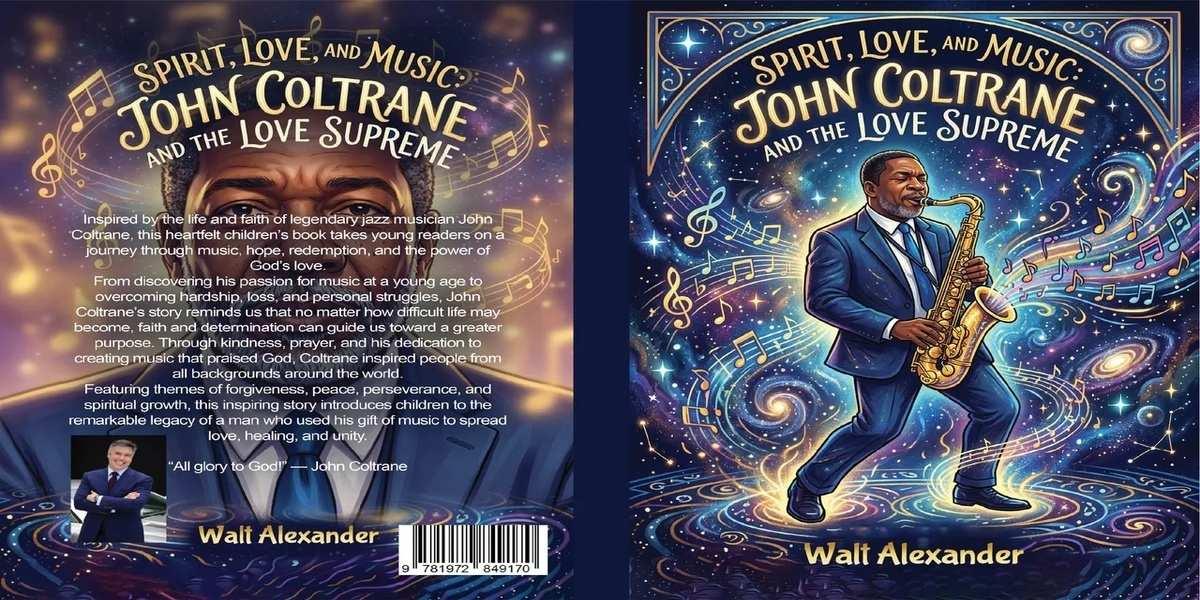
That origin story, and everything that followed it, is the subject of Walt Alexander’s Spirit, Love, and Music: John Coltrane and the Love Supreme, a picture book that tells Coltrane’s life not as a jazz history lesson but as a testimony. It is a story that has already reached young readers, and it is now set to reach a great many more.
A Story Built on Rock Bottom, Not Just Genius
Most tellings of Coltrane’s life linger on his technical brilliance, the “sheets of sound” that reshaped the saxophone. Alexander’s book takes a different route. It moves through Coltrane’s brief Navy service during World War II, where he witnessed the devastation of postwar Japan and prayed for a peace he would spend the rest of his life trying to make music out of. It follows him home to addiction: years of heroin and alcohol that cost him gigs, his reputation, and, for a time, his sense of who he was.
The book does not soften that chapter. It shows a man on his knees, surrounded by the wreckage of his own choices, before it shows him rebuilding. The turning point, as the book tells it, came through a friendship with fellow musician Eric Dolphy and a private vow Coltrane made to God, his family, and himself: no more drugs, no more alcohol.
What followed was a vision Coltrane described of visiting God in Heaven and asking only one thing: to give pleasure to people through music.
- What does it actually take to turn addiction and loss into a legacy of grace?
- How does a single promise, kept quietly for years, become a piece of music still studied and performed six decades later?
- And what does a picture book do with material this heavy, and still leave a child feeling hopeful?
Four Parts, One Prayer: A Love Supreme as the Book’s Spine
The album that gives the book its subtitle structures its final act. Alexander walks readers through the four movements Coltrane composed as an act of worship: Acknowledgment, Resolution, Pursuance, and Psalm, pairing each with the scripture that echoes it. Acknowledgment sits beside Christ’s words in John 14: “Let not your hearts be troubled.” Resolution answers Peter’s call in Acts 3 to “repent and turn to God.” Pursuance chases Matthew 6’s promise to “seek first the kingdom of God.” Psalm closes the circle with David’s charge in Psalm 100 to “enter His gates with thanksgiving.”
It is an unusual structure for a children’s book, treating a jazz record as a devotional in four parts. It is also precisely what makes the book resonate with adults who pick it up expecting a simple biography and find something closer to a testimony of forgiveness.
Why It Reaches Past the Children’s Shelf
Coltrane died of cancer in 1967, not long after a final tour of Japan where he performed for audiences still living with the aftermath of the war he had once prayed over, and wrote a piece called “Peace on Earth” for them. Alexander’s book closes on that note, and on Coltrane’s own signature phrase, repeated throughout his life and his liner notes alike: “All glory to God.”
That closing is the book’s real argument. Coltrane’s story, as Alexander tells it, was never really about jazz innovation for its own sake. It was about a man who fell, asked for forgiveness, got back up, and spent the rest of his life trying to be kind to people of every background and every faith, because he had come to believe God loved them all. Coltrane’s ongoing legacy through organizations like Kids for Coltrane is proof the story never stopped being useful to people well outside the jazz world.
The Author Behind the Story
Walt Alexander wrote Spirit, Love, and Music not as a music-history primer, but as a testimony he wanted young readers to inherit. What comes through across the book’s forty-plus pages is a storyteller more interested in redemption than in résumés, someone who found in Coltrane’s life a template for talking to children about faith, failure, and second chances without flinching from any of the three. The book’s dedication says as much in its own quiet way, offered to his parents “experiencing the Love Supreme,” and to a young reader named Sammy, urged to remember that faith, hope, and love in God, in yourself, and in others are the tools to make every dream come true. It is a small detail, but it tells you exactly what kind of book this was always meant to be: personal first, instructional second.
From the Page to the Screen
Spirit, Love, and Music is now moving beyond the page. A movie adaptation of the book is currently in development, built to carry Coltrane’s story of struggle, faith, and redemption from a children’s bookshelf to a much wider, cross-generational audience. The goal behind the adaptation is the same one that drove the book itself: put a message that has already resonated with young readers- that a fall is never the end of the story- in front of viewers who have never picked up the book at all.
When it arrives, the film will do for the screen what the book already does for the page: take a story usually confined to album credits and liner notes and hand it instead to anyone who has ever needed to believe that falling down is not the same thing as being finished.
A tailor’s son does not choose to become a legend…
A relapse does not have to be the last word on a life…
A promise kept quietly, one difficult day at a time, can still be composing music sixty years after the man who made it is gone…
All glory to God, Coltrane said. Sixty years later, his story is still finding new ways to say it back!
Author Name: Scout Walt
Book Title: Spirit, Love, and Music: John Coltrane and the Love Supreme
Published by: City Light Publishers