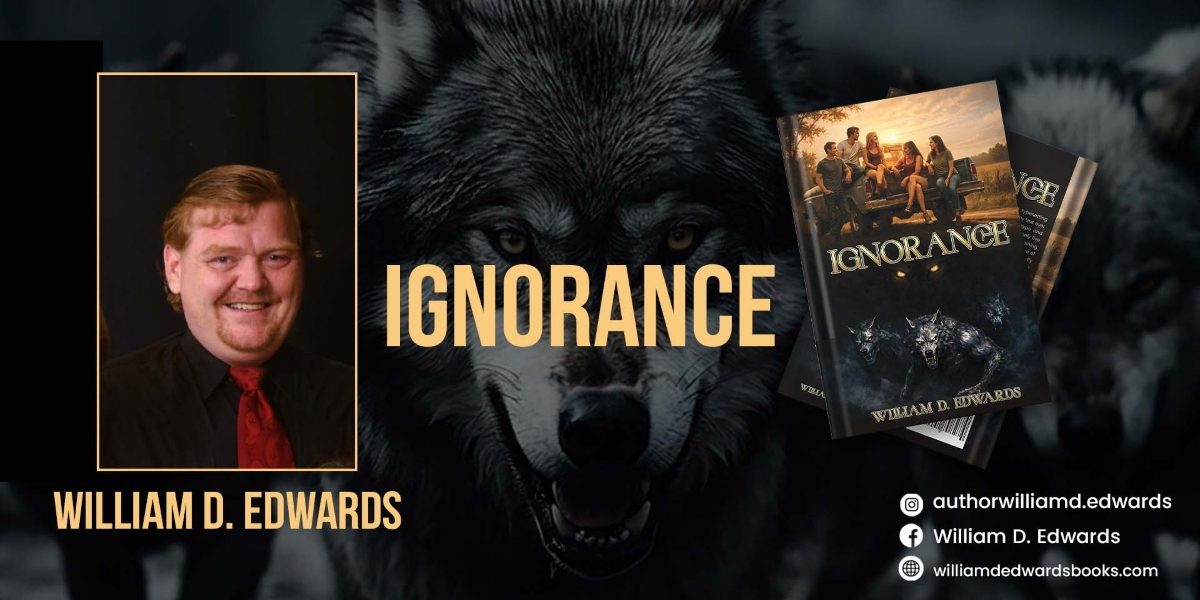

What if the scariest thing in the dark is not the monster itself, but the moment we finally learn it has always been there? In Immortals Ignorance, William D. Edwards builds a supernatural story around that dark idea. Vampires, werewolves, witches, hunters, hidden societies, family secrets, and ancient myths all move through the book, but behind them is a deeper question: how much of the world do we never truly see, and are we safer because of it? For Edwards, this book did not appear overnight. It is the result of a story that has lived in his mind since he was a teenager. He tried to write it more than once, but life and old technology got in the way. Early computer crashes cost him versions of the manuscript, and for a long time the idea remained unfinished. Still, the story never left him. After nearly twenty years of growing, changing, and waiting, he finally found the time to place those thoughts on paper.
That long creative history can be felt in the book’s main character, David Tagart. David begins as an ordinary teenager in Cherrywood, dealing with school, work, crushes, embarrassment, and friendship before the supernatural world crashes into his life. Edwards explained that David’s earliest roots came from his own high school years, when he and a friend created fantasy characters together. Over time, David changed through different influences, but the heart of the character remained. In many ways, David is written from a very personal place. Edwards said that David’s dialogue and reactions often came naturally because he asked himself how he would respond in David’s position. That is why the opening chapters matter so much. Before David is pulled into the world of immortals, readers see him as a young man with everyday concerns. He is nervous around Tiffany Stillwater, annoyed by history class, trying not to be late for work, and surrounded by people who feel real. His life at the drive-in, especially the banter with Sheila, Tower, Amanda, and the others, gives the story warmth before danger takes control. Edwards shared that the workplace dialogue was some of the easiest for him to write because it came from his own experience working in a fast-paced food-service environment, where people teased each other loudly, argued, cared, and kept moving.
One of the most personal figures in the book is Sheila. Edwards revealed that she was inspired by a real manager he worked under at Sonic, someone who took him under her wing and helped him grow. He spoke about her with visible emotion, explaining that he had recently lost her to cancer. That knowledge changes how readers may view Sheila. On the surface, she is sharp, bossy, and quick with a comeback. Underneath, she becomes a tribute to someone who shaped the author’s life. Her toughness is not coldness. It is a form of care. The same blend of memory and imagination appears in Mr. Gunthorpe, the strict teacher whose presence becomes far more important than readers may first expect. Edwards based him partly on a real teacher he remembered clearly from school: a good teacher, but one who could “flip a switch” from kind to intimidating. In the novel, that quality fits perfectly. Gunthorpe begins as a harsh authority figure, but the story later reveals a darker, supernatural role. The ordinary classroom becomes part of a much larger hidden design.
The supernatural foundation of Immortals Ignorance began with Edwards’s interest in vampires and werewolves, partly inspired by the film Underworld. Yet he did not want to stop there. He added another species and began shaping a broader mythology that reaches beyond one town or one conflict. The first book introduces the world; the second, which he said he is already halfway through, will explain more about where these species come from. His larger plan is even more ambitious. He wants David’s story to expand across the world, touching Native American myths, Incan and Aztec traditions, pirate legends connected to the Bermuda Triangle, Celtic and Norse mythology, Asian pantheons, and stories from Australia. This is where Edwards’s purpose becomes clearer. He is not using mythology only for decoration. He wants readers to become curious about the myths themselves. He sees them as rich, meaningful stories filled with lessons, beauty, and old wisdom. By placing his own characters inside those traditions, he hopes to encourage readers to look deeper into the legends that different cultures have preserved.
The title Immortals Ignorance also carries major weight. Edwards described ignorance, knowledge, and wisdom as three stages: ignorance is not knowing, knowledge is knowing, and wisdom is knowing how to use what has been learned. Those ideas form the planned titles of the first three books. In this first installment, ignorance is not only a weakness. It is also a strange form of protection. David could have lived his whole life without knowing immortals existed if he had never gone to the old mill. Many people in the book live peacefully for years because they never see the monsters hiding near them. As Edwards put it, once the monsters in the dark are exposed, that is when fear truly begins. The old mill scene is the turning point. Tiffany’s invitation pulls David away from his ordinary life and into a world he does not understand. Edwards said he has even thought about what would have happened if David had refused. In his view, someone still would have had to step into that role. That idea makes David feel less like a random victim and more like someone caught in a larger pattern, one that would eventually demand a price from somebody.
Edwards also spoke about the characters who continue to interest him most. The Hunter stands out for him because writing that character allows him to explore history, conflict, and moral complexity. He also believes the Hunter may be morally justified, even when readers might disagree. Tower, on the other hand, represents heart. Edwards said that if he could sit down with one character, it would be Tower, because Tower may not be the smartest person in the group, but he carries a gentle wisdom and a strong goodness that the author values. The hardest material for Edwards involved the interaction between William, David, and the Hunter near the final battle. By that point, the characters carry history, pain, and opposing perspectives. Edwards said the book truly came alive for him right before the final fight, when he entered David’s mind in a way he had never reached in earlier attempts. Since this was the fifth version of the story, finally reaching that moment made the novel feel real and complete.
He also admitted that the introduction took the most effort. He tried many versions and still wonders if he fully captured what he wanted. That honesty says a lot about him as a writer. He is not only building action scenes or supernatural rules; he is trying to catch the right feeling, the right doorway into a world where legends breathe beside human life. The main idea of Immortals Ignorance is not simply about vampires, werewolves, or battles. It is about perspective. Edwards does not see one clear monster in the story. Each character acts from a motive: protection, survival, fear, pride, loyalty, ego, or love. Even Alexander, the antagonist, is shaped by his own damaged need to protect himself and his pride. This makes the story more layered than a simple fight between good and evil. By the end, Edwards hopes readers will think about their place in the world and how much they do not know. That question lingers beyond the final page. Maybe ignorance is bliss. Maybe knowledge is terrifying. Maybe wisdom begins when we accept that the world is larger, stranger, and more complicated than we ever imagined. For William D. Edwards, Immortals Ignorance is only the beginning of that discovery.