
By: Elena Mart
EliteLink Women Foundation
Ten students. Ten real projects. One afternoon in New York that left an audience asking how kids this young had already built so much.
AUGUST 29 · MIDTOWN MANHATTAN, NEW YORK CITY
155 ATTENDEES
10 STUDENT PROJECTS
10th–11th GRADE LEVELS ON STAGE
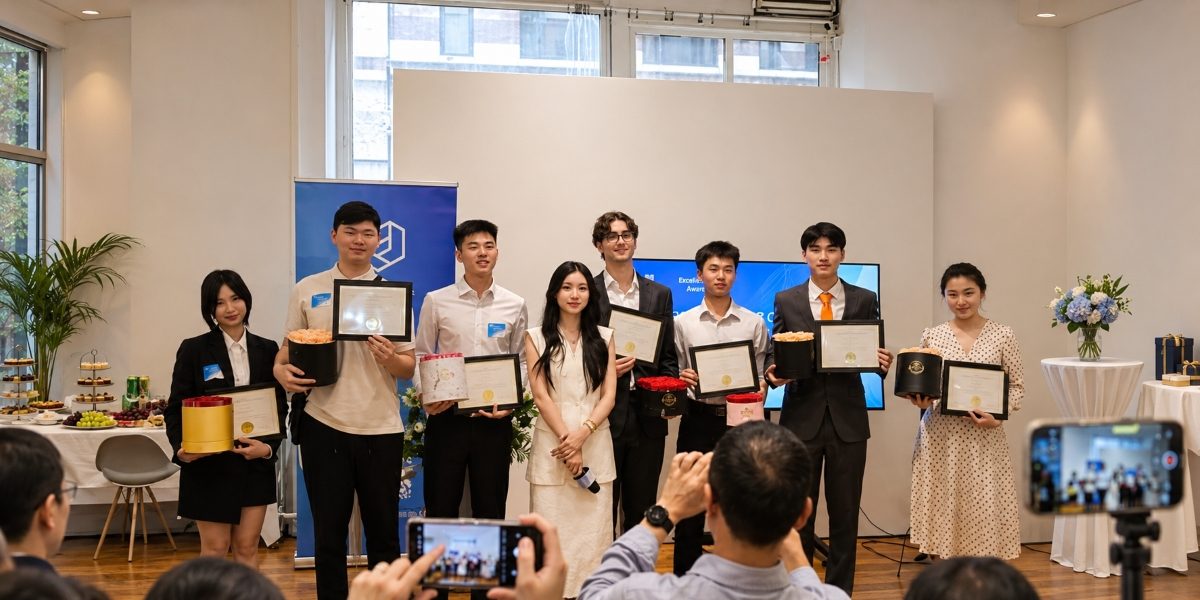
The EliteLink Next Gen Summit closed in Midtown Manhattan on August 29 to a room far fuller than anyone expected, with 155 people in attendance. Over a single afternoon, ten high school students presented ten real, ongoing projects: startups and nonprofits, art and research, artificial intelligence and financial education, consumerism research and Asian immigrant issues. Again and again, the audience marveled at the same thing: “They’re only in 10th and 11th grade!”
Those of us sitting in the audience knew the fuller story. These projects reached the stage not because the students suddenly became impressive, but because they had been working for over a year, trying, revising, scrapping, and restarting, with mentors beside them the whole way. From zero, step by step, an idea became a project that walks in the real world. That is the education EliteLink wants to deliver.
These were not ten versions of a standard answer. Each project began somewhere different, and each carries its own student’s thinking. Behind every student on that stage stood the EliteLink Education mentor team, handling project guidance, book publishing, website production, and speech training, building each piece by hand, from 0 to 1.
What Eight Students Presented at the Next Gen Summit
Eight student founders took the stage at EliteLink’s Next Gen Summit to pitch what they’d spent nearly a year building. Below are eight of their stories, shared with our EliteLink Women Foundation community.
Kailey, From a Labubu Poem to a Study of Consumerism: Kailey opened with a poem about Labubu. Yes, the plush toy. From there, she followed the thread, from a viral craze to buying behavior to the psychology underneath. The project started with an honest question, “Why do we want to buy things?” and, with mentors’ help, became real research: framework, data, a website, a stage-ready talk. Curiosity, refined step by step into scholarship.
Maxi, Meet Max: Maxi flew from Switzerland to New York for this event, then flew straight back for the first day of school. His project, Meet Max, is a social app exploring how young people find their community. That’s what real conviction looks like: believing in an idea enough to cross an ocean for a ten-minute pitch. EliteLink mentors built it with him from the ground up, covering product logic, UX, business model, website, script, slides, and rehearsals.
Athena, Beyond Blossom, and a Book Called Psyche: Athena presented her nonprofit, Beyond Blossom, alongside her newly published book, Psyche. What stood out wasn’t the scale of what she’d done. It was how clearly she could say why it matters. Mentors helped her turn a broad concern into a sharp story, from choosing the book’s topic through writing and editing, from nonprofit setup to stage presence. The goal was never polish for its own sake. It was helping her find the reason the story needed telling.
Leon, Lazy Alpha: Leon’s platform, Lazy Alpha, introduces young people to financial literacy earlier. On stage, he was calm and precise, but that composure was earned, not natural. It came from months of practice and mentors who challenged every assumption. Who exactly is your user? Does your market analysis hold up? Can you defend this live? Each hard question moved the project one step closer to real.
Bill, Office Automation Software: Bill is usually the quiet one. So when he showed up with ten slides, the team quietly wondered if he’d get through them. He didn’t just get through them. He owned the room, walking the audience through his office automation software feature by feature, completely in his element. Some kids aren’t short on words; they just haven’t found the subject worth talking about yet. Mentors helped him turn a technical walkthrough into a story anyone could follow, without sanding down his passion or putting words in his mouth.
Hanson, Where Fashion Meets Mental Health: Hanson paired his fashion label with a nonprofit for youth mental health, asking a disarmingly serious question: can fashion do more than self-expression? His creativity showed in what he made and in how he reframed what fashion can mean. Mentors supported the search, covering brand positioning, a workable nonprofit model, website design, and the case for social impact. They never handed him the answer; they helped him arrive at his own.
Richard, Immigration, Civic Life, and the Asian American Story: Richard’s research traced Asian immigration and civic participation across generations, how immigrant work changed with the eras, how Asian Americans’ role in public life evolved, and what young people can do next. He didn’t stop at gathering facts. He formed his own questions and judgments. Mentors helped build the research muscles: reading together, debating, interrogating sources, teaching him not what to think, but how.
Leo, Own Your Bloom: Leo’s AI e-commerce brand platform, Own Your Bloom, took him from an idea all the way to pitching actual investors. What we’re proudest of is the road there: idea to product, product to brand, brand to business model. His motto says it best: “Have an idea? Try it. Hit a problem? Solve it. Don’t know the answer? Go find it.”
A Round Table Bigger Than “How to Get In”
Three guest panelists joined the students.
May Ling Lai: former Wall Street professional with experience at Goldman Sachs and Morgan Stanley, adjunct professor of data science, and EliteLink mentor.
Lisa Patti: SVA professor; Broadway voice coach.
Bolong Li: VP at Amazon Audible and lecturer at Columbia Business School.
The prompt was deliberately bigger than college admissions: not just how to get in somewhere, but how to build something of your own one day. Students put candid questions to people working across business, education, and the arts, and got a first glimpse of a world where their ideas might actually live. That’s the ecosystem EliteLink is building, with admissions as the starting point, capability as the journey, and careers and ventures as the horizon.
The Mentors and Their Hardest Questions
Nearly a year of mentoring went into a single day on stage: shaping project direction, publishing books, designing websites, rehearsing talks. But mostly, mentors did something harder than giving answers. They asked questions. “Why?” “Are you sure?” “What if someone disagrees?” “Does your data actually prove that?” “How would you answer an investor?” “What if users don’t want it?” “What if it fails?” Then they waited while each student found their own answer. The goal was never a polished, obedient kid. It was a young person who can think, speak, judge, and act for themselves.
The Longer Road After the Summit
August 29 was never really about one summit. It’s about the longer road: helping students discover what they’re good at, turn small ideas into things that touch other people, stumble, restart, and learn to face the real world asking, Who am I? What problem do I want to solve? What can I create?
Admissions can be the starting point of an education, never the finish line. What we hope students take from EliteLink isn’t just an application file, but the ability to express, create, lead, and solve problems, and the nerve to face an uncertain future.
We don’t package students. We help each one find their own track and walk it, from 0 to 1, beside them.