
Stanchions are widely used to organise queues, guide pedestrians and temporarily restrict access in environments ranging from airports and retail stores to events, hotels and public buildings. While they may appear relatively simple, the type of stanchion selected can make a significant difference to how effectively a space is managed.
Queue Tech offers a broad range of stanchions designed for different crowd control and pedestrian guidance applications. Its range includes slimline and standard retractable belt posts, larger 75 mm posts, single-, dual- and triple-line configurations, long-span barriers and traditional post-and-rope systems.
The differences are not purely aesthetic. Post diameter, belt length, webbing width, base design and material all influence where a particular stanchion is best used.
1. Slimline 50 mm Stanchions
At the compact end of the Queue Tech range are its Slimline 50 mm (2-inch) stanchions.
These use a relatively narrow post profile, making them well suited to pedestrian guidance where operators want to minimise the visual and physical footprint of the barrier.
Queue Tech’s Slimline models are available with approximately 3.9 m (13 ft) of 50 mm webbing or 3.5 m (11 ft) of wider 75 mm webbing, depending on the configuration.
They are available in polished and brushed stainless steel as well as powder-coated black, grey, red and yellow finishes.
For everyday queues, event entrances, retail environments and other areas where space is at a premium, a slimline stanchion can provide pedestrian guidance without introducing an unnecessarily bulky barrier system.
2. Standard 63 mm Stanchions
Queue Tech’s Standard 63 mm (2.5-inch) stanchions provide a more substantial option for general crowd control.
These posts can be configured with 50 mm webbing extending approximately 3.9 m (13 ft) or wider 75 mm webbing extending approximately 3.5 m (11 ft).
Importantly, the range is not restricted to conventional single-belt posts.
Queue Tech also offers single-, dual- and triple-line configurations, allowing the barrier system to be selected according to the level of pedestrian separation required.
For many conventional applications, including events, airports, retail, ticketing and public-facing environments, a single-line configuration may be sufficient. Dual or triple-line configurations create a more substantial boundary where greater separation is desirable.
3. Plus 75 mm Stanchions
For larger spaces, Queue Tech’s Plus 75 mm (3-inch) stanchions combine a wider post profile with belt lengths of up to approximately 4.9 m (15 ft).
The additional reach can be particularly useful when fewer posts are desirable.
For example, covering a wide entrance using short belts can require several posts and bases. Using an appropriately specified longer-belt stanchion can reduce the amount of equipment needed while making installation and reconfiguration simpler.
However, longer does not automatically mean better.
The belt length still needs to correspond with the actual span being controlled. Excessively long spans can introduce belt sag, while using belts that are unnecessarily short can increase the number of posts, bases and storage space required.
4. Utility 10.6 m Stanchions
One of the more unusual products within the Queue Tech range is its Utility 75 mm (3-inch) stanchion, which provides approximately 10.6 m (35 ft) of retractable webbing.
At this length, the application begins to move beyond conventional queue formation.
Instead, a long-span stanchion can be used to temporarily define or restrict access across a much wider opening without positioning numerous posts across the area.
This can be useful where access requirements change frequently and operators need to open or close larger areas quickly.
5. Max 22.8 m Stanchions
Queue Tech extends the same concept further with its Max 75 mm (3-inch) range, capable of extending approximately 22.8 m (75 ft).
A belt of this length serves a very different purpose from the belt used to form a conventional customer queue.
Rather than creating several tightly controlled queue lanes, extra-long stanchions are better considered for large-span access restriction and area definition.
This illustrates an important point when comparing stanchions: the product with the longest belt is not necessarily the best product.
The correct belt length depends entirely on the space and application.
6. Single-Line Stanchions
The conventional single-line stanchion remains the most recognizable crowd control configuration.
One retractable belt creates a clear visual boundary between two posts. This is generally sufficient for normal adult pedestrian queues, ticketing areas, entrances and everyday customer-flow management.
The simplicity of the system also makes single-line stanchions quick to reposition when queue layouts change.
7. Dual-Line Stanchions
Queue Tech also produces stanchions with two retractable belts.
Adding a lower belt creates a more substantial boundary and can be particularly useful in environments with mixed-age pedestrian traffic.
A conventional belt positioned at adult waist height can sometimes be passed underneath by children. A second lower belt makes the boundary more obvious and discourages this behaviour.
Dual-line systems can therefore make sense where operators want greater pedestrian separation without moving to a completely rigid barrier.
8. Triple-Line Stanchions
For applications requiring an even more substantial pedestrian boundary, selected Queue Tech stanchions can be configured with three retractable belts.
Triple-line stanchions create a much stronger visual boundary than conventional single-belt posts and can be considered for environments where pedestrian separation needs to be particularly clear.
However, it is important to distinguish crowd control equipment from physical safety or security barriers.
Adding additional belts does not turn a portable stanchion into a protective fence or vehicle barrier. Where people need protection from significant hazards, appropriate purpose-designed safety equipment should always be specified.
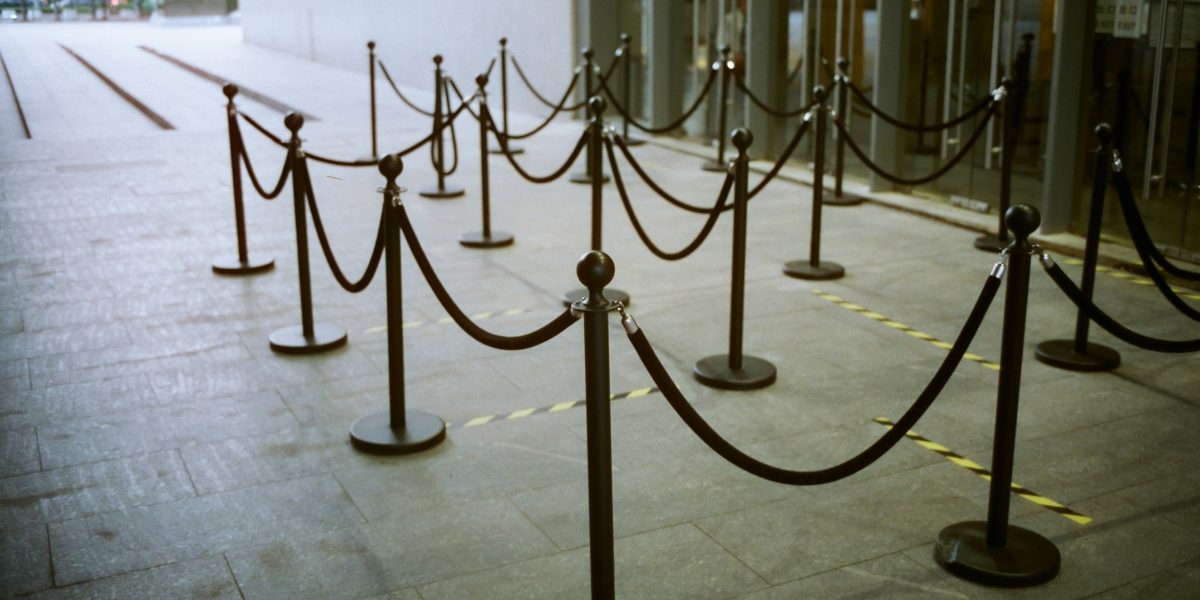
9. Post-and-Rope Stanchions
Retractable belts are not the only option in Queue Tech’s stanchion range.
For more elegant environments, the company also offers traditional post-and-rope stanchions.
These are available with different decorative post designs, including flat-top, crown-top and ball-top posts, along with polished stainless steel, polished brass and brushed brass finishes.
Different rope styles and fittings can then be used to complement the surrounding environment.
This makes post-and-rope barriers particularly relevant to hotels, VIP areas, premium entrances, exhibitions, theaters and other locations where the barrier contributes to the presentation of the space.
The distinction between the two systems is largely functional:
Retractable belt stanchions priorities flexibility and operational queue management, while post-and-rope stanchions combine pedestrian guidance with a more traditional premium appearance.
Choosing the Right Belt Length
Queue Tech’s range also demonstrates why belt length should be considered as part of the application rather than viewed simply as a product upgrade.
Its stanchions cover several very different ranges:
|
Approximate belt length |
Typical application |
|---|---|
|
3.5 m / 11 ft |
Controlled queues and tighter pedestrian layouts |
|
3.9 m / 13 ft |
General-purpose crowd control |
|
4.9 m / 15 ft |
Wider spaces where fewer posts are preferred |
|
10.6 m / 35 ft |
Long-span access restriction |
|
22.8 m / 75 ft |
Large-area temporary access control |
Operators should avoid routinely extending retractable webbing to its absolute maximum. Leaving some reserve helps prevent unnecessary tension on the belt mechanism and can reduce excessive sag.
This means that someone comparing crowd control barriers should not simply ask which model provides the greatest reach.
The more useful question is: What belt length will control the required space effectively without using an unnecessary number of posts?
What Should Buyers Compare When Choosing Stanchions?
Price and appearance are obvious considerations, but several less visible specifications can have a greater impact on long-term performance.
Post Construction
Post material and wall thickness influence durability. Stainless steel provides corrosion resistance and a premium appearance, while powder-coated finishes can provide practical alternatives for different operational environments.
A thicker, well-constructed post is also less susceptible to dents and deformation from repeated public contact.
Base Design
A stanchion is only useful if it remains stable.
Base weight and profile therefore matter, particularly in busy environments. A sufficiently weighted base can reduce tipping when a belt is pulled or the post is accidentally bumped.
Floor protection should also be considered. Rubber rings or non-marking pads can help prevent bases from damaging tile, timber and other finished surfaces.
Belt and Retraction Mechanism
Belt quality is another important consideration.
Commercial-grade woven webbing should resist fraying and deterioration from repeated use. The internal cassette and braking system are equally important.
A controlled or slow-retract mechanism reduces the speed at which the belt returns to the post if it is accidentally released, rather than allowing it to snap back abruptly.
Indoor or Outdoor Use
Not every stanchion should be treated as an outdoor product.
Where posts will be exposed to rain, moisture or changing weather conditions, appropriate corrosion-resistant materials, coatings and internal components should be specified.
Leaving a standard indoor stanchion permanently exposed to the weather can significantly shorten its useful life.
Common Mistakes When Choosing Stanchions
One common mistake is purchasing short-belt stanchions for a large space and subsequently discovering that far more posts are required than anticipated.
The opposite mistake also occurs. An extremely long belt can appear attractive because it covers more distance, but using unnecessary spans can lead to sag and an ineffective boundary.
Another mistake is selecting an unsuitable base. Lightweight equipment may work perfectly well in a controlled indoor environment but become unstable when used outside in wind or around heavier crowds.
Buyers should also think about the flooring beneath the posts. Dragging heavy bases across delicate surfaces can cause scratches, so appropriate floor protection can be just as important as the post itself.
Finally, the layout needs to maintain accessible pedestrian routes. Stanchions should guide people rather than create unnecessary obstacles for wheelchair users or people with limited mobility.
Which Queue Tech Stanchion Is Best?
There is no single Queue Tech stanchion that is best for every crowd control application.
The Slimline 50 mm range provides a compact solution for everyday pedestrian guidance. The Standard 63 mm range is a versatile option for conventional crowd management, with single-, dual- and triple-line configurations available.
The Plus 75 mm range provides longer reach for wider spaces, while the Utility 10.6 m and Max 22.8 m systems address increasingly large access-control applications.
Where appearance is a major consideration, Queue Tech’s barriers with rope provide an alternative to retractable webbing.
Ultimately, selecting the right stanchion means considering the environment, crowd volume, required span, frequency of layout changes, indoor or outdoor exposure, desired level of separation and the appearance required by the venue.
That application-first approach is far more reliable than choosing a stanchion based solely on price, post diameter or maximum belt length.