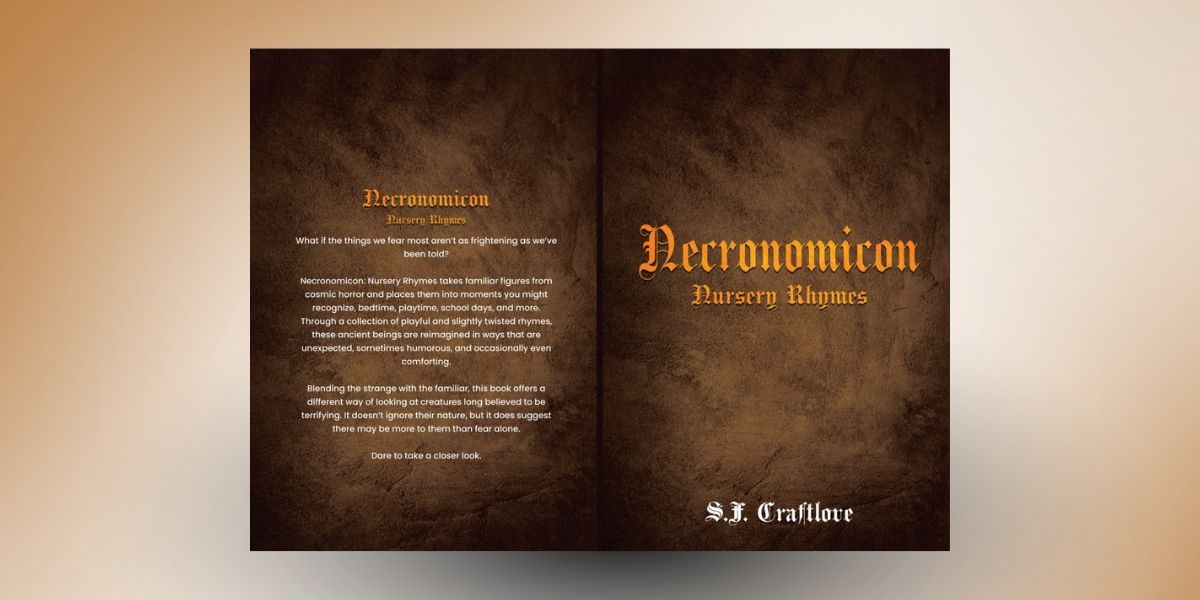

Every memorable children’s book needs a door. Some doors open into wardrobes, some into gardens, some into dreamlands. Necronomicon Nursery Rhymes opens into a place that looks, at first, much less safe: the universe of forbidden books, ancient gods, and things best not named too loudly. But S. F. Craftlove has no intention of simply frightening the reader. This is a book about what happens after the door creaks open and the monster on the other side waves hello.
That is the book’s great comic invitation. It takes names associated with cosmic dread and places them inside the patterns of childhood life. The book’s contents move through familiar scenarios: bedtime, bath time, swimming, sledding, school, movies, lazy afternoons, and visits through strange woods. The joke is not that the ancient beings have become ordinary. The joke is that ordinary childhood rituals become wonderfully bizarre when the ancient beings show up to help.
The book’s tone is unusually well judged. It is spooky but not grim. Funny but not disposable. Cute but not bland. Craftlove understands that children’s literature has always had room for darkness. Nursery rhymes themselves are often stranger than adults remember. Fairy tales are full of danger. Picture books have long known that fear can be thrilling when it is shaped by rhythm, color, and repetition. Necronomicon Nursery Rhymes belongs to that older, weirder tradition.
Its difference is the source material. The Lovecraftian world is usually built on dread of the unknown. Craftlove turns that dread into curiosity. What if the unknown is not automatically hostile? What if strangeness is not the same as evil? What if the creatures adults warn us about are simply waiting to be misunderstood in a more interesting way?
That question gives the book its emotional hook. Beneath the jokes about eldritch gods and domestic routines is a gentle lesson about otherness. The book explicitly tells readers that some creatures may be helpful and kind, and that fear of what we do not understand can distort what we see. This message might sound familiar in a conventional children’s book, but here it feels newly alive because the “misunderstood” figures are not cuddly rabbits or lonely dragons. They are cosmic entities with names like Yog-Sothoth and Nyarlathotep.
The illustrations carry much of the pleasure. A green creature with staring eyes, a many-eyed form with a cheerful strangeness, a scaly swimmer, a sleepy bulk on a couch: these images are funny because they refuse to choose between monster and friend. The book’s visual style suggests that the uncanny can be approachable without being domesticated entirely. There is still wobble, slime, scale, and shadow.
For adult readers, Necronomicon Nursery Rhymes is a literary gag executed with affection. It knows the Mythos well enough to play with it. The dedication, the Miskatonic University references, the mock bibliography, and the author biography all create a layered fiction around the poems. The book feels like something discovered in a basement archive by someone with both poor judgment and excellent comic timing.
For younger readers, the appeal is more direct. Monsters are fun. Rhymes are fun. Strange names are fun to hear aloud. And the idea that a frightening figure might become a companion is one of childhood’s most enduring fantasies.
Craftlove’s achievement is to make the abyss feel social. In Necronomicon Nursery Rhymes, horror does not disappear. It takes off its shoes, comes inside, and joins the game.