

The first volume in The Covenant Pulse Series invites readers into a powerful study of call, wilderness, arrival, grace, effort, and the human longing for divine promise.
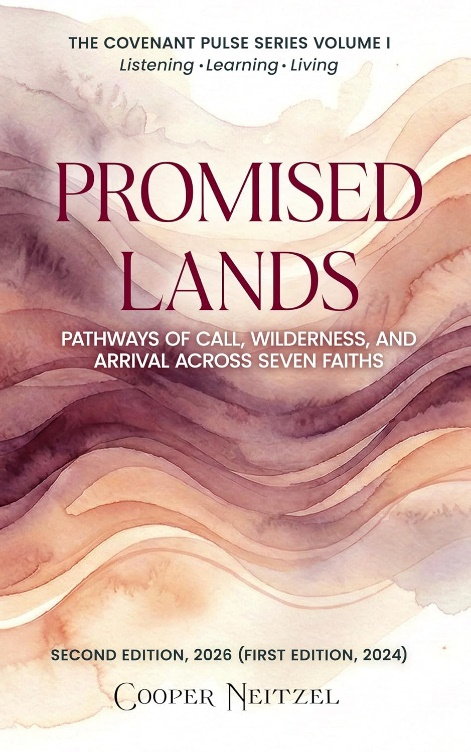
In an era when religious difference is often treated as division, Cooper Neitzel’s Promised Lands: Pathways of Call, Wilderness, and Arrival Across Seven Faiths offers a timely and thoughtful invitation: listen more deeply, compare more reverently, and rediscover the sacred journey that has shaped human faith across centuries.
Promised Lands is the first volume in The Covenant Pulse Series, a spiritually rich and intellectually engaging body of work built around the guiding rhythm of Listening • Learning • Living. The book, now presented in its Second Edition, 2026, following its first edition in 2024, positions itself as both a work of comparative theology and a formational guide for readers seeking to understand how divine promise, human struggle, and spiritual arrival appear across the world’s great faith traditions.
At the heart of the book is a question both ancient and urgent: What does it mean to be called away from the familiar, tested in a wilderness, and brought toward a promised land?
For Neitzel, that promised land is not limited to geography. It may be Canaan, the New Jerusalem, Jannah, Mokṣa, Nirvāṇa, Sach Khand, Zion, or the continuing covenant path of the Latter-day Saint Restoration. Each tradition names the destination differently. Each carries its own theology, sacred language, and historical memory. Yet beneath the differences, Neitzel identifies a recurring structure: Call, Wilderness, and Arrival.
This structure gives Promised Lands its distinctive shape.
The book first enters the Abrahamic traditions: Judaism, Christianity, and Islam. In Judaism, the promised land is bound to covenant, peoplehood, Torah, and the enduring hope of the Messianic Age. In Christianity, it becomes the renewed creation and the New Jerusalem, where heaven and earth are brought together in divine fulfillment. In Islam, it is Jannah, understood not merely as paradise but as the soul’s return to the nearness of God.
The second movement turns to the Dharmic traditions: Hinduism, Buddhism, and Sikhism. Here, the promised land becomes less about physical territory and more about transformation. Hinduism’s Mokṣa speaks of liberation and the soul’s long homecoming. Buddhism’s Nirvāṇa offers the cessation of craving and the release from suffering. Sikhism’s Sach Khand presents the Realm of Truth, where the soul is fulfilled in the presence of Waheguru.
The third movement brings readers into Latter-day Saint promised-land narratives, exploring covenantal journeys through scripture and history. These accounts are not presented as isolated stories, but as part of a larger sacred pattern: God calls, humanity responds, the wilderness refines, and arrival becomes both gift and responsibility.
What unites the book is Neitzel’s central framework: the Covenant Pulse.
The Covenant Pulse is the living rhythm between divine action and human faithfulness. It asks how grace and effort move together. It refuses the extremes of grace without response or effort without gift. Instead, it observes that every tradition examined in the book must answer the same spiritual question in its own language: What does God give, and what is humanity asked to become?
This idea gives Promised Lands its emotional and theological force. The book does not reduce religious traditions to similarities, nor does it rank them against one another. Instead, Neitzel practices what he calls Holy Envy, a posture of reverent admiration for the beauty, discipline, courage, and spiritual insight found in traditions beyond one’s own.
That posture is especially important because Neitzel writes from a Latter-day Saint perspective. Rather than hiding that location, he names it. The book is clear that it is written from within the Restoration, with respect for Latter-day Saint scripture, covenants, temple theology, and living prophetic witness. Yet that confessional grounding does not narrow the book’s vision. It strengthens it. Neitzel’s argument is that faith can be deepened, not diminished, when it listens honestly to the best of other traditions.
In this sense, Promised Lands is not simply a book about religion. It is a book about spiritual formation. It asks readers to think about their own call, their own wilderness, and their own promised land. It asks whether arrival is only a destination or also a transformation. It asks whether Zion is a place to be reached, a people to be formed, or a covenant practice to be lived.
The result is a work that feels both scholarly and devotional, both historically aware and deeply personal.
For readers interested in theology, comparative religion, Latter-day Saint thought, interfaith dialogue, sacred history, or personal spiritual growth, Promised Lands offers a meaningful and timely contribution.
It is a book for readers who believe the journey matters.
It is a book for those who have felt called, tested, stretched, or transformed.
And it is a book for anyone still searching for the place, state, or practice where the deepest longing of the soul finally meets divine promise.
Across seven faiths, Cooper Neitzel shows that the promised land has many names. The journey has many paths. The wilderness takes many forms.
But the Pulse continues.
About the Book
Promised Lands: Pathways of Call, Wilderness, and Arrival Across Seven Faiths is Volume I of The Covenant Pulse Series. Written by Cooper Neitzel and published by Hemingway Publishers, the book examines promised-land narratives across Judaism, Christianity, Islam, Hinduism, Buddhism, Sikhism, and the Latter-day Saint Restoration.
The book is organized around the three-stage sacred journey of Call, Wilderness, and Arrival. It explores how different faith traditions understand divine invitation, human struggle, spiritual refinement, and ultimate fulfillment.
At the center of the work is the Covenant Pulse, Neitzel’s framework for understanding the relationship between divine grace and human faithfulness. Rather than erasing theological differences, the book honors them while identifying meaningful resonances across traditions.
About the Author
Cooper Neitzel is the author of Promised Lands and the creator of The Covenant Pulse Series. Writing from a Latter-day Saint confessional perspective, Neitzel approaches comparative theology with reverence, scholarly care, and a commitment to interfaith listening.
His work emphasizes the importance of honoring religious difference while learning from the spiritual beauty, discipline, and wisdom found across traditions. In Promised Lands, Neitzel invites readers to see the sacred journey not only as a historical or theological pattern, but as a living reality that continues to shape personal faith, covenant life, and spiritual transformation.
Through this publication, Hemingway Publishers presents a work that contributes to conversations in theology, comparative religion, Latter-day Saint studies, spiritual formation, and interfaith understanding.
Availability
Promised Lands: Pathways of Call, Wilderness, and Arrival Across Seven Faiths by Cooper Neitzel is published by Hemingway Publishers as part of The Covenant Pulse Series.
Media Contact
Hemingway Publishers
Website:https://www.hemingwaypublishers.com/