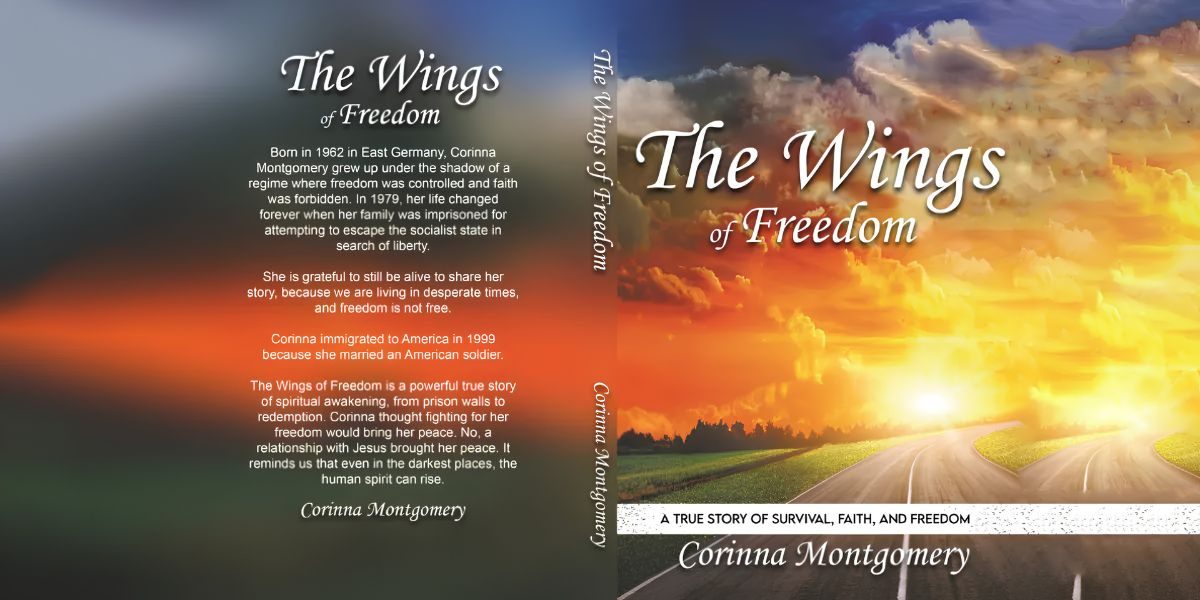

A True Story of Survival, Faith, and Courage Behind the Iron Curtain
For many readers in America, freedom is so deeply woven into daily life that it can feel almost invisible. It is there in the right to speak openly, to worship without fear, to question authority, to travel, to choose a future. But for Corinna Montgomery, freedom was never something to take for granted. It was something dangerous to desire, costly to pursue, and life-changing to finally reach. In The Wings of Freedom: A True Story of Survival, Faith and Freedom, Montgomery shares a deeply personal memoir of growing up in East Germany under Communist rule, enduring fear, arrest, imprisonment, and separation from family, and ultimately discovering not only physical freedom, but spiritual strength as well.
What makes this book especially powerful is that it does not read like distant history. It reads like a warning, a testimony, and a reminder all at once. Corinna does not present freedom as a slogan. She presents it as something she had to live without long enough to understand its true value. Her story begins in East Germany, where she was born in 1962 and raised in an environment defined by surveillance, political pressure, and silence. From an early age, she learned what it meant to live in a society where the government controlled education, work, movement, speech, and even belief. People stood in long lines for food, feared the Stasi, and understood that asking the wrong question could bring consequences no family wanted to face.
Life Inside a World Built on Fear
One of the strongest aspects of The Wings of Freedom is its plainspoken honesty about everyday life in the DDR. Corinna describes a system in which obedience was not simply encouraged; it was expected. Schools taught approved ideology. Young people were pushed toward political organizations. Creative freedom was restricted. Religion had to be kept quiet. People could not openly trust their neighbors, and sometimes not even their relatives, because the state relied on informants and on fear to maintain control.
These details make the memoir more than a personal recollection. They turn it into a vivid portrait of what happens when a government demands conformity at the expense of human dignity.
And yet, this is not a story written only in the language of oppression. It is also a story about awakening. Corinna’s stepfather plays a central role in that transformation. Unlike many around her, he encouraged her to think, to ask questions, and to understand that being told what to believe was not the same as truth. That influence changed everything. It gave her a private inner life even while she lived in a public culture of fear.
As a teenager, she began to understand that silence might keep a person safe for a while, but it could also slowly erase who they really were.
That tension sits at the heart of this memoir and gives it real emotional force…
The Moment Survival Became the Only Option
As the pressure mounted, Corinna’s family made the decision that many people only dream about, and very few dare attempt. They planned to escape. The way she recounts those preparations is one of the most gripping parts of the book. There are secret conversations, carefully managed letters, coded meetings, trusted contacts in West Germany, and the terrifying understanding that one mistake could destroy everything. This is not the stuff of fiction. It is the reality of a family trying to outthink a system designed to crush exactly this kind of hope.
One especially unforgettable episode involves Corinna carrying a letter during a covert attempt at a meeting. When the police appeared, she destroyed the letter and swallowed the torn pieces in a bathroom stall rather than risk discovery. It is the kind of detail no reader forgets because it captures both the terror of the moment and the courage demanded of someone still so young.
Montgomery’s memoir is filled with moments like this…
They show how survival is often built not on grand speeches, but on split-second choices made under pressure…
Then comes the arrest. Corinna and her family are swept into the machinery of the East German state, where questioning, intimidation, and imprisonment become brutal realities. The book does not sensationalize these experiences. Instead, it presents them with a directness that makes them hit even harder. She shows how quickly an ordinary day can turn into a nightmare, how families can be separated instantly, and how a government can trap even legal requests. Her account of being branded a traitor for seeking freedom highlights what authoritarian systems fear most: people who believe they have the right to choose their lives.
Why Faith Matters in a Story Like This
The subtitle promises survival, faith, and freedom, and the book truly earns all three. Faith is not presented here as an abstract theme pasted onto a hard story. It emerges gradually through suffering, endurance, and the search for meaning after trauma. Corinna’s journey eventually takes her beyond imprisonment and into a new life in West Germany, then later into the United States. But escape alone is not the whole destination.
What gives the memoir depth is its recognition that leaving oppression does not automatically heal the spirit!
Real freedom also involves rebuilding identity, learning trust, and discovering purpose…
The later sections of the manuscript reflect that spiritual evolution, including chapters centered on new beginnings, the Lord’s guidance, the Holy Spirit, and ministry.
That makes The Wings of Freedom more than a historical memoir.
It becomes a testimony of restoration. Corinna survives Communism, survives imprisonment, survives dislocation, and still refuses to let bitterness define her future. Instead, she turns memory into witness. She writes not only to recount what happened but also to remind readers that freedom can disappear when people stop valuing it. As her story makes clear, “We have to learn from history, or history will repeat itself.” Her faith also becomes the very thing that helps her endure what should have broken her.
Why This Story Matters Now
There is a reason books like this continue to matter. They remind readers that tyranny rarely arrives with a dramatic announcement. It grows through fear, compliance, censorship, and the steady normalization of control. Corinna Montgomery’s story is deeply rooted in East Germany, but its emotional and moral questions are universal.
· What happens when people are trained not to question?
· What does courage look like when danger is ordinary?
· How does a young woman hold onto her identity when the world around her keeps demanding surrender?
These are the questions that make The Wings of Freedom resonate far beyond its historical setting. It speaks to readers who love memoirs of resilience, stories of survival under authoritarian rule, Christian testimonies of endurance, and true accounts of women who refused to let fear have the final word. It is a book about family, sacrifice, conscience, and the difficult beauty of starting over. Above all, it is a book that understands freedom not as an entitlement, but as a gift worth protecting.
Corinna Montgomery has lived through Communism, arrest, separation, refugee life, and reinvention. She eventually built a new life in the United States, but she writes with the clarity of someone who never forgot what it felt like to live without basic liberties.
That perspective gives this memoir its weight and its urgency…
It also gives readers something rare: A true story that is both sobering and hopeful.
To learn more about this remarkable journey of endurance, conviction, and renewal, read The Wings of Freedom: A True Story of Survival, Faith, and Freedom by Corinna Montgomery.
Read the book today to deepen your appreciation for freedom, boost your courage, and stay with you long after the final page!
Author Name: Corinna Montgomery
Book Title: The Wings of Freedom: A True Story of Survival, Faith and Freedom
Book Published by: Global Author Publishing