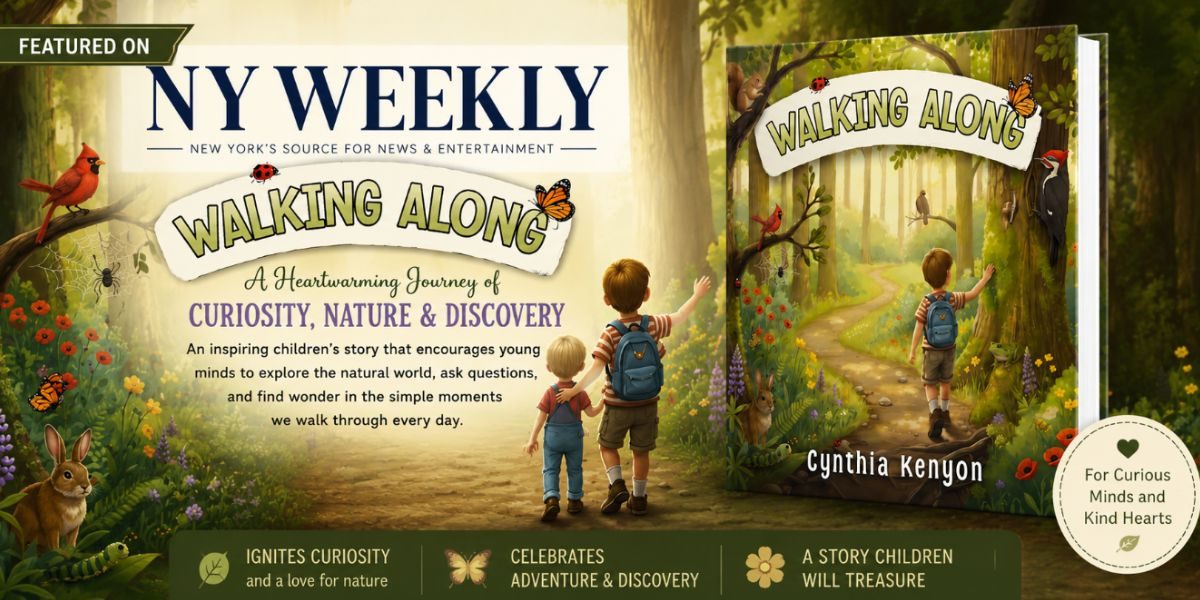

In an era where childhood is increasingly shaped by glowing screens and fast-paced routines, Walking Along by Cynthia Kenyon offers something refreshingly simple. An invitation to slow down. This beautifully illustrated children’s picture book transforms an ordinary walk through the woods into an extraordinary adventure, proving that wonder isn’t something children have to search for. It is something they only need to notice.
With gentle storytelling, rhythmic repetition, and an infectious sense of curiosity, Cynthia has created more than a picture book. She has written an experience that encourages young readers to rediscover the joy of looking up, looking down, and looking all around.
Finding Magic in the Everyday
One of Walking Along‘s greatest strengths lies in its ability to celebrate the ordinary. There are no dragons to defeat, no kingdoms to save, and no impossible quests. Instead, readers encounter birds gliding overhead, butterflies dancing through the air, squirrels climbing trees, and tiny snails quietly making their way across the forest floor.
Each finding reminds children that adventure doesn’t always arrive with fanfare. Sometimes, it is hidden beneath a leaf, buzzing past a flower, or waiting patiently along a woodland trail. That perspective feels especially meaningful in today’s world, where moments of stillness have become increasingly rare.
Story That Invites Participation
Rather than asking children to simply follow a story, the book encourages them to become part of it. Its rhythmic, repetitive structure invites young readers to predict what comes next, turning every page into an interactive experience. The recurring pauses become moments of anticipation, encouraging children to imagine what they might discover if they stopped and looked around during their own walks.
It’s the kind of storytelling that naturally extends beyond the pages. After finishing the book, children are likely to head outdoors, eager to spot birds, butterflies, flowers, or perhaps even a curious frog crossing the path. Few picture books inspire real-world exploration as effortlessly as this one.
Nature as a Classroom
Without ever feeling instructional, the author introduces children to the incredible diversity of the natural world. Along the journey, readers encounter woodland creatures, insects, plants, and even gentle lessons about respecting nature’s boundaries, such as recognizing poison ivy from a safe distance.
The educational value emerges organically through discovery rather than explanation. Children aren’t told why nature matters. They experience its beauty firsthand. This subtle approach allows curiosity to become the teacher, making learning feel joyful rather than prescribed.
Celebration of Shared Adventures
While the book begins as a personal journey of observation, it concludes with something equally important: togetherness.
As friends join the walk, the story quietly shifts its focus from individual discovery to shared experiences. It’s a reminder that some of life’s happiest memories are created not through elaborate plans but through simple moments spent exploring with people we love. This emotional transition gives the story unexpected depth, leaving readers with a lasting sense of warmth and connection.
Gentle Invitation to Step Outside
At its heart, Walking Along is a celebration of curiosity, mindfulness, and the quiet beauty waiting just beyond the front door. Cynthia Kenyon doesn’t rely on spectacle to capture a child’s imagination. Instead, she trusts in something far more enduring: the natural world’s ability to surprise those willing to slow down and pay attention.
Takeaway
In doing so, she has created a picture book that speaks to children, parents, educators, and caregivers alike. Walking Along is more than a story to read. It is an invitation to explore, observe, and reconnect with the simple pleasures that too often go unnoticed. Sometimes, all it takes to discover something extraordinary is the willingness to take that very first step.