
By: Aman Jalan
Discarded textiles rarely make international headlines. Yet an environmental initiative from Bengaluru is showing how everyday household items can become part of a larger climate solution. At the centre of this effort is Manya Harsha, a 15-year-old Indian environment activist whose Grandma’s Green Weave Campaign is reviving an age-old tradition of reusing sarees while addressing two of today’s pressing environmental concerns: textile waste and plastic pollution.
Launched under the Sunshine Children For Change program, Grandma’s Green Weave Campaign demonstrates that climate action does not always require expensive technology or large infrastructure. Sometimes, it begins with a simple idea rooted in family values. By collecting discarded sarees and transforming them into reusable shopping bags, Manya Harsha has created an initiative that combines sustainability, community participation and environmental education.
The campaign reflects a practice that was once common across Indian households. Older generations rarely discarded worn sarees. Instead, fabrics were repaired, reused and eventually repurposed into useful household items. As consumer habits changed, many of these traditions gradually disappeared. Grandma’s Green Weave brings that philosophy back into everyday life, presenting it as a practical response to modern environmental challenges.
The environmental impact of the initiative is becoming increasingly significant. More than 2,200 discarded sarees and 230 bedspreads have already been collected through the campaign. Instead of ending up in landfills, these materials have been transformed into nearly 28,000 reusable cloth bags, diverting almost 1.2 tonnes of textile waste from disposal.
The campaign also addresses one of the world’s fastest growing pollution problems: single-use plastics. According to estimates associated with the initiative, these reusable bags could replace nearly 245,000 plastic carry bags every year. Each cloth bag distributed represents a small but meaningful reduction in plastic waste entering streets, waterways and landfill sites.
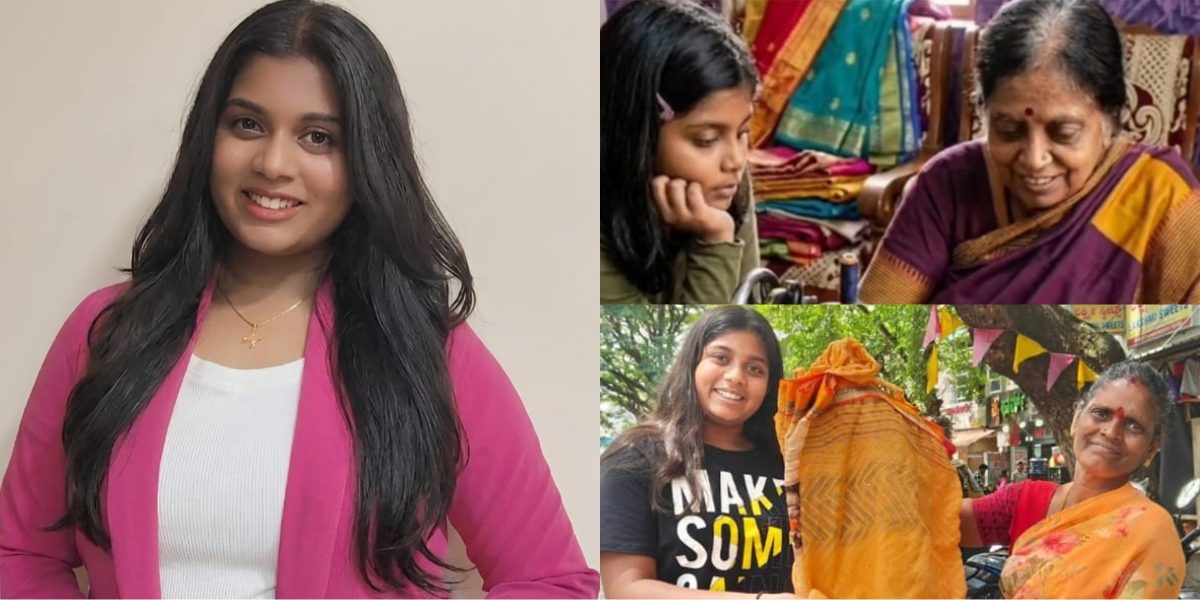
Unlike many awareness campaigns that remain confined to social media, Grandma’s Green Weave places its environmental message directly into local communities. Manya Harsha has personally distributed the reusable bags to street vendors across several local markets in Bengaluru, while also taking the campaign to schools, exhibitions and awareness programmes in different parts of India. The initiative may have started locally, but its underlying message has found relevance far beyond the city where it began.
Another important aspect of the campaign is its community impact. The reusable bags are stitched by local tailors, creating meaningful livelihood opportunities while promoting sustainable production. More than 500 street vendors, 30 schools and 10 community organisations have directly benefited from the campaign. Environmental workshops connected with Grandma’s Green Weave have engaged over 25,000 participants, encouraging families, students and neighbourhood groups to rethink their everyday consumption habits.
Environmental experts often argue that the circular economy begins with extending the life of products already in use. Grandma’s Green Weave reflects that principle in a way that is easy to understand and replicate. Instead of treating old textiles as waste, the campaign views them as valuable resources capable of serving a second purpose. That simple shift in perspective carries significant environmental value.
Grandma’s Green Weave is only one chapter in Manya Harsha’s broader environmental journey. Born and raised in Bengaluru, she began exploring sustainability at the age of four, inspired by the environmentally conscious lifestyle of her late grandmother, V. Rudramma. That early inspiration has since evolved into a series of projects centred on waste reduction, climate literacy and community engagement.
During the COVID-19 lockdown, while much of the world adjusted to life indoors, Manya began experimenting with kitchen waste that would normally be discarded. Onion peels, pea husks, baby corn husks and flower waste became raw materials for handmade vegetable paper. Her experiments demonstrated how common household waste could reduce dependence on tree-based paper production while encouraging families to recycle organic materials creatively.
The idea attracted attention because of its simplicity. Rather than relying on industrial processes, the innovation encouraged people to rethink the value of everyday waste. The handmade vegetable paper could be used for writing, painting, drawing and craft activities, making environmental education accessible to children and schools.
Beyond recycling innovations, Manya Harsha has planted around 40,000 saplings and participated in waste collection drives that have removed nearly 100 kilograms of waste from public spaces. She regularly conducts environmental workshops, guest lectures and awareness sessions promoting climate literacy, climate justice and climate action among young people.
Education remains a central part of her mission. Manya is the author of nine nature-themed books, each encouraging children to understand sustainability through engaging stories and relatable characters. She also served as editor and writer of the Sunshine Fortnightly Environment Magazine, an educational publication distributed across schools in Bengaluru to promote environmental awareness among students.
Her contributions have also received recognition from organisations including UN-Water, Earth.Org, SDG Vision, India’s Ministry of Jal Shakti, the Ministry of Culture, and the Karnataka Forest Department. While these recognitions highlight the growing influence of youth-led environmental initiatives, Manya continues to focus on practical solutions that communities can adopt in everyday life.
At a time when conversations around climate change often centre on global policy and technological innovation, Grandma’s Green Weave offers a different perspective. It reminds communities that meaningful environmental progress can begin with familiar traditions, responsible consumption and local participation. By turning discarded sarees into reusable bags, the campaign demonstrates how cultural heritage and sustainability can work together to address modern environmental challenges.
As the world searches for practical responses to climate change, initiatives like Grandma’s Green Weave highlight the growing role of young changemakers in shaping that future. Through measurable environmental impact, community engagement and a commitment to reviving sustainable traditions, Manya Harsha is showing that powerful climate movements do not always begin with large institutions. Sometimes, they begin with a single idea, a family legacy and the determination of one young environmental activist to inspire change, one reused saree at a time.