How Robi Powers Helps Leaders Beat Executive AI Paralysis

Everywhere business leaders turn, someone is talking about artificial intelligence. One expert says to automate everything. Another recommends investing in the latest platform before competitors do.

Boards want an AI strategy. Investors expect innovation. Employees are asking how AI will change the way they work.

The pressure keeps growing, yet for many founders and CEOs, confidence is becoming harder to find.

Few executives admit it publicly, but many are quietly asking themselves the same question. What if we make the wrong decision?

Choosing the wrong technology could waste millions, disrupt operations, confuse teams, and leave the business even further behind.

Waiting too long creates another risk altogether. Opportunities disappear while competitors move ahead. Caught between moving too fast and moving too slowly, many leaders find themselves stuck.

Robi Powers (@robipowers) calls this Executive AI Paralysis.

As Founder of IONIK and an AI Transformation Strategist, Robi has spent years helping business leaders understand that this hesitation is rarely caused by a lack of intelligence or ambition.

It happens because leaders are trying to solve one of the biggest business transformations in history without a clear framework for making decisions.

His work begins by replacing uncertainty with clarity, allowing executives to lead AI transformation with confidence instead of fear.

When Too Much Information Makes Decision Making Harder

Artificial intelligence has created an unusual leadership challenge.

Never before have executives had access to so much information while feeling so uncertain about what to do with it.

Every week introduces another model, another platform, another success story, and another prediction about the future. Instead of making decisions easier, the constant flow of information often creates more doubt.

Robi noticed this long before it became a common conversation. Most leaders were not struggling because they lacked AI knowledge.

They were struggling because they lacked a practical way to filter that knowledge, evaluate opportunities, and decide what truly mattered for their business. They were collecting information instead of building conviction.

Why Smart Leaders Freeze When the Stakes Feel Too High

Many people assume hesitation is a sign of weak leadership.

Robi sees it differently.

In his experience, the leaders who pause are often the ones carrying the greatest responsibility.

They understand that every major AI decision affects employees, customers, operations, and the future direction of the company. They are not afraid of technology. They are trying to avoid making an expensive mistake. This is where Executive AI Paralysis begins. The more options leaders have, the harder it becomes to move forward.

Every decision feels permanent, every investment feels risky, and every delay creates new uncertainty. Without a structured way to think through those decisions, confidence slowly gives way to hesitation.

The Leadership Framework That Changes the Conversation

Rather than beginning with software demonstrations or automation plans, Robi starts somewhere much more fundamental. He helps leaders strengthen the way they think before changing the way their organizations operate.

That philosophy became the foundation of AI Leadership Mastery, a framework designed to help executives develop the clarity, judgment, and leadership capability needed to guide AI transformation successfully.

Through IONIK, Robi combines executive coaching with practical implementation, helping high trust founders modernize their businesses without compromising the premium experience they have worked so hard to build.

Every recommendation is shaped by practical experience, allowing leaders to make decisions with greater confidence instead of reacting to every new trend.

Confidence Becomes a Competitive Advantage

Research continues to show that most AI initiatives fail because of leadership and

organizational challenges rather than technical limitations.

For Robi, those findings reinforce something he has believed for years. Organizations do not outperform because they buy better software. They

outperform because their leaders know how to create alignment, communicate a clear vision, and guide people through uncertainty.

That is why the businesses gaining the greatest value from AI are not always the first to adopt new technology.

They are often the ones that prepare their leadership teams first.

Once leaders become confident decision makers, technology becomes easier to evaluate, easier to implement, and far more likely to deliver lasting business results.

Building the Confidence to Lead AI Successfully

Executive AI Paralysis is not solved by adopting another AI platform or chasing the latest technology.

It disappears when leaders gain the confidence to make thoughtful decisions, stay focused, and lead through constant change with clarity.

That is the transformation Robi helps create through AI Leadership Mastery and his work at IONIK.

Instead of adding to the noise, he gives founders, CEOs, and executive teams practical leadership frameworks that simplify decision making and strengthen their ability to lead successful AI transformation.

Better leadership decisions lead to better AI decisions, helping organizations move forward with confidence instead of uncertainty.

Connect with @robipowersto discover how IONIK is helping business leaders build organizations that are ready for the future.

When Search Stops Showing Links and Starts Defining Authority

As search moves from blue links to direct answers, professionals are learning that credibility must now be structured before it can be recognized.

The New Visibility Problem

A fund manager may oversee serious capital. An attorney may have years of specialized experience. A technology founder may be well known inside private investor circles. Yet when someone searches their name, or asks an AI assistant who they are, the answer can still feel thin, incomplete, or strangely off.

That gap reveals a deeper problem. Professional authority no longer lives only in referrals, résumés, press mentions, or personal networks. It also lives inside the systems that organize information for search engines and AI tools.

For years, the goal was to appear in search results. Now, the goal is more exacting. You need to be understood correctly by the machines producing the answers.

What a Knowledge Panel Actually Does

A Google Knowledge Panel is the information box that often appears beside search results, listing a person’s name, profession, company, social profiles, and related facts. To many users, it appears to be a simple summary. In practice, it reflects how Google’s Knowledge Graph understands a person or organization as a recognized entity.

That matters because search is moving from links to answers. People no longer always scroll through pages of results. They ask Google, ChatGPT, Gemini, or Perplexity for a direct explanation. Those answers are shaped by structured, machine-readable sources.

For professionals in finance, law, technology, and real estate, this changes the stakes. If the right facts are not verified and organized, AI systems may rely on whatever they can find. The result may be incomplete at best and misleading at worst.

Authority as a Systems Problem

This is where the work becomes different from standard SEO. SEO often focuses on rankings, traffic, and keywords. Entity authority asks another question: what does the system believe is true, and what trusted inputs support that belief?

Abhay Aditya Jain, Founder and CEO of Lindy Panels, approaches reputation through game theory and philosophy rather than traditional marketing language. The focus is on signals, incentives, verification, and structure.

That distinction is important. The goal is not to game a platform. It is to give information systems the verified, structured truth they are already trying to surface.

Built Through Volume, Not Guesswork

Knowledge Panels are not simple applications that someone can fill out and submit. Google’s systems are opaque, and much of the work depends on understanding what the Knowledge Graph recognizes over time.

That is why volume matters. The firm’s methodology was shaped by over 500 panels delivered, with lessons drawn from direct work rather than theory alone. In a field without a public manual, repeated hands-on execution becomes a form of research.

The result is a practical thesis: authority must be built as infrastructure. It needs consistent facts, credible sources, and organized entity data that can withstand platform changes.

Why Durability Matters

The company’s name comes from Nassim Taleb’s Lindy Effect, the idea that things that have endured are more likely to continue to do so. Applied to digital authority, the lesson is clear. Visibility hacks decay. Durable authority assets compound.

That is the larger point behind Abhay Aditya Jain’s work. As AI engines become new arbiters of credibility, the people and firms that control their machine-readable presence will have more influence over how they are understood.

Everyone else may still be visible. They may simply be summarized by a machine guessing on their behalf.

The Art of Reinvention: Diana Elizabeth Martinovich’s Journey Across Opera, Writing, and Jazz

Many professional careers follow a predictable, straight path from beginning to end. Creative journeys, however, often resemble music because they move through distinct movements, unexpected key changes, and quiet pauses before a major crescendo. You can see this exact artistic fluidity in how some creators refuse to stay in one lane. Diana Elizabeth Martinovich belongs firmly to this dynamic category of artists. She treats her entire life as an evolving song. Her professional history includes celebrated work as a classical opera singer, a published novelist, and a contemporary jazz songwriter. This expansive reach extends into the business sector as well, where she established a premium beauty brand and a successful coaching practice.

True success always stems from a deep emotional commitment to authentic self-expression.

This determination to explore multiple paths makes her life story remarkably compelling. Restlessness did not drive her transitions across these different industries. Instead, her evolution resembles an explorer who constantly discovers hidden rooms inside the same house. This diverse background offers an incredible creative advantage. Every new venture gains immense strength from its previous milestones. A creative mind can achieve total mastery across multiple fields without losing focus.

A Voice Trained for the Stage

A rare vocal gift defined her artistic presence long before she ever picked up a pen or wrote a lyric. Her foundational training occurred in the strict world of classical opera. She earned her master’s degree in singing from the University of Music and Performing Arts in Stuttgart, Germany. She also completed a second master’s degree in International Cultural Policy and Management from the University Lumière Lyon. European opera houses welcomed her talent, and she won the prestigious German DAAD Award. She also spent more than twenty years as an international voice teacher.

Opera instilled in her an intense sense of artistic discipline. This rigorous training taught her patience during the slow build of a complex narrative. She mastered the exact balance of controlled emotion and perfect timing on stage. These precise instincts translate beautifully to the page and the recording studio today.

Photo Courtesy: Diana Elizabeth Martinovich

This operatic expertise now guides her work as the Artistic Director of BM Global Opera & Arts. She oversees major creative initiatives, including the Vienna Opera & Art Song Festival. This role frequently brings her together with her husband and creative partner, the celebrated bass-baritone Boris Martinovich. His extensive career on the world’s greatest opera stages remains a powerful presence in her world. This personal and professional partnership shapes a massive portion of her creative output. He joins her projects as a guest artist, and their shared musical history connects all her work.

Echoes of the Unspoken

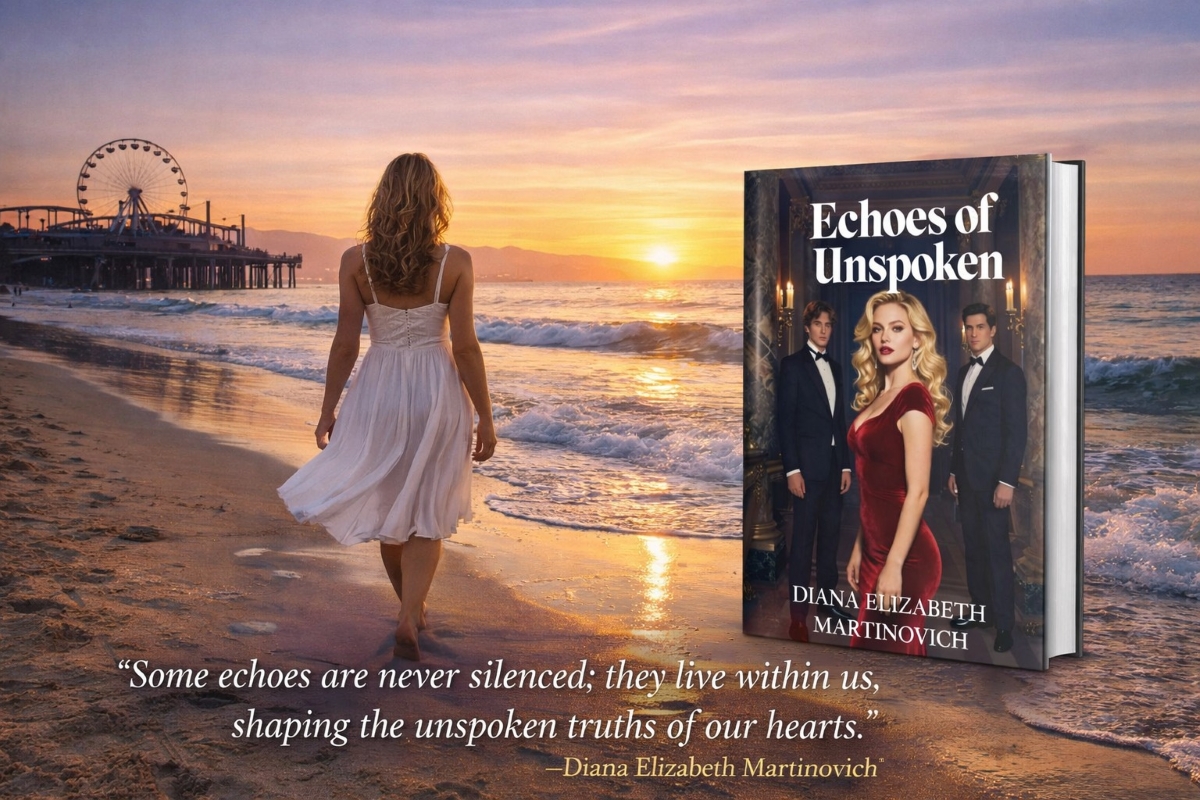
An artist who spends years analyzing the internal lives of different characters will eventually want to write original stories. Her debut novel, Echoes of the Unspoken, functions as a natural extension of everything opera taught her about human connection. The book addresses deep longing, personal transformation, and the true cost of authenticity. Readers find this captivating psychological drama directly on Amazon to experience her literary style firsthand.

“The plot centers on Elena Marković, a world-renowned soprano. Elena abruptly walks away from her glittering life on Park Avenue to search for a truer existence.”

Clear parallels exist between Elena’s choices and her own life path. Both women understand the stark contrast between public glamour and the need for an unguarded, private truth. Critics praise Echoes of the Unspoken for its deep psychological insights and poetic phrasing. The narrative proves that reinvention does not require anyone to abandon their past. True transformation occurs when people finally listen to the lessons their past experiences tried to teach them.

Shades of Love: A New Chapter in Jazz

Photo Courtesy: Diana Elizabeth Martinovich

Diana Elizabeth Martinovich turned her emotional world into elegant prose with her book, but music holds a different kind of magic. Her upcoming jazz album sets those same deep feelings to melody. Listeners can look forward to the official launch of Shades of Love in Fall 2026. The project marks a bold debut for her as a songwriter, especially since the genre sits so far away from traditional opera houses.

Opera demands extreme vocal precision and immense physical grandeur. Jazz, in contrast, rewards raw vulnerability and spontaneous improvisation.

Classical spaces favor grand scale and intense precision, whereas jazz celebrates raw vulnerability. Still, the transition feels like a beautiful, natural step for her creative voice. The tracklist moves like chapters in an intimate diary. You will hear songs like If You Want Me, Let Me Know, Golden Boy, and I Am Coming Home. The collection also features evocative tracks like Shades of Love, Now You Know, and In Dreams You Are My Silence. She took complete creative control here, writing both the lyrics and the music herself. This personal touch blends loose musical phrasing with poetic storytelling. The stylistic shift offers total freedom to a creator who loves internal exploration.

Beyond the Stage Entrepreneur and Coach

Her immense creativity extends far beyond concert halls and book pages. She founded AVY Cosmetics to offer premium skincare, beauty, and wellness products to consumers. Corporate development required a completely different type of focus, but her basic instincts remained identical. “Real craftsmanship comes from noticing what people lack and delivering high-quality solutions.”

This exact mindset guides her professional coaching practice as well. She works as a certified life, career, and business coach today. She helps other artists and corporate leaders navigate their own major transitions. This role does not separate her from her artistic roots. She simply shifted her focus from performing personal transformation to teaching it to others.

A Life Composed in Movements

The soprano, the novelist, the songwriter, the entrepreneur, and the coach connect as parts of a single whole. Fixed boundaries do not define human identity. People compose their lives one movement at a time. This journey across multiple industries shows that reinvention is an honest continuation of a past self. Truth simply finds expression in a different musical key.

Magnificent new milestones approach as Shades of Love nears its Fall 2026 launch. At the same time, Echoes of the Unspoken gains new readers daily around the globe. She does not chase a single, static legacy. Her work builds an expansive framework that leaves room for spontaneous adjustments and future growth. These projects resemble a great jazz standard because they always allow room for improvisation.

An outside observer might see separate careers stitched together randomly. The clear thread that binds them becomes obvious when looking closely at her work. The novels, the melodies, the operatic performances, and the coaching sessions all share a common purpose. Every version of her career answers a fundamental question. Honesty with oneself matters most, even when that honesty requires a fresh start. This central inquiry serves as the authentic signature on all her creations. Public updates regarding her work appear regularly on the official Facebook page.

How CORE is Raising the Standard of Rehabilitation in South London

By Sophia Mudanza

For many people living with persistent pain, treatment often becomes a cycle of temporary relief rather than lasting recovery. Patients may seek help from multiple providers, only to find symptoms returning because the underlying cause has never been properly identified or addressed.

At CORE, the philosophy is different. Through its two specialist services, CORE Soft Tissue Therapy and CORE Physio, the clinic brings together physiotherapy, osteopathy, remedial massage, sports massage, soft tissue therapy and acupuncture to provide an integrated approach to musculoskeletal health, placing long-term recovery ahead of short-term symptom relief.

Founded in 2024 by Sam and Nok, CORE was created with a shared vision of delivering evidence-informed, patient-centred care within a collaborative clinical environment.

“We wanted to create more than a treatment clinic,” says Sam. “Our aim was to build a place where patients receive a thorough assessment, understand why they’re experiencing pain, and leave with a personalised plan to help them recover and stay well.”

Patients attending CORE Soft Tissue Therapy for sports massage or soft tissue therapy begin with a comprehensive consultation and clinical assessment before treatment starts. Practitioners evaluate posture, movement patterns, joint mobility and soft tissue function to understand the factors contributing to pain or restricted movement. Treatment is then tailored to the individual and, where appropriate, supported with rehabilitation exercises, movement education and practical advice to help prevent symptoms from returning.

Alongside CORE Soft Tissue Therapy, CORE Physio provides specialist physiotherapy, osteopathy and acupuncture, allowing patients to access the treatment best suited to their condition. By bringing multiple disciplines together under one organisation, practitioners can work collaboratively to deliver coordinated care throughout every stage of rehabilitation.

The clinic supports patients with a wide range of musculoskeletal conditions, including sports injuries, chronic pain, neck and back pain, postural dysfunction, muscular tension, reduced mobility and workplace-related injuries. Rather than focusing solely on symptom management, treatment plans are designed to improve function, restore movement and promote long-term physical health.

Nok believes education is one of the most important parts of successful rehabilitation.

“We want patients to leave feeling confident, not dependent on treatment,” she says. “Helping people understand their bodies and giving them the knowledge to manage their recovery is just as important as the treatment itself.”

This philosophy reflects a growing shift towards conservative, evidence-informed approaches to musculoskeletal healthcare. Increasingly, patients are looking for integrated treatment that combines hands-on therapy with rehabilitation, education and preventative strategies to achieve lasting outcomes.

At CORE, collaboration between disciplines is central to that approach.

“No single profession has every answer,” says Sam. “By combining different areas of expertise, we can provide more complete care that focuses on achieving meaningful, long-term results for every patient.”

The clinic has built a strong reputation across South London, welcoming patients from Dulwich, Peckham, Herne Hill, Forest Hill, Sydenham and the surrounding areas through referrals and word-of-mouth recommendations.

Today, patients can access specialist care through both CORE Soft Tissue Therapy and CORE Physio.

Looking ahead, Sam and Nok are preparing for the next phase of growth with plans to open a second CORE clinic in Central London towards the end of 2026. The expansion will allow the organisation to bring its multidisciplinary model to a wider community while maintaining the personalised care and clinical standards that have defined the business since its launch.

“Our ambition has always been to grow without compromising quality,” says Nok. “Every patient deserves to feel listened to, understand their treatment and leave with a clear plan for recovery. That’s the standard we set for ourselves every day.”

As demand for integrated musculoskeletal healthcare continues to grow, CORE is helping shape a more collaborative model of rehabilitation, one where physiotherapy, osteopathy, remedial massage, sports massage, soft tissue therapy and acupuncture work together to support long-term health, movement and wellbeing.

NYC Restaurant Week Returns July 20 With $30, $45, and $60 Menus Across Five Boroughs

NYC Restaurant Week returns for its summer 2026 run from July 20 to August 16, with prix-fixe menus and reservations opening July 14 through NYC Tourism. Participating restaurants across all five boroughs will offer fixed-price lunch and dinner menus at three tiers: $30, $45, and $60, giving diners a set-price route into kitchens they might not otherwise book.

Key Takeaways

  • NYC Restaurant Week Summer 2026 runs July 20 through August 16, with menus and reservations going live July 14 on the NYC Tourism site.
  • Pricing follows three fixed tiers of $30, $45, and $60, and each restaurant chooses whether to apply its tier to lunch, dinner, or both.
  • Hundreds of restaurants across Manhattan, Brooklyn, Queens, the Bronx, and Staten Island are expected to participate in the bi-annual program.
  • The summer edition arrives alongside a fresh crop of openings, including Somssi in Manhattan and Greenpoint newcomers Arthur and Soccería.
  • Investor-backed fast-casual chains continue to reshape the ground-level dining map, adding a business dimension to a consumer-facing tradition.

When Does NYC Restaurant Week Summer 2026 Take Place?

NYC Restaurant Week Summer 2026 spans nearly four weeks, from July 20 to August 16, according to NYC Tourism. The program is a bi-annual fixture that runs each summer and winter, typically landing in July and August and again in January and February. For summer 2026, menus and the full list of participating restaurants become viewable only when reservations open on July 14, which gives diners a defined window to plan before tables begin filling.

The timing places NYC Restaurant Week directly after the city’s America 250 holiday weekend, positioning it as the next large hospitality draw of the season. NYC Tourism frames the program as a way to nudge residents and visitors out of their usual neighborhoods and into different boroughs, a goal that shapes how the roster is spread across the map.

How Much Do NYC Restaurant Week Menus Cost?

Pricing for NYC Restaurant Week Summer 2026 holds to three fixed tiers: $30, $45, and $60 per person, per NYC Tourism. Restaurants decide which meal periods to offer and which tier fits their menu, so a single venue may run a $30 lunch, a $60 dinner, or both. The structure lets higher-end kitchens participate at the top tier while neighborhood spots hold entry-level pricing, widening the range of cuisines a diner can reach at a predictable cost.

That flexibility is part of why the program has endured. Rather than forcing a single price citywide, the tiered model accommodates a Michelin-adjacent dining room and a corner trattoria under the same banner, and it lets diners calibrate spending against the experience they want during the run.

Which New Restaurants Are Shaping the Summer 2026 Dining Scene?

NYC Restaurant Week 2026 Dates, Prices, Reservations

Photo Credit: Unsplash.com

The summer edition of NYC Restaurant Week lands during an active stretch of openings that give the program fresh material. Resy’s July list highlights Somssi, the newest venture from the team behind Atoboy and Atomix, led by longtime operations director Ahris Kim, which leans on Korean influences in dishes such as linguine al ragù paired with mustard kimchi.

Greenpoint has drawn particular attention. Arthur, from chef Kevin Finch, moved into the former Fulgurances Laundromat and carries a résumé that includes Atelier Crenn and Maaemo, though its menu trades tweezer plating for warmth and familiarity. Nearby, Soccería pairs sporting events with Mexican fare from the group behind Taqueria Ramírez and Carnitas Ramírez. These openings sit outside Manhattan’s core, reinforcing the borough-crossing behavior NYC Tourism promotes and giving the summer roster depth beyond the usual Midtown names.

What Does the Rise of Investor-Backed Chains Mean for NYC Dining?

Alongside independent openings, a business shift is reshaping the streetscape. The Infatuation has tracked rapid expansion among venture-backed fast-casual concepts, noting that 7th Street Burger grew from a single location to roughly 20 across New York City, and that both it and coffee operator Blank Street draw backing from investment firm Stripes.

That consolidation matters for a program built on variety. As capital-backed chains multiply storefronts and standardize what a block looks like, the contrast with owner-operated newcomers such as Arthur becomes part of the city’s dining identity. NYC Restaurant Week’s roster reflects both ends of that spectrum, which is arguably its quiet value: it surfaces the independents competing for attention against faster-scaling, better-funded rivals.

How Can Diners Reserve a Table for NYC Restaurant Week?

Reservations for NYC Restaurant Week Summer 2026 open July 14 on the NYC Tourism site, where the full participant list becomes searchable by borough and cuisine. Because the roster stays private until that date, diners cannot lock in tables before July 14, which historically concentrates demand the moment booking begins. Popular rooms tend to fill within the opening days, so early planning carries real weight during the four-week window.

NYC Restaurant Week Summer 2026 gives diners a fixed-price passport to hundreds of kitchens across all five boroughs from July 20 to August 16, with booking opening July 14.

FAQs

When is NYC Restaurant Week Summer 2026? It runs from July 20 to August 16, 2026. Menus and reservations open July 14 through NYC Tourism.

How much does NYC Restaurant Week cost? Prix-fixe menus are priced at $30, $45, or $60 per person. Each restaurant decides whether to offer the deal at lunch, dinner, or both.

Where can diners find participating restaurants? The full list appears on the NYC Tourism Restaurant Week page once reservations go live July 14, searchable by borough and cuisine.

Does NYC Restaurant Week cover all five boroughs? Yes. Hundreds of restaurants across Manhattan, Brooklyn, Queens, the Bronx, and Staten Island typically take part.

How often does NYC Restaurant Week happen? It is a bi-annual program, running each summer and winter, usually in July and August and again in January and February.

Are reservations required? Reservations are strongly advised, since demand spikes once booking opens and popular tables fill quickly.


The Illusion of Arrival and Why Success Never Feels Enough

By: Jason Gerber

You know the feeling well. You chase a goal for months or even years. You sacrifice sleep, rest, and relationships. You pour everything into that one finish line. Then you cross it. You get the promotion. You buy the house. You hit the target. And within days, the satisfaction fades. A familiar emptiness creeps back in. You wonder, “Was this all there is?”

What the Illusion of Arrival Really Means

Photo Courtesy: Richard Davies

Richard Davies calls this experience the illusion of arrival. In his book BEcoming: The Essence of Your True Self, he dedicates Chapter 1 to exploring why so many successful people feel secretly hollow. The answer is not that you lack ambition or gratitude. The answer is that you have been chasing the wrong kind of finish line.

Think back to your childhood. From a very young age, the world taught you that success equals worth. Good grades earned praise. Gold stars meant you mattered. Winning brought love and attention. You learned to mistake accomplishment for validation. You learned to see achievement as proof that you are enough. This script ran quietly in the background for years. It never asked for your permission. It simply took over.

As you grew older, the stakes got higher. The right school. The right job. The right title. The right salary. Each milestone promised lasting happiness. Each milestone delivered a short burst of pride followed by a long exhale of nothing much. Richard Davies explains that this happens because the finish line keeps moving. You reach one goal, and another one appears immediately. The treadmill never stops. You exhaust yourself running faster and faster, hoping that this next achievement will finally fill the hole.

But the hole does not fill. Why? Because external success cannot heal internal emptiness. A bigger paycheck does not quiet your inner critic. A corner office does not teach you how to rest. Applause from strangers does not help you sleep at night. These things feel good for a moment. Then they vanish. You are left with the same quiet ache.

Why External Success Cannot Fill the Void

BEcoming: The Essence of Your True Self shares stories of people who looked successful on paper but felt like failures inside. A lawyer who climbed the ranks only to dread Monday mornings. A startup founder featured on magazine covers who privately battled anxiety every single day. A mother who checked every box society handed her and then sat alone in her kitchen, wondering why she felt invisible. These are not weak people. They are people trapped in the illusion of arrival.

Richard Davies does not ask you to abandon ambition. He asks you to examine it. Who taught you to want what you want? Whose approval are you really seeking? What would you still pursue if no one ever praised you again? These questions cut through the noise. They separate borrowed dreams from genuine desire.

The illusion of arrival persists because our culture worships the hustle. We glorify busyness. We confuse exhaustion with importance. Social media feeds us highlight reels of other people’s successes, making us feel perpetually behind. No wonder you cannot rest. No wonder you feel like you are never doing enough. The system is designed to keep you wanting more.

How to Redefine Success on Your Own Terms

But there is a way out. Richard Davies invites you to shift your definition of success. Instead of measuring life by milestones, measure it by alignment. Do your daily actions reflect your true values? Do you feel present, not just productive? Can you sit in silence without reaching for your phone? These are the real questions. They lead to a different kind of success. One that feels like peace, not exhaustion.

Here is a simple journal prompt from the spirit of BEcoming: The Essence of Your True Self. Take out a notebook. Write down three achievements you once thought would make you happy. Next to each one, write how you actually felt two weeks after achieving it. Then write one sentence answering this question. “If no one would ever know about my success, what would I still want to do with my life?”

Do not rush this exercise. Sit with it. Let honest answers rise slowly. You might discover that your truest desires have nothing to do with applause or titles. You might find that you already have enough. You might realize that the finish line you are chasing belongs to someone else.

The illusion of arrival loses its power when you stop looking for happiness at the top of a mountain. Happiness lives in the small moments you ignore while rushing toward the next goal. A quiet morning with coffee. A deep conversation with a friend. A walk without a destination. These moments do not impress anyone. But they fill your soul.

Richard Davies wrote BEcoming: The Essence of Your True Self to help you wake up from the illusion. You do not need to quit your job or sell your possessions. You only need to pause. Breathe. Ask yourself one honest question. Then listen to the answer.

Choosing Presence Over Performance

None of this requires walking away from ambition or starting over. Richard Davies points readers toward something quieter. The goal is to notice when enough is already in front of you, and to let it count.

His book gathers reflective prompts and simple exercises built around that shift. Readers who want to explore these ideas more fully will find them developed there in greater depth.

How Indian Teen Manya Harsha Is Turning Old Sarees Into a Powerful Climate Movement

By: Aman Jalan

Discarded textiles rarely make international headlines. Yet an environmental initiative from Bengaluru is showing how everyday household items can become part of a larger climate solution. At the centre of this effort is Manya Harsha, a 15-year-old Indian environment activist whose Grandma’s Green Weave Campaign is reviving an age-old tradition of reusing sarees while addressing two of today’s pressing environmental concerns: textile waste and plastic pollution.

Launched under the Sunshine Children For Change program, Grandma’s Green Weave Campaign demonstrates that climate action does not always require expensive technology or large infrastructure. Sometimes, it begins with a simple idea rooted in family values. By collecting discarded sarees and transforming them into reusable shopping bags, Manya Harsha has created an initiative that combines sustainability, community participation and environmental education.

The campaign reflects a practice that was once common across Indian households. Older generations rarely discarded worn sarees. Instead, fabrics were repaired, reused and eventually repurposed into useful household items. As consumer habits changed, many of these traditions gradually disappeared. Grandma’s Green Weave brings that philosophy back into everyday life, presenting it as a practical response to modern environmental challenges.

The environmental impact of the initiative is becoming increasingly significant. More than 2,200 discarded sarees and 230 bedspreads have already been collected through the campaign. Instead of ending up in landfills, these materials have been transformed into nearly 28,000 reusable cloth bags, diverting almost 1.2 tonnes of textile waste from disposal.

The campaign also addresses one of the world’s fastest growing pollution problems: single-use plastics. According to estimates associated with the initiative, these reusable bags could replace nearly 245,000 plastic carry bags every year. Each cloth bag distributed represents a small but meaningful reduction in plastic waste entering streets, waterways and landfill sites.

Unlike many awareness campaigns that remain confined to social media, Grandma’s Green Weave places its environmental message directly into local communities. Manya Harsha has personally distributed the reusable bags to street vendors across several local markets in Bengaluru, while also taking the campaign to schools, exhibitions and awareness programmes in different parts of India. The initiative may have started locally, but its underlying message has found relevance far beyond the city where it began.

Another important aspect of the campaign is its community impact. The reusable bags are stitched by local tailors, creating meaningful livelihood opportunities while promoting sustainable production. More than 500 street vendors, 30 schools and 10 community organisations have directly benefited from the campaign. Environmental workshops connected with Grandma’s Green Weave have engaged over 25,000 participants, encouraging families, students and neighbourhood groups to rethink their everyday consumption habits.

Environmental experts often argue that the circular economy begins with extending the life of products already in use. Grandma’s Green Weave reflects that principle in a way that is easy to understand and replicate. Instead of treating old textiles as waste, the campaign views them as valuable resources capable of serving a second purpose. That simple shift in perspective carries significant environmental value.

Grandma’s Green Weave is only one chapter in Manya Harsha’s broader environmental journey. Born and raised in Bengaluru, she began exploring sustainability at the age of four, inspired by the environmentally conscious lifestyle of her late grandmother, V. Rudramma. That early inspiration has since evolved into a series of projects centred on waste reduction, climate literacy and community engagement.

During the COVID-19 lockdown, while much of the world adjusted to life indoors, Manya began experimenting with kitchen waste that would normally be discarded. Onion peels, pea husks, baby corn husks and flower waste became raw materials for handmade vegetable paper. Her experiments demonstrated how common household waste could reduce dependence on tree-based paper production while encouraging families to recycle organic materials creatively.

The idea attracted attention because of its simplicity. Rather than relying on industrial processes, the innovation encouraged people to rethink the value of everyday waste. The handmade vegetable paper could be used for writing, painting, drawing and craft activities, making environmental education accessible to children and schools.

Beyond recycling innovations, Manya Harsha has planted around 40,000 saplings and participated in waste collection drives that have removed nearly 100 kilograms of waste from public spaces. She regularly conducts environmental workshops, guest lectures and awareness sessions promoting climate literacy, climate justice and climate action among young people.

Education remains a central part of her mission. Manya is the author of nine nature-themed books, each encouraging children to understand sustainability through engaging stories and relatable characters. She also served as editor and writer of the Sunshine Fortnightly Environment Magazine, an educational publication distributed across schools in Bengaluru to promote environmental awareness among students.

Her contributions have also received recognition from organisations including UN-Water, Earth.Org, SDG Vision, India’s Ministry of Jal Shakti, the Ministry of Culture, and the Karnataka Forest Department. While these recognitions highlight the growing influence of youth-led environmental initiatives, Manya continues to focus on practical solutions that communities can adopt in everyday life.

At a time when conversations around climate change often centre on global policy and technological innovation, Grandma’s Green Weave offers a different perspective. It reminds communities that meaningful environmental progress can begin with familiar traditions, responsible consumption and local participation. By turning discarded sarees into reusable bags, the campaign demonstrates how cultural heritage and sustainability can work together to address modern environmental challenges.

As the world searches for practical responses to climate change, initiatives like Grandma’s Green Weave highlight the growing role of young changemakers in shaping that future. Through measurable environmental impact, community engagement and a commitment to reviving sustainable traditions, Manya Harsha is showing that powerful climate movements do not always begin with large institutions. Sometimes, they begin with a single idea, a family legacy and the determination of one young environmental activist to inspire change, one reused saree at a time.

When a Second Act Takes a Dark Turn in Mickey Zinczenko’s Thrillers

By: Alexander Sebastian

Most second careers begin quietly, a hobby, a passion project, a long-shelved dream finally taken off the shelf. Few begin with murder.

But Mickey Zinczenko did not return to writing to be gentle. After thirty years as a department manager at JCPenney, a part-time stint as a receptionist in retirement, and a children’s book during the pandemic, she sat down to write the kind of novel she had always wanted to read. The result was My Dear Sweet Lily, a dark, fast-moving psychological thriller about a family destroyed by a femme fatale who hides a monstrous secret behind a glittering modeling empire.

It would not be her last.

A Trilogy Taking Shape

Zinczenko’s work is built around a single, unsettling premise: that corruption is inherited like a name. My Dear Sweet Lily introduces the Corona family, Jack, the salesman who falls for the wrong woman; Mary, the wife slowly drowning; and their two children, Jonathan and Sophia, who absorb the wreckage of their parents’ choices and carry it into their own.

The sequel, My Darling Sophia, asks what happens to a survivor who has spent her childhood watching predators. The answer is not redemption. It is a transformation. Sophia leaves the wreckage of her family behind, takes a new face, a new name, and a new continent, only to discover that the woman who corrupted her did not have to teach her very much. Most of it, it turns out, was already there.

A third book, My Precious Jonathan, is in the works.

A Protagonist Who Refuses to Be One Thing

What sets the series apart is Zinczenko’s willingness to let her characters be both victim and perpetrator at once. Sophia is not redeemed by her suffering, nor condemned by her cruelty. She is simply, recognizably, both, a young woman who learned the wrong lessons from the wrong teacher and chose to apply them.

For readers of dark psychological suspense, this is familiar ground. But Zinczenko writes it with an older, plainer voice. There is no irony in her violence and no glamour in her glamour. The modeling agencies are corrupt. The doctors are crooked. The mansions are pretty until the bodies pile up.

It is fiction that knows what it is doing.

The Recurring Cross

A throughline of the first book is a small device that returns across each character’s introduction, a short, dark verse, written like a nursery rhyme, ending with the phrase “this is my cross to bear.” Each member of the Corona family receives one. Each verse condenses a lifetime of choices into eight or ten lines.

It is one of the more arresting structural choices in recent suspense fiction. The verses act as warnings, confessions, and small dark prayers. They give the novel a folk-tale quality that sits uneasily against its modern settings, and they suggest a writer thinking carefully about how moral weight gets transmitted from one generation to the next.

In a genre that often treats violence as spectacle, Zinczenko treats it as inheritance.

Writing Through Illness

Zinczenko’s path to publication was not a straight one. She first tried to write twenty-five years ago and set the manuscript aside. She returned to the page during the pandemic, finished both a children’s book and her first adult novel, and has been writing steadily ever since.

Along the way, she was diagnosed with multiple sclerosis. She chose not to slow down.

“Life is short,” she has said, “so do what makes you happy.”

The phrase reads differently after you have read her books. What makes Mickey Zinczenko happy is not light reading. It is the slow, careful construction of characters most authors would not have the patience or the nerve to follow into the dark.

About the Author

Mickey Zinczenko spent thirty years as a department manager at JCPenney before retiring to write full-time. She is the author of a children’s book and two adult psychological thrillers, My Dear Sweet Lily and My Darling Sophia, with a third book in the series, My Precious Jonathan, on the way. She lives in Oxford, Pennsylvania, and proudly shares the title of “author” with one of her two stepsons. Diagnosed with multiple sclerosis, she continues to write daily.

Get Copies of Mickey Zinczenko’s Books

There is a certain kind of reader who finishes a thriller and wants the next one immediately, and a different kind who finishes one and wants to sit with it for a while. Zinczenko writes for both. Her novels are fast, propulsive, even, but the questions they leave behind are slow.

How much of who we become is taught to us?

How much do we choose?

And when the people who shaped us turn out to be monsters, what do we owe the child we used to be?

Find My Dear Sweet Lily and My Darling Sophia by Mickey Zinczenko on Amazon.

Employee Management Has Become Every Company’s Biggest Headache. How Is Dps Airem Being the Painkiller?

In an economy where companies can track customer behavior down to the second but still struggle to manage their own workforce efficiently, operational disorder has become one of the most expensive problems in modern business.

Missed shifts. Payroll disputes. Unverified field activity. Endless spreadsheets.

Managers are drowning in calls and messages. Employees are clocking in from the wrong locations. Supervisors are trying to coordinate dozens—sometimes hundreds—of workers across multiple sites without real visibility into what is actually happening on the ground.

For years, many businesses accepted this chaos as normal. It was simply considered part of managing people.

But platforms like DPS Airem are beginning to challenge that assumption entirely.

What started as a workforce and security management platform is quickly emerging as something much larger: a centralized operational control system designed for companies that can no longer afford blind spots in employee management.

And at a time when accountability, speed, and coordination matter more than ever, that shift is becoming increasingly important.

The End of Manual Workforce Management

The modern workforce no longer operates from a single office floor.

Employees are mobile. Teams are distributed. Security staff work across multiple properties. Healthcare workers rotate shifts across facilities. Field employees move between sites throughout the day.

Managers are expected to maintain oversight in real time while also handling:

• Scheduling

• Payroll

• Reporting

• Compliance

• Client communication

The problem is not simply scale. It is fragmentation.

Too many businesses still rely on disconnected systems that were never designed to work together. One platform handles scheduling. Another tracks attendance. Incident reports are stored elsewhere. Communication happens through text messages and phone calls. Payroll is processed manually at the end of the week after hours of reconciliation.

The result is operational fatigue.

Not because managers lack skill, but because the infrastructure itself creates unnecessary friction.

This is precisely the gap DPS Airem is attempting to close.

Rather than treating workforce management as a collection of separate administrative tasks, the platform approaches it as a single operational ecosystem where scheduling, accountability, communication, reporting, and oversight function together in real time.

The difference sounds subtle until you see how most organizations actually operate day to day.

Where Oversight Becomes Visibility

One of the strongest aspects of DPS Airem is its emphasis on visibility.

Not surveillance for the sake of control, but operational clarity.

Companies managing large teams often face a basic but costly question:

How do you know work is actually being completed properly when employees are spread across multiple locations?

For many organizations, the answer is still surprisingly outdated:

• Phone calls

• Paper logs

• Manual check-ins

• Delayed reporting

• Trust without verification

DPS Airem replaces much of that uncertainty with live operational data.

Its system combines:

• GPS tracking

• Geofencing

• Mobile workforce management

• Incident reporting

• Scheduling tools

• Digital guard tour technology

All within a centralized platform that allows supervisors and managers to see workforce activity as it happens.

Employees can clock in through mobile devices. Managers can verify locations in real time. Patrol routes can be tracked digitally. Incidents can be documented instantly from the field rather than hours later through paperwork.

For businesses operating across multiple job sites, the impact is immediate.

Small inefficiencies that once went unnoticed become measurable. Delays become visible. Coverage gaps become easier to prevent. Communication becomes faster and more structured.

In many cases, the software is not adding complexity—it is removing it.

Why Accountability Has Become a Competitive Advantage

There was a time when workforce accountability was viewed mostly as an internal management concern.

Today, it is directly tied to business reputation.

Clients want proof. Companies want documentation. Industries facing compliance pressure need audit trails that can withstand scrutiny.

Businesses managing field employees cannot afford uncertainty when disputes arise over:

• Attendance

• Response times

• Completed work

• Incident handling

This is where DPS Airem’s guard tour and reporting infrastructure becomes especially valuable.

The platform allows organizations to digitally verify:

• Patrol activity

• Employee movement

• Completed checkpoints

• Incident reports

• Shift performance

Through mobile systems that create a clear operational record.

For security companies, this can help reduce liability and improve client confidence.

For broader workforce operations, it creates something equally important:

Trust built on transparency.

Managers no longer need to rely entirely on fragmented updates or delayed paperwork. Clients no longer need to wonder whether contracted services are actually being delivered consistently.

The operational story exists in real time.

That level of visibility is increasingly becoming an expectation rather than a luxury.

Reducing the Hidden Cost of Administrative Work

One of the least discussed problems inside workforce management is the sheer amount of invisible labor required to keep operations functioning.

Managers spend hours:

• Adjusting schedules

• Reconciling attendance records

• Answering repetitive questions

• Managing paperwork

• Resolving avoidable administrative issues

Small errors compound into larger operational headaches by the end of the month.

Many companies do not realize how much productivity is lost simply by trying to manage the mechanics of employee coordination.

DPS Airem appears designed with this exact frustration in mind.

The platform integrates:

• Scheduling

• Attendance management

• Payroll support

• Reporting

• Task management

• Employee communication

Into one environment.

Instead of forcing businesses to juggle disconnected systems, it centralizes operational workflows in a way that reduces repetitive manual processes.

That matters because administrative overload eventually affects everything else.

Response times slow down. Managers burn out. Errors increase. Communication becomes inconsistent. Growth becomes harder to sustain.

Software alone cannot solve every organizational problem. But the right infrastructure can remove many of the obstacles that create those problems in the first place.

A Platform Built for Real-World Operations

What makes DPS Airem particularly relevant is that it was clearly built around operational realities rather than abstract corporate theory.

The platform understands that workforce management is messy.

Employees call out unexpectedly. Emergencies happen. Schedules shift. Supervisors need answers immediately, not after a chain of emails. Clients demand updates in real time. Field workers need mobile access because they are rarely sitting behind desks.

This practical orientation is visible throughout the platform’s structure.

Its mobile-first approach allows field teams to remain connected without depending on outdated communication methods.

Its reporting tools reduce the lag between incidents and documentation.

Its workforce tracking systems help businesses maintain structure even across large and decentralized operations.

Most importantly, it creates consistency.

And in workforce management, consistency is often what separates scalable organizations from chaotic ones.

The Shift Toward Operational Intelligence

The rise of platforms like DPS Airem reflects a larger change happening across industries.

Businesses are beginning to realize that workforce management is no longer just an HR function.

It is an operational intelligence function.

The companies that succeed over the next decade will not simply hire more people. They will manage coordination more effectively. They will reduce inefficiencies faster. They will build systems that allow leadership to see problems before they become crises.

In that environment, software is no longer just software.

It becomes infrastructure.

Key Benefits Organizations Seek Today

Businesses are increasingly looking for solutions that can help them:

• Improve workforce visibility

• Strengthen accountability

• Reduce administrative workload

• Simplify scheduling and reporting

• Improve communication across teams

• Enhance compliance tracking

• Support scalable operations

DPS Airem enters this space at a moment when businesses are actively searching for ways to reduce friction, improve accountability, simplify operations, and regain control over increasingly complex workforce environments.

For companies still trapped in spreadsheets, scattered communication channels, and manual oversight systems, that transformation may feel overdue.

Because the future of workforce management is not about watching employees more closely.

It is about giving organizations the clarity, structure, and operational confidence they have been missing for years.

As organizations work to consolidate these functions, platforms such as DPS Airem show how scheduling, attendance, reporting, and field oversight can operate within a single system built for the way distributed teams actually work.