
In an economy where companies can track customer behavior down to the second but still struggle to manage their own workforce efficiently, operational disorder has become one of the most expensive problems in modern business.
Missed shifts. Payroll disputes. Unverified field activity. Endless spreadsheets.
Managers are drowning in calls and messages. Employees are clocking in from the wrong locations. Supervisors are trying to coordinate dozens—sometimes hundreds—of workers across multiple sites without real visibility into what is actually happening on the ground.
For years, many businesses accepted this chaos as normal. It was simply considered part of managing people.
But platforms like DPS Airem are beginning to challenge that assumption entirely.
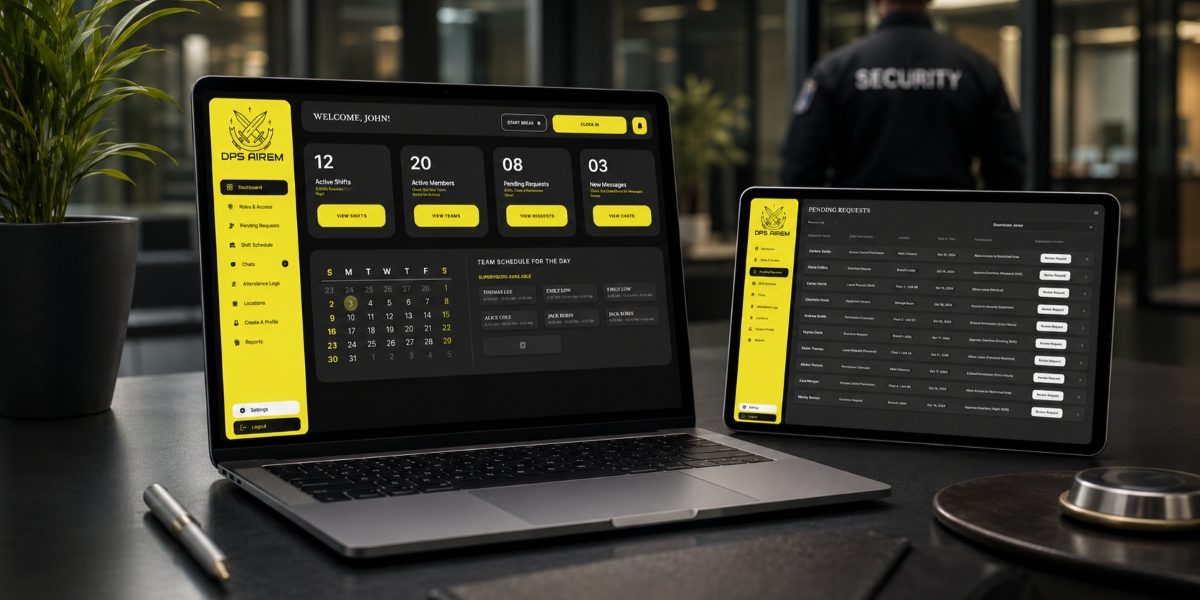
What started as a workforce and security management platform is quickly emerging as something much larger: a centralized operational control system designed for companies that can no longer afford blind spots in employee management.
And at a time when accountability, speed, and coordination matter more than ever, that shift is becoming increasingly important.
The End of Manual Workforce Management
The modern workforce no longer operates from a single office floor.
Employees are mobile. Teams are distributed. Security staff work across multiple properties. Healthcare workers rotate shifts across facilities. Field employees move between sites throughout the day.
Managers are expected to maintain oversight in real time while also handling:
• Scheduling
• Payroll
• Reporting
• Compliance
• Client communication
The problem is not simply scale. It is fragmentation.
Too many businesses still rely on disconnected systems that were never designed to work together. One platform handles scheduling. Another tracks attendance. Incident reports are stored elsewhere. Communication happens through text messages and phone calls. Payroll is processed manually at the end of the week after hours of reconciliation.
The result is operational fatigue.
Not because managers lack skill, but because the infrastructure itself creates unnecessary friction.
This is precisely the gap DPS Airem is attempting to close.
Rather than treating workforce management as a collection of separate administrative tasks, the platform approaches it as a single operational ecosystem where scheduling, accountability, communication, reporting, and oversight function together in real time.
The difference sounds subtle until you see how most organizations actually operate day to day.
Where Oversight Becomes Visibility
One of the strongest aspects of DPS Airem is its emphasis on visibility.
Not surveillance for the sake of control, but operational clarity.
Companies managing large teams often face a basic but costly question:
How do you know work is actually being completed properly when employees are spread across multiple locations?
For many organizations, the answer is still surprisingly outdated:
• Phone calls
• Paper logs
• Manual check-ins
• Delayed reporting
• Trust without verification
DPS Airem replaces much of that uncertainty with live operational data.
Its system combines:
• GPS tracking
• Geofencing
• Mobile workforce management
• Incident reporting
• Scheduling tools
• Digital guard tour technology
All within a centralized platform that allows supervisors and managers to see workforce activity as it happens.
Employees can clock in through mobile devices. Managers can verify locations in real time. Patrol routes can be tracked digitally. Incidents can be documented instantly from the field rather than hours later through paperwork.
For businesses operating across multiple job sites, the impact is immediate.
Small inefficiencies that once went unnoticed become measurable. Delays become visible. Coverage gaps become easier to prevent. Communication becomes faster and more structured.
In many cases, the software is not adding complexity—it is removing it.
Why Accountability Has Become a Competitive Advantage
There was a time when workforce accountability was viewed mostly as an internal management concern.
Today, it is directly tied to business reputation.
Clients want proof. Companies want documentation. Industries facing compliance pressure need audit trails that can withstand scrutiny.
Businesses managing field employees cannot afford uncertainty when disputes arise over:
• Attendance
• Response times
• Completed work
• Incident handling
This is where DPS Airem’s guard tour and reporting infrastructure becomes especially valuable.
The platform allows organizations to digitally verify:
• Patrol activity
• Employee movement
• Completed checkpoints
• Incident reports
• Shift performance
Through mobile systems that create a clear operational record.
For security companies, this can help reduce liability and improve client confidence.
For broader workforce operations, it creates something equally important:
Trust built on transparency.
Managers no longer need to rely entirely on fragmented updates or delayed paperwork. Clients no longer need to wonder whether contracted services are actually being delivered consistently.
The operational story exists in real time.
That level of visibility is increasingly becoming an expectation rather than a luxury.
Reducing the Hidden Cost of Administrative Work
One of the least discussed problems inside workforce management is the sheer amount of invisible labor required to keep operations functioning.
Managers spend hours:
• Adjusting schedules
• Reconciling attendance records
• Answering repetitive questions
• Managing paperwork
• Resolving avoidable administrative issues
Small errors compound into larger operational headaches by the end of the month.
Many companies do not realize how much productivity is lost simply by trying to manage the mechanics of employee coordination.
DPS Airem appears designed with this exact frustration in mind.
The platform integrates:
• Scheduling
• Attendance management
• Payroll support
• Reporting
• Task management
• Employee communication
Into one environment.
Instead of forcing businesses to juggle disconnected systems, it centralizes operational workflows in a way that reduces repetitive manual processes.
That matters because administrative overload eventually affects everything else.
Response times slow down. Managers burn out. Errors increase. Communication becomes inconsistent. Growth becomes harder to sustain.
Software alone cannot solve every organizational problem. But the right infrastructure can remove many of the obstacles that create those problems in the first place.
A Platform Built for Real-World Operations
What makes DPS Airem particularly relevant is that it was clearly built around operational realities rather than abstract corporate theory.
The platform understands that workforce management is messy.
Employees call out unexpectedly. Emergencies happen. Schedules shift. Supervisors need answers immediately, not after a chain of emails. Clients demand updates in real time. Field workers need mobile access because they are rarely sitting behind desks.
This practical orientation is visible throughout the platform’s structure.
Its mobile-first approach allows field teams to remain connected without depending on outdated communication methods.
Its reporting tools reduce the lag between incidents and documentation.
Its workforce tracking systems help businesses maintain structure even across large and decentralized operations.
Most importantly, it creates consistency.
And in workforce management, consistency is often what separates scalable organizations from chaotic ones.
The Shift Toward Operational Intelligence
The rise of platforms like DPS Airem reflects a larger change happening across industries.
Businesses are beginning to realize that workforce management is no longer just an HR function.
It is an operational intelligence function.
The companies that succeed over the next decade will not simply hire more people. They will manage coordination more effectively. They will reduce inefficiencies faster. They will build systems that allow leadership to see problems before they become crises.
In that environment, software is no longer just software.
It becomes infrastructure.
Key Benefits Organizations Seek Today
Businesses are increasingly looking for solutions that can help them:
• Improve workforce visibility
• Strengthen accountability
• Reduce administrative workload
• Simplify scheduling and reporting
• Improve communication across teams
• Enhance compliance tracking
• Support scalable operations
DPS Airem enters this space at a moment when businesses are actively searching for ways to reduce friction, improve accountability, simplify operations, and regain control over increasingly complex workforce environments.
For companies still trapped in spreadsheets, scattered communication channels, and manual oversight systems, that transformation may feel overdue.
Because the future of workforce management is not about watching employees more closely.
It is about giving organizations the clarity, structure, and operational confidence they have been missing for years.
As organizations work to consolidate these functions, platforms such as DPS Airem show how scheduling, attendance, reporting, and field oversight can operate within a single system built for the way distributed teams actually work.