
In the quiet, dim-lit scriptoriums of medieval Armenia, monks did more than just preserve the word of God. They carefully documented the visual identity of a nation’s spiritual leadership.
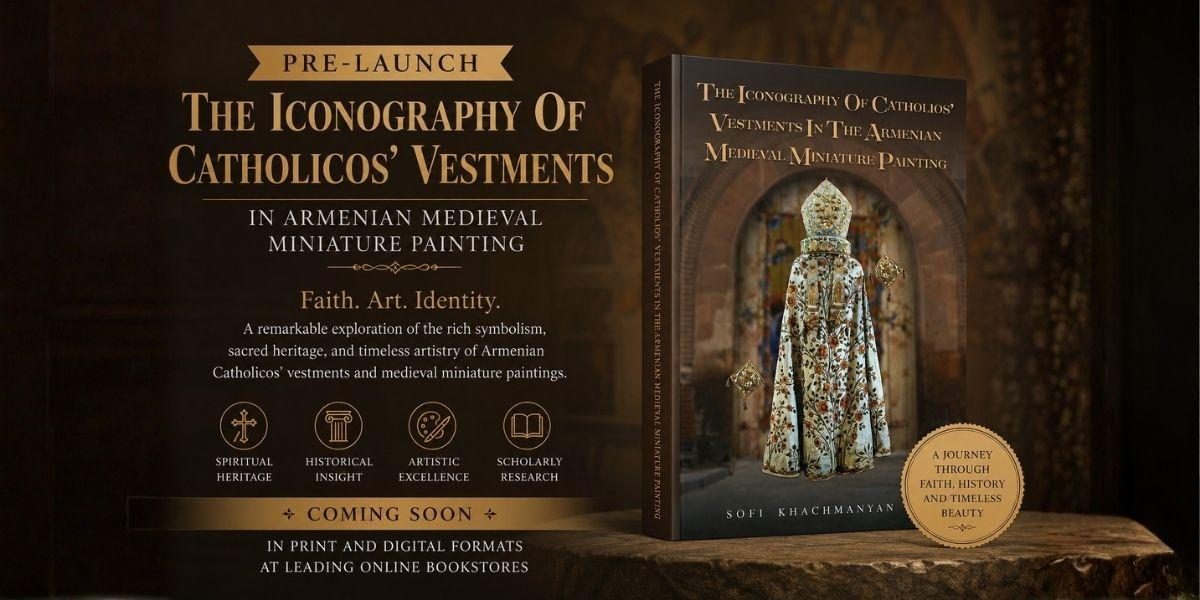
A new study by Dr. Sofi Khachmanyan, The Iconography of Catholicos’ Vestments in the Armenian Medieval Miniature Painting, offers a deep dip into this world, peeling back the silk and gold layers of the head of the Armenian Apostolic Church to reveal a narrative of cosmic proportions.
More Than a Uniform
To the uninitiated, the elaborate robes of a Catholicos might seem like mere ceremonial splendor. However, the author’s research reveals that every stitch is a syllable in a complex theological language. The book is a vital bridge between the 13th and 18th centuries, using the vibrant, often microscopic details of medieval miniature paintings to decode the plot of Armenian liturgical history.
The core purpose of the work is to demonstrate that these vestments are not static relics. Instead, they are dynamic symbols that represent a man’s transition into a living icon. As the book describes, the process of dressing the Catholicos is a sacred ritual in itself. With each garment, from the simple linen tunic to the jewel-encrusted miter. The high priest recites specific prayers intended to shed his everyday clothing, as his earthly sins, and to don the armor of light.
A Journey Through Time
Dr. Sofi takes the reader on an interdisciplinary journey, arguing that the roots of these Christian garments reach far deeper than the conversion of Armenia to Christianity in 301. The study traces a direct lineage back to the Urartian Kingdom and the ancient ritual attire of Mesopotamia and Persia. This plot of evolution shows how the Armenian Church synthesized local pagan aesthetics with Byzantine and Western influences to create something entirely unique.
The book catalogs the hierarchy of these garments. While a priest or bishop wears specific items, the Catholicos alone carries the full weight of the Church’s history. He dons the vestments of all subordinate ranks, topped by the epigonation, an identifying piece hanging from his belt, a symbol of his supreme spiritual authority over the Armenian Apostolic Church and his role as the vicar of Christ.
The Geometry of Heaven
One of the most fascinating revelations in the author’s work is the role of sacred geometry and color. The book explores how medieval miniaturists used the circle to represent the zero point of creation and the square to represent the material world. The colors are equally intentional. Red for the sacrifice of the martyrs, blue for the celestial heights, and gold for the uncreated light of the divine.
By examining the works of master miniaturists such as Sargis Pitsak and Mesrop Jughaet’si, Dr. Khachmanyan shows how these artists didn’t merely paint what they saw. They painted the spiritual reality of the office. They often depicted historical figures, such as Saint Mesrop Mashtots, in the contemporary vestments of the artist’s era, effectively bridging the gap between the ancestral past and the liturgical present.
Takeaway
The Iconography of Catholicos’ Vestments is more than an art history book, it is a celebration of Armenian spiritual and cultural heritage. Through the lens of theology, history, and sacred art, it reveals the rich symbolism woven into Armenian ecclesiastical vestments and medieval miniature paintings.
An essential read for anyone interested in Armenian history, faith, and visual culture, this book invites readers to discover the deeper meanings behind these timeless traditions.
The Iconography of Catholicos’ Vestments in the Armenian Medieval Miniature Painting will soon be available in print and digital formats through leading online bookstores.