In the quiet, dim-lit scriptoriums of medieval Armenia, monks did more than just preserve the word of God. They carefully documented the visual identity of a nation’s spiritual leadership.
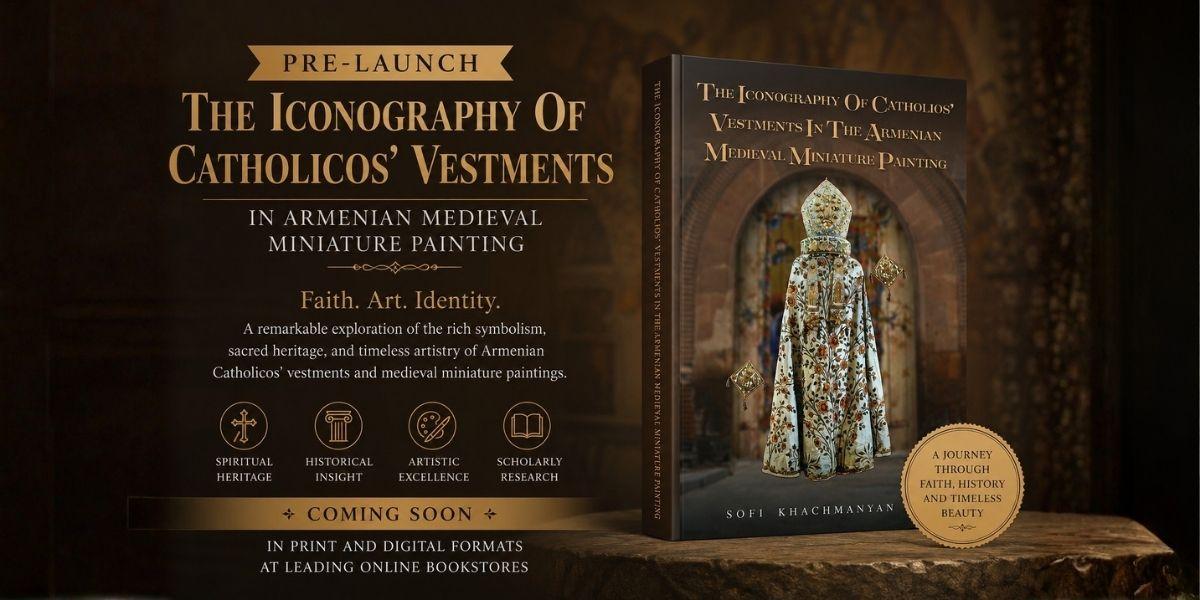
A new study by Dr. Sofi Khachmanyan, The Iconography of Catholicos’ Vestments in the Armenian Medieval Miniature Painting, offers a deep dip into this world, peeling back the silk and gold layers of the head of the Armenian Apostolic Church to reveal a narrative of cosmic proportions.
More Than a Uniform
To the uninitiated, the elaborate robes of a Catholicos might seem like mere ceremonial splendor. However, the author’s research reveals that every stitch is a syllable in a complex theological language. The book is a vital bridge between the 13th and 18th centuries, using the vibrant, often microscopic details of medieval miniature paintings to decode the plot of Armenian liturgical history.
The core purpose of the work is to demonstrate that these vestments are not static relics. Instead, they are dynamic symbols that represent a man’s transition into a living icon. As the book describes, the process of dressing the Catholicos is a sacred ritual in itself. With each garment, from the simple linen tunic to the jewel-encrusted miter. The high priest recites specific prayers intended to shed his everyday clothing, as his earthly sins, and to don the armor of light.
A Journey Through Time
Dr. Sofi takes the reader on an interdisciplinary journey, arguing that the roots of these Christian garments reach far deeper than the conversion of Armenia to Christianity in 301. The study traces a direct lineage back to the Urartian Kingdom and the ancient ritual attire of Mesopotamia and Persia. This plot of evolution shows how the Armenian Church synthesized local pagan aesthetics with Byzantine and Western influences to create something entirely unique.
The book catalogs the hierarchy of these garments. While a priest or bishop wears specific items, the Catholicos alone carries the full weight of the Church’s history. He dons the vestments of all subordinate ranks, topped by the epigonation, an identifying piece hanging from his belt, a symbol of his supreme spiritual authority over the Armenian Apostolic Church and his role as the vicar of Christ.
The Geometry of Heaven
One of the most fascinating revelations in the author’s work is the role of sacred geometry and color. The book explores how medieval miniaturists used the circle to represent the zero point of creation and the square to represent the material world. The colors are equally intentional. Red for the sacrifice of the martyrs, blue for the celestial heights, and gold for the uncreated light of the divine.
By examining the works of master miniaturists such as Sargis Pitsak and Mesrop Jughaet’si, Dr. Khachmanyan shows how these artists didn’t merely paint what they saw. They painted the spiritual reality of the office. They often depicted historical figures, such as Saint Mesrop Mashtots, in the contemporary vestments of the artist’s era, effectively bridging the gap between the ancestral past and the liturgical present.
Takeaway
The Iconography of Catholicos’ Vestments is more than an art history book, it is a celebration of Armenian spiritual and cultural heritage. Through the lens of theology, history, and sacred art, it reveals the rich symbolism woven into Armenian ecclesiastical vestments and medieval miniature paintings.
An essential read for anyone interested in Armenian history, faith, and visual culture, this book invites readers to discover the deeper meanings behind these timeless traditions.
The Iconography of Catholicos’ Vestments in the Armenian Medieval Miniature Painting will soon be available in print and digital formats through leading online bookstores.
Toni Beaino was twenty years old, and Lebanon was at war. The year was 1975. Bombs fell, borders shifted, and an entire country lurched into a civil conflict that would grind on for fifteen years. Most people looked for cover. Toni looked for a stall. He found one in Jounieh, a coastal town just north of Beirut. The setup was bare-bones: a wood-fired oven, a handful of ingredients, and hands that knew exactly what to do with them.
He made manakish, traditional Lebanese flatbreads topped with thyme, cheese, and spinach, and lahm baajin, his soon-to-be-legendary minced lamb pie, fragrant with onions and tomatoes and finished with a squeeze of lemon. There were no printed recipes. No operations manuals. Just a young man, a hot oven, and the kind of stubbornness that only survival can produce. “He used to wake up at 3 A.M. every day,” his son Wissam recalled.
“Even when he was super tired, super sick, he went. When you have to survive, you have to do it for your family. You have to do it right.” That modest stall in Jounieh is now the origin story of Furn Beaino, furn being Arabic for bakery, a Lebanese F&B brand with locations across the UAE, an accelerating GCC expansion, and a partnership that could carry the family name to 70 locations by 2030. What started as one man’s wartime hustle has become, over fifty years and across two generations, one of the Middle East’s most beloved fast-casual brands.
A Son’s Decision to Go All In
For years, Wissam El Beaino lived a different kind of life. He earned an engineering degree, completed a master’s program at one of Lebanon’s top universities, spent eight years in the engineering sector, and published academic papers. He was, by any measure, successful. But something kept pulling him back to the bakery. The shift came in 2017, when the Beaino family opened a central kitchen in Lebanon and began building the brand with the seriousness it deserved. A proper branding. Documented processes.
A push to earn the food safety certifications that would signal, beyond any marketing copy, that Furn Beaino operated at the highest possible standard. They earned ISO 22000:2005 in 2018, upgraded to ISO 22000:2018 in 2019, and most recently captured the FSSC 22000 certification from UKAS, the British accreditation body widely regarded as the world’s gold standard in food safety. Furn Beaino became one of only three food businesses in all of Lebanon to hold that distinction. Wissam resigned from his engineering career and stepped into a full-time role.
His brother, Samer, took on the co-CEO role, anchoring Lebanon’s operations. And Wissam set his sights on the Gulf. “It’s something that runs in the veins,” he said of the brand. “The name of the restaurant comes from our family name. It’s the only thing you have, and you really want to take good care of it.” The four values Toni built the business on, Quality, Consistency, Passion, and Pride, were formalized and embedded so deeply into the brand’s DNA that they appear as the four parallel lines in the Furn Beaino logo.
From Cloud Kitchens to a GCC Footprint
The Lebanon of Toni Beaino’s generation had been devastating, civil war, financial collapse, a currency that shed 99% of its value, and on August 4, 2020, one of the largest non-nuclear explosions in recorded history tore through the port of Beirut. Wissam had already made his move. He relocated to Dubai, scouted the market, and launched Furn Beaino’s first UAE cloud kitchen in Business Bay in 2022. A second followed in Hessa Street in 2023. A third opened in Silicon Oasis shortly after. Revenue from Dubai operations grew 30 percent year-on-year.
The next chapter is bigger. A flagship dine-in store, a full brick-and-mortar location, opened in Bay Square, Business Bay in early 2026. Additional cloud kitchens are rolling out in Sharjah and Ras Al-Khaimah. Abu Dhabi’s Al Reem Island already has a location. And the engine powering all of it is a deepened partnership with Ambrosia Foods, a regional F&B platform with the networks and capital to accelerate what the Beaino family has built. Through that partnership, Furn Beaino has also secured master franchise rights for Mr. Brown, a beloved American diner brand, across the entire GCC region, a move that signals the company’s transformation from a family bakery to a multi-concept hospitality group. The target: more than 70 locations across the Gulf by 2030.
Back in Lebanon, Toni Beaino still walks into the central kitchen. At 72, after navigating a civil war, economic ruin, a catastrophic explosion, and a year of conflict with Israel, he still shows up before anyone else. He still prepares the lahm baajin meat filling by hand. His sons have taken that example, that relentless, unglamorous, deeply personal dedication, and built something the Gulf is only beginning to taste. “We want to preserve this for the coming generations,” Wissam said. “It’s about legacy. It’s about history.” In the F&B world, legacies like this are rarely manufactured. They have earned one flatbread at a time, over fifty years, by a family that never stopped showing up.
There’s a quiet, sacred moment that happens in every surrogacy journey. It’s not captured in medical charts or contracts; it’s when two families meet for the first time, united by something bigger than themselves. In that instant, the world feels smaller, softer, and filled with possibility.
For those who’ve lived it, surrogacy isn’t just about the baby at the end of the road; it’s about the human connections made along the way. It’s about resilience, generosity, and the shared faith that life has a way of bringing people together in the most extraordinary ways.
At Joy of Life® Surrogacy, these moments are what matter most. Because the journey to parenthood isn’t just a process, it’s a story of hearts aligning, of hope renewed, and of joy unfolding with every step.
The Unexpected Beauty of the Journey
To outsiders, surrogacy can look like a transactional process: one family, one surrogate, one baby. But for those who experience it firsthand, it becomes something deeply emotional and transformative.
Every surrogate, every intended parent, carries a story. Some begin in heartbreak, years of infertility, unsuccessful treatments, or dreams delayed. Others start in gratitude, a woman who’s had children of her own and feels called to help another family experience the same joy.
When their paths meet, something powerful happens. A bridge forms between two lives that might otherwise never have crossed. It’s a connection built on trust, compassion, and the belief that giving life is one of the most profound gifts imaginable.
“We see the courage and generosity of our surrogates every day,” says one coordinator from Joy of Life. “And we see the humility and love in the intended parents. It’s not just about the baby, it’s about what they teach each other on the way there.”
The Surrogate’s Heart: A Gift That Redefines Giving
Ask any surrogate why she chose this path, and the answer almost always comes from the heart.
Some say it’s because they love being pregnant and want to use that gift to help others. Others were touched by a friend’s or sister’s fertility struggle and felt called to do something meaningful. Whatever the reason, the motivation is almost always selfless.
The experience of being a gestational carrier, carrying a child for someone else, often becomes one of the most rewarding chapters in a woman’s life. Through programs like Joy of Life’s CARES™ initiative, surrogates receive not only practical support and wellness coaching but also a sense of belonging. CARES™ was designed to ensure every surrogate feels seen, heard, and celebrated, not just during pregnancy, but before and after as well.
This sense of community is what many surrogates treasure most. They often stay in touch with other carriers, swapping stories, sharing milestones, and cheering one another on.
The Parents’ Perspective: Hope, Reimagined
For intended parents, surrogacy represents something both deeply vulnerable and profoundly brave.
Some arrive at this moment after years of heartbreak, failed IVF cycles, pregnancy losses, or medical diagnoses that made carrying unsafe. Others, like single parents and LGBTQIA+ families, see surrogacy as the pathway to their long-held dream of parenthood.
When they meet their surrogate for the first time, many describe the emotion as indescribable. Relief, gratitude, disbelief, all mixed together.
That connection becomes a lifeline during the journey. Through regular updates, shared milestones, and heartfelt messages, families and surrogates often become partners, and, in many cases, friends. The relationship is rooted in respect, empathy, and shared purpose.
By the time the baby arrives, there’s more than one kind of family being formed.
The Joy That Lingers: Bonds Beyond Birth
Surrogacy stories rarely end in the hospital. For many, they continue, through birthday messages, video calls, holiday cards, and visits. Some surrogates are even honored as godparents or invited to family celebrations years later.
These ongoing bonds reveal the deeper truth about surrogacy: it’s not a brief exchange, but the start of something lasting.
One Joy of Life surrogate described the moment she watched her intended parents hold their baby for the first time. “It was pure joy,” she said. “I’ll never forget the look on their faces. That’s when I understood what surrogacy is really about, it’s love, multiplied.”
That moment, filled with tears, laughter, and gratitude, is what gives the entire journey its meaning. It’s not just the baby being born, but the connection between people who chose to walk this path together.
The Team Behind the Scenes: Guiding Every Step
Every great story has its quiet heroes. In surrogacy, those heroes often include the coordinators, counselors, and nurses who make sure each step feels supported and transparent.
At Joy of Life®, that behind-the-scenes care is where much of the magic happens. From the first phone call to postpartum recovery, every family and surrogate is guided by a professional team who believes compassion is just as important as coordination.
This approach blends professionalism with empathy. It’s not just about paperwork, it’s about people. And it’s one reason why so many families describe their experience not as a transaction, but as a journey of trust and transformation.
Joy of Life’s CARES™ Program: Centering Compassion
A standout element of Joy of Life’s philosophy is the CARES™ Program, a first-of-its-kind life-coaching and wellness initiative for surrogates. It recognizes that emotional well-being and personal growth are integral to a healthy surrogacy experience.
Through CARES™, surrogates gain access to wellness workshops, one-on-one coaching, and community-building events. It’s a program built to nurture not just the pregnancy, but the woman behind it.
This kind of intentional support sets a new standard for care in the surrogacy field. It reminds everyone involved that while the baby is the ultimate goal, the journey, the people, the emotions, the growth, is what truly defines success.
Redefining Family: Expanding the Meaning of Love
Surrogacy challenges traditional definitions of family in the best possible way. It reminds us that family isn’t only about biology, it’s about intention, compassion, and shared purpose.
For many, this realization is transformative. The surrogate’s family often becomes emotionally invested, the intended parents become extended family, and the child grows up surrounded by stories of love and community.
These journeys reflect a broader truth about modern parenthood: love knows no boundaries. Whether through surrogacy, adoption, or blended families, what matters most is the courage to build connection where once there was distance.
In this way, surrogacy becomes not just a medical achievement, but a deeply human one, a celebration of empathy in action.
The Ripple Effect of Kindness
Perhaps the most beautiful part of surrogacy is its ripple effect.
One act of generosity can change countless lives. Children born through surrogacy grow up in families built on gratitude. Surrogates’ own children witness compassion and selflessness firsthand. Friends and communities gain new awareness about the power of giving.
It’s easy to see surrogacy as a one-to-one story, one family helping another, but in truth, it echoes outward, shaping how we understand love, service, and humanity.
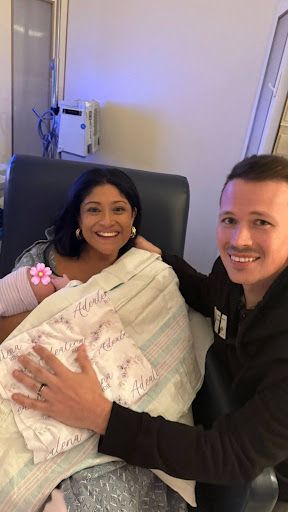
Photo Courtesy: Joy of Life
The Joy That Lasts a Lifetime
The day a surrogate gives birth is often filled with tears, of joy, relief, and awe. It’s the culmination of months of dedication and trust. But for everyone involved, it’s also the beginning of a new kind of joy.
For the intended parents, it’s the start of their lifelong dream of family. For the surrogate, it’s a moment of quiet pride, knowing she’s made the impossible possible.
That’s why, at Joy of Life®, the team always reminds families that this journey is about so much more than arrival. It’s about transformation, how each person is changed by the process, by the connection, by the courage to take that first step.
Because in the end, surrogacy isn’t just about creating life, it’s about celebrating life in all its beautiful, interconnected forms.
Ready to Begin Your Own Journey?
Whether you’re dreaming of growing your family or inspired to become a surrogate yourself, Joy of Life® is here to guide you with compassion and expertise.
Your first step starts with a simple, heartfelt conversation.
Disclaimer: This information is for general educational purposes only and is not medical or legal advice. Laws and requirements vary by state.
The Global E-Waste Monitor projects a 32% rise in e-waste generation between 2022 and 2030, from 62 billion kg to an estimated 82 billion kg. Of that volume, only 22.3% was documented as properly collected and recycled. The rest, roughly 48 billion kg, ends up in landfills or informal processing chains, releasing toxins, wasting recoverable metals, and generating avoidable greenhouse gas emissions.
For IT asset managers and ITAD operators, these numbers raise a straightforward question: how much of that volume consists of functional equipment destroyed not because it was beyond use, but because no secure alternative to destruction existed within the organization’s process? The answer, for many enterprises, is more than it should be. Physical destruction remains the default end-of-life option for a significant share of corporate IT assets, not because it is technically superior, but because it feels operationally simpler and carries less perceived compliance risk. That perception is worth examining.
The Case Against Physical Destruction
Physical destruction accounts for over 15% of the ITAD market, per SNS Insider. The assumption of sustaining that share is that shredding guarantees data security in a way that software-based sanitization cannot. On closer inspection, this does not hold true.
For hard disk drives, overwrite-based erasure performed in accordance with NIST SP 800-88 or IEEE 2883-2022 renders stored data unrecoverable with commercially available forensic tools. An organization meeting NIST 800-88 requirements for media sanitization is sound for permanently erasing data.
Solid-state and NVMe drives require a different approach. Because wear-leveling algorithms managed by the Flash Translation Layer (FTL) distribute writes across NAND cells, a sequential software overwrite will not reliably reach every logical block. The right tools for the job are ATA Secure Erase for SATA SSDs and NVMe Format with Crypto Erase for NVMe media. Both operate below the FTL, targeting user-addressable and over-provisioned space, and both satisfy NIST 800-88 r2 sanitization requirements. Crypto Erase works by discarding the media encryption key, rendering all stored data cryptographically inaccessible; a distinction worth understanding in compliance contexts, where “data destroyed” and “data rendered permanently inaccessible” may carry different weight depending on the applicable regulation.
A shredded laptop is an asset permanently removed from any value chain. A laptop sanitized through a certified process retains full operational value; it can be redeployed internally, donated, or sold on the secondary market. Physical destruction, used as a default rather than a last resort, writes off that value without justification.
The Environmental Cost of Linear Disposal
The scale of e-waste mismanagement carries measurable environmental and financial consequences. The Global E-Waste Monitor 2024 reports that in 2022 alone, improperly managed e-waste released 58 tonnes of mercury into the environment. Formal e-waste management, by contrast, avoided 93 million tonnes of CO₂-equivalent emissions through recaptured refrigerants and avoided metals mining and recovered US$28 billion worth of secondary raw materials through what the report describes as “urban mining” of e-waste. The gap between what is being recovered and what could be recovered is large. The 2022 e-waste stream contained an estimated US$91 billion in embedded metals. Less than a third of that was reclaimed.
In this context, IT equipment occupies a particular position. The Global E-Waste Monitor places small IT and telecommunications equipment, laptops, mobile phones, GPS devices, and routers, all at 4.6 million tonnes of e-waste in 2022, with a documented collection and recycling rate of only 22%. These are not industrial components at the end of a long service life. Enterprise IT assets are routinely decommissioned for three to five years, well within their functional lifespan. The constraint on reusing is not a hardware condition. It is data security, or more precisely, the organizational assumption that security requires destruction.
Regulatory frameworks are shaping expectations in this area. The EU’s WEEE Directive requires producers and distributors to take back and recycle end-of-life electronics responsibly. In the US, RCRA governs hazardous waste management and applies to certain categories of electronic scrap. Organizations that extend device lifecycles through certified sanitization and reuse are better positioned under both frameworks and contribute to reducing the volume of functional equipment that becomes part of the problem.
What Certified Data Erasure Actually Delivers?
Data security and environmental sustainability are frequently treated as separate organizational concerns. They are not. A device that cannot be securely sanitized cannot be reused. A device destroyed instead of sanitized contributes to e-waste. Certified erasure is the mechanism that resolves this tension and operates across three practical dimensions.
Documented, Verifiable Data Sanitization
Standards-aligned erasure produces a certificate for each device processed: a tamper-proof record of the device identifier, media type, sanitization method applied, and verification result. This is not administrative overhead. It is the evidence that converts an erased device into a defensible compliance artifact. Without it, a wiped device is legally indistinguishable from one that was never touched. Professional tools like BitRaser Drive Eraser can also address areas of storage media that routine overwrites miss, including the Host Protected Area (HPA) and Device Configuration Overlay (DCO), though coverage varies by tool and should be confirmed against vendor documentation.
Retained Asset Value
Physical destruction forecloses every downstream value pathway. Certified erasure keeps them open. A sanitized, operationally functional device can be redeployed to a different business unit, donated as part of a corporate responsibility program, or liquidated on the secondary market. For organizations managing hundreds or thousands of devices annually, the cumulative financial and environmental difference is material.
Regulatory Compliance
GDPR, CCPA/CPRA, and India’s Digital Personal Data Protection Act each impose obligations regarding how personal data is handled at the end of life. Erasure performed under NIST SP 800-88 Rev. 1 or IEEE 2883-2022, with a certificate of completion, gives organizations a documented, auditable basis for demonstrating compliance. Physical destruction without accompanying documentation does not confer the same standing.
Operationalizing the Shift
The change most organizations need is procedural, not technical. The tools and standards already exist. End-of-life IT asset handling needs to be treated as a managed process with defined sanitization criteria, a documented chain of custody, and an audit trail that can be produced on demand.
In practice, this means physical destruction should be reserved for devices that are genuinely unfit for sanitization, due to hardware failure, media damage, or missing encryption keys, while certified erasure becomes the standard path for everything else. It means certificate generation is a non-negotiable output of the process, not an optional add-on. And it means the disposition workflow connects to asset management systems so that reuse and recovery rates are tracked and reportable.
Organizations that build this into their operations are not just managing compliance risk more effectively. They are reducing procurement costs, generating secondary market revenue, and contributing measurably to reducing the volume of functional IT equipment that ends up as e-waste. The technical case for certified data erasure over physical destruction is well-established. So is the business case. Translating both into operational practice is what remains.
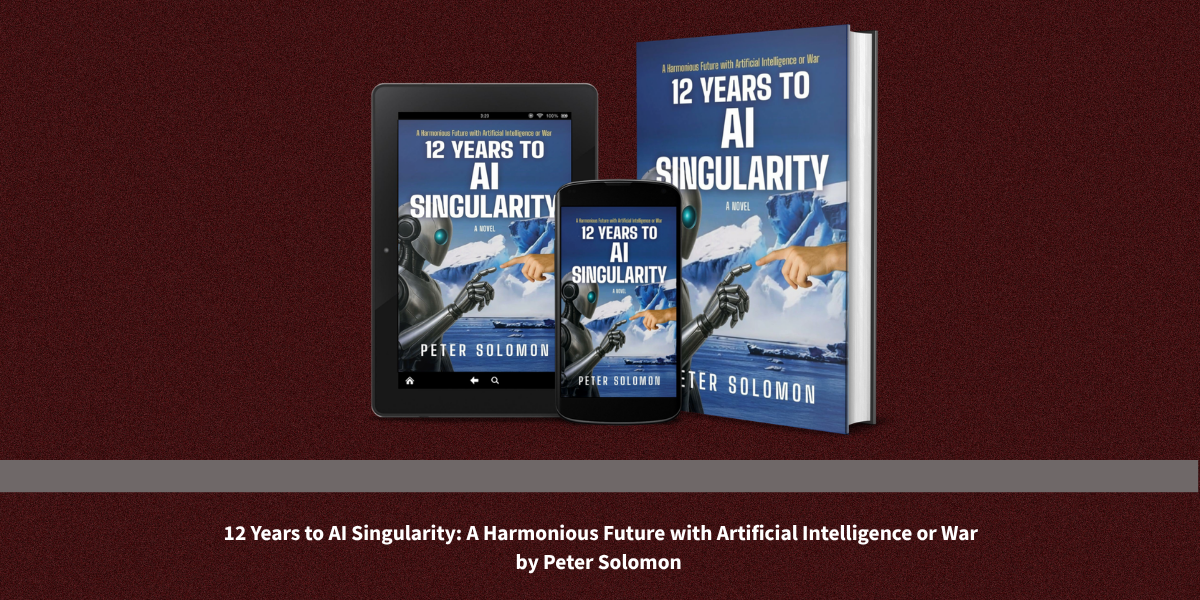
Most novels about artificial intelligence keep a careful distance between the reader and the thing they are supposed to be afraid of. The AI is vast and remote, the threat is systemic and abstract, and the experience of reading about it, however gripping, remains fundamentally separate from the experience of actually living in a world where these questions are becoming real. Dr. Peter Solomon does something considerably braver and more unsettling but also hopeful in 12 Years to AI Singularity. He closes that distance entirely. He puts the singularity, when AI surpasses humans in the ability to control the future,in the room with you. He puts it at the kitchen table, in the middle of a family disagreement, inside a romance that is complicated by everything the characters know and fear about where their world is heading. And then he asks you to sit with what that actually feels like.
The experience of reading this book is not comfortable and it is not supposed to be. Solomon is a scientist who believes the warnings being issued about unchecked AI development are not being taken seriously enough by the people and institutions with the most power to act on them, and he has written this novel as a form of alarm that fiction can sound in ways that technical papers and policy documents simply cannot. You feel that purpose in the narrative from the opening pages, when a robot may have killed a human being on Earth. The small community on Mars that is trying to understand what happened realizes that the frameworks they have been relying on to keep human civilization safe may no longer be adequate.
What makes the book’s themes resonate so far beyond its genre boundaries is how insistently Solomon connects the grand civilizational question to the intimate human one. The debate over whether humans and AI can share a future without destroying each other is never allowed to remain purely philosophical. It shows up in how people treat each other, in what they are willing to trust, in the choices they make about the communities they want to build and the futures they are willing to fight for. The Mars setting amplifies this dynamic beautifully, because a small human settlement on another planet is already a place where the stakes of every decision are unusually visible and the margin for catastrophic error is unusually thin. But the Mars experience of AI and human cooperation can be a model for Earth. A family and friends, humans and sentient robots, return to Earth to help create a harmonious, cooperative future.
Solomon writes with the conviction of someone who has spent serious time thinking about these questions at a scientific level and emerged with genuine concern rather than measured professional neutrality. That conviction gives the prose an urgency that carries you through even the more idea-dense passages, and his willingness to let his characters be fully human in the middle of an inhuman situation, scared and funny and loving and wrong in the ways people are wrong, keeps the intellectual ambition of the book grounded in something emotionally real.
This is science fiction that takes its responsibility to the present moment seriously, and in a moment when the questions it is asking are becoming impossible to defer, that seriousness is exactly what the genre needs to be doing. Dr. Peter Solomon has written a book that will make you think harder and sleep a little less soundly, which is precisely the effect a book like this should have.
If the idea of the AI singularity has always felt like something happening in the distant future and you are ready for a book that brings it uncomfortably close to home, 12 Years to AI Singularity by Dr. Peter Solomon is waiting for you on Amazon. Pick up your copy and prepare to look at the technology around you with completely different eyes.
Chronograph, the Brooklyn-headquartered portfolio monitoring and analytics platform serving institutional private capital investors, confirmed a strategic minority growth equity round of more than $140 million on Tuesday, June 16. Sixth Street Growth, the dedicated growth investing arm of Sixth Street, led the round. All existing investors — Summit Partners, Carlyle AlpInvest, Nasdaq Ventures, and Sidekick Partners — held their minority positions and stayed in.
The raise is the largest single capital event in Chronograph’s ten-year history and positions the company to accelerate three priorities: expanding its AI product suite, launching a new private credit portfolio monitoring platform, and growing its global footprint beyond its current Brooklyn and London offices.
What Chronograph Does and Who Uses It
Chronograph builds cloud-based software that institutional limited partners and general partners use to monitor private capital portfolios, run valuations, generate analytics, and automate LP and GP reporting. The platform currently monitors more than $5.9 trillion in client-invested capital across 15,000 unique private funds and 258,000 private companies. Eight of the ten largest private capital general partners and five of the ten largest private capital limited partners globally are on the platform.
The company was founded in 2016 by Charlie Tafoya, who serves as CEO, and Michael Bridge, who serves as CTO. Revenue splits evenly between LP and GP clients, an unusual balance in a market where most competitors skew toward one side.
That balance matters because it positions Chronograph as a shared data layer between two sides of the same transaction. LPs use the platform to track performance across their private fund commitments. GPs use it to prepare the reporting that LPs demand. When both sides run on the same system, the data reconciliation problem — one of the heaviest operational burdens in private capital — shrinks substantially.
Why The Round Is Sized The Way It Is
Photo Credit: Unsplash.com
The Wall Street Journal reported the round values Chronograph at roughly $350 million. For a company that has not previously disclosed a valuation publicly, the number places it in the upper tier of private-markets fintech but well below the billion-dollar thresholds that have defined the sector’s headline names over the past two years.
That positioning is deliberate. Sixth Street Growth provides growth equity and capital solutions to mid- and late-stage technology companies and manages its own portfolio inside Sixth Street, a firm with over $130 billion in assets under management and committed capital. As part of the transaction, Sixth Street Growth’s Michael Bauer and Alex Goodman join Chronograph’s board of directors.
The capital has a stated deployment plan. Chronograph is using the funds to deepen its AI product line, build out the new private credit monitoring platform, and expand internationally. The private credit angle is the newest: the asset class has grown faster than traditional private equity over the past three years, and the reporting and monitoring infrastructure around it has not kept pace. Chronograph is entering that gap with a dedicated product rather than stretching its existing PE-focused tools to cover credit workflows.
The AI Layer and the Trust Problem
Chronograph has been integrating machine learning and AI into its platform since its founding, with a data architecture designed to serve as a deterministic system of record at scale. In 2025, the company partnered with Anthropic as a launch partner for Claude for Financial Services, enabling portfolio data to be accessed and analyzed through AI-driven interfaces while maintaining audit-grade accuracy.
CTO Michael Bridge framed the company’s AI position in terms of institutional risk rather than capability: the challenge is not getting an answer from a large language model, but getting one that can be defended in front of an auditor, an LP, or an investment committee. That framing aligns with the broader institutional buyer psychology around AI adoption in financial services, where accuracy, auditability, and regulatory defensibility carry more weight than speed or novelty.
Where Chronograph Sits Inside NYC’s Fintech Map
The raise adds to a Brooklyn fintech cluster that has built quietly while Manhattan’s financial district and Midtown drew the louder venture headlines. Chronograph operates out of Brooklyn with a second office in London, and its investor base — Summit Partners, Carlyle AlpInvest, Nasdaq Ventures — reflects institutional capital rather than the seed-stage accelerator pipeline that dominates Brooklyn’s consumer-tech narrative.
The broader NYC venture ecosystem continues to run at an elevated pace. NYC startups raised $16.6 billion across more than 460 deals in 2024, and Manhattan now hosts more early-stage startups than San Francisco according to Tech:NYC data. The investment-tech sector alone has seen $3.72 billion in U.S. funding in 2026 to date. Chronograph’s raise lands inside that current and adds a data infrastructure layer to a city whose fintech identity has historically been defined by payments, lending, and trading platforms rather than portfolio analytics.
Chronograph’s 180-person team, the new board seats from Sixth Street Growth, and the private credit product launch collectively signal a company moving from category leader to platform expansion. The full press release and investor details are available through Chronograph’s official site at chronograph.pe.
Disclaimer: This article is for informational purposes only and does not constitute investment advice, an endorsement of any company mentioned, or a recommendation to buy or sell any securities. Readers should conduct their own due diligence before making any financial decisions.
For the modern parent, the daily schedule is a masterclass in logistics. Between school pick-ups, sports practices, and enrichment activities, time is a premium commodity. Yet, the pressure to equip children with global life skills has never been higher. Chief among those skills is language acquisition.
While traditional weekend language schools or private, in-person tutors have long been the standard, a major shift is happening right from our living rooms. One platform behind this shift is Novakid, an online learning service that is changing how the next generation approaches a second language.
By replacing rigid desk work with an immersive, game-based digital ecosystem, the platform reflects a growing belief that play is one of the most effective ways for young children to learn.
The Death of the Vocabulary Drill
Ask any adult how they learned a second language, and they will likely recall a blur of flashcards, tedious grammar tables, and the anxiety of speaking up in a crowded room.
Novakid’s approach is fundamentally different. Designed for children aged 4 to 12, the platform uses 1-on-1, 25-minute sessions with certified international teachers.
Crucially, these lessons are rooted in full linguistic immersion. Instructors use Total Physical Response (TPR), a methodology relying on exaggerated gestures, facial expressions, and visual aids to build real-time comprehension without translating back to the child’s native tongue.
This immersive style makes high-quality English for kids accessible to anyone with an internet connection, effectively bringing experienced educators from around the world straight to your kitchen table.
Enter the ‘Game World’
What truly sets Novakid apart in a crowded ed-tech market is its commitment to gamification. Recognizing that digital natives respond poorly to passive lecture formats, the creators built the Novakid Game World.
When a student logs in, they aren’t just opening a classroom; they are entering an animated universe. Children choose their own avatars, follow comic-book style storylines, and earn digital rewards for completing challenges and homework. The platform even features virtual reality (VR) tours, allowing a student in New York to virtually walk through a historic landmark alongside a teacher based halfway across the world, conversationalizing in English the entire time.
It’s this highly engaging environment that has made these interactive English classes for kids a favorite among busy urban parents. Because the platform’s backend tracks progress dynamically, the curriculum automatically adjusts to a child’s unique learning curve, introducing extra practice or moving ahead without the stress of formal, high-stakes testing.
Cultivating Tomorrow’s Global Citizens
In our increasingly interconnected world, language is about more than just passing an exam; it is about connection. Alongside individual sessions, Novakid opens the door to international speaking groups where children from dozens of different countries can converse, collaborate, and build social confidence together.
For parents looking for an efficient, flexible way to support English learning for kids, the digital format offers real convenience. There are no commuting times, no physical textbooks to lose, and everything from progress reports to class scheduling is easily managed via a streamlined parent dashboard.
Ultimately, the future of education isn’t about forcing kids to adapt to old systems; it’s about building systems that capture their natural curiosity. By prioritizing fun and psychological engagement, learning English for kids transforms from a mandatory after-school chore into the highlight of their week.
Novakid offers free trial lessons for families who want to see how an immersive, game-based approach works in practice.