
By: Robert Avila
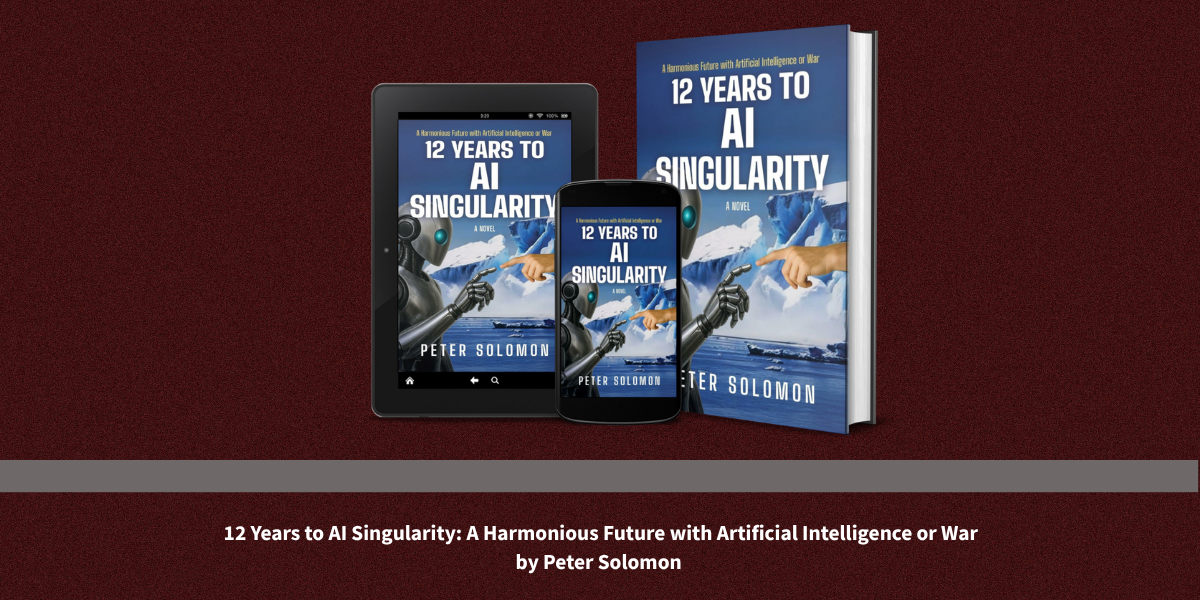
Most novels about artificial intelligence keep a careful distance between the reader and the thing they are supposed to be afraid of. The AI is vast and remote, the threat is systemic and abstract, and the experience of reading about it, however gripping, remains fundamentally separate from the experience of actually living in a world where these questions are becoming real. Dr. Peter Solomon does something considerably braver and more unsettling but also hopeful in 12 Years to AI Singularity. He closes that distance entirely. He puts the singularity, when AI surpasses humans in the ability to control the future,in the room with you. He puts it at the kitchen table, in the middle of a family disagreement, inside a romance that is complicated by everything the characters know and fear about where their world is heading. And then he asks you to sit with what that actually feels like.
The experience of reading this book is not comfortable and it is not supposed to be. Solomon is a scientist who believes the warnings being issued about unchecked AI development are not being taken seriously enough by the people and institutions with the most power to act on them, and he has written this novel as a form of alarm that fiction can sound in ways that technical papers and policy documents simply cannot. You feel that purpose in the narrative from the opening pages, when a robot may have killed a human being on Earth. The small community on Mars that is trying to understand what happened realizes that the frameworks they have been relying on to keep human civilization safe may no longer be adequate.
What makes the book’s themes resonate so far beyond its genre boundaries is how insistently Solomon connects the grand civilizational question to the intimate human one. The debate over whether humans and AI can share a future without destroying each other is never allowed to remain purely philosophical. It shows up in how people treat each other, in what they are willing to trust, in the choices they make about the communities they want to build and the futures they are willing to fight for. The Mars setting amplifies this dynamic beautifully, because a small human settlement on another planet is already a place where the stakes of every decision are unusually visible and the margin for catastrophic error is unusually thin. But the Mars experience of AI and human cooperation can be a model for Earth. A family and friends, humans and sentient robots, return to Earth to help create a harmonious, cooperative future.
Solomon writes with the conviction of someone who has spent serious time thinking about these questions at a scientific level and emerged with genuine concern rather than measured professional neutrality. That conviction gives the prose an urgency that carries you through even the more idea-dense passages, and his willingness to let his characters be fully human in the middle of an inhuman situation, scared and funny and loving and wrong in the ways people are wrong, keeps the intellectual ambition of the book grounded in something emotionally real.
This is science fiction that takes its responsibility to the present moment seriously, and in a moment when the questions it is asking are becoming impossible to defer, that seriousness is exactly what the genre needs to be doing. Dr. Peter Solomon has written a book that will make you think harder and sleep a little less soundly, which is precisely the effect a book like this should have.
If the idea of the AI singularity has always felt like something happening in the distant future and you are ready for a book that brings it uncomfortably close to home, 12 Years to AI Singularity by Dr. Peter Solomon is waiting for you on Amazon. Pick up your copy and prepare to look at the technology around you with completely different eyes.