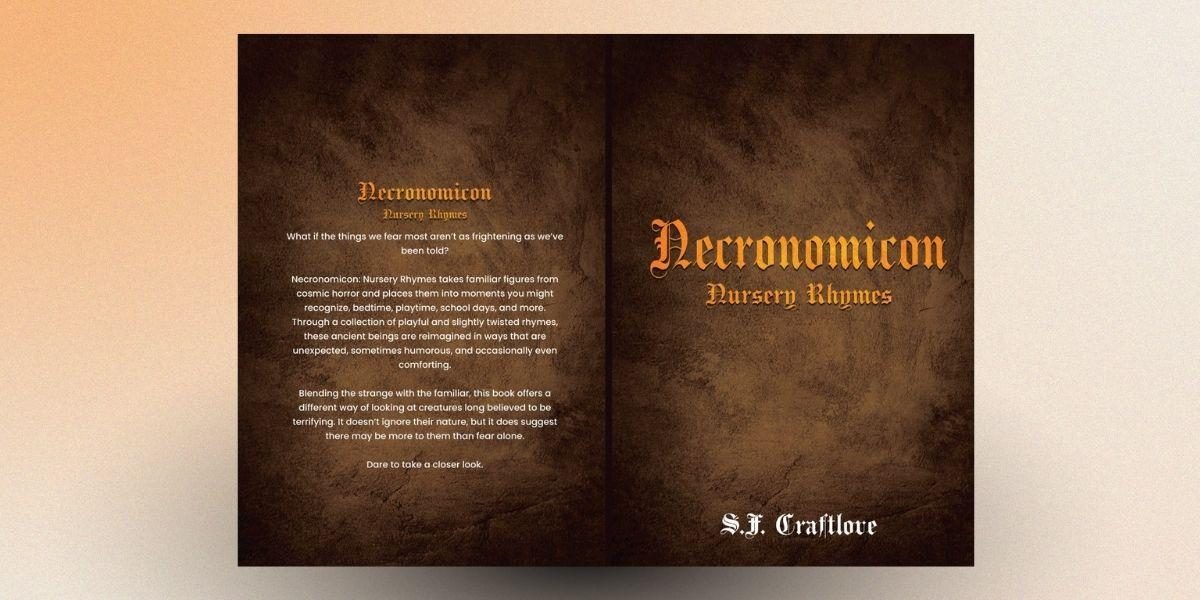

The first joke of Necronomicon Nursery Rhymes is visual. Before a single poem begins, the book appears to be staging a grand occult performance. The title page wears its gothic type like a ceremonial robe. The parchment backgrounds suggest age, secrecy, and danger. Even the mock copyright page participates in the act, dryly warning that the publisher will not be liable for the summoning of deities. It is the kind of joke that tells you exactly what kind of book this is: clever, theatrical, and fully committed to its own absurdity.
Then the rhymes begin, and the second joke arrives. The supposedly forbidden world of cosmic horror has been moved into the rhythms of childhood. Not softened entirely, not explained away, not turned into bland cuteness, but redirected. The creatures of nightmare become companions in ordinary rituals: washing up, going to sleep, playing outdoors, heading to school, visiting friends, relaxing on the couch.
This is where S. F. Craftlove’s book finds its real energy. It understands that humor is often a matter of distance. Cosmic horror traditionally depends on vastness. Human beings are tiny. The universe is indifferent. The gods are older than thought. Craftlove narrows the camera. Suddenly, the ancient being is not looming over civilization; it is involved in bath time. Now the dreadful name is not whispered by a doomed scholar; it is bouncing through a nursery rhyme.
That shift makes the book accessible, but it also gives it an unexpectedly warm center. The manuscript’s “Letter to the Reader” explains that these creatures may not be what people assume. The book repeatedly returns to that idea: the monstrous is not always malicious, and fear can be a poor guide. In a children’s book, that message could easily become syrupy. Here, because it comes wrapped in tentacles, jokes, and faux-forbidden scholarship, it feels fresh.
The illustrations are essential to the effect. They have a hand-drawn, comic looseness that keeps the tone friendly, while never allowing the creatures to look entirely normal. Many-eyed faces, exaggerated limbs, odd bodies, and theatrical expressions populate the pages. The art gives each figure enough personality to be funny, enough weirdness to remain memorable, and enough visual simplicity to keep the book moving.
Craftlove’s rhymes have a handmade quality, which suits the project. They are playful, direct, and often knowingly silly. The best lines work because they sound like something a child might chant, even when the subject matter belongs to a locked shelf in a doomed library. The book’s table of contents alone reads like a comic manifesto: lessons, snow days, movies, and school days, all attended by beings who usually arrive with thunder, madness, or prophecy.
The book will likely speak most strongly to horror fans with children, teachers who enjoy offbeat read-aloud material, collectors of strange illustrated books, and readers who like their whimsy with a little shadow. Yet it also has a broader appeal. Its central idea is easy to grasp and hard to resist: maybe the monster is not the problem. Maybe the problem is how quickly we decide what a monster is.
By the end, Necronomicon Nursery Rhymes has done something more interesting than parody. It has made the Mythos feel playful without making it harmless, affectionate without making it dull. It does not drain the darkness. It hangs fairy lights in it.