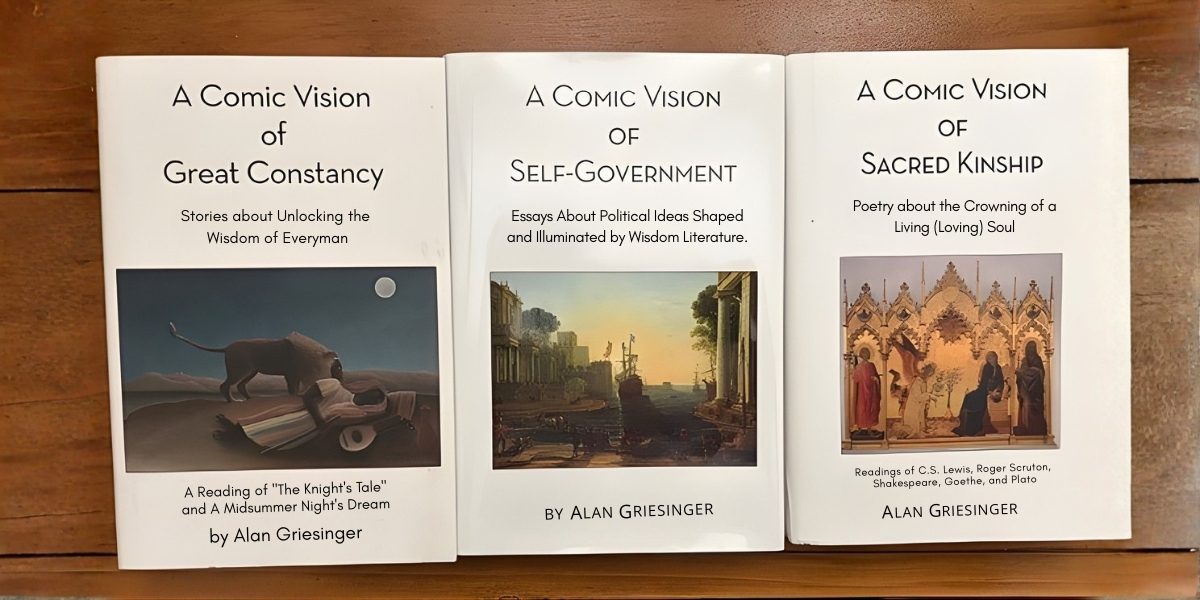

Alan Griesinger’s Second Act: Why Self-Government Starts Way Before Politics
Most people hear the word “government” and picture institutions, elections, and power plays. Headlines stuff.
Alan Griesinger goes in the opposite direction.
In his second book, A Comic Vision of Self-Government, he pulls the whole idea inward. Way inward. Past systems, past ideology, straight into the individual.
His argument is uncomfortable in the best way. If people can’t manage themselves, nothing they build will hold together for long.
From Personal Growth to Political Reality
In his first book, Alan Griesinger was focused on something personal.
How people grow up. Not physically, but internally.
He explored how stories show us falling apart, waking up, and rebuilding. That whole arc from illusion to clarity.
The second book takes that same pattern and stretches it across society.
If individuals need self-awareness to function, then governments need it too. Same rules, just bigger consequences.
That shift sounds obvious once you hear it. But most people never connect those dots.
The Question That Changes Everything
At the core of the book sits one question.
What can I do that lies within my own power to make a situation better?
It sounds simple. Almost too simple.
But most people skip it.
They look outward first. Blame, systems, leadership, bad luck. Anything but their own role in the situation.
Alan flips that instinct.
He is not saying systems don’t matter. He is saying they depend on something deeper. The people inside them.
If those people lack restraint, awareness, or responsibility, no structure will save them.
Power Does Not Start at the Top
There is a quiet but sharp idea running through the book.
Power in a democracy does not really sit with leaders.
It sits with individuals who know how to govern themselves.
That does not mean perfection. It means awareness.
Knowing when you are wrong. Knowing when your ego is driving. Knowing when to step back instead of doubling down.
Without that, freedom turns into chaos.
With it, even flawed systems can survive.
A Trip to India That Shook His Assumptions
Some of the book’s strongest insight did not come from a classroom.
It came from a trip.
In 2015, Alan visited India. Like most visitors, he saw the Taj Mahal. Impressive, no question.
But that was not what stayed with him.
What stuck was everything around it.
Crowded streets. Families living their lives out in the open. Cooking, washing, working, raising kids in conditions that would challenge most Western expectations.
And yet, it worked.
Not perfectly. Not cleanly. But it held together.
There was rhythm. Order. Continuity.
Weddings fill the streets with music at night. Kids heading to school in uniforms. Rituals unfolding along the Ganges as if time had never sped up.
It forced a rethink.
Maybe stability is not just about policy or infrastructure. Maybe it comes from shared beliefs, habits, and stories people carry with them.
Why People Accept Authority
This is where philosophy slips in.
Alan leans on David Hume, who made a strange observation.
The many are governed by the few.
Not because they have to be, but because they accept it.
That acceptance is not blind. It is rooted in opinion. In the belief that the system, however imperfect, has legitimacy.
That insight hits harder when you see it play out in real life.
In India, despite massive inequality, there is still a sense of order. Not imposed from above alone, but sustained from below.
People participate in it.
That changes how you think about power.
Culture Builds the Ground Beneath Government
One of the book’s most pointed ideas is this.
Government is downstream from culture.
What people read, believe, admire, and repeat shapes what they tolerate and what they reject.
Alan connects this back to literature again.
Stories are not decoration. They are rehearsal spaces.
They let people explore decisions, consequences, failure, and repair, all before it shows up in real life.
That is why ancient stories still matter. Not because they are old, but because the problems inside them have not changed.
You still see pride, obsession, misunderstanding, recovery.
Same patterns. Different setting.
The Inner Judge You Can’t Escape
At some point, Alan brings in Adam Smith.
Not for economics, but for something more psychological.
Smith described what he called the “impartial spectator.”
A voice inside you that watches what you do and quietly judges it.
No applause. No public reaction. Just a steady question.
Was that right?
It is easy to ignore when things are going well.
Harder to ignore when they are not.
Alan draws a parallel between this idea and literature. Stories create that same distance. They let you step outside yourself and see your behavior more clearly.
That gap is where change starts.
Why Everyday Life Matters More Than Theory
Another influence that shows up is Edmund Burke.
Burke did not trust abstract theories to hold societies together.
He trusted habits. Traditions. Small, repeated actions that build trust over time.
Alan leans into that.
He talks about ordinary things. Meals. Routines. Even watching old shows with family.
Not as filler, but as structure.
These are the moments where relationships are maintained. Where tension is softened. Where people reconnect.
It is not dramatic. It is essential.
Without those rhythms, everything else starts to fray.
What Happens When Governments Forget Their Limits
The book does not stay optimistic the whole way through.
It also looks at failure.
Alan draws on Paul Johnson to explore what happens when governments try to control everything.
The twentieth century offers plenty of examples.
Systems that replaced individual responsibility with forced conformity.
At first, it looks efficient. Orderly. Controlled.
Then it breaks people.
When individuals lose the ability to think, choose, and act freely, society does not become stronger. It becomes brittle.
And brittle systems eventually crack.
Freedom Without Wisdom Is Not Enough
One of the sharper edges of the book is its view on freedom.
Modern culture celebrates choice. Do what you want, be who you want, follow your path.
Alan does not reject that.
But he adds something most people do not want to hear.
Freedom without wisdom is unstable.
Self-government requires humility. The willingness to admit you do not have everything figured out.
To listen. To adjust. To recognize limits.
That is not a popular message.
But it is a durable one.
The Bigger Picture Behind the Book
This second book is not a standalone idea.
It builds directly on the first and points toward a third.
Together, they circle around one belief.
People flourish when they take responsibility for themselves first.
Not in isolation, but as part of something larger. Families, communities, cultures.
Before laws, before institutions, before systems.
There is the individual.
And whether that individual can face reality without flinching too hard.
That is where everything begins.
Griesinger’s first book, A Comic Vision of Great Constancy, traces these same ideas back to their literary origins in Chaucer and Shakespeare. His full body of work is available at acomicvision.com.