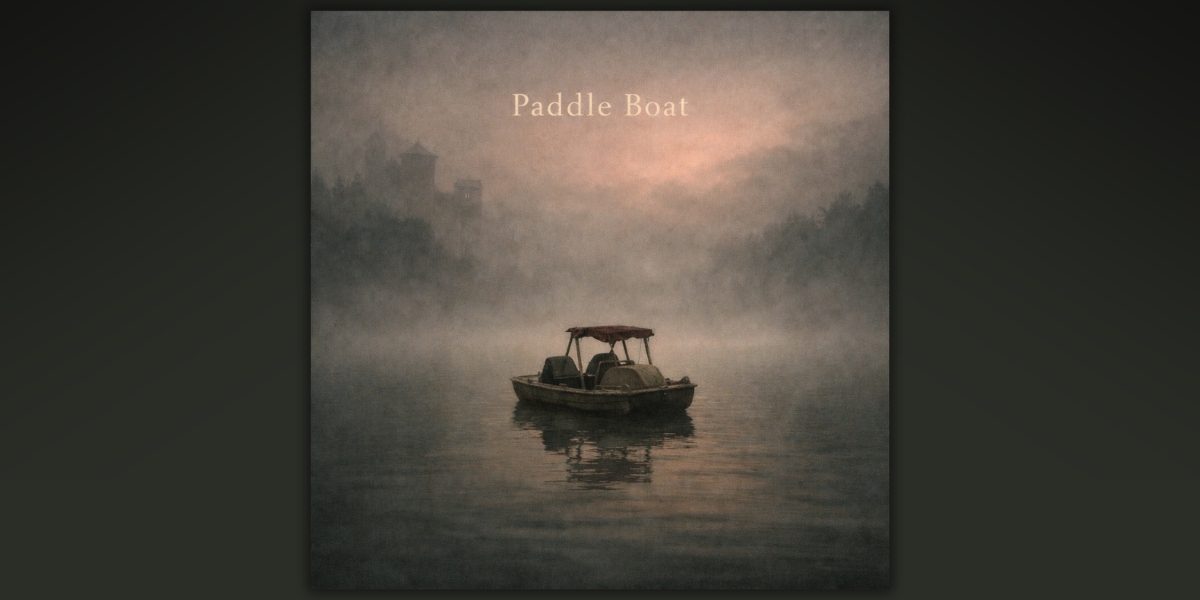

An introspective, self-produced record that finds meaning not in arrival, but in repetition.
Paddle Boat is a slow, surreal meditation on isolation, habit, and quiet persistence. Moving with the circular logic of its title, the album unfolds deliberately—never rushing toward resolution, never overstating its intent. Instead, it lingers in the experience of motion itself: the effort it takes to move forward when progress is difficult to measure, and the strange clarity that can emerge from staying in one place long enough to truly observe it.
The record exists in a state of controlled tension, drifting between calm and unease. Its songs feel enclosed yet open, as if floating on water within invisible boundaries—walls that are both imagined and real. There is freedom here, but it is a freedom shaped by routine and repetition, powered entirely by the self. Paddle Boat does not promise escape; it offers presence.
Rather than framing isolation as tragedy, the album treats it as a condition—sometimes chosen, sometimes inherited, often misunderstood. It examines solitude without spectacle, using understatement and subtle shifts to capture emotional realities that rarely announce themselves loudly.
Key Songs
While Paddle Boat functions as a cohesive emotional loop, several tracks serve as anchor points within the album’s quiet gravity.
“I Like to Party Alone” stands as one of the record’s most revealing moments, using humor as both armor and invitation. On the surface, the title suggests detachment as punchline, but the song itself explores isolation as an act of agency. It reframes opting out not as failure, but as control—a way of reclaiming routine and peace in a world that often demands constant participation. The track captures the uneasy balance between comfort and avoidance, asking whether solitude is something to hide behind or something to stand inside deliberately.
“Cup of Tea” slows the album’s pulse, focusing on ritual and stillness. Built around small, grounding moments, the song observes time passing without urgency. It finds meaning in repetition—simple actions that offer temporary calm without promising transformation. Rather than striving for change, “Cup of Tea” accepts stasis as a valid emotional state, allowing quiet observation to replace expectation.
Later in the record, “Cheers” occupies a pivotal emotional space. Positioned as a forced celebration, the track examines performative happiness and the social habits that persist even when genuine feeling has receded. The act of raising a glass becomes reflex rather than expression, highlighting the distance between outward behavior and internal truth. “Cheers” captures the hollow echo of routine celebration, revealing how easily gestures can outlive their meaning.
Together, these songs illustrate the album’s core tension: the coexistence of self-awareness and inertia, comfort and dissatisfaction, motion and stagnation. They do not resolve these contradictions. They sit with them.
Sound and Process
Paddle Boat was written, recorded, mixed, and mastered entirely by the artist, with full creative control maintained throughout the process. Built slowly and intentionally, the album was produced using Logic Pro as the primary digital audio workstation, emphasizing clarity, restraint, and performance over excess.
Recording was handled through an Apogee Ensemble Thunderbolt A/D converter and interface, routed through a UAD-710d for compression and tonal shaping where appropriate. Instrumentation includes Fender Stratocaster, Gibson SG, Taylor acoustic guitar, Fender Mustang Bass, Arturia keyboards and controllers, and Premier drums, alongside vocals, spoons, tambourine, and programmed MIDI elements.
Microphone choices were limited and deliberate, relying primarily on a Neumann TL-2, a Shure SM7B, and a Shure SM56. Rather than relying on heavy processing, the production allows room for character and subtle imperfections to shape the final sound, reinforcing the album’s themes of presence and authenticity.
An Album About Staying With the Moment
At its core, Paddle Boat is not about change—it is about endurance. It recognizes the monotony, peace, discomfort, and quiet beauty of continuing without certainty. The album finds meaning in the act of paddling itself, in maintaining motion even when direction feels ambiguous.
In an era defined by urgency and spectacle, Paddle Boat chooses patience. It invites listeners to sit with their thoughts, to observe emotional cycles as they rise and fall, and to accept that understanding does not always require resolution.
Paddle Boat does not ask where you are going.
It asks whether you are willing to keep moving.