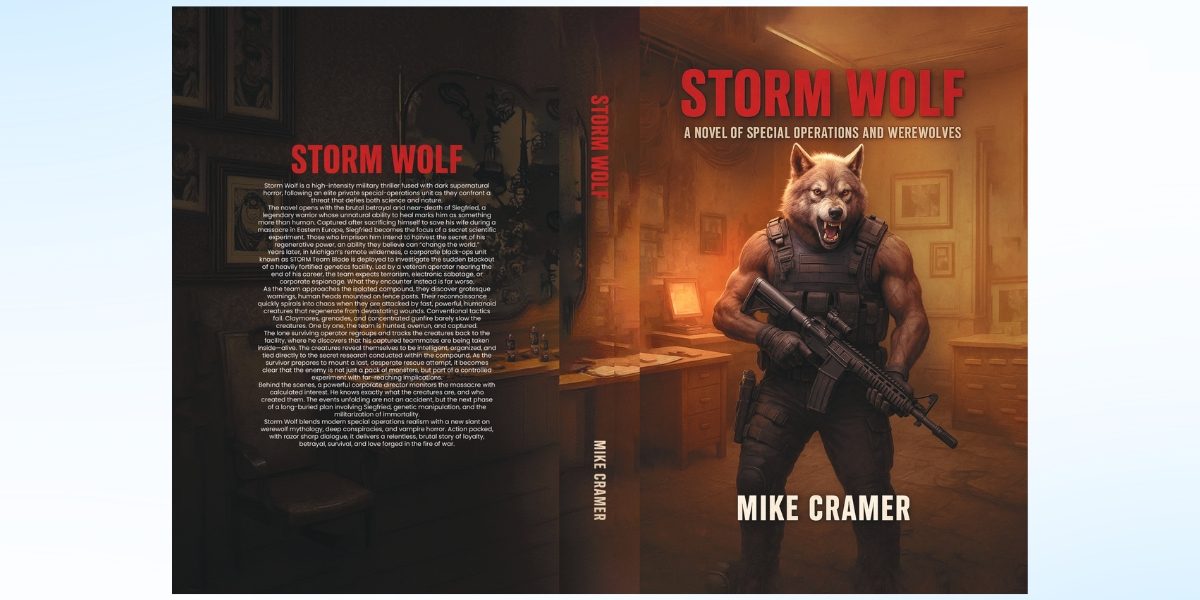

Most writers can only imagine what it feels like to kick down a door in hostile territory, to feel the weight of a combat load after hours of movement, or to hear the specific crack of incoming fire that demands immediate action. Mike Cramer has lived these moments. His two decades of special operations experience transform Storm Wolf from conventional supernatural fiction into something far more potent, a narrative that carries the weight of genuine combat knowledge on every single page. This is not a book written by someone who researched military tactics online or interviewed veterans for authenticity. This is a book written by someone who was there.
Cramer’s background as a former Ranger and Special Forces operator permeates every page of Storm Wolf, transforming what could have been a conventional monster hunt into something far more substantial. The difference begins with the small details that civilian writers simply do not know. When the STORM Team prepares for insertion, the ritual of checking equipment follows an unspoken rhythm that anyone who has served will recognize. The way each man arranges his gear according to personal preference while maintaining unit standards, the silent communication through hand signals and eye contact, the specific weight of battle rattle after hours of wear, these are details that cannot be researched. They must be lived.
The insertion sequence itself demonstrates Cramer’s operational expertise. The team’s movement from the helicopter to the tree line follows proper patrol protocol, with Mace taking point and the others maintaining specific intervals. When they encounter the fence, they carefully check for booby traps, and alarms reflect genuine field craft. Later, when the team establishes their ambush, the L-shaped formation and the command detonation of claymore mines represent tactics that Cramer has likely employed or trained others to employ. This authenticity grounds the supernatural elements that follow, making the extraordinary believable because the ordinary has been rendered with such precision.
Perhaps most impressive is Cramer’s treatment of communication under fire. The radio protocols in Storm Wolf carry the specific cadence of military operations, with call signs, prowords, and the clipped efficiency of men who understand that clarity saves lives. When Storm reports contact with an unknown enemy, the exchange with control follows the actual procedure. When the team goes dark and must communicate without electronics, the use of double clicks and prearranged signals reflects genuine operating procedures. These elements create a texture of authenticity that draws readers deeper into the narrative.
Cramer’s martial arts training adds another layer of credibility to Storm Wolf that most supernatural fiction lacks. His practice of traditional Japanese and Okinawan disciplines, combined with his background in amateur boxing and wrestling, informs every physical confrontation in the novel. The fight scenes carry the weight of genuine technique rather than Hollywood choreography. When Storm faces off against Siegfried in their alpha challenge, the combat reads as a clash between two trained warriors rather than a supernatural spectacle. The foot wheel throw that Siegfried compliments, the palm strikes, and the clinch work all reflect real martial arts principles.
This physical intelligence extends to the supernatural elements themselves. The wolves in Storm Wolf fight not with magic but with enhanced versions of human capabilities. Their speed and strength feel plausible because Cramer understands what the human body is capable of at its limits. The vampires employ tactics that reflect centuries of combat experience rather than supernatural powers. Both species are rendered as warriors first and monsters second, a perspective that only an author with genuine fighting experience could provide.
The psychological dimension of Storm Wolf also benefits from Cramer’s operational background. The thousand-yard stare that Mace experiences when confronted with the security station slaughter reflects real combat trauma. The adrenaline dumps that leave Storm exhausted after extended contact mirror the physiological reality of sustained combat. The bond between team members, closer than brothers, emerges not from sentiment but from the shared experience of facing death together. These psychological truths elevate Storm Wolf above simple genre fiction.
Cramer’s understanding of leadership adds yet another layer of authenticity. Storm’s burden as team leader, his responsibility for the lives of his men, his need to make split-second decisions with incomplete information, these elements reflect the reality of command in combat situations. When Storm must decide whether to inject Mace with the experimental serum, the weight of that decision carries genuine emotional force because Cramer understands what it means to hold another man’s life in your hands.
The tactical evolution throughout Storm Wolf also demonstrates Cramer’s expertise. The team begins the operation following established doctrine, but each encounter with the supernatural forces them to adapt. They learn that standard ammunition is ineffective, that their night vision capabilities must be supplemented by other senses, that the enemy they face requires new tactics and new thinking. This adaptability reflects the real nature of special operations, where flexibility and innovation often determine survival.
What makes Storm Wolf truly remarkable is how seamlessly Cramer integrates his military expertise with supernatural elements. The silver ammunition that Mace questions on the helicopter becomes a tactical necessity rather than a mystical solution. The night vision goggles that represent technological superiority become tools for hunting creatures that see in darkness as easily as daylight. The careful patrol formations that the team employs become methods for tracking enemies that move faster than any human. Cramer uses his operational knowledge not as window dressing but as the foundation upon which the entire narrative rests.
For readers who have grown tired of supernatural fiction written by authors who have never faced real danger, Mike Cramer’s Storm Wolf offers something genuinely different. This is a novel written by someone who understands combat not as an abstraction but as a lived experience. The result is a work that satisfies both as military fiction and as supernatural horror, blending genres with an authority that only genuine experience can provide.
For readers who demand authenticity in their action fiction and crave a story where the hero bleeds real blood and thinks like a real soldier, Storm Wolf delivers an experience that no amount of research could replicate. Mike Cramer has written the novel that only he could write, and the result is essential reading for anyone who has ever wondered what might happen when special operations forces are sent to fight the creatures of legend. Available now for those who know the difference between entertainment and experience.