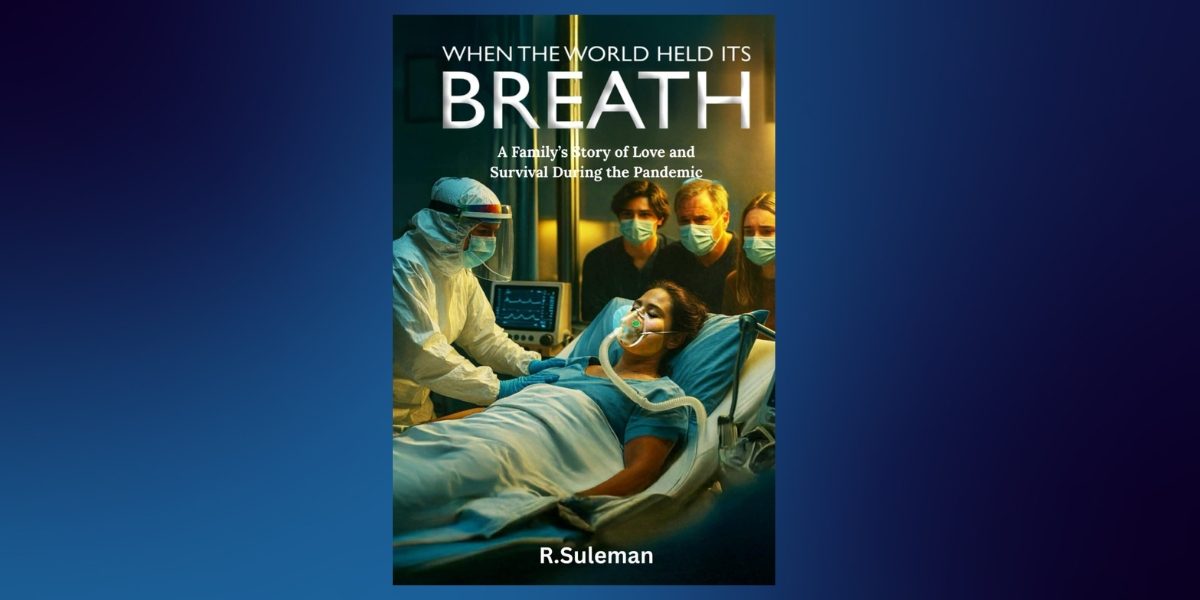

By: R. Suleman
During the pandemic, there was a moment many of us remember clearly, even if we’ve never spoken about it.
A moment when we realized we were holding our breath.
Not because someone told us to, but because the future felt fragile, and breathing deeply felt like tempting fate.
In When the World Held Its Breath, novelist R. Suleman turns that moment into a story. Not a loud one. Not a political one. A human one. The kind that happens behind closed doors, in dim kitchens, on sleepless nights, when the world feels too large, and the home feels very small.
A Life That Slowed Enough to Notice
R. Suleman did not set out to write a “pandemic novel.” He didn’t even set out to be a writer in the conventional sense.
After retirement, he found himself managing an agricultural farm, a life that moves at the pace of weather, soil, and daylight. There are no notifications on a field. No urgency that can’t wait until morning.
In that quiet, Suleman began to notice what he had missed before.
Children sitting in the same room as their parents, eyes locked on glowing screens. Conversations that never quite began. Feelings were postponed because there was always something else demanding attention.
He didn’t judge it. He observed it. And when you observe long enough, stories begin to form.
Stories Written for Small Hands
The first stories weren’t meant for bookstores. They were meant for grandchildren.
Suleman wrote them to help a child understand why school felt hard. Why friendships hurt. Why does doing the right thing sometimes feel lonely? They were simple stories, printed at home, stapled together. Nothing polished. Nothing marketed.
But they were read. And re-read. And talked about.
That mattered more than anything.
As the grandchildren grew, their questions changed. So did the stories. Teenagers didn’t need answers. They needed honesty. They needed to see their confusion reflected back at them without shame.
Suleman followed them there, writing not to guide, but to sit beside.
When Illness Arrived Without Asking
The pandemic arrived the way it did for so many families. Quietly, then all at once.
Despite taking every possible precaution, R. Suleman and his wife contracted the virus. The days that followed were not dramatic in a cinematic sense. There were no speeches. No declarations. There was exhaustion. Fear. The unnerving awareness of breath — how shallow it had become, how uncertain the next inhale might be.
There is something uniquely humbling about measuring your life in breaths.
At the same time, close friends began to succumb to the virus. People he had spoken to weeks earlier were suddenly gone. Funerals took place without gatherings. Grief unfolded in isolation. The situation did not feel temporary. It felt desperate.
In those days, the world did not look stable or manageable. It looked fragile and frightening.
What carried them through was not confidence. Not control. Not data.
It was family.
Children calling. Grandchildren checking in. Messages that said nothing extraordinary — only “We’re here.” The steady presence of love when there was nothing practical to fix.
That experience did not simply inspire a story. It shaped a conviction.
The message of When the World Held Its Breath was born in those rooms. In illness. In loss. In the realization that when systems fail and certainty dissolves, it is family that gives us reason to keep going.
Later, when strength returned and writing resumed, Suleman understood something clearly:
This was never a story about a virus.
It was a story about what holds when everything else loosens.
A Family Under Pressure
In When the World Held Its Breath, the family at the center of the novel is not extraordinary. That is the point.
They have jobs. Schedules. Arguments about ordinary things. They believe, as many of us did, that planning equals safety.
Then the systems they trust begin to fail.
Work becomes unstable. Schools close. Supply chains fracture. Hospitals feel unreachable. Inside the home, fear moves quietly, showing up as irritability, silence, sleeplessness.
The children sense it first. Children always do.
The Moment Strength Breaks
There is a chapter in the novel, “The Long Summer,” that readers often return to.
In it, a father finally collapses under the weight of responsibility. His wife is on a ventilator. His job has become a constant crisis. His children need him to be steady, reassuring, capable.
He can’t be.
When his children see their “Superman” on his knees, something irreversible happens. Not trauma, but recognition. The understanding that adults are not invincible. That love does not come with guarantees.
Suleman shaped this scene slowly, knowing it would define the emotional core of the book. He wanted it to feel real, not heroic, not melodramatic. Just human.
What Strength Really Looked Like
The novel refuses to glorify endurance.
Instead, it suggests that strength is not about holding everything together. Sometimes strength is allowing yourself to be seen when you can’t.
This belief comes directly from Suleman’s own experience. From illness. From fear moving through a household. From realizing that credibility, emotional or ethical, is built long before it is tested.
Choosing Integrity When Panic Is Easier
Beneath the emotional story runs a quieter question. What do we do when fear makes shortcuts tempting?
In the novel, characters face ethical decisions that don’t come with easy rewards. Integrity costs something. It always does.
Suleman does not explain these moments. He lets them sit. He trusts the reader to feel their weight.
That trust defines his storytelling.
Where the Love of Stories Began
Long before this novel, there was a boy and his father reading Shakespeare together.
On his tenth birthday, R. Suleman received a set of abridged plays. Evenings were spent reading aloud, discussing characters, wondering why people made the choices they did.
Those moments shaped him. Not because they taught lessons, but because they created space for thought.
Today, as he watches grandchildren grow up in a world of constant distraction, that memory feels like responsibility.
Writing, for him, is preservation.
A Book for Those Who Never Quite Moved On
When the World Held Its Breath is for people who carried on because they had to. For those who lost something unnamed. For those who never had time to process what happened.
Readers often say the same thing after finishing the book.
“I didn’t realize I was still holding this.”
That recognition is its quiet power.
What We Keep After the Noise Returns
Life is loud again. Schedules are full. The pause is over.
But something stayed behind in that silence. A tenderness. A clarity. A reminder of what matters when everything else falls away.
Here is a short news-style addition you can place at the end of the article:
Author R. Suleman’s latest novel, When the World Held Its Breath, has officially been released. The book is now available for purchase on Amazon and directly through the author’s website.
In telling one family’s story, R. Suleman preserves a shared human memory. Not to relive fear, but to honor what endured.
Love. Family. Breath.
Where to Find R. Suleman
- Website: Friendscorner.net
• Instagram@Friendscorner682
• Facebook: Rich Suleman
• X (formerly Twitter): @RichSuleman682
• Reddit: https://www.reddit.com/user/friendscorner682
Where to Buy When the World Held Its Breath
- Amazon: https://a.co/d/0fUaVGfd
(Hardcover and other formats available — publication details on Amazon) (Amazon) - Barnes & Noble: https://www.barnesandnoble.com/w/when-the-world-held-its-breath-r-suleman/1149287676
(Listing on B&N for the same title) (Barnes & Noble) - Walmart: https://www.walmart.com/ip/seort/19449056362?action=SignIn&rm=true&sid=df58397d-1596-4e72-8468-4ad4e8af53bc