
By: Elena Mart
Managing shutdown and turnaround projects in the oil and gas industry presents unique challenges, and few resources address these projects from the contractor’s perspective. Haithm Elsaka’s Roadmap to Managing Shutdowns: A Contractor’s Guide to Successful Execution offers contractors invaluable insights into the intricacies of executing successful shutdown projects. With over 18 years of experience, Haithm Elsaka shares practical advice, lessons learned, and a tested roadmap that guides professionals through the complexities of these critical, high-pressure projects. In this interview, we explore key insights from the book, including the unique challenges contractors face, the significance of the pre-shutdown phase, and the leadership qualities essential for success.
Q. What inspired you to write this book specifically from the contractor’s perspective rather than the client’s side, which is more commonly covered in existing literature?
Haithm Elsaka:
I was fortunate to work on both sides. More than 18 years as a client, and 15 ½ as a contractor. I was motivated by several reasons to write this book for contractors:
First: there are very few books that address shutdown & turnaround projects from the contractors’ perspective. I had accumulated significant lessons learned and best practices that I felt were worth sharing with other professionals.
Second: Clients do not recruit staff solely to execute Shutdown projects. They use their most experienced and dedicated staff for such roles.
Contractors, on the other hand, recruit temporary staff solely to execute an awarded shutdown project. Their original staff may represent a maximum of 15% to 20% of the manpower involved in the execution. Unless they have documented methodology and invest considerable time in familiarizing their teams with the scope, the deliverables, and the set rules & standards, their execution efforts might go awry.
Third: after executing 75 shutdowns and 53 Brown Field projects, I came to the conclusion that there is a proven approach to executing shutdowns successfully by every key member of the Contractor’s Project Management team (PMT). This book provides a well-tested roadmap.
Fourth: Based on my experience, the professionals who execute shutdown projects are genuinely motivated to perform as effective teams. But good intentions alone are often insufficient to execute highly complex & intricate projects like shutdowns. Further, a professional might be aware of his or her role, but not necessarily the roles of the other stakeholders alongside them. If each PMT member understands what others are busy with and the challenges they face while performing, then he or she will likely support them and work in harmony towards achieving the challenging deliverables and the execution schedule.
And finally, I believe that the execution methodology I describe in the book has been tested for success and could be applicable to a wide range of Shutdown & turnaround projects in the Oil & Gas sector and the industrial sector at large.
For all these reasons, I felt compelled to write this book for my fellow contractor professionals to assist them in executing shutdown projects successfully as often as possible.
Q. How does managing a shutdown differ from managing other types of oil and gas projects, and what makes it uniquely challenging?
Haithm Elsaka:
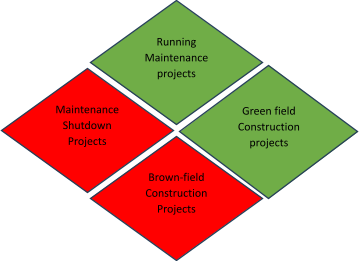
Based on my experience, oil and gas projects fall into maintenance and construction. Maintenance projects may be executed while the plant is operating or may require partial or full shutdowns. Construction projects are either greenfield or brownfield. Greenfield projects generally do not affect operations, while brownfield projects require shutdowns for tie-ins. Shutdown and brownfield projects are therefore often planned and executed together.
Contractors who pursue these projects must possess specialized competencies. The key challenges include working under extreme pressure while being continuously scrutinized by the client to minimize downtime, managing complex scopes while parts of the plant remain operational, and relying on personnel who must be experienced, well-trained, and situationally aware despite constant risk.
Having executed all project types, I can say with confidence that shutdown and brownfield projects are among the most demanding because they: (1) involve a significant number of manpower from various engineering disciplines working simultaneously at congested locations, (2) must be executed within the shortest possible time and with high levels of effectiveness, (3) require as close to zero mistakes as possible, zero incidents, and seamless execution by a large group of people working together for the first time under pressure to execute correctly, and (4) will not tolerate delays to the point that discovery jobs and surprises must be resolved without any significant impact on the schedule. Very few projects will have such demands!
Q. Can you explain the significance of the “Pre-Shutdown” phase and why so much emphasis is placed on it in your book?
Haithm Elsaka:
Shutdown projects are typically awarded 6 to 12 months before execution. This period is known as the Pre-Shutdown phase, where planning and preparation occur. Successful shutdown execution depends largely on this phase.
If a shutdown is compared to preparing a meal, the Pre Shutdown phase includes planning the menu, preparing ingredients, arranging utensils, and setting the table. Execution is the meal itself, and post-shutdown is cleanup. Without proper preparation, execution can fail.
Key contractor deliverables during Pre-Shutdown include selecting and mobilizing the project management team, studying and verifying the scope through site measurements, selecting subcontractors, finalizing schedules and documentation, arranging procurement and prefabrication, mobilizing manpower and equipment, and eliminating execution obstacles. These activities represent the most complex elements of the project and largely determine execution success.
The core topic of the book is to explain a systematic execution roadmap. The book contains checklists for the most critical key members of the Contractor’s Project Management Team (PMT).
Q. You mention that shutdowns are not for the faint-hearted. What qualities do you believe are essential for a successful shutdown leader?
Haithm Elsaka:
I have already addressed this question in several chapters of the book, emphasizing the importance of shutdown leadership. While technical competence is essential, the execution environment demands exceptional personal and professional qualities.
A typical incident-free day for a shutdown leader involves arriving early for shift handover, leading mass toolbox talks, reviewing progress reports, coordinating with planning, HSE, quality, logistics, and subcontractors, meeting the client daily, conducting site walks, supporting critical work fronts, reconfirming readiness for the next shift/day, managing contractual correspondence, addressing workforce issues, documenting handovers, and maintaining team morale. These responsibilities intensify significantly if any incident occurs.
Shutdown leaders must have sharp decision-making abilities, physical stamina, strong contractual awareness, uncompromising safety and quality focus, and strong people management skills. Those without these attributes often struggle to succeed.
Q. How does your book help improve collaboration between contractors, subcontractors, and the client during shutdown execution?
Haithm Elsaka:
Effective collaboration requires mutual understanding of goals, roles, & associated actions. All stakeholders agree on 4 success parameters: zero incidents, meeting quality standards, schedule compliance, and budget control. Conflicts arise when actions appear to violate these parameters.
The book explains in detail the actions leaders must take to meet these goals. It transparently addresses cost control, revenue opportunities, and contractual compliance. Actions are presented chronologically for different disciplines and functions.
When stakeholders understand why others act the way they do, collaboration improves. I tested this approach by sharing methodologies and checklists with clients and subcontractors. Conflicts were minimal and mostly related to pressures arising from encountered delays, which were resolved, and trust & cooperation were restored through transparent explanation rather than contractual disputes.
Q. What practical outcomes can a reader expect after applying the methods and systems described in your book?
Haithm Elsaka:
Implementing the methods and systems of the book can provide a comprehensive operational methodology for managing the execution of shutdowns. Implementing the checklists by the PMT members should build up their confidence. The chronologically set actions were accumulated & refined after incorporating the lessons learned and best practices generated from tens of shutdowns & brownfield projects… what to do and what to avoid!
The implementation is likely to avoid incurring losses, improve team alignment, manage an effective manpower selection, achieve maximum productivity, and maintain continuous improvement across shutdown execution.
Book Details:
Book Name: The Ultimate Guide to Manage Shutdowns a Roadmap to Successful Execution
Author Name: Haithm Elsaka
ISBN Number: 978-1969368059
Paperback Version: Click Here