
By: Jeremy V. Santos
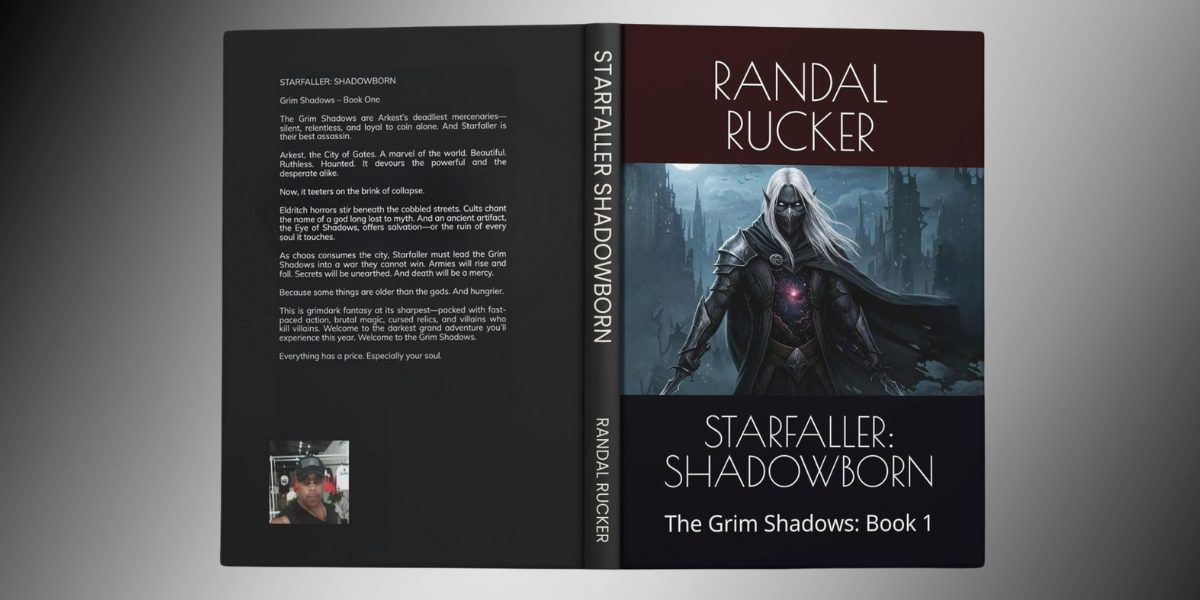
Arkest is a city that eats. It chews through power and desperation with the same cold appetite, and that ravenous spirit is the engine that drives STARFALLER: SHADOWBORN: The Grim Shadows: Book 1. In R.C. Rucker’s grimdark debut, the City of Gates becomes a living constraint: the pressure that forces every character into sharp, costly choices. The result is a novel that wields the genre’s familiar steel, brutal magic, cursed relics, and mercenary codes, but hones them to a modern edge.
At the center is Starfaller, a precision-minded assassin working within the Grim Shadows, Arkest’s coin-first mercenary company. Contracts are sacred, loyalty is transactional, and the job is simple until it isn’t. What should be another clean kill becomes a fuse, and the city provides the powder: cults murmuring in shuttered temples, nobles swapping favors like counterfeit coin, and syndicates treating human lives as line items. The deeper Starfaller moves through Arkest’s alleys and salons, the more precise the novel’s thesis becomes: systems survive by devouring those who can’t pay the escalating price.
The Eye of Shadows, an ancient artifact, is the story’s gravitational center. It promises salvation to those who can wield it and ruin to everyone else. Grimdark often courts despair, but Rucker steers toward consequence. The Eye isn’t just a doom-machine; it’s a mirror that forces characters to examine what they’re willing to trade. Power doesn’t arrive for free here. Every advantage drips with cost, and the ledger never stops updating. The refrain: “Everything has a price. Especially your soul.”
Action sequences convey the intricate logic of real-world operations. Ambushes aren’t clean; plans degrade on contact with fear, greed, and bad information. When the Grim Shadows move, they do so with discipline and the constant dread that discipline might not be enough. That tactical authenticity keeps the pages turning, but it’s the politics that are quiet, lethal, and omnipresent—that give the novel its torque. You feel the shelves of power groaning as factions test each other’s limits: cultists coaxing eldritch phenomena beneath cobbles; aristocrats laundering cruelty through ritual; crime lords buying influence by the body.
Rucker’s worldbuilding resists the postcard view. Arkest is rich, but not for spectacle’s sake. Its beauty has teeth; its rituals smother; its commerce whispers. The City of Gates invites endless traversal—and punishes naïveté. Even the city’s grandeur, its palaces and markets, reads like a trap designed to measure what you can’t afford to lose. In that sense, STARFALLER: SHADOWBORN is a novel about economics as much as it is about magic. Currency changes hands, but so do memories, loyalties, and names.
Where the book distinguishes itself is in its moral architecture. Villains kill villains, yes, but the violence is purposeful. The ethical terrain is navigable if you have the stomach for its gradients. Starfaller’s choices matter not because they redeem or doom him outright, but because they ripple through the networks that keep Arkest upright. In a lesser book, The Eye of Shadows would reduce everything to an apocalyptic spectacle. Here, it sharpens focus: every scheme, alliance, and betrayal revolves around what the artifact reveals about those who reach for it.
For readers who want their fantasy to sprint, the pacing delivers: a clean opening hook, escalating pressure, and set pieces that pop without breaking the world’s internal logic. For those who want to think, the book invites them to consider mercenary ethics, the cost of belonging, and how cities metabolize human need. STARFALLER: SHADOWBORN doesn’t argue that hope is foolish; it argues that hope is expensive and that in Arkest, the invoice arrives early.
This is grimdark tuned for 2025: kinetic, psychologically literate, and allergic to empty nihilism. Come for the cursed relic and knife fights, you’ll get your fill. Stay, and you’ll find the city staring back, asking what you’re willing to pay next.