The fourth quarter gives business owners a chance to evaluate profits, prepare for taxes, and make financial decisions before the year closes. Waiting until filing season can leave fewer opportunities to adjust. Working with a San Diego tax accountant before December 31 can help you connect tax planning with cash flow, purchasing needs, and business goals. The starting point is an accurate picture of where your business stands.
Review Profit and Your Expected Tax Bill
Start with an updated profit and loss statement and balance sheet. Reconcile accounts, resolve uncategorized transactions, and confirm that expenses are recorded correctly. Compare year-to-date results with your original projections. Higher profits may mean a larger tax obligation, while slower revenue could change your planning priorities.
Ask for an updated tax estimate that includes expected fourth-quarter activity. Knowing the potential balance gives you time to reserve cash without disrupting payroll or essential operations.
Revisit Estimated Tax Payments
Estimated payments based on earlier projections may no longer match your business income. Review payment records alongside your updated forecast. Federal underpayment penalties can apply when required payments are insufficient or late. Paying the balance when you file does not necessarily eliminate those penalties.
Ask which payments remain due and whether adjustments are appropriate. Review federal and California obligations separately so your cash plan accounts for both.
Evaluate the Timing of Income and Expenses
Discuss outstanding invoices, customer deposits, unpaid bills, and planned purchases. Your accounting method affects when income and expenses are recognized, so timing decisions need careful review.
Consider:
Which customer payments are expected before year-end?
Are necessary operating expenses coming due?
Would accelerating an expense strain working capital?
How would a timing change affect next year’s projections?
A strategy should support the business beyond its immediate tax effect. Moving an expense forward may provide little benefit if it creates a cash shortage.
Assess Equipment Purchases Before Committing
If your business needs computers, machinery, or other equipment, discuss the purchase before signing. Ask how the cost would be treated, what documentation is needed, and whether delivery and readiness for use affect the deduction.
Business expenses generally must be ordinary and necessary, and some property costs are recovered through depreciation. Compare the potential tax benefit with financing costs, cash needs, and expected productivity. A deduction does not make an unnecessary purchase financially worthwhile.
Prepare Payroll and Contractor Records
Review employee information, payroll reports, contractor payments, and missing tax documentation. Resolve discrepancies while there is time to request corrections. Also discuss proposed bonuses and employer retirement contributions before promising amounts or scheduling payments. Ask which rules and deadlines apply to your business structure and plan.
California treatment can differ from federal treatment, making a separate state review important.
Close the Year with Clear Priorities
Work with a San Diego tax accountant early enough to turn recommendations into action before December 31. Leave with a tax estimate, payment schedule, and list of decisions requiring follow-through. A focused fourth-quarter review can help protect cash flow and prepare your business for the year ahead.
Disclaimer: This article is for general informational and educational purposes only and should not be considered tax, financial, legal, or accounting advice. Tax laws and regulations may change, and their application varies depending on individual and business circumstances. Readers should consult a qualified tax accountant or financial professional before making tax-related or financial decisions.
Buying an established business can be faster and less risky than starting one from scratch. You inherit customers, staff, systems, and a revenue history. But acquisitions also involve large sums of money, complex negotiations, and financing structures that many first-time buyers have never encountered.
This playbook breaks the acquisition financing process into six phases. Each phase ends with a clear deliverable, so you know when you are ready to move to the next step.
Phase 1: Define What You Can Afford
Before you look at a single listing, establish your financial boundaries.
Start with your available cash. Most acquisition lenders expect the buyer to contribute a meaningful down payment, commonly in the range of 10 to 20 percent of the purchase price, and sometimes more for riskier deals. Lenders also want to see that you have reserves left over after closing to handle the unexpected.
Next, look at your personal credit and experience. Lenders financing acquisitions care deeply about whether the buyer can actually run the business. Industry experience, management background, and transferable skills all strengthen an application.
Finally, think about how much debt the business itself can support. A simple rule of thumb: the business’s annual cash flow, after paying the new owner a reasonable salary, should comfortably exceed the annual loan payments.
Deliverable: A personal financial statement, a down payment figure, and a target purchase price range.
Phase 2: Learn the Financing Options
Acquisition deals often combine several sources of money. Understanding each one helps you structure a deal that works.
SBA 7(a) loans are among the most common tools for small business acquisitions. They can offer longer repayment terms, which keep payments manageable, though they require extensive documentation.
Conventional bank loans may be available for buyers with strong credit, significant experience, and substantial collateral.
Seller financing occurs when the current owner agrees to accept part of the purchase price over time. It reduces the amount you need from a lender and signals that the seller believes in the business’s future. Many lenders view seller participation favorably.
Earnouts tie part of the purchase price to the business’s future performance. They can bridge disagreements over valuation, though they require careful drafting.
Equity partners or investors contribute cash in exchange for a share of ownership.
Asset-based loans may be possible when the business has significant receivables, inventory, or equipment.
Resources such as Business Loans Engine can help you understand eligibility requirements for different structures, and Compare Small Business Loans lets you weigh acquisition options against one another.
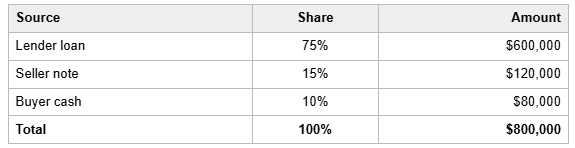
Here is how those pieces might fit together on a hypothetical $800,000 purchase of a plumbing company:
In this structure, the buyer also keeps a separate cash reserve for operations after closing, and the seller note is repaid over several years once the business is under new ownership. Every deal is different, but laying out the sources this way makes it easy to see where each dollar comes from.
Deliverable: A preferred financing structure, such as “SBA loan for 75 percent, seller note for 15 percent, buyer cash for 10 percent.”
Phase 3: Evaluate the Target Business
Once you have identified a business you want to buy, lenders will evaluate it almost as carefully as they evaluate you. Do your own analysis first.
Request at least three years of tax returns and financial statements, along with year-to-date figures. Look for consistent revenue, healthy margins, and an explanation for any significant swings. Review customer concentration: if one client represents a large share of revenue, losing them after the sale could be devastating. Ask why the owner is selling, too. Retirement is a common and reassuring answer; declining sales or a new competitor nearby deserve deeper investigation.
Understand the seller’s discretionary earnings, which add back the current owner’s salary, certain personal expenses, and one-time costs to estimate the true cash the business generates for an owner. Lenders and brokers rely heavily on this figure, but you should verify every add-back.
Examine the lease, key contracts, licenses, staff, equipment condition, and any pending legal issues. Consider engaging an accountant for a quality-of-earnings review on larger deals.
Deliverable: A due diligence summary that confirms or adjusts the business’s value.
Phase 4: Research Lenders and Select One
Not every lender finances acquisitions, and those that do often specialize by deal size or industry. Some focus on businesses under $1 million; others prefer larger transactions. Some understand franchise resales, medical practices, or professional service firms particularly well.
Spend real time on this research. Look at which lenders regularly close acquisition loans in your industry, what down payments they require, how they view seller financing, and how long their process typically takes. Directories like Business Loans Companies can help you identify providers that focus on acquisitions, and review sites such as Best Rated Business Loans offer insight into how other borrowers describe their experiences.
Then choose the one lender best suited to your deal and apply there. Acquisition timelines are tight, and buyers sometimes feel pressure to submit their package to every lender they can find. That approach usually creates more problems than it solves. Multiple hard credit inquiries can lower your score in the middle of a high-stakes transaction. Lenders may hesitate to invest underwriting time in a deal they suspect is being shopped widely. Sellers and brokers may lose confidence if they hear from several lenders requesting the same information. A single, well-prepared application to the right lender typically moves faster and more smoothly.
Deliverable: One selected lender and a complete application package.
Phase 5: Assemble the Loan Package
Acquisition loan packages are among the most document-heavy in small business lending. Expect to provide:
• Buyer’s personal financial statement, tax returns, and resume
• Target business’s tax returns and financial statements for three years
• Year-to-date profit and loss statement and balance sheet
• Signed letter of intent or purchase agreement
• Business valuation, if required
• Projections for the first one to three years under your ownership
• Details of seller financing or other funding sources
• Copy of the commercial lease or real estate documents
• Explanation of how you plan to operate and grow the business
Organize everything clearly, with labeled files and a short cover summary of the deal. A disorganized package slows underwriting and can raise doubts about your ability to manage the business.
Deliverable: A complete, organized loan package submitted to your chosen lender.
Phase 6: Close and Transition
After approval, the lender issues a commitment letter outlining terms and conditions. Review it carefully with your attorney and accountant. Closing typically involves legal documents for the purchase, loan agreements, personal guarantees, lien filings, and transfer of licenses, leases, and accounts.
The transition period matters as much as the financing. Negotiate a reasonable period during which the seller will help introduce you to customers, suppliers, and staff. Plan your first ninety days carefully, focusing on stability rather than dramatic change. A practical early agenda might include:
• Meeting every employee individually to understand their roles and concerns
• Calling or visiting the top customers personally
• Confirming supplier terms and payment schedules under the new ownership
• Reviewing cash flow weekly against your projections
• Holding off on major pricing or staffing changes until you understand the operation
Deliverable: Ownership transferred, financing in place, and a transition plan underway.
Common Pitfalls to Avoid
Overpaying based on optimistic projections. Base your price on verified historical performance, not the seller’s hopes or a broker’s enthusiasm.
Underestimating working capital needs. Many buyers finance the purchase but forget they need cash to operate after closing. Build working capital into your financing plan.
Ignoring the seller note terms. Seller financing often must be subordinate to the bank loan, and SBA rules may restrict payments on seller notes in certain cases. Understand these conditions in advance.
Neglecting key employee retention. In many small businesses, a handful of staff hold critical relationships and know-how. If they leave after the sale, revenue can suffer. Consider retention conversations, or even modest retention bonuses, before closing.
Skipping professional advice. An experienced attorney, accountant, and possibly a business broker can prevent mistakes that cost far more than their fees.
Moving Through the Acquisition Process
Acquiring a business can be one of the most rewarding moves an entrepreneur makes, and the right financing makes it possible. Move through each phase deliberately: understand your limits, learn your options, evaluate the target honestly, research lenders thoroughly, apply with the single best fit, and plan the transition carefully. Buyers who work through each phase in order tend to enter negotiations better prepared and step into ownership with a clear plan, ready to protect what the previous owner built and to grow it further.
Disclaimer: This article is provided for general informational and educational purposes only and does not constitute financial, lending, investment, legal, tax, accounting, or professional advice. Business acquisitions and financing arrangements involve significant financial and legal risks, and loan terms, eligibility requirements, interest rates, fees, and lending practices may vary by lender, transaction, location, and individual circumstances. Any examples, figures, financing structures, or scenarios presented are illustrative only and should not be considered guarantees or predictions of actual results. Readers should conduct their own due diligence and consult qualified financial, legal, tax, and accounting professionals before purchasing a business or entering into any financing agreement. References to specific lenders, websites, products, or resources are for informational purposes only and do not constitute an endorsement or guarantee of their services, terms, approval, or results.
Businesses and households booking a van for collections around Peterhead are advised by vanhirepeterhead.co.uk to put the job in writing before they enquire: what is being collected, from where, in what order, and what has to happen at each stop. A short written brief helps the hire desk suggest a suitable vehicle and avoids the common mistake of choosing a van by name rather than by the work it has to do.
Why Collection Jobs Need A Brief
A single move from one address to another is fairly easy to describe. Collection work is harder. A small business might need to pick up stock from a supplier, drop off at a unit and return empty, all in one day. A household might be gathering furniture from two relatives and a seller before heading home. Each extra stop adds loading time, access questions and the risk that the van fills up before the last pickup.
In north-east Scotland, distances between towns are also part of the planning. A day that starts in Peterhead and includes a collection in Inverurie takes in a fair amount of road. Returning to the start, or finding the van is too small and needing a second trip, uses up the day quickly. Writing the job down shows those pressures before the booking is made rather than halfway through the day.
The Load-And-Route Brief
The brief does not need to be long. Five headings cover most collection jobs:
Stops in order. List each collection and drop-off point, with the town and the approximate time window at each. Note which stops are fixed and which can move.
What is collected where. For each stop, list the main items and mark the longest and heaviest. Pallets, long lengths, and appliances matter more than boxes.
Access at each end. Is there a loading bay, a driveway, on-street parking only, stairs, or a narrow lane? Will anyone be there to help load?
Running total. Will the van be at its fullest after the last pickup or partway through? A route that unloads in the middle needs less space than one that collects everything first.
Collection and return of the van. Where and when the hire starts and ends, and who will be driving.
Handing over a brief like this lets a hire desk suggest a size of van that suits the busiest point of the day, not the first stop.
A Hypothetical Example
The following is an illustration only. A small Peterhead business needs to collect shelving from a supplier in Inverurie, pick up boxed stock from a second address on the way back, and deliver both to its own premises. Written as a brief, it looks something like this:
Stop 1, Inverurie: flat-packed shelving, longest piece about two metres, needs two people to lift.
Stop 2, en route: around twenty boxed cartons, light but bulky.
Stop 3, Peterhead: unload everything at a ground-floor unit with parking at the door.
Van fullest after stop 2. One driver plus one helper.
From this, the hire desk can see the load length that matters, the number of seats needed in the cab, and the point at which space is tightest. That is more useful than “we need a Transit”.
Weight Is A Question, Not An Assumption
The brief should flag anything heavy, but it should not try to work out payload. A van’s gross weight includes the vehicle itself, the driver, passengers and fuel, so the weight of goods it can carry is much lower than the figure on its plate. Ask the hire desk for the payload of the specific van offered.
Keep The Route Current
Check readiness with each collection address before setting off. Ask whether the goods will be packed, whether measurements include their packaging, and whether someone will be present to help. Record any appointment or access window beside the stop. If a collection is delayed, review the later stops before changing the order: the original loading plan may depend on unloading certain items first. Keep one person responsible for passing changes to the driver, and ask the receiving address to confirm that it can accept the revised arrival. This keeps the brief useful throughout the day, rather than only when the vehicle is booked.
Peterhead And Inverurie Starting Points
For jobs based in Peterhead, the website for van hire in Peterhead lists van types from small panel vans and Transits through to Luton box vans with a tail lift. Its booking guidance asks for the vehicle type, dates and times, collection and return locations, and the driver’s details. Ask the provider to confirm the documents and payment arrangements for collection. For collection jobs that start in Inverurie, vanhireinverurie.co.uk covers van hire there. Whichever website is used, availability for a given date and the exact vehicle offered should be confirmed at enquiry.
About Vanhirepeterhead.Co.Uk
vanhirepeterhead.co.uk is a vehicle hire website for Peterhead and nearby areas, with pages covering van, car, minibus and truck hire. Enquiries are made through the website.
Across Nigeria and West Africa, the recreational misuse of tramadol and codeine among adolescents and young adults has been documented for years – in news coverage, in public health reporting, in the lived experience of parents, teachers, and community health workers who have watched it unfold at close range. Too often, though, the public conversation about this misuse stays at the level of behavior and morality: young people making poor choices, a discipline problem to be managed. What that framing leaves out is what is actually happening biologically inside the brains of the young people involved, and the evidence for that biological reality is now considerably clearer than it used to be.
What the Laboratory Evidence Shows
In a study I co-authored with colleagues at the University of Lagos, published in the journal Neurotoxicity Research, we modeled a pattern of use that mirrors exactly the kind of recreational misuse reported anecdotally in this region: repeated, escalating combinations of tramadol and codeine, administered to adolescent mice over multiple consecutive days rather than as a single isolated dose. The findings were unambiguous. The combination produced a measurable reduction in both motor coordination and cognitive function, alongside clear evidence of oxidative stress, impaired mitochondrial energy production, and altered expression of genes linked to neurotoxicity, concentrated in brain regions responsible for movement control and decision-making.
None of this required a dramatic overdose event to occur. It required only the pattern that adolescent misuse commonly follows – repetition and combination – sustained over a relatively short window of time.
Photo Courtesy: J-Visuals
Why Timing Matters So Much
The adolescent brain is not a smaller, simpler version of an adult brain. It is an actively developing system, still undergoing significant structural change – particularly in the prefrontal cortex, the region responsible for judgment, impulse control, and long-term planning, which continues maturing well into a person’s twenties. A nervous system in that state of active construction has less capacity to absorb and recover from the kind of cellular disruption our research documented than a fully matured one does. This is not a minor technical detail. It is the central reason adolescent substance misuse carries a different, often more consequential, risk profile than the same behavior would carry in a fully developed adult brain.
Photo Courtesy: J-Visuals
Reframing the Public Conversation
None of this is offered as an argument for shame or punishment. If anything, the evidence points the other way: framing adolescent opioid misuse primarily as a moral or disciplinary failing tends to push young people toward secrecy rather than help-seeking, and it obscures a genuinely useful public health message – that early, biologically grounded education and intervention are likely to be far more effective than after-the-fact discipline.
For schools, that might mean health education that explains, in age-appropriate terms, what stacking and combining these substances actually does to a developing brain, rather than relying on vague warnings alone. For parents, it means recognizing early behavioral signs – changes in coordination, concentration, or mood – as potential health signals worth a calm conversation, not just a punishable offense. For policymakers, it means treating access and availability of these substances as a public health lever worth continued attention, alongside investment in adolescent mental health support broadly.
The biology is no longer a mystery. What remains is the harder work of building a public response – in homes, schools, and policy – that actually reflects what the evidence now shows.
Published Research Referenced: Ishola, I., Eneanya, S., Folarin, O., Awogbindin, I., Abosi, A., Olopade, J., & Okubadejo, N. (2022). Tramadol and codeine stacking/boosting dose exposure induced neurotoxic behaviors, oxidative stress, mitochondrial dysfunction, and neurotoxic genes in adolescent mice. Neurotoxicity Research, 40, 1304–1321.
Every small business starts somewhere, and for most entrepreneurs, that starting point is a spreadsheet. In the early days, tracking income and expenses by hand feels manageable. Invoices are few, transactions are simple, and an evening at the kitchen table is enough to keep the books in order.
But businesses change, and the systems that once worked can quietly stop keeping up. The tricky part is that this shift is not likely to announce itself. It shows up in small signs first, and those signs are worth paying attention to before they turn into bigger problems.
When Should I Hire a Bookkeeper for My Business?
A business owner should consider hiring a bookkeeper once manual tracking starts costing more time than it saves, or once financial mistakes start slipping through unnoticed. This tipping point looks different for every business, but a few patterns tend to repeat. Reconciliations get pushed back a week, then a month. Reports meant to show cash flow can become outdated before anyone opens them.
There’s no single revenue number or employee count that marks the exact moment. What matters more is whether the current system still gives an accurate, timely picture of the business. If checking the numbers feels like guesswork instead of a quick glance, that is a sign the setup has been outgrown.
Growth itself is often the trigger. Adding new sales channels, hiring the first employee, or expanding into new markets all add complexity that a basic spreadsheet was never built to handle. Recognizing this shift early tends to prevent bigger cleanup work later.
Common Warning Signs Point To A System Under Strain
Certain patterns tend to show up again and again once a business has outgrown do-it-yourself bookkeeping. Recognizing these signs early makes the eventual transition much smoother. A few of the most common ones include:
Reconciliations get delayed or skipped for weeks at a time
Cash position feels unclear even with money coming in
Tax season turns into a scramble to find missing records
Revenue growth starts outpacing the ability to track it accurately
Reports take hours to pull together and still raise more questions than answers
Any one of these signs on its own might not mean much. Seeing several of them together, especially on a recurring basis, usually points to a bigger structural issue. A search for the best bookkeeper often begins right around this point, once an owner realizes the current approach is no longer sustainable.
The good news is that none of these signs mean something has gone wrong with the business itself. They simply mean the bookkeeping process hasn’t kept pace with everything else that has grown around it.
Real Cost Of Waiting Too Long To Get Help
Delaying the switch away from manual bookkeeping usually costs more than it seems to save. Errors that go unnoticed for months are harder and more expensive to fix than ones caught right away. Missed deductions, miscategorized expenses, and overlooked invoices can quietly drain profit over time.
There’s also a hidden cost in time. Hours spent wrestling with spreadsheets are hours not spent on sales, hiring, or product development. For many owners, this tradeoff is the real turning point, even more than any single financial error.
Searching for reliable bookkeeping solutions in the USA becomes a priority once these costs start to add up. Waiting for a perfect moment to make the change rarely works, since the workload tends to grow faster than the motivation to fix it. Acting on early warning signs, rather than waiting for a crisis, tends to produce the smoothest transition.
Professional Bookkeeping Support Offers A Clear Next Step
Once the warning signs are clear, the next step is finding support built for the complexity a growing business now carries. Bookkeeper360 was founded in 2012 and has spent over a decade helping small and medium-sized businesses move past the limits of manual tracking. The company pairs a US-based accounting team with an AI-driven app that gives real-time dashboards and insights.
Working with experienced online bookkeepers means transactions get reconciled on schedule, reports stay current, and tax time stops being a scramble. Bookkeeper360 focuses on QuickBooks and Xero, and has been recognized twice with a Xero Award and named to the Inc. 5000 three times. Coverage from outlets such as NerdWallet, Forbes, and Entrepreneur has highlighted the company as a leading online bookkeeping solution.
Bookkeeper360 serves a range of industries, including eCommerce, SaaS, service businesses, healthcare, real estate, and nonprofit organizations. This breadth means the systems and reporting are built to handle the specific complexities each industry brings, rather than applying a one-size-fits-all approach.
Looking Ahead With A Clearer Financial Picture
Recognizing the signs of outgrown bookkeeping is not a failure. It’s simply a natural part of running a business that is moving forward. The businesses that adapt their financial systems alongside their growth tend to make clearer decisions and avoid costly surprises down the road.
As a business continues to scale, its financial processes should scale with it. Making that shift sooner rather than later tends to save both time and money, while giving owners a clearer view of where the business actually stands.
About Bookkeeper360
Bookkeeper360 is a US-based financial technology solution offering full-service bookkeeping, Fractional CFO guidance, payroll and HR, and tax services, including support with the R&D tax credit, backed by the Bookkeeper360 app with BOLT, its AI-powered virtual CFO feature, for eCommerce, SaaS, service, healthcare, real estate, and nonprofit businesses. eCommerce brands looking for accounting built around their specific operations can reach Bookkeeper360 at (516) 200-4793 or sales@bookkeeper360.com.