

By Amarachukwu Jacinta Abosi
Across Nigeria and West Africa, the recreational misuse of tramadol and codeine among adolescents and young adults has been documented for years – in news coverage, in public health reporting, in the lived experience of parents, teachers, and community health workers who have watched it unfold at close range. Too often, though, the public conversation about this misuse stays at the level of behavior and morality: young people making poor choices, a discipline problem to be managed. What that framing leaves out is what is actually happening biologically inside the brains of the young people involved, and the evidence for that biological reality is now considerably clearer than it used to be.
What the Laboratory Evidence Shows
In a study I co-authored with colleagues at the University of Lagos, published in the journal Neurotoxicity Research, we modeled a pattern of use that mirrors exactly the kind of recreational misuse reported anecdotally in this region: repeated, escalating combinations of tramadol and codeine, administered to adolescent mice over multiple consecutive days rather than as a single isolated dose. The findings were unambiguous. The combination produced a measurable reduction in both motor coordination and cognitive function, alongside clear evidence of oxidative stress, impaired mitochondrial energy production, and altered expression of genes linked to neurotoxicity, concentrated in brain regions responsible for movement control and decision-making.
None of this required a dramatic overdose event to occur. It required only the pattern that adolescent misuse commonly follows – repetition and combination – sustained over a relatively short window of time.

Why Timing Matters So Much
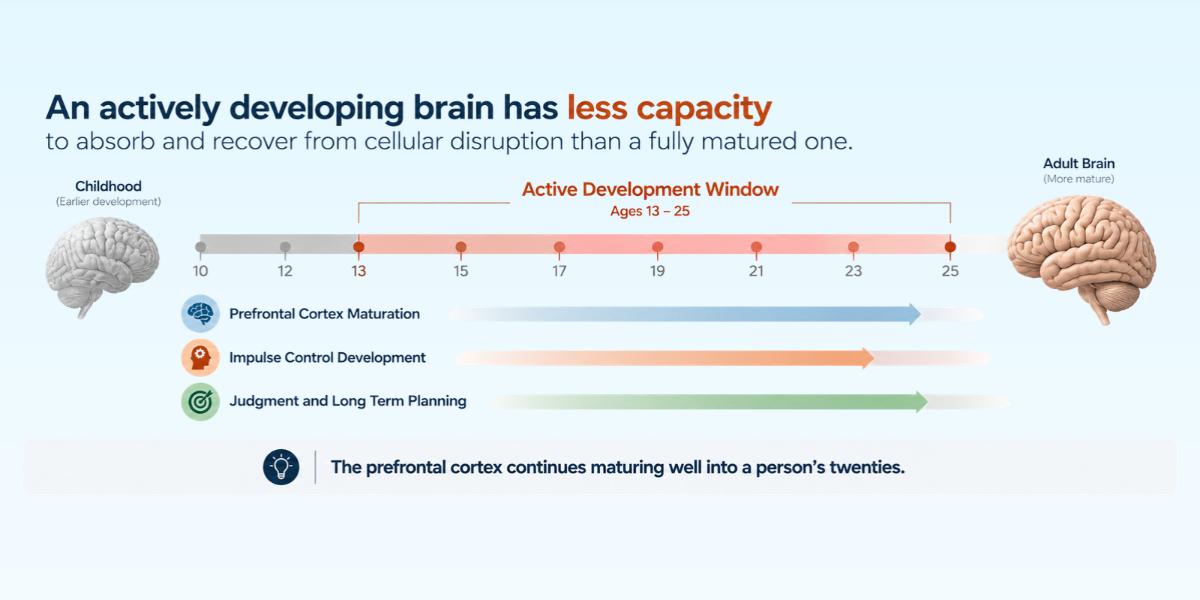
The adolescent brain is not a smaller, simpler version of an adult brain. It is an actively developing system, still undergoing significant structural change – particularly in the prefrontal cortex, the region responsible for judgment, impulse control, and long-term planning, which continues maturing well into a person’s twenties. A nervous system in that state of active construction has less capacity to absorb and recover from the kind of cellular disruption our research documented than a fully matured one does. This is not a minor technical detail. It is the central reason adolescent substance misuse carries a different, often more consequential, risk profile than the same behavior would carry in a fully developed adult brain.
Reframing the Public Conversation
None of this is offered as an argument for shame or punishment. If anything, the evidence points the other way: framing adolescent opioid misuse primarily as a moral or disciplinary failing tends to push young people toward secrecy rather than help-seeking, and it obscures a genuinely useful public health message – that early, biologically grounded education and intervention are likely to be far more effective than after-the-fact discipline.
For schools, that might mean health education that explains, in age-appropriate terms, what stacking and combining these substances actually does to a developing brain, rather than relying on vague warnings alone. For parents, it means recognizing early behavioral signs – changes in coordination, concentration, or mood – as potential health signals worth a calm conversation, not just a punishable offense. For policymakers, it means treating access and availability of these substances as a public health lever worth continued attention, alongside investment in adolescent mental health support broadly.
The biology is no longer a mystery. What remains is the harder work of building a public response – in homes, schools, and policy – that actually reflects what the evidence now shows.
Published Research Referenced: Ishola, I., Eneanya, S., Folarin, O., Awogbindin, I., Abosi, A., Olopade, J., & Okubadejo, N. (2022). Tramadol and codeine stacking/boosting dose exposure induced neurotoxic behaviors, oxidative stress, mitochondrial dysfunction, and neurotoxic genes in adolescent mice. Neurotoxicity Research, 40, 1304–1321.