

Buying an established business can be faster and less risky than starting one from scratch. You inherit customers, staff, systems, and a revenue history. But acquisitions also involve large sums of money, complex negotiations, and financing structures that many first-time buyers have never encountered.
This playbook breaks the acquisition financing process into six phases. Each phase ends with a clear deliverable, so you know when you are ready to move to the next step.
Phase 1: Define What You Can Afford
Before you look at a single listing, establish your financial boundaries.
Start with your available cash. Most acquisition lenders expect the buyer to contribute a meaningful down payment, commonly in the range of 10 to 20 percent of the purchase price, and sometimes more for riskier deals. Lenders also want to see that you have reserves left over after closing to handle the unexpected.
Next, look at your personal credit and experience. Lenders financing acquisitions care deeply about whether the buyer can actually run the business. Industry experience, management background, and transferable skills all strengthen an application.
Finally, think about how much debt the business itself can support. A simple rule of thumb: the business’s annual cash flow, after paying the new owner a reasonable salary, should comfortably exceed the annual loan payments.
Deliverable: A personal financial statement, a down payment figure, and a target purchase price range.
Phase 2: Learn the Financing Options
Acquisition deals often combine several sources of money. Understanding each one helps you structure a deal that works.
SBA 7(a) loans are among the most common tools for small business acquisitions. They can offer longer repayment terms, which keep payments manageable, though they require extensive documentation.
Conventional bank loans may be available for buyers with strong credit, significant experience, and substantial collateral.
Seller financing occurs when the current owner agrees to accept part of the purchase price over time. It reduces the amount you need from a lender and signals that the seller believes in the business’s future. Many lenders view seller participation favorably.
Earnouts tie part of the purchase price to the business’s future performance. They can bridge disagreements over valuation, though they require careful drafting.
Equity partners or investors contribute cash in exchange for a share of ownership.
Asset-based loans may be possible when the business has significant receivables, inventory, or equipment.
Resources such as Business Loans Engine can help you understand eligibility requirements for different structures, and Compare Small Business Loans lets you weigh acquisition options against one another.
Here is how those pieces might fit together on a hypothetical $800,000 purchase of a plumbing company:
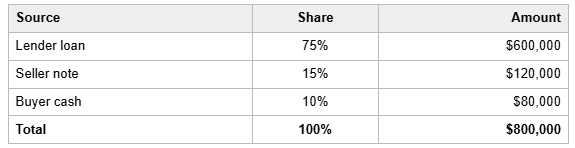
In this structure, the buyer also keeps a separate cash reserve for operations after closing, and the seller note is repaid over several years once the business is under new ownership. Every deal is different, but laying out the sources this way makes it easy to see where each dollar comes from.
Deliverable: A preferred financing structure, such as “SBA loan for 75 percent, seller note for 15 percent, buyer cash for 10 percent.”
Phase 3: Evaluate the Target Business
Once you have identified a business you want to buy, lenders will evaluate it almost as carefully as they evaluate you. Do your own analysis first.
Request at least three years of tax returns and financial statements, along with year-to-date figures. Look for consistent revenue, healthy margins, and an explanation for any significant swings. Review customer concentration: if one client represents a large share of revenue, losing them after the sale could be devastating. Ask why the owner is selling, too. Retirement is a common and reassuring answer; declining sales or a new competitor nearby deserve deeper investigation.
Understand the seller’s discretionary earnings, which add back the current owner’s salary, certain personal expenses, and one-time costs to estimate the true cash the business generates for an owner. Lenders and brokers rely heavily on this figure, but you should verify every add-back.
Examine the lease, key contracts, licenses, staff, equipment condition, and any pending legal issues. Consider engaging an accountant for a quality-of-earnings review on larger deals.
Deliverable: A due diligence summary that confirms or adjusts the business’s value.
Phase 4: Research Lenders and Select One
Not every lender finances acquisitions, and those that do often specialize by deal size or industry. Some focus on businesses under $1 million; others prefer larger transactions. Some understand franchise resales, medical practices, or professional service firms particularly well.
Spend real time on this research. Look at which lenders regularly close acquisition loans in your industry, what down payments they require, how they view seller financing, and how long their process typically takes. Directories like Business Loans Companies can help you identify providers that focus on acquisitions, and review sites such as Best Rated Business Loans offer insight into how other borrowers describe their experiences.
Then choose the one lender best suited to your deal and apply there. Acquisition timelines are tight, and buyers sometimes feel pressure to submit their package to every lender they can find. That approach usually creates more problems than it solves. Multiple hard credit inquiries can lower your score in the middle of a high-stakes transaction. Lenders may hesitate to invest underwriting time in a deal they suspect is being shopped widely. Sellers and brokers may lose confidence if they hear from several lenders requesting the same information. A single, well-prepared application to the right lender typically moves faster and more smoothly.
Deliverable: One selected lender and a complete application package.
Phase 5: Assemble the Loan Package
Acquisition loan packages are among the most document-heavy in small business lending. Expect to provide:
• Buyer’s personal financial statement, tax returns, and resume
• Target business’s tax returns and financial statements for three years
• Year-to-date profit and loss statement and balance sheet
• Signed letter of intent or purchase agreement
• Business valuation, if required
• Projections for the first one to three years under your ownership
• Details of seller financing or other funding sources
• Copy of the commercial lease or real estate documents
• Explanation of how you plan to operate and grow the business
Organize everything clearly, with labeled files and a short cover summary of the deal. A disorganized package slows underwriting and can raise doubts about your ability to manage the business.
Deliverable: A complete, organized loan package submitted to your chosen lender.
Phase 6: Close and Transition
After approval, the lender issues a commitment letter outlining terms and conditions. Review it carefully with your attorney and accountant. Closing typically involves legal documents for the purchase, loan agreements, personal guarantees, lien filings, and transfer of licenses, leases, and accounts.
The transition period matters as much as the financing. Negotiate a reasonable period during which the seller will help introduce you to customers, suppliers, and staff. Plan your first ninety days carefully, focusing on stability rather than dramatic change. A practical early agenda might include:
• Meeting every employee individually to understand their roles and concerns
• Calling or visiting the top customers personally
• Confirming supplier terms and payment schedules under the new ownership
• Reviewing cash flow weekly against your projections
• Holding off on major pricing or staffing changes until you understand the operation
Deliverable: Ownership transferred, financing in place, and a transition plan underway.
Common Pitfalls to Avoid
Overpaying based on optimistic projections. Base your price on verified historical performance, not the seller’s hopes or a broker’s enthusiasm.
Underestimating working capital needs. Many buyers finance the purchase but forget they need cash to operate after closing. Build working capital into your financing plan.
Ignoring the seller note terms. Seller financing often must be subordinate to the bank loan, and SBA rules may restrict payments on seller notes in certain cases. Understand these conditions in advance.
Neglecting key employee retention. In many small businesses, a handful of staff hold critical relationships and know-how. If they leave after the sale, revenue can suffer. Consider retention conversations, or even modest retention bonuses, before closing.
Skipping professional advice. An experienced attorney, accountant, and possibly a business broker can prevent mistakes that cost far more than their fees.
Moving Through the Acquisition Process
Acquiring a business can be one of the most rewarding moves an entrepreneur makes, and the right financing makes it possible. Move through each phase deliberately: understand your limits, learn your options, evaluate the target honestly, research lenders thoroughly, apply with the single best fit, and plan the transition carefully. Buyers who work through each phase in order tend to enter negotiations better prepared and step into ownership with a clear plan, ready to protect what the previous owner built and to grow it further.
Disclaimer: This article is provided for general informational and educational purposes only and does not constitute financial, lending, investment, legal, tax, accounting, or professional advice. Business acquisitions and financing arrangements involve significant financial and legal risks, and loan terms, eligibility requirements, interest rates, fees, and lending practices may vary by lender, transaction, location, and individual circumstances. Any examples, figures, financing structures, or scenarios presented are illustrative only and should not be considered guarantees or predictions of actual results. Readers should conduct their own due diligence and consult qualified financial, legal, tax, and accounting professionals before purchasing a business or entering into any financing agreement. References to specific lenders, websites, products, or resources are for informational purposes only and do not constitute an endorsement or guarantee of their services, terms, approval, or results.