

By: Samantha Thacker
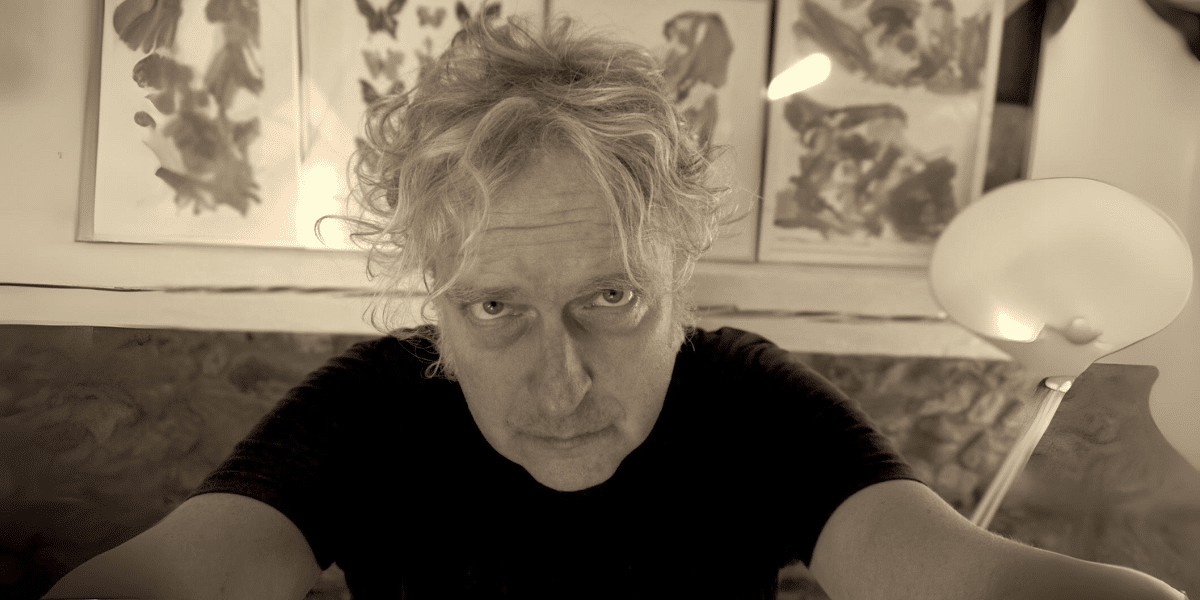
In today’s world, digital communication is rapidly increasing, and people’s ability to express ideas and feelings through words often fails. Joas Nebe is an award-winning artist. He has risen as a pioneer of such artworks with pieces which alter how we perceive communication. Many art industries have been questioned about their relevance in the post-internet era; however, Nebe’s work shows how painting and media complement each other.
Nebe’s artistic practice, which consists of video art installations, paintings, drawings, and collages, proves the power of interdisciplinary methods in contemporary art.
In this interview, we will delve into his unique perspective of Nobe on language and expression and how his work contributes to broader discussions about art’s role in society.
1. It is characteristic of your works that they contain the motifs of literature, nature, and technology. Where and how do all these varied factors intermingle in your creative practice?
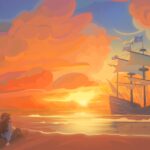
I started with traditional artistic methods such as painting, woodcut, and drawing, and then gradually moved to modern technical processes. Today, I use both old and new techniques side by side. For instance, in my video project “Peace Talks,” I began with stop-motion animated charcoal drawings depicting real scenes. By erasing and redrawing, I bring these scenes to life.
This way, a narrative emerges featuring ships, birds, cityscapes, war scenes with burning villages, etc. In a second step, I ran the first video through various filters of a video editing program. This process resulted in four abstract films showing kaleidoscopic structures. I then layered these four films on top of each other and processed them according to the following pattern: The versions of the second step are 1, 2, 3, 4 and are combined as follows: 1-2, 1-3, 1-4, 2-1, 2-3, 2-4, 3-1, 3-2, etc. The idea behind this is to symbolize the abstract mental structures of participants in peace negotiations.
Another example is my video projects “Landmark: Vogelhaus” and “The Tower.” At that time, I was still living in Berlin, a city with several vacant lots, even in the center. On these lots, birds could find nesting sites, so there were many migratory birds that settled in the middle of the city.
I’ve only seen so many swallows, which always arrived in spring and left in autumn, in the Pyrenees in northern Spain. Based on this experience, I developed the video installation “Landmark: Vogelhaus.” The technique is that of a classic animated film. In the second video on the same theme, “The Tower,” I placed the birds in animation over recordings of tin cans,
around which I wandered with the camera, symbolizing the skyscrapers of the big city.
2. Is there any creation of yours that you can feel best represents your exploration of language in art?
Perhaps my project “The Grammar Series/Gangland”. Here, I combine grammatical elements with political ideologies, which perhaps best symbolize pure language. Gangland, in the title, stands for the ideology. In this project, I searched for images for various grammatical elements such as adjectives, verbs, and nouns. For example, for the adverb, I chose a close-up of a woman’s face, an advertising photograph whose eyes I animated. The face runs on five screens side by side.

Photo Courtesy: Joas Nebe
3. In your opinion, what is the importance of the body in communication, and how is this represented in your creations?
Communication takes place on many levels. It is part of everyday life. We all communicate in one form or another. When we move, we communicate. We communicate with our choice of clothing, etc. The body is a measuring instrument that perceives its surroundings, including other people, on an audiovisual, tactile, and olfactory level. Bodies are the elements with which we express ourselves and our opinions, both consciously and unconsciously. Bodies have become a means of expression in the 20th century, independent of fashion. The naked body is increasingly in focus and becomes a sculptural object shaped and altered by sports and cosmetic surgery. Physical beauty has become a commodity that enhances or diminishes an individual’s social standing. Investing in one’s body means investing in one’s social reputation. I play with this realization in my video series “Most Wanted Fugitive Picture.” In “Most Wanted Fugitive Picture,” I took descriptions of the most wanted criminals from the FBI website and developed an animated photo for each of these descriptions. These photographs show men with two noses, a head tapering conically upwards, etc. Our cognitive pattern regarding the appearance of criminals leads us to expect that the character flaws of these people are reflected in an ugly exterior.
4. Your art results in active engagement from people. How do you create your artwork to encourage this active engagement?
My art operates on a meta-level that is actually opposed to the audiovisual medium and aims to discredit this medium as superficial. By depicting abstract things like ideologies, thought patterns, and grammar, I show things that cannot be shown. I am doing something I can only be partially successful at. I distract the viewer by presenting funny, colorful, and sometimes strange imagery, which usually lacks a narrative structure, leaving them quite perplexed. By doing this, I hope they think about what they are seeing, which in no way matches what is presented to them on a secondary level, such as through the title of a work.
5. As you have worked across various mediums, how do you select the best format for a particular idea to represent it?
The medium I choose for implementing an idea depends, among other things, on the theoretical context in which the medium is placed by research, how ideologically charged it is, and what theoretical assumptions exist. Besides, intuition plays a role, of course. Sometimes a collage seems more appropriate than a drawing. Sometimes an animated film or an abstract painting.
6. How and in what measure do you assume art can help in modifying or advancing usual practices of communication?
Becoming aware of the mechanisms of different forms of communication means understanding the limitations of each language. When I recognize the boundaries of what can be expressed linguistically, for example, and realize that what I actually want to say can be better expressed in images, I come closer to achieving my goal of being understood by the other person.
Generally speaking, art clarifies the air, the atmosphere, the space so that something new can emerge. The new is, at best, something beyond what we know, yet very familiar because we have already expected it in one form or another.
Published by: Holy Minoza