
By: Jay Kt
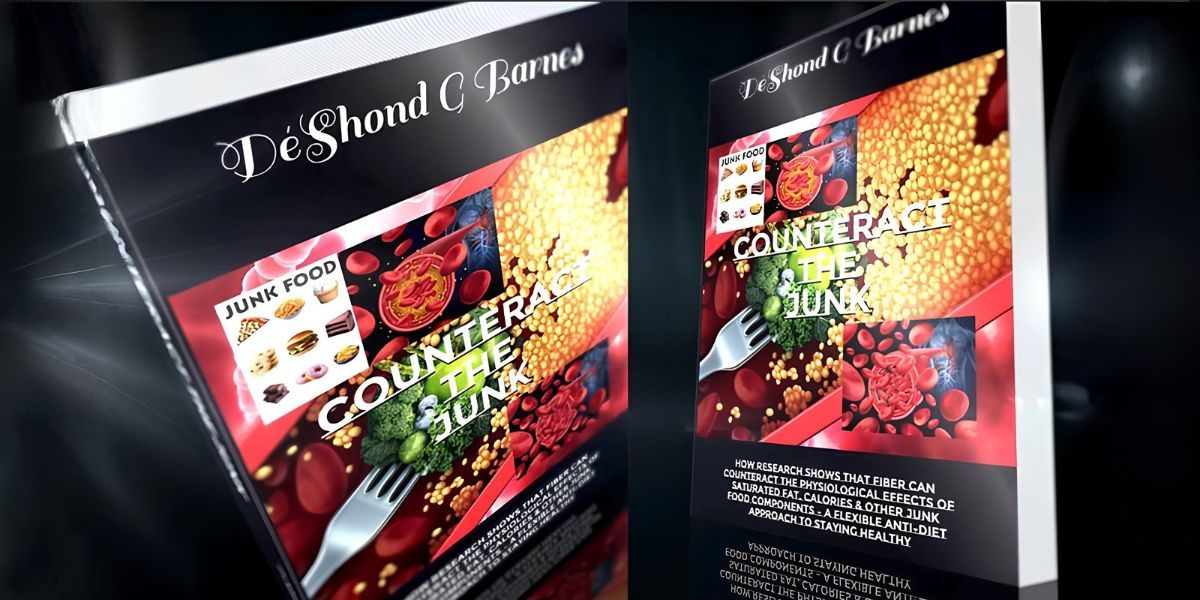
Many people have a fondness for junk food, and studies indicate that taste is the primary driver. But some of us reluctantly choose to either not indulge in those high-fat, high-calorie, high-sodium, high-sugar and deep-fried treats, or to indulge only on occasion, out of fear of possible medical conditions and weight gain. If you are one of those individuals, a new book gathers long-standing scientific research on fiber, antioxidants and other essential nutrients, and on what that research says about eating with greater flexibility.
Research published in scientific journals and on other health and medical platforms has examined how a daily intake of 100+ percent of the Recommended Daily Allowance for fiber, antioxidants and other essential nutrients may counteract the physiological effects of saturated fat, calories and other potentially harmful components of junk food. Much of that work looks at healthy adults with no history of chronic, debilitating diseases or binge-eating disorders. The question it raises is whether a less restrictive approach to eating can still support body weight and cholesterol levels.
The findings are well established and long standing, going as far back as the late 1980s, and were made at research centers and institutions across America and abroad over the decades. The new book Counteract the Junk collects a handful of them.
Cholesterol Management
High-fat junk foods such as cake, ice cream, doughnuts, cookies and pies produce cholesterol-related acids that can clog arteries and raise cholesterol levels over time, opening the door to heart disease. Scientists have identified a special type of soluble fiber known as beta glucans (or B-glucan) that has been studied for its effect on fat absorption. Research indicates that beta glucans can reduce the absorption of dietary fats, including in diets that contain some high-fat foods.
Scientists have also reported that beta glucans bind the cholesterol-related acids produced by saturated and other dietary fats, ushering them out of our bodies before they reach the heart and arteries. That mechanism is the one researchers point to when they study soluble fiber in relation to heart health.
Weight Management
The excess calories in high-fat foods are absorbed by our bodies and stored as fat, and can cause us to gain weight over time. Fiber plays a role here. Scientists have reported that fiber can reduce the amount of calories our bodies absorb, moving them through the digestive system before they are stored as fat. Research has also examined the part antioxidants play in metabolism, though the evidence there is less direct than the evidence on fiber.
Deep-Fried Fatty Foods and Oxidized Lipids
Deep-fried fatty foods such as fried chicken, French fries and Polish sausage can form oxidized lipids. Over time, those compounds may damage cells and the lining of the blood vessels. Antioxidants have been studied as a counter to that process. Scientists have reported that dietary antioxidants such as vitamin C (ascorbic acid) and vitamin E (alpha-tocopherol) inhibit the formation of oxidized lipids, which is the mechanism researchers examine in connection with heart disease, cancer and aging.
Processed Meats and Nitrosamines
Hot dogs, bacon, sausages and other processed meats contain nitrites. Over time, nitrites can break down and combine with amines to form compounds known as nitrosamines, which research has associated with pancreatic cancer risk. Vitamins C, E and selenium have been studied in this context. Scientists have reported that these nutrients neutralize nitrites and inhibit the formation of nitrosamines.
Sodium and High Blood Pressure
Many of our favorite junk foods are high in sodium. Excess sodium can contribute to high blood pressure by causing our bodies to retain water, which increases the volume of blood. Both potassium and calcium have been studied as counters to that effect.
Scientists have reported that potassium helps the body clear excess sodium. Calcium has been described as acting like a natural diuretic, helping the kidneys release excess sodium and water. These are among the mechanisms researchers cite when they look at diet and blood pressure.
Red Meat and Homocysteine
Some of our favorite animal protein foods such as steaks, bacon, burgers and ribs can increase our body’s production of an amino acid known as homocysteine. Homocysteine is not a component of red meat. It occurs naturally in the body as a by-product of protein metabolism, and at normal levels it is safe.
Excess homocysteine in the bloodstream has been associated with heart disease and stroke. Researchers describe the pathway as injury to blood vessels, followed by a buildup of plaque and narrowing of the carotid arteries. The B vitamins folic acid (folate), vitamin B6 and vitamin B12 are involved in clearing it. Scientists have reported that these three vitamins break down excess homocysteine into harmless compounds.
High-Fat Foods and Estrogen
High-fat foods can encourage the growth of certain intestinal bacteria that convert bile acids into estrogen-like hormones. That same bacterial growth can cause our bodies to reabsorb circulating estrogen rather than excrete it, and blood levels of estrogen rise as a result. Elevated estrogen has been associated with the growth of tumors in the breasts and ovaries.
A class of compounds known as isoflavones has been studied as a counter to that process. Scientists say isoflavones are structurally similar to natural estrogen, and that they occupy the body’s estrogen receptors, leaving circulating estrogen with nowhere to bind. Researchers examine this mechanism in connection with breast and other hormone-related cancers.
About the Author
Health writer DéShond G Barnes developed the Counteract the Junk food freedom and preventive health concept in the late 1990s, after spending nearly a year reading medical journals and health and nutrition publications. The approach centers on reading nutrition facts labels and calculating the total fiber, antioxidant and other essential nutrient content of health foods, with a daily target averaging 100+% of the Recommended Daily Allowance.
Barnes has followed that approach since then and published the book more than two decades later. Barnes also periodically conducts seminars at local YMCAs in northern Illinois, and lives and writes in northern Illinois.
This article presents a sampling of the long-standing research on how fiber and antioxidants interact with the foods many of us enjoy. More of that research is covered in Counteract the Junk, available on Amazon.
Original Sources
- Dr. Ed Blonz, Ph.D. Power Nutrition. Penguin Putnam Inc., 1998.
- Editors of Prevention. Prevention’s Healing With Vitamins. Rodale Press, Inc., 1996.
- Jean Carper. Food, Your Miracle Medicine. HarperCollins Publishers Inc., 1993.
- Judy Jameson. Fat-Burning Foods and Other Weight-Loss Secrets. NTC/Contemporary Publishing Group, Inc., 1994.
- Katharine Colton. Smart Guide to Healing Foods. John Wiley & Sons, Inc., 1999.
- Kristi A. Steinmetz and John D. Potter. Vegetables, fruit, and cancer prevention: a review. Journal of the American Dietetic Association, 1996.
- Mark Bricklin. Prevention Magazine’s Nutrition Advisor. Rodale Press, Inc., 1993.
- Patricia Hausman and Judith Benn Hurley. The Healing Foods. Dell Publishing Group, Inc., 1989.
- Patrick Holford. The Optimum Nutrition Bible. The Crossing Press, Inc., 1997.
- Robert Garrison Jr., M.A., R.Ph. and Elizabeth Somer, M.A., R.D. The Nutrition Desk Reference. Keats Publishing, Inc., 1995.
- Selene Yeager and the Editors of Prevention. Prevention’s New Foods For Healing. Rodale Press, Inc., 1999.
- Alicja Wolk et al. Long-term intake of dietary fiber and decreased risk of coronary heart disease among women. Journal of the American Medical Association, 1999.